When Peter Medak showed his class


From wikipedia.org / © United Artists / AVCO Embassy Pictures


The British-Hungarian film and TV director Peter Medak died near the end of last month.  Here’s an update of something I wrote a decade ago about what I consider to be Medak’s greatest movie, 1972’s The Ruling Class…


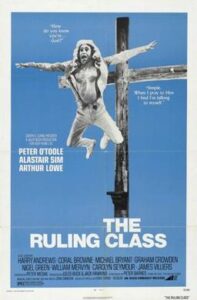
It’s fair to say that the British film industry hasn’t produced anything else quite like The Ruling Class, the satirical 1972 movie starring flamboyant Anglo-Irish actor Peter O’Toole, directed by émigré Hungarian filmmaker Peter Medak and scripted by English playwright Peter Barnes, who adapted for the screen his 1968 play of the same name.


Okay, The Ruling Class’s surreal but relentless lampooning of Britain’s social, religious and political establishments puts it in territory similar to that occupied by the famous film trilogy directed by Lindsay Anderson, If (1968), O Lucky Man! (1973) and Britannia Hospital (1982).  Indeed, the similarities feel more pronounced due to the presence in The Ruling Class of Arthur Lowe and Graham Crowden, two actors who appeared regularly in Anderson’s work.


Also, the casting of Lowe, Coral Browne and Harry Andrews in The Ruling Class calls to mind Douglas Hickox’s delicious comedy-horror movie Theatre of Blood (1973), in which all three actors fall victim to a psychopathic Shakespearean actor played by Vincent Price.  The Ruling Class contains a dose of the macabre too and shares with Theatre of Blood a mad but compelling antihero.


But for acting gusto, for directorial flair, for a story that blends a bewildering range of genres, and for mocking humour that veers between the delightfully subtle and the bruisingly un-subtle, The Ruling Class is in, well, a class of its own.
 

© United Artists / AVCO Embassy Pictures


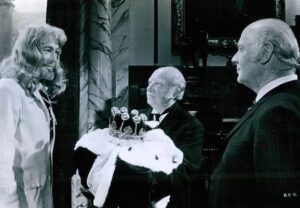
O’Toole plays Jack Gurney, the 14th Earl of Gurney, who inherits his title after the 13th Earl – a brief but barnstorming performance by Andrews – accidentally perishes during a disturbing sex-game involving a noose and a ballerina’s skirt.  To the relief of the late earl’s brother, a Church of England bishop played by the incomparable Alistair Sim, he didn’t commit suicide, which would of course have been sinful.


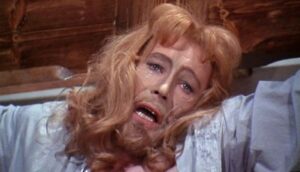
The Gurney family is dismayed to learn that young Jack is out-and-out, barkingly insane.  He believes he is Jesus Christ and sports an appropriately Christ-like beard and mane of hair.  He also wishes to bring peace and love to the earth and sleeps upright on a giant wooden cross.  Before long, the most unscrupulous of his relatives, his Uncle Charles (William Mervyn) and Aunt Claire (Browne), are plotting to get rid of him.


Charles decides to ensnare Jack using his young opera-singing mistress Grace (Carolyn Seymour).  He introduces them, calculating – correctly – that Jack will fall in love with her and marry her.  When the marriage is consummated and an heir produced, Charles can then have Jack committed.  Charles’s plans go astray, however.  Grace falls in love with the crazy but unsettlingly charming Jack and, later, Jack seems to be cured of his madness by his psychiatrist Dr Herder.  Herder is played by Michael Bryant, who for some reason does an uncannily accurate impersonation of the great Czech character actor Herbert Lom.  Indeed, so much is Bryant like Herbert Lom that during the film I assumed I was watching Lom.  I only realised it was Bryant in the role when I saw his name in the closing credits.


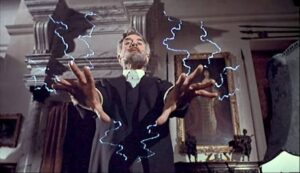
Herder bases his cure on the reasoning that there can only be one Jesus Christ, and if Jack can be convinced that somebody else is Christ then he’ll be cured of his own delusions.  There follows a sequence in which Herder introduces Jack to a psychiatric patient called McKyle, played by Nigel Green, who believes himself to be a very different sort of Messiah: a wrathful, blood-and-thunder, take-no-prisoners, Old Testament-style one with a booming Scottish accent.  Green’s performance here is electrifying – literally electrifying, because the panic-stricken Jack sees bolts of energy shooting out of his hands.  Actually, it’s disconcerting to watch Nigel Green in a role like this if, like me, you mainly remember him for playing Colour-Sergeant Bourne in Zulu (1964), who was surely the most unflappable and down-to-earth character in the history of British cinema.
 

© United Artists / AVCO Embassy Pictures


And Charles’s scheme to have his troublesome nephew banged away in the loony-bin ultimately fails when the court psychiatrist (Crowden) discovers to his joy that Jack is a fellow old Etonian – the film’s dig at the ‘old-boy network’ that’s promoted incompetence and mediocrity in the upper echelons of British society for centuries.  The pair of them then burst into a jolly rendition of The Eton Boating Song.  Incidentally, the film is peppered with musical interludes like this one.  None of them last long enough for it to quite qualify as a musical, but they add yet another colour to its palette.


Predictably, Jack isn’t really cured of his insanity.  “I’m Jack!” he affirms a little too keenly, “I’m Jack!”  He no longer believes that he’s Jesus Christ, but he soon develops a worrying interest in Victoriana and we realise that the Jack he thinks he is now isn’t Jack Gurney.  It’s a different Jack, one who gained notoriety in the back-streets of Whitechapel in the late 1880s.  In one phantasmagorical scene, splendidly orchestrated by director Medak, we see Jack step through the wall of his mansion’s living room and into a Victorian back-street, accompanied by one of the film’s female characters – who soon gets spitted on a long sharp blade.


However, in the film’s final spasm of irony, Jack Gurney’s confusion with Jack the Ripper does him no harm whatsoever.  His Ripper-style murder is blamed on someone else – the film’s sole working-class character, the Gurneys’ butler Tucker (Lowe).  Then, near the movie’s end, Jack takes his seat in the House of Lords and there delivers a debut speech that is a demented, psychotic hang-’em / flog-’em rant.  The speech, needless to say, is wildly popular among the House’s venerable members.  (Medak memorably shows the assembled lords through Jack’s eyes as a horde of rotting, cobwebbed but somehow animate corpses.)  His infant son, meanwhile, is also gurgling, “I’m Jack!  I’m Jack!” which suggests that the insanity of this particular branch of the ruling class will continue for another generation at least.


With all this going on, the success or failure of The Ruling Class depends on the ability of the actor in the lead role and Peter O’Toole is glorious.  He’s at the height of powers – still surfing the waves he made in 1962’s Lawrence of Arabia, 1964’s Beckett and 1968’s The Lion in Winter; and before booze and bad movie choices, like 1979’s Caligula and 1984’s Supergirl, took their toll on his reputation.  For the entire film his character is as mad as a hatter and yet you have no difficulty believing Carolyn Seymour’s Grace – and indeed, later, Coral Brown’s Aunt Claire – could fall for this wild-eyed, loquacious and charismatic lunatic.


But O’Toole is helped by his supporting cast.  Arthur Lowe is wonderful as the beleaguered and cantankerous butler, Tucker.  While Lowe’s career was full of delightful moments, I think the most delightful moment of all comes in The Ruling Class when he learns that the late 13th Earl of Gurney has left him 30,000 pounds in his will and he does a wee dance to celebrate.  Coral Browne, meanwhile, who was pushing 60 at the time she made the film, gives a memorable performance as a mature lady who remains sexually charged, slinky and alluring.  There’s nothing inelegant about the scene towards the movie’s end where she tries to seduce O’Toole, who’s some 20 years her junior.  Actually, I can understand why in real life Vincent Price married Browne shortly after he’d murdered her onscreen in Theatre of Blood.
 

© United Artists / AVCO Embassy Pictures


The film also showcases the talents of several actors whose careers were never quite as successful as they should have been.  Carolyn Seymour is excellent as Grace and it seems a shame that most of her subsequent work was on British and American television.  William Mervyn, who was typecast playing upper-class gentlemen in the likes of The Railway Children (1970) and various Carry On films, makes a splendid main villain, Uncle Charles, and it’s unfortunate he wasn’t given some similarly meaty roles before his death in 1976.  Also in the movie is James Villiers, playing Jack’s dim-witted but amiable cousin Dinsdale.  I was used to seeing Villiers in villainous or officious roles, like in Seth Holt’s Blood from the Mummy’s Tomb (1972) or the 12th Bond movie For Your Eyes Only (1982) and it’s a pleasure watching him play a very different character in this.


Another person connected with The Ruling Class whose talent didn’t get to blossom as much as it should have was Peter Medak.  This and his 1972 adaptation of the Peter Nichols play A Day In the Death of Joe Egg put plenty of wind in his sails, but that wind suddenly died in 1973 when he took on the near-career-ending task of directing the pirate-comedy movie Ghost in the Noonday Sun.  He later described it as “the biggest disaster of my life.”  The project was sabotaged by the almost pathological uncooperativeness of its star, Peter Sellers, then at his most unpredictable and volatile.  Having the famously bipolar Spike Milligan involved probably didn’t help.  Denied a cinematic release at the time, it finally saw the light of day on video in 1985.  I’ve watched half-an-hour of it on YouTube and it’s bloody awful.


In 1980, though, Medak directed The Changeling, a brave attempt at staging a subtle, old-fashioned ghost story during a period when most scary movies involved screaming teenagers, masked knife-wielding maniacs and buckets of gore.  And in the early 1990s he made a couple of decent British films like The Krays (1990) and Let Him Have It (1991) and also the ludicrous, overwrought but stylish thriller-noir Romeo is Bleeding (1993) with Gary Oldman and Lena Olin.  In 1998 he directed the old tosh that was Species II but thereafter, gratifyingly, was able to work on episodes of several top-quality American TV shows like The Wire (2002-8), Breaking Bad (2008-13) and Hannibal (2013-15).  Indeed, after Medak’s death on October 27th, Hannibal’s showrunner Bryan Fuller remembered him as a “gentle teddy bear of a Hungarian” and a “wonderfully talented, kind, and funny man who always had a great story to tell, both on and off the set.”


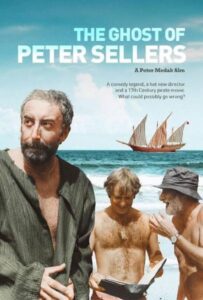
It was also gratifying that in Medak’s swansong, the 2018 documentary The Ghost of Peter Sellers, he managed to turn the darkest and most traumatic episode of his career, Ghost in the Noonday Sun, into a critically acclaimed account of the making of that luckless film.  The Ghost of Peter Sellers gives fascinating insight into how, in multitudinous ways, film projects can go wrong.  It’s also unexpectedly moving because, despite all the strife that Peter Sellers caused him, Medak vocalises with breathtaking magnanimity how much he loved and admired Sellers too.
 

© Vegas Media / 1091 Pictures


But the finest monument to Peter Medak, in my opinion, remains the exuberance and chutzpah of The Ruling Class.   At one point, Nigel Green’s deranged McKyle describes himself as “the high-voltage Messiah, the electric Christ, the AC/DC god”, and the film is something like a cinematic equivalent of that.

Cinematic heroes 4: Brian Glover


© Brandywine Productions / 20th Century Fox


Brian Glover’s Wikipedia entry begins with a quote from the great man that served both as a mission statement and as a career summary: “You play to your strengths in this game.  My strength is as a bald-headed, rough-looking Yorkshireman.”  For a quarter-century, Glover played characters that were shiny of pate, pugnacious of visage and flat of vowels in many a British movie, TV show and stage play, and in the process made himself one of the most recognisable character actors in the country.


Born in Sheffield and brought up in Barnsley, the young Glover initially followed in his father’s footsteps.  His dad had been a professional wrestler and, while attending the University of Sheffield, Glover topped up his student grant by wrestling too.  He fought bouts under the moniker of ‘Leon Aris, the man from Paris’ and was good enough to appear on television, featuring in the Saturday-teatime wrestling slots shown on the ITV programme World of Sport that, a half-century ago, turned such burly, grappling bruisers as Kendo Nagasaki, Giant Haystacks, Mick McManus, Jim Brakes and Big Daddy into household names.  He continued to wrestle long after he’d graduated and settled into a respectable day job, which was teaching English and French at Barnsley Grammar School.


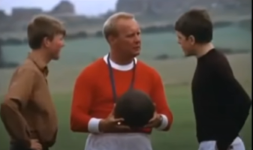
One of Glover’s school colleagues was Barry Hines, who’d authored the novel A Kestrel for a Knave.  In 1968, this was filmed as Kes by the incomparable Ken Loach. Loach needed someone to play the puffed-up, preposterous and loutish Mr Sugden, the PE teacher at the school attended by Kes’s put-upon, juvenile hero, Billy Casper (Dai Bradley).  Hines suggested Glover.  For his audition, and to test Glover’s believability as a teacher, Loach staged a playground brawl and got Glover to break it up.  This obviously wasn’t difficult for him, being a teacher already and a wrestler.


Glover’s turn as Sugden, who organises a football match with his pupils, insists on captaining one of the teams, and then cheats, dives and brutally fouls the kids while spouting his own match commenatary – likening himself to “the fair-haired, slightly-balding Bobby Charlton” – provides a bleak film with its one shaft of comic sunshine.  Come to think of it, Loach’s 1998 movie My Name is Joe has some funny footballing sequences too, and when he finally got round to directing a proper comedy, it was 2009’s Waiting for Eric with French soccer legend Eric Cantona.  The beautiful game is clearly the one thing guaranteed to make the famously grim, anti-establishment Loach lighten up.


© Woodfall Film Productions / United Artists


Glover spent another two years teaching before his next acting assignment, which was a role in the Terence Rattigan play Bequest to the Nation.  Thereafter, he swiftly became ubiquitous.  On television he appeared in Coronation Street (1972), The Regiment (1973), Dixon of Dock Green, The Sweeny, Quiller (all 1975), Secret Army (1977), Minder (1980), Last of the Summer Wine and Doctor Who (both 1985).  In that last show he makes a memorable exit when he’s blasted away by some Cybermen.  He also gives notable performances in two 1970s shows written by Dick Clement and Ian La Frenais, who at the time scripted virtually the only British TV sitcoms set outside London and southeast England.  In a famous 1973 episode of Whatever Happened to the Likely Lads he plays the devious Flint, who makes a bet with Geordie heroes Bob and Terry that they can’t get through the day in Newcastle-upon-Tyne without hearing the result of an important football match.  A year later, Glover joined the cast of Clement and La Frenais’ revered prison sitcom Porridge, playing the hapless, slow-witted convict Cyril Hislop, whose key line is: “I read a book once.  Green, it was.”


When not playing bald-headed, rough-looking Yorkshire chancers and convicts, Glover could leaven his northern tones with a twinkly avuncularity, which made him popular among advertisers.  Thus, when his face wasn’t popping up on TV shows, his voice was popping up on commercials between TV shows.  He voiced the TV advertisements for Allinson’s bread – “Bread with nowt taken out” – and for Tetley teabags.  In the Tetley ads, he played the leader of the Tetley Tea-folk, an animated tribe of diminutive, white-coated, cloth-capped characters tasked with the exacting job of giving each teabag its ‘2000 perforations’.


© Wellborn / United Artists


Meanwhile, during the 1970s, Glover became a regular in British movies. These included Lindsay Anderson’s oddball 1973 epic O Lucky Man! and its follow-up, 1982’s Britannia Hospital (about which I intend to write on this blog very soon); Michael Crichton’s 1979 period adventure The First Great Train Robbery; and Terry Gilliam’s 1978 medieval comedy Jabberwocky, in which he plays the foreman of an ironworks that’s reduced to chaos when Michael Palin blunders into it.  In Douglas Hickox’s 1975 London-set thriller Brannigan, he’s a minor villain who gets roughed up by John Wayne, playing a tough American cop on an assignment to the British capital – Wayne creates mayhem as he behaves like a Wild West sheriff dealing with an unruly frontier town.  “Now,” he warns Glover, “would you like to try for England’s free dental care or answer my question?”


In 1981, John Landis made his much-loved horror-comedy An American Werewolf in London, the opening scenes of which, set in a northern pub called the Slaughtered Lamb, called for a bald-headed, rough-looking Yorkshireman.  Obviously, there was only one man for the job.  Landis duly cast Glover and the resulting scene, wherein he entertains the Lamb’s patrons with his ‘Remember the Alamo!’ joke, is, along with Kes, his finest cinematic moment – both films show what a fine comic actor he was.  Unfortunately, the pub’s jovial mood is then ruined when David Naughton and Griffin Dunn inquire about the strange five-pointed star painted on the wall.  And as they’re ejected from the premises, Glover utters the film’s most quoted piece of dialogue: “Beware the moon, lads!”


© PolyGram Pictures / Gruber-Peters Company / Universal Pictures


Three years later, Glover turned up in another classic werewolf movie, playing a villager in Neil Jordan’s adaptation of Angela Carter’s gothic short story, The Company of Wolves.  At one point, he’s involved in a brawl with the previous subject of this Cinematic Heroes series of posts, David Warner; and at another, he comes out with a very Yorkshire-esque line: “If you think wolves are big now, you should have seen them when I were a lad!”


Glover faced another monster, a slimy one rather than a hairy one, in 1992’s Alien 3, wherein he plays the warden in charge of a prison-colony on the stormy planet Fiorina 161.  Sigourney Weaver crash-lands there, unwittingly bringing with her a cargo of egg-laying alien face-huggers.  Directed by a young David Fincher, Alien 3 is a much-maligned film.  It can’t help but seem anti-climactic after the previous film in the Alien series, James Cameron’s barnstorming Aliens (1986), and the fact that it begins by killing off most of the characters left alive at the end of Aliens didn’t endear it to fans.  It’s got some wonderfully grungy set design, though, and there is something heroic about the film’s un-Hollywood-like, and commercially-suicidal, pessimism.  Even Weaver herself gets it at the end.


One of Alien 3’s biggest problems is that, due to incompetent scripting and editing, most of its interesting characters – Glover, Charles Dance, Paul McGann – vanish from the story halfway through.  Incidentally, for British audiences, Glover perhaps brought a little too much baggage to his role.  When I saw Alien 3 in an Essex cinema, a scene where Weaver confronts Glover in his office, while he – voice of the Tetley Tea-folk – absent-mindedly dunks a teabag in a cup of boiling water, provoked guffaws.


© Brandywine Productions / 20th Century Fox


Glover must have got on well with Sigourney Weaver, for he subsequently turned up in 1997’s Snow White: a Tale of Terror, in which Weaver played the evil queen.  Another late role was in the endearingly off-the-wall 1993 comedy Leon the Pig Farmer, in which a young Jewish Londoner, played by Mark Frankel, gets the unsettling news that he was the result of an artificial-insemination mix-up and his father is actually a Yorkshire pig farmer – inevitably a bald-headed, rough-looking one played by Glover.  What makes Leon, which also starred Fawlty Towers’ Connie Booth and former Bond girl Maryam D’Abo, slightly melancholic to watch now is the knowledge that lead-actor Frankel died in a motorcycle accident a few years later.


Glover’s stage CV was as busy as his film and TV ones.  He appeared with the Royal Shakespeare Company in productions of As You Like It (playing, appropriately, Charles the Wrestler) and Romeo and Juliet, while other theatre work included Don Quixote, The Iceman Cometh, The Long Voyage Home, The Mysteries and Saint Joan.  Lindsay Anderson, a stage director as well as a film one, cast him in productions of the David Storey plays The Changing Room and Life Class and Joe Orton’s What the Butler Saw.  Such was Glover’s fame by the time he appeared in a West End version of The Canterbury Tales that it was advertised with a slightly amended version of one of his catch-phrases: “Chaucer with nowt taken out.”


Glover was a literary figure as well.  He was a prolific playwright and writer, was responsible for over 20 plays and short films, and penned a column in a Yorkshire newspaper.  Asked to contribute a script to a 1976 TV drama anthology called Plays for Britain, which also featured writing by Stephen Poliakoff and Roger McGough, Glover found himself short of inspiration.  He ended up paying a visit to a police station and inquiring if they’d experienced anything unusual lately that he might be able to use as an idea.  While he was at the station, a woman trooped in to the front desk to report indignantly that someone had pinched her front door.  Suddenly, Glover knew what his story would be about.


Meanwhile, I remember seeing him on a TV arts programme, discussing – with Anthony Burgess, no less – Paul Theroux’s acerbic 1983 travel book about the British coastline, The Kingdom by the Sea.  Glover, who during his wrestling days had toured many of the towns Theroux wrote about, took particular exception to a comment Theroux made about Aberdeen: “…the average Aberdonian is someone who would gladly pick a halfpenny out of a dunghill with his teeth.”


© UK Film Council / Entertainment Film Distributors


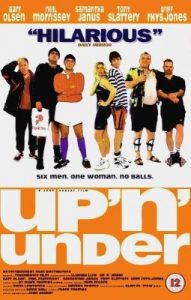
Alas, in September 1996, Brian Glover met his own Alamo.  He underwent an operation for a brain tumour, although a fortnight later he was back at work, making one of his final films, Up ‘n’ Under.  Fittingly, this was about the north-of-England sport of rugby league and was made by the playwright John Godber, whose debut play Bouncers has become a much-revived classic.  Glover was among the first people to go and see Bouncers when it premiered at the Edinburgh Festival in 1977 and was quick to offer Godber encouragement.  Despite the surgery, the tumour eventually killed him in July 1997.


Thanks to his gruff-but-lovable persona, unmistakable voice, and talent for stealing any scene he was in, Glover lives on in the memory of people like me, who grew up watching a lot of television and movies in 1970s and 1980s Britain.  Those folk include actor Jason Isaacs, who admits to using him as inspiration for his star turn as the Soviet war-hero and Red Army commander-in-chief Georgy Zhukov in Armando Iannucci’s historical satire The Death of Stalin (2017).  While he played Zhukov as a blunt, abrasive and – crucially – Yorkshire-accented bad-ass, Isaacs said, “I had a picture of Brian Glover in my head.  Magnificent actor.”


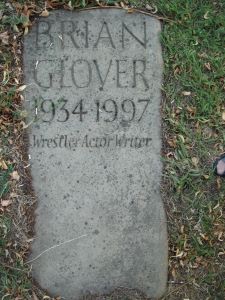
Meanwhile, Glover is buried in Brompton Cemetery in London, where a simple gravestone describes him as a ‘Wrestler… Actor… Writer’.  Not just a Yorkshireman, then, but a true Renaissance man.


From wikipedia.org / © Edwardx