© Channel Four Films / PolyGram Filmed Entertainment
Just over a year ago, I posted on this blog about the sad closure of The Projector, Singapore’s alternative cinema. According to a statement on the cinema’s Facebook page, this was caused by “rising operational costs, shifting audience habits, and the global decline in cinema attendance,” factors that had “made sustaining an independent model in Singapore especially challenging.” The Projector was the one venue in the city-state where you could see, on a big screen, independent and arthouse films, ones that were generally offbeat, ones focused on minorities and not necessarily made in the handful of big international languages. It also offered opportunities to watch older movies in a cinema, for example, ones by Alfred Hitchcock, Akira Kurosawa and David Lynch. Though sometimes it showed modern Hollywood and Chinese blockbusters too.
The Projector operated at two locations, the Cineleisure shopping mall on Grange Road and the Golden Mile Tower on Beach Road. Happily, this year, a new cinema called The Filmhouse has started doing business in The Projector’s Golden Mile Tower premises and has a similar agenda of showing films you wouldn’t otherwise see in Singaporean cinemas. According to Wikipedia, The Filmhouse retains “certain key team members and features” from The Projector.
Last week, I made my first visit to The Filmhouse and was pleased to find it busy. It’s a smaller operation than The Projector with, as far as I can ascertain, just two screens, but probably that makes more financial sense – a non-mainstream cinema can’t afford to have many overheads. The lobby contained a bar, comfortable seats and, most importantly, a relaxed and friendly ambience.

When I went into one of the halls and found my seat, I was slightly disappointed that, before the movie started, the short film warning patrons to keep their phones silent and refrain from using them during the show wasn’t the famous one used by The Projector. That had footage from the super-schlocky Turkish science-fiction movie Dünyayı Kurtaran Adam, better known as Turkish Star Wars, and featured ‘Turkish Luke Skywalker’ training for battle by smashing his big fists repeatedly against a desert boulder. You were warned that if you violated the cinema’s policy on phone-use, you would suffer punishment similar to that being inflicted on the rock.
Still, The Filmhouse’s anti-phone film is cute enough. It has a brief clip of the late David Lynch telling us, “You have a very good heart.’ Then we’re asked to prove Lynch right about our hearts by turning off or muting our devices and not spoiling anyone else’s enjoyment of the movie with them.
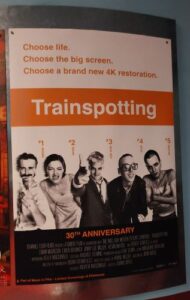
Anyway, what was the film I went to see? It was a 30th-anniversary showing of Danny Boyle’s Trainspotting (1996), freshly spruced up for cinematic re-release. As the movie poster’s tagline announced: “Choose life. Choose the big screen. Choose a brand new 4K restoration.”
At the time of its release, Trainspotting caught the zeitgeist of mid-1990s Britain, obsessed with Britpop and all things Cool Britannia. Yes, how long ago that all seems now. To be honest, it annoyed me in some ways that the movie got lumped in with the Britpop / Cool Britannia thing, even if the filmmakers opportunistically loaded its soundtrack with music of the time, by bands such as Pulp, Blur, Sleeper, Elastica, Leftfield and Underworld. That said, the two songs that defined the film, Iggy Pop’s Lust for Life from 1977 and Lou Reed’s Perfect Day from 1972, had nothing to do with 1990s Britain.
To me Trainspotting sprang from an earlier, darker and less glamorous era than the one of Damien Hirst’s formaldehyde shark, Geri Halliwell’s Union Jack mini-skirt and Blur-versus-Oasis – namely, the mid-to-late 1980s, when Edinburgh’s boom in heroin use and the subsequent, resultant HIV / AIDS epidemic led to the city being dubbed ‘the AIDS capital of Europe’.
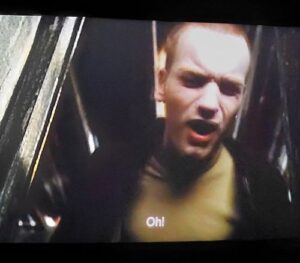
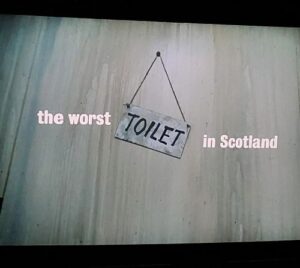
This became material for the book that inspired the film, Irvine Welsh’s novel Trainspotting (1993), which is an altogether bleaker and rougher-edged piece of work than Boyle’s cinematic version. Though of course the film isn’t without its bleak or rough-edged moments either. The worst toilet in Scotland, anyone?
© Channel Four Films / PolyGram Filmed Entertainment
Still, I’m not complaining too much. I think both Trainspotting the book and Trainspotting the movie are great and are classics in their respective fields, 1990s Scottish literature and 1990s British cinema. But after 30 years, how would the latter work hold up?
Pretty well, I thought, though the animatronic zombie-baby that Renton (Ewan McGregor) imagines crawling across the ceiling during a traumatic ‘cold turkey’ episode looks terrible now. Mind you, it looked ropey enough in 1996.
I wondered how, in these days of extreme anxiety about sex predators preying on children, the gag about Renton meeting Diane (Kelly Macdonald) in a nightclub, going home with her and discovering the next day that she’s still at school would come across. Not as ickily as I feared. Diane is clearly the one doing the manipulating and Renton is properly horrified when he learns how old she is really. Plus, McDonald’s true age at the time, 20, means the sequence’s punchline, when Diane appears in her school uniform, is cringily funny but – thankfully – a bit unbelievable.
Meanwhile, I winced at the scene following the death of Tommy (Kevin McKidd), where a grieving Spud (Ewan Bremner) pays tribute to his late friend by singing Two Little Boys – a song popularised by, and forever associated with, the Australian entertainer, TV personality and artist Rolf Harris, who had a smash-hit with it in 1969. In 2014, Harris hit the headlines when he was found guilty of sexually assaulting four underage girls. But to be fair to Two Little Boys, it was around long before Harris got his hands on it. It was written in 1903 by composer Theodore F. Morse and lyricist Edward Madden.
The Singaporean audience I saw Trainspotting with certainly enjoyed it, even though I wondered how a film about heroin addicts would go down in a country with some of the strictest anti-drugs laws in the world. If Trainspotting had taken place in Singapore, the drug dealing characters in it like ‘Mother Superior’ (Peter Mullan) and Mikey Forrester (Welsh in a cameo) would have been executed long ago. Much of it they found funny, which is appropriate because the film is essentially a (very black) comedy. The Worst Toilet in Scotland sequence and the one where the hapless Spud spectacularly soils the bedsheets in the house of this girlfriend Gail’s (Shirley Henderson) parents, then manages to scatter the contents of those bedsheets across Gail, her parents and their kitchen, elicited guffaws.
© Channel Four Films / PolyGram Filmed Entertainment
Also getting laughs was Renton’s famous ‘It’s shite being Scottish’ rant. He may have hit a chord with the audience when he raged, “Some hate the English. I don’t. They’re just wankers. We, on the other hand, are colonised by wankers!” The Singaporeans, of course, were once colonised by the English too – though, technically, as part of the British Empire, they were colonised by the Scots and Welsh as well.
On the other hand, I must have been the only person in the cinema-hall chuckling during the references to and jokes about Sean Connery. (“Do you shee the beasht? Have you got it in your shights?” “Clear enough, Missh Moneypenny! This should preshent no shignificant problemsh”) Most folk there were about half my age and I guess ‘Big Sean’ is unknown to the younger generation.
One thing I felt about seeing Trainspotting 30 years on was that now the Britpop musical soundtrack sounds quaint rather than cutting edge, and now that I know the punchlines to all the jokes about jobbies, Sean Connery and so on, its depiction of heroin addiction is more on-the-nose. Without the film’s cultural baggage distracting me, I better perceived the horribleness of the characters’ situations. Like when baby Dawn – whose zombie-fied form Renton will hallucinate about later – dies from neglect and her parents, Sick-Boy and Allison (Susan Vidler), after a moment’s anguish, greedily reach for the syringes, needles and smack again. Or when Tommy – who was originally the healthiest and most level-headed of the gang – becomes ruinously addicted and, while he lies ravaged on a mattress, a conscience-stricken Renton tries to apologise for getting him hooked on the stuff. Tommy pays the apology no heed and is interested only in getting money for his next fix.
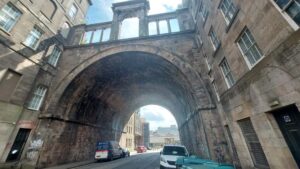
Another thing I noticed in 2026 about Trainspotting is that, for a film supposed to be the greatest one ever set in Edinburgh, you see very little of Edinburgh in it. You have the famous opening scene where Renton, Spud and Sick-Boy try to shoplift in (the now long-gone) John Menzies bookstore on Princes Street and are chased along the thoroughfare by security, with Renton making a last, doomed break for freedom down Calton Road and under Waterloo Place. But that’s all. The streets, side-streets, bunker-like nightclubs, pub-interiors and blighted junkies’ dens could be anywhere. Though that’s hardly surprising considering it was partly funded by the Glasgow Film Fund and most of it was shot in Glasgow.
Compare that with the sequel, T2: Trainspotting (2017), which was partly based on Irvine Welsh’s literary follow-up Porno (2003), also used some bits from the novel Trainspotting that didn’t get into the first film, and also featured stuff from scriptwriter John Hodge’s own imagination – like the psychotic Frank Begbie (Robert Carlyle) staging an escape from Saughton Prison. In T2, you get to see the Royal Mile, the Grassmarket, Cockburn Street, Harvey Nichols, the Scottish Parliament, the tram system, the Forth Road Bridge and Salisbury Crags. It’s practically a love-letter to the Scottish capital.
Still, a few months ago, I was in Edinburgh and found myself walking down Calton Road. And my immediate reation was, “Hey, this is where Ewan McGregor ran and got caught in Trainspotting!” So one little piece of the city, at least, was immortalised by the original film.