
© Serpent’s Tail
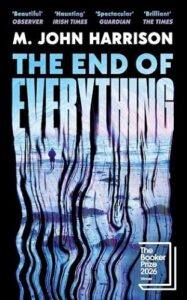
Recently, I was halfway through a novel when suddenly the novel was announced as the winner of 2026’s Booker Prize. What a surprise. I’d started reading M. John Harrison’s The End of Everything (2026) knowing that it was on the prize’s shortlist – this was stated on its cover – but it was so unique, riffing on old tropes of the science-fiction genre whilst doing new, unexpected and plain weird things with those tropes, that I’d assumed its chances of winning were zero.
Indeed, it was more the weirdness than the science-fictional aspects of The End of Everything that convinced me it had no chance. The British literary establishment is famously snobby towards science fiction, and genre writing of any type, but lately the Booker has gone to books that can be (even if their authors aren’t wild about the idea) classified as sci-fi – Margaret Atwood’s The Testaments (2019), Paul Lynch’s Prophet Song (2023) and Samantha Harvey’s Orbital (2024). The End of Everything, however, simply seemed too odd to win.
Harrison was as surprised as I was that he’d bagged the Booker. Interviewed in the Observer, he said of the prize-giving ceremony, “I was enjoying it up until I heard my name, and then I had a moment of utter terror, realising that I had to go up onto the podium…” His panic was partly due to “the fact that I had taken three days to write a very short speech about something that I didn’t think I was going to get, trying to fill it with authenticity when it wasn’t authentic.”
I’ve been aware of Harrison for a long time but read his work only sporadically. As a teenager, I came across his writings in the influential science-fiction publication New Worlds. In the 1960s it’d been a monthly magazine that promoted ‘new wave’ science fiction, i.e., eschewing the tropes of traditional sci-fi, like spaceships, alien planets, robots and intergalactic empires, and instead embracing more literary and experimental content and prose-styles, 1960s counter-culture, the modern media landscape, the soft sciences, radical politics, feminism…. Basically, anything likely to get up the noses of science fiction’s conservative old guard who’d made their names writing more straightforward, escapist fare in the 1930s, 1940s and 1950s. When I read New Worlds, in the 1970s, it was being published four times a year in paperback form and in it I discovered reviews and essays penned by Harrison.
It’s fair to say he was not a fan of the afore-mentioned traditional science fiction, with its afore-mentioned spaceships, alien planets, robots and intergalactic empires. I seem to remember him giving a right old kicking to a novel by the American sci-fi author Poul Anderson, whom I mentioned on this blog a few posts ago.
I also saw him in an episode of the 1979 BBC documentary series Time Out of Mind, which looked at the lives and works of science fiction writers. Episode 3 was about Michael Moorcock who, as well as being a prolific and innovative writer of science fiction and fantasy, edited New Worlds. For the episode, he insisted on being interviewed with Harrison present. Thus, while Moorcock was slagging off writers of old-school science fiction, Harrison chimed in with criticisms of his own, that, for instance, those old guys had no ‘sense of irony’. The episode of Time Out of Mind can be viewed on YouTube here. It’s fun seeing the 1979 Harrison looking so young and boyish compared to the still-sprightly but rather Gandalfian figure he cuts today.
Soon afterwards, I encountered Harrison’s short story The Ice Monkey in a volume of horror stories, edited by Ramsey Campbell, entitled New Terrors 2 (1980). The Ice Monkey made a big impression on me. It arguably has an element of the supernatural – the ornamental monkey of the title may, like a pin-pierced voodoo doll, have initiated a tragic accident – but the real horror resides in the circumstances of one of the main characters, who has a broken marriage behind him. It’s a ‘kitchen-sink’ kind of horror, something that was very new to me at the time. The story is also about rock climbing, an activity Harrison indulged in for much of his life. He only gave up climbing a few years ago. “I stopped just about at the end of Covid. I was getting tired, physically tired, which I think was simply to do with age. I was halfway up a wet piece of gritstone somewhere outside Sheffield, and I suddenly thought, ‘I’m wet, I’m cold, I’m tired, my hands are all cut up. Why am I doing this? What sensible person would do this?’”
© Bruce Pennington / New English Library
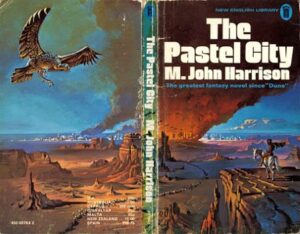
In the decades since, I’ve read his 1971 ‘dying earth’ fantasy novel The Pastel City, the first book in his Viriconium sequence, which caught my eye on a second-hand bookshop shelf because of its gorgeous cover by the artist Bruce Pennington; and his 2006 novel Light, a space opera (of sorts) that’s the first volume in his Kefahuchi Tract trilogy; and his 2017 collection of short fiction, You Should Come With Me Now. I’m glad I read that last book because the strange stories in it helped prepare me for The End of Everything.
The End of Everything is set in a near-future Britain where an alien invasion is in progress. The invaders are called the iGhetti and they seem to manifest themselves as ‘tall writhing bursts of light’. Quite how and why they arrived on earth is a mystery: “Competing authorities associated the iGhetti with dark matter or the banking crisis of the late 2000s, while others believed it to be less an invasion than a ‘re-enchantment of the world’, a process of spiritual tourism and gentrification pursued by advanced civilisations from a mooted ninth planet. More popularly, they were seen as having ‘come out of the internet’: indeed, this was the favoured theory of the internet itself…”
In Britain, the iGhetti seem concentrated around the City of London, against which the authorities – what’s left of them – stage constant military assaults. Meanwhile, their presence is apparently the cause of hallucinogenic episodes, euphemistically called ‘bad patches’, in people’s consciousness. They’ve also seemingly caused Britain to lose all contact with the rest of Europe, which is referred to as a ‘lost continent’. That doesn’t deter shiploads of Britons from regularly setting sail into a misty English Channel optimistically thinking there’s still something to find on the other side of it.
Perhaps most alarmingly, the iGhetti appear to have seeded the sea with organisms – ‘artefacts’ – that start off as small blobby things but rapidly evolve, sometimes into human forms with the power of speech. One of the book’s characters, Philip Tennent, makes a living as a beachcomber in the East Sussex seaside resort of Dalston-on-Sea. He collects such artefacts when they’re washed ashore and sells them to interested parties. His customers include a man called Hampson, who uses artefacts in gruesome scientific experiments aimed at making contact with the iGhetti – Hampson is “the beachcomber’s call of last resort, a man no one liked, or liked to deal with. No one liked what he did with the things they sold him.”
The End of Everything’s plot begins with Philip retrieving an artefact that evolves with unsettling speed and becomes unsettlingly human. He hooks up with his aunt, Marnie, an artist whose lifelong feistiness and rebelliousness are starting to manifest themselves in extreme ways now that she’s succumbing to dementia. And the three of them, Philip, Marnie and the artefact, set off on a road trip. The events that follow unfold through the prism of the weirdness that the iGhetti have unleashed upon the world.
I’ve described the plot in tentative language – ‘seem to’, ‘appear to’, ‘apparently’, ‘seemingly’, ‘perhaps’ – because none of the characters have much clue about what’s going on. Harrison has stated that he doesn’t like ‘the over-explanation of everything’ in fiction and pointed out that upheaval in real life is frequently under-explained. It isn’t like in traditional science fiction stories where the Martians invade, humanity reacts, the invasion ends, and everyone immediately knows what’s happened. Rather, there’s confusion – people not knowing when the disaster or upheaval has started or ended, not knowing it’s happened at all because it hasn’t impacted on them, trying to ‘keep calm and carry on’, being in denial about it, being taken in by conspiracy theories, and so on. The climate emergency, which is wreaking havoc around us right now, is a good example of that.

From wikipedia.org / YouTube.com / © Virtual Futures
The End of Everything’s premise of a catastrophe happening and causing reality to fray around it recalls the works of J.G. Ballard, one of my all-time favourite writers and someone who was an influence on Harrison. But while Ballard’s fiction often took place in exotic locales, in the forests of Cameroon or on Pacific atolls or in gated communities in southern France, Harrison bases his catastrophe in some very British – very English – settings: in crumbling, fading seaside towns.
You get such details as ‘the concrete paths and slipways of the old sea defences’ or ‘a hot snacks van that operated from a viewpoint car park above the shingle line’ or beaches consisting of ‘pebbles patched with open sand, rimmed with weeds and rubbish, evening primrose, sparse sea buckthorn, the trickle of a sewage overflow, an abandoned ice cream parlour’ or, most memorably, the benches along the seafronts with their memorial plaques, which are almost always dedicated to old men. At one point Marnie believes she sees “the ghosts of old men drawn out to sea, released from the mysterious dawn-to-dusk confinement of their commemorative benches along the north shore, to rise until they face out towards the lost continent.”
Obviously, those seaside settings imbue The End of Everything with an oh-so-British melancholia and slightly seedy, slightly pathetic nostalgia. And this makes me feel it’s a more personal and inward-looking book than some critics have made out – critics who’ve seized on the ‘big things’ in the plot and read them as metaphors, like the ‘lost continent’ symbolising Brexit or the artefacts symbolising the recent intrusion of AI into our lives. (The artefact that Philip and Marnie end up with resembles an LLM because, as it develops, it gobbles up the sensory input and information around it, learns to speak and eventually becomes quite garrulous.)
I’m more inclined to think that the book is about Marnie and her weakening mental faculties. How much of the confusion sown by the iGhetti is simply the result of her own, accelerating dementia, with past and present, fantasy and reality, becoming increasingly muddled? The suspicion that we might have blundered into Marnie’s unstable private universe is augmented by the fact she’s an artist and, in his descriptions, Harrison makes repeated references to artists: Canaletto, Giorgio de Chirico, H.R. Giger, Henry Moore, Pablo Picasso. Marnie would no doubt interpret the world around her in the same way, likening it to the works of painters and sculptors.
Because it’s won the Booker, lots of people will be buying and starting to read The End of Everything just now, which is excellent news for Harrison’s bank account. I wonder, however, how many of them will actually finish the novel and, if they do, how many will actually like it. Personally, I didn’t find it an easy read. But finally – by the end of everything – I thought it was wonderful.
From YouTube.com / © BBC