© Cork University Press
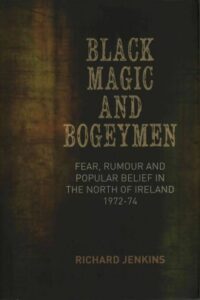
A few posts ago, I mentioned the Satanic panic that seized Northern Ireland in late 1973 and early 1974. As Halloween is nearly upon us, I thought I would republish the following, which is a slightly revised version of something I wrote a decade ago, after I’d read Richard Jenkins’s book on the topic, Black Magic and Bogeymen (2014).
When I was eight years old, I lived in a tiny village near the border between Counties Tyrone and Fermanagh in Northern Ireland. Thinking back, I suspect that when my neighbours saw me they’d whisper, “Look… There’s the most gullible child in the village.”
They probably thought I was gullible because I readily believed any old guff people told me, especially relating to things that, scientifically speaking, didn’t exist – i.e., manifestations of the supernatural.
I was a sucker for ghost stories. For instance, an uncle once told me about the Cooneen Ghost – a tale involving a local family who supposedly were tormented by poltergeist-type knockings on the doors and windows of their house. When they tried to escape the entity by emigrating to North America, it travelled with them. The phantom knockings continued in their cabin on board the ship and then at their house in the New World. After hearing that, I lived in dread of hearing similar knockings on the doors and windows of my house.
I also believed that fairies were real because a girl in my primary-school class had assured me that once her mother had been in the family’s stick-house (Northern Irish for ‘wood-shed’) when she’d heard crying sounds coming from a block of wood. Presumably these were made by a fairy whose home was in the tree that’d been chopped down for the timber.
I even believed in banshees for a while because an older boy spun me a yarn about how, one night long ago, his father had heard a hideous screeching noise out in the darkness; and very soon afterwards, someone well-known to his father died unexpectedly.
So you can imagine my alarm one day when a couple of my primary-school classmates started talking about devil worshippers being active not only in Northern Ireland, but in the town of Enniskillen a few miles along the road from us. They talked about a family in Enniskillen who, according to rumour, drew all the curtains in their house as soon as it got dark and then spent the night performing black-magic rituals. They described the carcasses of freshly-sacrificed goats that’d been discovered beside the River Erne in Enniskillen with their hearts removed. Most alarmingly, they claimed a child, about our age, had been abducted by devil worshippers and later been found dead and cut into pieces. I swallowed every word of this and took it as gospel truth.
Talking of the gospel, I’ll say in my defence that I belonged to a fairly religious community of Northern Irish Protestants. We were a paradox. On one hand, we prided ourselves on being rational and not superstitious, seemingly unlike the Roman Catholics, with their talk about saints, visions and weeping statues; but on the other hand we believed everything that was said to have happened in the Bible because it was the Word of God. And since the Bible said the devil existed – he did exist. Our local clergyman confirmed this. I remember him telling us sternly during a Sunday sermon that if you believed in the existence of God, you had to believe in the existence of the devil too.
From wikipedia.org
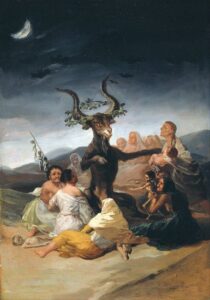
So if the devil was real, surely it followed that evil people who worshipped him by slaughtering humans and animals were also real?
During the decades since, I often wondered how my primary-school classmates got hold of those grisly stories about devil worship in early-1970s Northern Ireland. Well, I finally found the answer when I read Black Magic and Bogeymen, a 2014 book by Richard Jenkins, Professor of Sociology at the University of Sheffield and a one-time undergraduate at Queen’s University in Belfast. This investigates a “wave of rumours about black magic, Satanism, animal sacrifice and child abduction” that “swept across the north of Ireland in late 1973 and early 1974.”
According to Jenkins, “(b)etween 5th August and mid-December 1973, sixty-five items about witchcraft and black magic appeared in the mainstream press north and south of the Irish border: news reports, features, editorials, letters to the editor, church reports, and what appeared to be religious announcements… Most of the reporting concerned the east of the province: Belfast and counties Antrim, Armagh and Down… The reports peaked between mid-October and the third week in November, clustering around Hallowe’en.”
At their height, these reports seemed to reflect genuine panic in parts of Northern Ireland – adults concerned that their children might be kidnapped and sacrificed, and children generally scared witless. (I was one of them.) As Jenkins observes, children were also among the worst culprits for spreading the rumours. They “seem to have actively elaborated or invented stories about bad people doing bad things” and were “likely to have contributed to the meagre ‘tangible evidence’ of supposed witchcraft and black magic practices.”
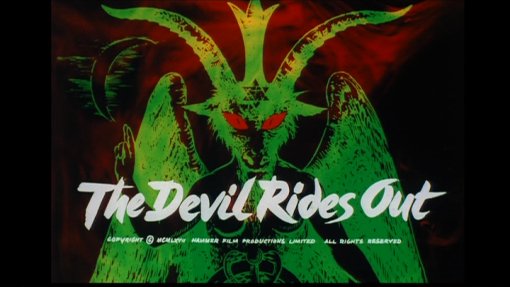
Jenkins explores the many factors likely to have fostered these stories of devil worship, black magic and ‘witchcraft’. (My apologies to any Wiccans or other practitioners of white or pagan magic reading this, but to 1970s Northern Ireland’s Protestants and Catholics, witchcraft was devil worship and vice-versa: end of.) He describes the heightened interest in the occult in Western culture at the time, signified by such things as the sensational black-magic novels of Dennis Wheatley and high-profile movies like Rosemary’s Baby (1968) and The Exorcist (1973). He devotes a chapter too to “the supernatural lore that was part of the enchanted world-views that could be encountered in Northern Ireland in the early 1970s” and no doubt made some people believe the rumours more readily – supernatural lore that includes not just the ghosts, fairies and banshees that so worried my eight-year-old self, but also traditions of faith and folk healing and a great enthusiasm for celebrating Hallowe’en.
Obviously, something that casts a huge shadow over Jenkins’ subject matter is the Northern Irish Troubles. In their fourth year when the rumours began, the Troubles had already claimed an appalling toll – 467 people killed in 1972 alone. Jenkins discusses how “social conflicts may be symbolised and re-worked in supernatural imagery and stories, not least in threats such as witchcraft and fears of spiritual jeopardy”. The Troubles figured in the rumours in more tangible ways too, for example, through tales of teenagers getting embroiled in the occult after “trying to contact the souls of those killed in the Troubles, using Ouija boards or other methods.”
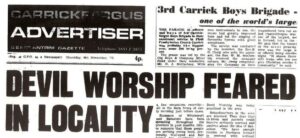
Jenkins attributes considerable blame for the scare to the province’s local newspapers, which generally reported the stories with ‘very modest facts’ that were ‘inflated and misrepresented’, ‘framed with unconnected material’ and ‘ornamented by apparently authoritative, if somewhat imprecise, anonymous information.’ Admittedly, those newspapers were under massive pressure. A few years earlier their main stories had been about ‘livestock sales’ and ‘the Women’s Institute’ but now they were regularly covering ‘intimidation, murder and mayhem.’ Thus, standards weren’t high among their beleaguered journalists.
© Carrickfergus Advertiser
Fascinatingly, another possible culprit identified is the British Army, which depending on your political viewpoint was then in the province as protectors or oppressors, as peacekeepers or occupiers. Jenkins provides evidence suggesting the army was happy to stir the pot of black-magic rumours. It conducted ‘black propaganda’ operations promoting the belief that, yes, diabolical things were going on and religious and / or superstitious Northern Irish parents should keep their offspring off the streets at night. On those streets, they were actually unlikely to tangle with devil worshippers; but they could tangle with paramilitaries or the security forces.
Jenkins prints an interview conducted in 1993 with the legendary Intelligence officer and ‘psychological warfare’ expert Colin Wallace, who claims he and his men went around Northern Irish properties mocking them up with magic circles, esoteric symbols, blood, bones, candles and inverted crosses to make it look like unspeakable rituals had taken place in them.
Tragically, one element in the stories was real – the child who, my classmates had told me, had been ‘cut to pieces’. Jenkins devotes a chapter to the murder of ten-year-old Brian McDermott. Brian was reported missing from his home in east Belfast at the start of September 1973 and his remains, ‘burned, mutilated and partially dismembered’, were discovered in the River Lagan a week later. Although the police dismissed the idea that the murder was the result of some occult ritual, Jenkins notes how “a ‘black magic’ interpretation of the murder of Brian McDermott became an established tale of the Northern Irish Troubles.” Officially the crime remains unsolved. According to the journalist Martin Dillon, British Army Intelligence suspected the killer as being John McKeague (himself killed in 1982), one of the conflict’s most notorious and feared loyalist terrorists. However, the fact that McKeague was in prison at the time of the murder casts doubt on his culpability.
Richard Jenkins conducts his investigations with academic thoroughness, analysing certain stories and rumours from different perspectives as he goes through the various actors in the drama – the Troubles, religion, superstitious belief, the media, the army, etc. His approach is exhaustive and may seem exhausting to the casual reader. However, I found Black Magic and Bogeymen fascinating – well, I was there at the time – and it’s surely the last word on the subject.
Returning to my own experience, I recall being asked in December 1973 if I wanted to go to the Christmas pantomime being held at Enniskillen High School and telling my parents flatly that no, I didn’t, because Enniskillen was full of witches and devil worshippers. My Dad went ballistic at me for believing such ‘a pack of nonsense’ and then demanded to know who’d told me those stories. I gave him the names of my guilty classmates. “More fool you,” he raged, “for listening to them slabbering eejits!” And that was that. I stopped worrying and agreed to go to the pantomime. Somehow, that angry burst of rationality from my Dad cured me of my fears.
Surprisingly, decades later, I remember my Dad – who originally hailed from Country Cavan in the Irish Republic – having a whiskey with an old Irish friend. The pair of them started talking about their childhood in the Irish countryside and how, once the sun went down, their family members would tell ghost stories.
“I’m not kidding,” marvelled my Dad. “After dark, you’d be too terrified to step outside the house.”
“I think,” said his friend, “that was why they told us them stories.”
Which proves I wasn’t the first member of the family to be troubled by tales of ghosts, fairies, banshees, black magic and bogeymen.
© Hammer Films / Seven Arts Productions / 20th Century Fox