
From wikipedia.org / © Warner Bros Entertainment
We’ve entered October, the month that ends with the spooky and supernatural-tinged festival of Halloween. I usually mark this time of year by posting some entries related to the macabre – well, I am a published writer of horror stories. So, here is a piece listing the various things, in real life, in print, on TV or in the cinema, that terrified me as a kid and, possibly, affected my development and made me the person I am today.
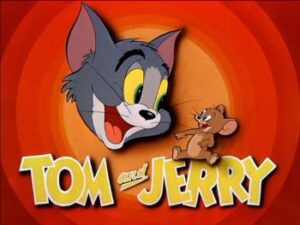
The Tom and Jerry cartoon Heavenly Puss (1949)
When I was five or six years old, popular children’s cartoons that suddenly and without warning turned creepy were like booby traps for my delicate psyche. For example, I remember watching an episode of The Inspector, which was part of The Pink Panther Show (1969-78), where the Inspector’s sleepy sidekick Sergeant Deux-Deux accidently drinks a mad scientist’s potion and turns into a hulking Mr Hyde-like monster. This horrified me.
But my all-time cartoon nightmare came when I watched a Tom and Jerry short called Heavenly Puss, in which Tom is terrorised by a horned, red-pelted, green-eyed devil-dog – basically a satanic version of Spike the Bulldog – who keeps appearing and threatening to boil him alive in a cauldron. I was living in Northern Ireland at the time, and was already having my head filled with warnings about the devil by the multiple religious personages who populated the place. Seeing a similar, infernal figure intrude on something as innocuous as Tom and Jerry was deeply upsetting.
Incidentally, the 1942 Tom and Jerry short Fraidy Cat freaked me out too, though not quite as much as Heavenly Puss did.
Mij gets it in Ring of Bright Water (1969)
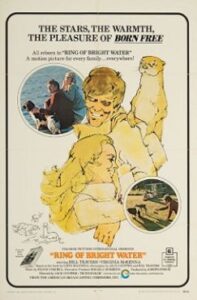
With this one I was less terrified than traumatised. Many people my age go on about how they were reduced to quivering wrecks when they watched the animated, leporine bloodbath Watership Down (1978). But a far worse experience for me was the movie Ring of Bright Water, based on the 1960 book of the same name by Gavin Maxwell, in which Bill Travers plays a hapless Londoner who rescues a rambunctious otter called Mij from a pet shop and ends up moving with him to the more otter-friendly environment of Scotland’s remote west coast. Not only Mij thrives there – Travers does too, especially when he makes the acquaintance of the fanciable local doctor (Virginia McKenna).
© Palomar Pictures International / Rank Film Distributors
I saw Ring of Bright Water on TV in the early 1970s. For most of its running time, it’s an amiable comedy in which Travers and Mij get up to amusing high-jinks. Nothing prepares you for the ending. McKenna is taking Mij for a walk when he gets his head flattened in a random act of violence by a shovel-wielding ditch-digger who regards otters as vermin. It’s made even worse by the fact that Travers is in London at the time. In the next scene he returns, cheerfully believing all is well, and McKenna has to interrupt his garrulous blather with the bald statement, “Mij is dead.”
It’s a sobering reminder of the fact that, no matter how much we sentimentalise animals, they frequently live or die – more often die – by the whims of humans beings. But sneaking that reminder into what’d been, for the most part, a fun, good-natured family film seemed a bit rotten.
Playing the ditch-digger was the Glaswegian actor Archie Duncan, who passed away in 1976. I wonder if that’s inscribed on his headstone: ‘HE KILLED MIJ.’
The Northern Irish satanic panic in 1973
According to the 2014 book Black Magic and Bogeymen by Richard Jenkins, Professor of Sociology at the University of Sheffield, a “wave of rumours about black magic, Satanism, animal sacrifice and child abduction… swept across the north of Ireland in late 1973 and early 1974.” Jenkins notes that “(b)etween 5th August and mid-December 1973, sixty-five items about witchcraft and black magic appeared in the mainstream press north and south of the Irish border: news reports, features, editorials, letters to the editor, church reports, and what appeared to be religious announcements… The reports peaked between mid-October and the third week in November, clustering around Hallowe’en.”
© Cork University Press
This was a classic example of what today we’d call a ‘satanic panic’ though, with the Northern Irish Troubles in progress at the time, Jenkins offers intriguing evidence that the British Army was stirring the pot with ‘black propaganda’ operations – i.e., trying to convince superstitious Northern Irish parents that the province was overrun with devil-worshippers so they wouldn’t let their kids outdoors at night. Keeping them indoors meant there was less chance of them getting into genuine bother with the paramilitaries or the security forces.
Jenkins also observes that children were among the worst culprits for spreading the rumours. I can testify to that. I remember a girl in my class gleefully assuring me there was a family in nearby Enniskillen who drew their curtains as soon as it got dark and then spent all night performing ghastly black-magic rituals. She also told me about goat-carcasses being found beside the river in Enniskillen with their hearts cut out and, worst of all, a child being abducted there, sacrificed and chopped into pieces. Needless to say, gullible me swallowed every word of this and, for the next few months, the prospect of visiting Enniskillen petrified me.
The trailer for Penda’s Fen (1974)
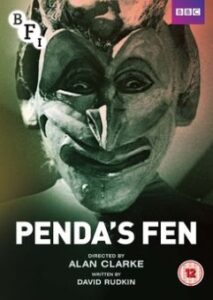
Today, Penda’s Fen is regarded as a visionary piece of TV drama. Time Out magazine has described it, rather pompously, as a “multi-layered reading of contemporary society and its personal, social, sexual, psychic and metaphysical fault lines…” that fuses “Elgar’s Dream of Gerontius with a heightened socialism of vibrantly localist empathy, and pagan belief systems with pre-Norman histories and a seriously committed – and prescient – ecological awareness.” Written by David Rudkin and directed by Alan Clarke, it was, however, seriously offbeat even by the standards of Play for Today (1970-84), the anthology series whose fourth season contained it as an episode. Maybe that’s why I remember the trailer the BBC showed prior to its broadcast being so scary – the channel couldn’t make head nor tail of it and decided to market it as a folk-horror film.
© BBC
Two creepy moments of Penda’s Fen were included in that trailer. Firstly, there was a sequence where the young hero (Spencer Banks) sits by the edge of a pool and sees reflected in it a statue of an angel – the statue stands behind him, but when he looks around it suddenly isn’t there anymore. I wonder if the TV writer Steven Moffat saw this as a kid and, three decades later, it inspired him to create the Weeping Angels for the 21st-century reboot of Doctor Who (2005-25). Even worse for my tender sensibilities was a sequence where Banks cowers in his bed while a devilish face hovers over him. Living in super-religious Northern Ireland, I had no doubt at the time that devils and demons were real. I didn’t want to wake up in the middle of the night and be confronted by a face like that.
Haunted by the images in its trailer, I didn’t watch Penda’s Fen when it was broadcast a few evenings later. In fact, I didn’t see it in its entirety until several years ago and, of course, it was nothing like what my eight-year-old self had been led to believe.
Talos comes to life in Jason and the Argonauts (1963)
In my childhood I loved the movie Jason and the Argonauts, based on the Greek myth of Jason and the Golden Fleece. I especially loved the mythical creatures in it like the hydra and harpies, which were animated by stop-motion-animation / special effects genius Ray Harryhausen. One scene absolutely creeped me out, however, and has stuck in my memory ever since. That’s when Jason and co. arrive on an island populated by gigantic bronze statues and Hercules (Nigel Green) and Hylas (John Cairney) not very smartly steal a giant broach from a treasure chamber inside the plinth of the statue of Talos. They’re discombobulated, to say the least, when the head of the titanic statue slowly turns and its bronze face gazes down at them, impassively but accusingly.

© Morningside Productions / Columbia Pictures
I think it’s the creaking noise that accompanies the twisting of Talos’s neck that gets me – every time I watch it.
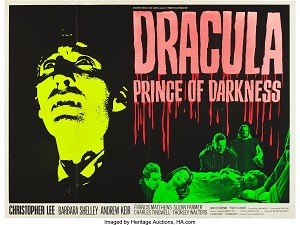
The first half of Dracula, Prince of Darkness (1966)
The horror movies made by the famous British studio Hammer Films aren’t regarded today as being particularly frightening. At their best, they have a wonderful gothic flamboyance. At their worst, they’re endearingly tacky. But genuinely frightening? Not really. However, when I was a kid, some of them turned up on TV for the first time and, to me then, they did seem scary. For instance, Quatermass and the Pit (1968) left me shaken. But it was the first half of Hammer’s Dracula, Prince of Darkness that truly gave me the willies. I say ‘first half’ because when I initially saw it on TV, that was all of it I could take. At its midpoint, I threw in the towel and retreated to bed.
In part, the film’s impact on me was due to misleading expectations. I knew Dracula was villainous but didn’t think he could be frightening. I’d already seen a couple of old black-and-white films featuring the character, made by Universal Studios, where he was played in a raffish fashion, by John Carradine in House of Dracula (1945), or in an urbane and slightly camp one, by Bela Lugosi in Abbott and Costello Meet Frankenstein (1948). So I wasn’t ready for Christopher Lee’s portrayal of him in Dracula, Prince of Darkness, where he alternates between being chillingly imperious – he unsettlingly doesn’t utter a word of dialogue during the whole film – and being a hissing, spitting hell-fiend.
In fact, Dracula is hardly in the movie’s first half. It begins with a prologue showing him being reduced to ashes, by Peter Cushing, at the climax of the previous instalment in Hammer’s Dracula series. What follows is a grim tale in which four naïve English travellers (Francis Matthews, Suzan Farmer, Barbara Shelley and Charles Tingwell) end up spending the night at Castle Dracula and an acolyte (Philip Latham) slaughters one of them and uses his blood to revive his dead master. The sight and sound of copious blood splattering down onto the Count’s powdery remains inflicted another scar on my already heavily-scarred young psyche.
© Warner Pathé / Hammer Films
I’ll post about more things that terrified my juvenile self shortly.