
Attack ‘n’ Byrne


In the past few weeks I’ve been fortunate enough to attend two of the best musical concerts I’ve ever experienced.  Both took place at Singapore’s Star Theatre.


On July 29th, the Star hosted the English trip-hop collective Massive Attack.  Formed in Bristol in 1988 by Robert ‘3D’ Del Naja, Grant ‘Daddy G’ Marshall, Adrian ‘Tricky’ Thaws and Andre ‘Mushroom’ Vowles, Massive Attack is less massive in terms of members nowadays.  Only 3D and Daddy G remain, Tricky and Mushroom having left in 1995 and 1999 respectively.  What we got on July 29th still sounded massive, though.


In the 1990s, I loved the band.  Their three albums from that decade, Blue Lines (1991), Protection (1994) and Mezzanine (1999), are all-time favourites of mine.  I found their sound irresistible: its hypnotic melodies, its measured pace, its building crescendos, its atmospherics, its lurking orchestral grandeur – composer John Barry never seemed far away – and, unpinning everything, its relentless drums and basslines.  After hearing them, I had a hard time getting songs like the soaring Unfinished Symphony or the sublimely restless Safe from Harm from Blue Lines, or the haunting Teardrop from Mezzanine, out of my head.


My ultimate Massive Attack song, though, was Mezzanine’s Angel, which after a slow but remorseless build-up lets fly two minutes and 19 seconds in.  That’s the best crescendo in music ever.  It would make a terrific accompaniment to a movie sequence where there’s a brooding sense of unease, then an explosion of action.  It has been used in films, actually, but the only one I’ve heard it in was the forgettable 2004 remake of Robert Aldrich’s The Flight of the Phoenix (1965).  I know it turned up in Guy Ritchie’s Snatch (2000) too, but I’ve never watched that one.


The one time I saw them live during the 1990s was in insalubrious circumstances.  They played at the now-defunct Scottish music festival T in the Park in 1999.  The crowd was boozed-up and raucous and I’d been at the front of it all afternoon, before they performed, watching earlier bands on the bill.  These included the then-popular rock band Reef.  While Reef were playing, someone bodysurfed past me and accidentally struck me in the head with a boot.  A week previously, I’d been the victim of an assault, which resulted in me getting multiple stitches in the back of my head in an A and E department.  The body-surfer’s boot opened those stitches and blood leaked out everywhere, including down my face.  Consequently, when Massive Attack came on, I looked like I’d just strolled off the set of a horror movie.


It didn’t help that a crowd-member then flung a bottle at the stage, which smashed down close to their frequent collaborator, the reggae roots singer Horace Andy.  They continued playing, but looked extremely pissed off.  (They should have followed the example of Jim Kerr, the frontman of Simple Minds.  Supposedly, once, when somebody chucked a bottle at Simple Minds during a Parisian gig, he told the crowd, “I hope whoever threw that dies of cancer.”)
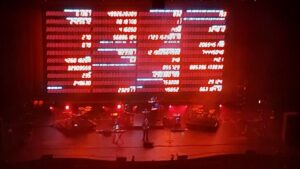


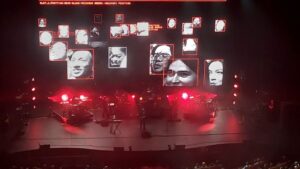
So, what a contrast to see them again, 27 years later, from a vantage point high in the circle of the grand and comfortable Star Theatre.  On the stage, 3D, Daddy G and their team of travelling musicians were ensconced, in near-darkness for much of the time, among their instruments and consoles while the theatrics were provided by dazzling visuals that materialised on giant screens above them to accompany each song.  In fact, ‘visuals’ is too lame a word to describe what the audience saw.  A reviewer in Australian Musician wrote that the band used “monolithic LED screens, archival footage, political imagery and dreamlike sequences to create a constantly shifting portrait of a world where personal freedom, privacy and even human emotion are increasingly commodified.”


As the visuals shifted wrenchingly from the picturesque Swiss lakeside city of Zug (where much equity money ends up, apparently) to Africa and impoverished locals having to dig up precious minerals in wretched  conditions, from worrying graphics illustrating the global reach of mass surveillance to gibbering headlines about celebrities, from Peter Thiel quotations about why democracy is a bad idea to bald statements that could have come from 1984’s Ministry of Truth (‘WHAT IS PURPOSE?’), I was reminded of the work of radical documentary filmmaker Adam Curtis.  Later, I learnt that Curtis and the band have enjoyed a long association and he worked with them to put these digital displays and film clips together.


Not that the visual show was entirely serious.  I was delighted to see the great horror actor Bruce Campbell get chased through a cabin by the forces of darkness in The Evil Dead (1982) while a message flashed up telling us we can’t escape ‘the algorithm’.  Later, another great horror actor, Boris Karloff, appeared as the title character in The Mask of Fu Manchu (1932) in an ironic commentary on the West’s tendency to blame China for everything.  (See Covid-19.)



Musically, it was superb.  The crowd gave roars of appreciation for Horace Andy, singing on three tracks, including – yes! – Angel; and for other longtime collaborators Deborah Miller,  singing on Unfinished Symphony and Safe From Harm, and Elizabeth Fraser, who did vocal duties on Mezzanine’s Black Milk and Group Four and a cover of Tim Buckley’s Song to the Siren (1970).  Fraser also brought the evening to a perfect close with the final song, Teardrop.


The gig was overshadowed by an incident at the end when, briefly, 3D and Daddy G brandished a Palestinian flag onstage.  Singapore’s Straits Times newspaper reported that this broke a local law forbidding “the public display of foreign national emblems without a permit or exemption.”  Afterwards, according to the Times, the authorities released a statement saying, “…the police… administered stern warnings to both men for the offences of Section 3 of the Foreign National Emblems (Control of Display) Act and Section 16 of the Public Order Act,” and “both men will be banned from re-entering Singapore.”  The BBC, meanwhile, quoted an official spokesman as saying Singapore’s police “take a serious view of acts which could potentially harm the racial and religious harmony in Singapore”.


This leaves me with mixed feelings.  I believe people should be free to express their opinions, so long as that expression doesn’t cause innocent parties any harm, and I don’t see how two 60-something men holding a flag for a few seconds in a theatre full of Massive Attack fans could cause much harm.  However, I also believe in the old adage, ‘When in Rome, do as the Romans do’.  Singaporeans are proud of the stable, prosperous, multicultural society they’ve created, in a region that, elsewhere, has often been troubled by ethnic and religious conflicts.  For many people, having strict laws outlawing the display of foreign flags (and eliminating any possibility they could be used to stir up trouble) is a price worth paying.  I didn’t see much sympathy for the band on local Internet discussion-forums, where the sentiment was largely, “Bloody foreigners, coming over here, breaking our laws.”  “Good riddance to bad rubbish,” said one commentator, evidently not a fan.


It’s worth noting that the UK authorities have given Massive Attack a hard time too for their pro-Palestinian sympathies.  3D was arrested in Trafalgar Square in April this year for carrying a sign expressing support for the proscribed, allegedly terrorist group Palestine Action.


Anyway, this furore obscures the fact that the concert itself was exceptional.



Then on August 7th, singer-songwriter David Byrne – one-time vocalist and guitarist with legendary American new-wave band Talking Heads – performed at the Star to promote his 2025 solo album Who is the Sky?  This gig didn’t begin well for me.  When I bought my ticket via Ticketmaster, I got an email warning me not to try to enter the venue using a screenshot of it.  I should have the ticket open in my Ticketmaster account, on my phone, ready for security staff to scan its QR code.  Just before I set off for the Star, I discovered the link in the email was taking me not to the David Byrne ticket in my account, but to the Massive Attack one from 10 days earlier.  This kept happening on my phone only.  When I clicked the link on my computer, I was taken to the correct ticket.  Finally, exasperated, I took a screenshot of the Byrne one on my computer and sent it to my phone, as proof I’d at least bought the ticket.


When I explained the problem to the ladies at the Ticketmaster table outside the Theatre entrance, they told me to use the screenshot on my phone.


“But your instructions said…”


“Just use it!”


The security lady looked at me tetchily when I presented the screenshot, but she scanned its QR code and it was accepted.  I was in.
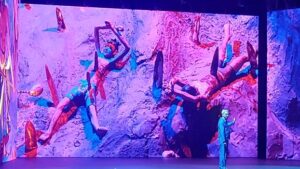


I wasn’t only me suffering technical difficulties.  The gig was scheduled to start at eight o’clock but nothing happened onstage for another half-hour – except for a few minutes when David Byrne himself walked into view.  He explained that some glitches were delaying proceedings and, by way of apology, entertained us with some sightseeing photos he’d taken that day in Singapore.  He did this with much enthusiasm.  His photos appeared on big screens above him and included one taken at Singapore’s marvellous Haw Par Villa, where you can stroll through a giant diorama depicting the 10 Courts of Hell from Chinese and Buddhist mythology.  That photo depicted sinners impaled bloodily on a ‘hill of knives’, which Byrne cheerfully informed us was the afterlife punishment awaiting people who charge too much interest on loans.  You know, bankers.


Byrne came across as someone with genuine interest in the places he travelled to and his good humour was greatly engaging.  I’d always thought he was decent, but after this episode I decided he was an absolutely top bloke.


During the delay I’d observed how the stage was empty.  It contained no instruments or equipment.  When the gig finally started, I understood why.  After the opening number, a static rendition of the 1979 Talking Heads song Heaven, which Byrne sang accompanied by two musicians playing a violin and portable keyboard (while the earth rose majestically through space on the screens behind), the show really became a show – a dance one as well as a musical one.


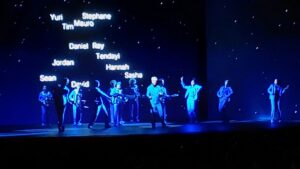
For each song, Byrne and eleven blue-clad co-performers went through a set of choreographed moves.  Six of the eleven were dancers and background singers.  The other five were musicians, carrying their instruments with them – guitars and keyboards, drums such as a tom-tom, timbale, snare drum and marching bass drum, and, when the song required, a violin or saxophone.  The musicians especially impressed me, keeping focused on where they were going as well as on what they were playing.  Meanwhile, the screens conjured up various backdrops: American suburbia, a forest, a skyscape, psychedelic patterns, a disorientating video where the same performers followed the same moves they were currently doing onstage but wearing animal-heads.
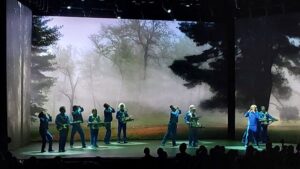


It felt part Broadway musical, part cheerleader routine, part circus (with Byrne as the ringmaster), part parade by a marching band.  Byrne even reminded me at times of Willy Wonka, orchestrating his co-performers like Oompa Loompas.  (I have to say, though, that with his blonde hair and cheery demeanour, Byrne looked more like Peter Isherwell, the sinister, ultimately incompetent billionaire played by Mark Rylance in the 2021 end-of-the-world movie Don’t Look Up.)  It’s also pretty astonishing how Byrne can do all this, seemingly effortlessly, at the age of 74.


With a plethora of drums, the music was percussion-heavy, which suited the catchy rhythms of Byrne’s solo songs perfectly.  I wondered if his Talking Heads songs would come across as well, but they did.  Several (including 1985’s And She Was) were performed during the first half of the set, before the focus switched to his solo stuff.  Then, near the end, out came the biggest Talking Heads numbers: Psycho Killer (1977), Life During Wartime (1979), Once in a Lifetime (1981) and Burning Down the House (1983).  Psycho Killer got the biggest reaction from the crowd, who inevitably chanted “Fa-fa-faa-fa-fa, fa-fa-faa-fa-fa!” in unison.  But I think it’s Once in a Lifetime that’s my favourite in Byrne’s oeuvre.  I remember first hearing it on Top of the Pops (1964-2006) when I was 16 and thinking it was bloody weird.  A week later, when I heard it again, I was hooked.


Anyway, this was a wonderful concert too.  Maybe not quite a once-in-a-lifetime experience, but not far off one.
 

It could have happened here


© Triad Granada


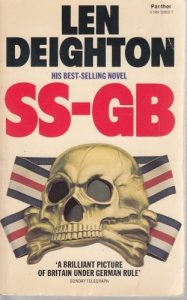
Recently, I’ve read a couple of ‘alternative history’ novels that imagine different realities in the 1930s and 1940s: wherein Britain and the USA were taken over by fascism just as Germany and Italy were.  What could have induced me, in 2025, to read novels about Britain and the USA succumbing to fascism?  I really can’t imagine.  Here are my thoughts on one of those books, Len Deighton’s SS-GB (1978).


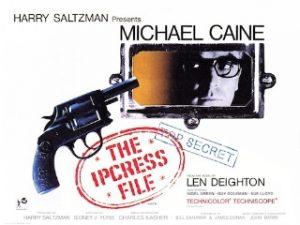
Deighton is best known as the author of The IPCRESS File (1962), the book that introduced the world to Harry Palmer, a down-at-heels spy whose humdrum experiences are a corrective to the glamorous espionage fantasy-world inhabited by Ian Fleming’s James Bond.


Actually, that description does both Deighton and Fleming a disservice.  Harry Palmer isn’t even the name of the protagonist in The IPCRESS File.  Deighton keeps its first-person narrator anonymous.  The name was only devised for the character in 1965 when the book was made into a film with the non-capitalised title The Ipcress File, directed by Sidney J. Furie and starring Michael Caine.  Also, while the film version is determinedly unexotic and, possibly for budgetary reasons, restricts its action to a non-swinging 1960s London, Deighton’s novel is more expansive.  It allows its hero to do some properly exciting, Bondian things, such as participate in a rescue mission in Beirut and visit an American neutron-bomb test site in the Pacific Ocean.


Meanwhile, Fleming’s novels certainly featured exotic locations (the Caribbean, the Swiss Alps, the French coast), exotic activities (scuba diving, skiing, gambling in casinos) and exotic food and drink (caviar, stone crabs, Dom Pérignon champagne), which no doubt tantalised his readers, many of whom were living in drab, austere, post-war Britain and eating such rationing-era fare as pig’s trotters, spam and lardy cake.  But he invested at least some of those novels with a little grit and realism too.  However, just as the medium of film made Harry Palmer more lowkey than the literary original, so a series of over-the-top movies unanchored the character of Bond and floated him off into the realms of total fantasy.  Ironically, the Harry Palmer movies and the first nine Bond movies shared the same producer, Harry Saltzman.


© Lowndes Productions / Rank Film Distributors


I was reminded of this dichotomy when reading SS-GB because, while its hero inhabits a grey, downbeat world, where dealing with even the simplest details of everyday life can be exhausting, some big, almost Bondian things hove into view and require his attention.  These, though, hardly make his existence any more glamorous.  Rather, they make it a lot harder for him than it was already.


In Deighton’s imagined alternative universe, SS-GB begins in November 1941.  Nine months earlier, in February, Britain surrendered to Germany.  February 1941 was four months before, in real history, Hitler turned against Stalin and ordered the invasion of the Soviet Union, an event that in in SS-GB evidently didn’t happen because the novel depicts Germany and the Soviet Union as, still, firm allies.  Japan’s attack on Pearl Harbour, which drew the USA into the war against the Axis powers, occurred at the end of 1941 and hasn’t happened yet.  One wonders if, here, it will happen, given the alterations elsewhere on the timeline.  The USA remains neutral in SS-GB, whilst peering across the Atlantic at a fully Nazi-controlled Europe with wariness and trepidation.  Incidentally, Deighton provides almost no exposition about what has gone on and it’s left to the reader to infer.


SS-GB’s hero, Detective Superintendent Douglas Archer, is a policeman at Scotland Yard who finds himself having to do his police-work under the supervision of the German occupiers.  His immediate superior is General – ‘or, more accurately in SS parlance, Gruppenführer’ – Fritz Kellerman: “a genial-looking man in his late fifties… of medium height but his enthusiasm for food and drink provided a rubicund complexion and a slight plumpness…”  Obviously, it was never put to the test, but Kellerman represents a good guess on Deighton’s part about how many German officials would have behaved if they had been posted to a defeated Britain and put in power there.   They’d have behaved like amiable Anglophiles, dressing in tweed suits, going hunting and fishing on country estates, playing golf, guzzling Scotch whisky and stocking their rooms with British antiques.  (Deighton has fun developing that last idea.  He depicts a bunch of 1940s British spivs running an illicit trade in British heirlooms, aimed at the German occupiers.)


Archer fits neatly into those Germans’ image of Britain because he represents another cosy and much-loved British cliché: the famous sleuthing detective.  Recognising him, one occupier exclaims, “You’re Archer of the Yard… You’re the detective who solved the Bethnal Green Poisonings and caught ‘the Rottingdean Ripper’ back before the war.”  Later in the book, Archer plays up his fame among the Germans – at least, the ones who enjoy true-life crime stories – to his advantage.


Behind the bonhomie of the likes of Kellerman, however, lurks the despotic ruthlessness of Nazi Germany.  Early on, Kellerman warns Archer about what may be coming.  Of Scotland Yard, he says, “Neither of us want political advisors in this building, Superintendent.  Inevitably, the outcome would be that your police force is used against British Resistance groups, uncaptured soldiers, political fugitives, Jews, gypsies and other undesirable elements.”


The story begins with Archer assigned to what looks like a straightforward murder case, a shooting in a rundown neighbourhood called Shepherd Market.  The murder scene is a flat “crammed with whisky, coffee, tea and so on, and Luftwaffe petrol coupons lying around on the table.  The victim is a well-dressed man, probably a black-marketeer.”  Of course, Archer gradually realises there’s more to the case than initially meets the eye.  And, as he grapples with the increasingly serious implications of what he’s investigating, he encounters a variety of characters who may be on his side or may be out to get him.


These include an officer in the SS’s intelligence service, an intense and driven man called Oskar Huth, who’s flown in from Berlin and put in charge of Archer and his investigation, and who’s the antithesis of the jocular Kellerman.  When Archer meets him off his Lufthansa plane and inquires where his bags are, he snaps, “Shotguns, golf-clubs and fishing tackle, you mean?  I’ve no time for that sort of nonsense.”  Constituting the one glamorous element that enters Archer’s life during the book is Barbara Barqa, a foxy American journalist who’s been allowed into London by the press attaché of the German Embassy in Washington.  She unexpectedly turns up at the murder scene and, predictably, isn’t all that she seems.  Meanwhile, additional tension comes from Archer’s elderly sergeant, and mentor, Harry Woods.  He’s a man ‘who fought and won in the filth of Flanders’ and ‘would never come to terms with defeat.’  It’s whispered that he has connections with the British Resistance movement, which makes Archer’s position very precarious.


As Archer’s investigation continues, I was, initially, a little disappointed by two of the main plot devices that Deighton uses.  These devices seemed to me slightly obvious ones for an alternative-history / World War II novel set in early-1940s London.  One is the race by various countries to develop a game-changing weapon – guess which weapon that is.  Indeed, when Archer learns that the murder-victim was suffering from radiation poisoning, I was reminded of Troy Kennedy Martin’s masterly TV miniseries Edge of Darkness (1985), which had a policeman investigating a killing and finding himself embroiled in a huge conspiracy involving the nuclear industry.  The other plot device is an operation to rescue an important personage whom the Germans have imprisoned in the Tower of London.  If the rescue is successful, it’ll be a boost for Britain’s battered morale and a propaganda win for the British Resistance.  Again, guess who that personage is.


To be fair, Deighton keeps both plot devices grounded. They’re wrapped in believably authentic realpolitik involving the neutral Americans, different elements in the British Resistance, and competing factions among the occupying Germans.  And the way one of them is resolved, near the end, caused me genuine surprise.  Also, there’s a subplot involving Karl Marx – whose remains are buried at London’s Highgate Cemetery – that I thought Deighton handled ingeniously.


But what really makes SS-GB a pleasure are Deighton’s descriptions of everyday life in occupied London – and what the ordinary population, war-weary, demoralised and living near the breadline, have to put up with.  There’s ‘the green, sooty fog’ with its ‘ugly smell’, which doesn’t quite hide ‘advertisement hoardings, upon which appeals for volunteers to work in German factories, announcements about rationings and a freshly pasted German-Soviet Friendship Week poster shone rain-wet.’  There’s Archer’s landlady, whose soldier-husband is in ‘a POW camp near Bremen, with no promised date of release.’  She serves her policeman lodger eggs she got from a neighbour as payment for an ‘old grey sweater to unravel for the wool’, and a cube of margarine, ‘the printed wrapper of which declared it to be a token of friendship from German workers.’


And there’s a rather desperate-sounding gala evening at the Metropolitan Music Hall.  This ends with the cast trying to cheer up the dejected London audience by ‘throwing paper streamers, wearing funny hats and popping balloons that descended from a great wire basket suspended from the ceiling’ – leaving the theatre ‘in a chaos of litter that had to be salvaged for re-use.’  The line-up for the evening includes Gracie Fields and Flanagan and Allen.  No George Formby, though.  Probably he’s in a prison camp, as a punishment for punching Hitler in his 1940 movie Let George Do It! 


And there are the ruins and wreckage left both by the Blitz and by Deighton’s imagined German invasion.  It’s a grey, wet, cold, blasted place, full of dejected and frustrated people, and it isn’t difficult to envision the London of George Orwell’s 1984 (1949) being a little further along the road.  Deighton, who’s still with us at the venerable age of 96, was ten years old when World War II broke out, and he came from the Marylebone area of London.  Presumably, he had images of the city in wartime seared into his memory and didn’t have to stretch his imagination too much to describe SS-GB’s version of it.


Thus, SS-GB’s crowning achievement is a depiction of Nazi-controlled London, and Britain, that you can practically see, hear, feel, smell and taste.  Though of course, you really wouldn’t have wanted to.


© Harper Collins Publishers


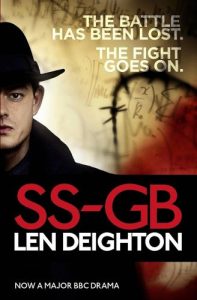
Apparently, in 2017, the BBC turned SS-GB into a five-episode TV miniseries, starring Sam Riley, Rainer Bock, Lars Eidinger, Kate Bosworth and James Cosmo.  I haven’t seen it, but let’s hope the BBC made a good job of it.  

My safe space


The world is in a terrible state at the moment.  It’s apparently morphing into a real-life version of the scenario imagined by George Orwell’s 1984 (1949), wherein the planet is divided into three authoritarian superstates, Eurasia, Eastasia and Oceania.  We now have Russia run by Vladimir Putin, China run by Xi Jinping, and the USA run by the grotesque triumvirate of orange gobshite Donald Trump, viper-in-hillbilly-form J.D. Vance, and the chainsaw-wielding, ketamine-popping, Seig Heiling, superrich super-dickhead Elon Musk.  All three countries have been open about their territorial ambitions, about their wish to expand and become real-life, continent-engulfing equivalents of Eurasia, Eastasia and Oceania.  Very bad news if you live in Ukraine, Poland, the Baltic states, Taiwan, Panama, Greenland or Canada.  Pretty bad news for the rest of us.


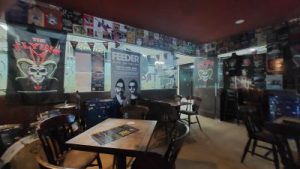
Thus, in these troubled times, it’s a relief to have a safe space: a little cubby hole you can retreat to, and hide in, and where your brain can function removed from all the awfulness happening outside for a while.  For me, that space is provided by the Flying V bar, Singapore’s self-styled ‘heavy metal headquarters’, which is hidden away in a back corridor in the basement of the Adelphi Shopping Centre on the city’s Colman Street.  Actually, the shopping centre is next door to the National Gallery, which makes the Flying V an ideal spot to sit with a beer after a visit to the gallery and ruminate on all the artwork you’ve just experienced.


A Singaporean shopping centre may seem an incongruous place to find a heavy metal bar.  However, it isn’t the only music or metal-related business in the Adelphi.  On your way there, you pass a few units containing shops that sell vinyl records, many of the heavy-metal variety.


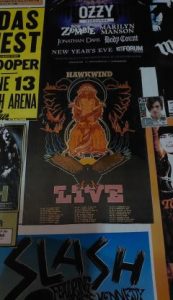
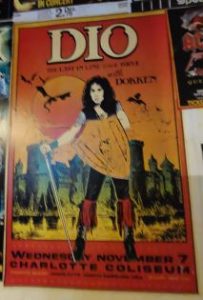
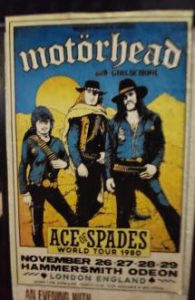
Inside, the walls of the Flying V are slathered with old posters and flyers advertising heavy-metal bands, concerts and festivals.  Even if you don’t touch a drop of alcohol, you can spend a pleasant hour in the place just reading the items crammed over the walls and enjoying the little glows of nostalgia they kindle in you.  On my part, for example, I gave happy sighs when I discovered an Art Nouveau-inspired poster for the mighty space-rock band Hawkwind, designed by the graphic artist Barney Bubbles; a picture of the late, great Ronnie James Dio tricked out in sword-and-sorcery gear, as was Ronnie’s wont to wear; and a poster for the much-missed Motörhead on their 1980 world tour, promoting their greatest-ever album Ace of Spades.


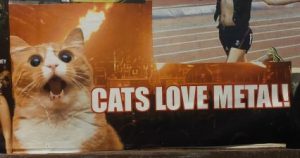
On the other hand, when I took my cat-loving partner there, she was delighted to find this proclamation about the feline species emblazoned on the wall behind our table.


The Flying V’s drinks menu includes a beverage called Trooper Premium British Beer.  Trooper’s vivid label-design gives you a clue as to who produces it.  Yes, it’s the result of a project involving veteran heavy-metal band Iron Maiden, singers of such anthems as Number of the Beast (1982) and Bring Your Daughter to the Slaughter (1990).  The latter song will always be close to my heart because of the fact it knocked Cliff Richard’s sanctimonious Saviour’s Day (1990) off the coveted Christmas Number One slot in the 1990 British singles chart.  The band produce Trooper in partnership with England’s Robinson’s Brewery.  So, if you spend an afternoon getting sloshed on the stuff in the Flying V, you’re not being wasteful or unproductive.  You’re actually helping to fund Iron Maiden.


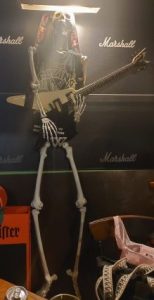
As I’ve said, the world is in a dire state just now and it sometimes feels tempting to retreat into the Flying V and hole up there for good.  However, the place does contain a warning against staying on the premises for too long.  You might end up like this guy.


Eco chamber


From wikipedia.org / © Rob Bogaerts


A follow-on from my previous post…


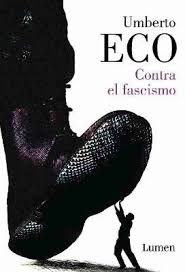
Elon Musk’s stiff-armed salutes at Donald Trump’s presidential inauguration on January 24th – at least, unlike Dr Strangelove, he didn’t address Trump as “Mein Führer!” – inspired me to read again Umberto Eco’s 1995 essay Ur-Fascism or Eternal Fascism: 14 Ways of Looking at a Blackshirt.


This begins with Eco reminiscing: “In 1942, at the age of ten, I received the First Provincial Award of Ludi Juveniles (a voluntary, compulsory competition for young Italian Fascists—that is, for every young Italian).  I elaborated with rhetorical skill on the subject ‘Should we die for the glory of Mussolini and the immortal destiny of Italy?’  My answer was positive.  I was a smart boy.”  It goes on to describe Eco’s hometown being taken over in 1945 first by the partisans and then by American soldiers (all of whom were African-Americans) and then muses on the nature of Italian fascism, as helmed by Mussolini, and of fascism generally.  It ends with Eco identifying 14 key traits that he believes appear in fascist movements and quoting Franklin D. Roosevelt in 1938: “I venture the challenging statement that if American democracy ceases to move forward as a living force, seeking day and night by peaceful means to better the lot of our citizens, fascism will grow in strength in our land.”


Well, Roosevelt’s words seem sadly ironic now.  Under Trump, American democracy appears to be moving backwards as a dying force, and the only citizens whose lot he’s seeking day and night to better are rich, white, straight, male ones.  But what about those 14 traits of fascism?  How many of them are detectible in Trump’s America at the moment?


Spoilers…  A lot.


The American far-right’s modus operandi of ‘moving fast and breaking things’ was a concept originally attributed to Mark Zuckerberg, one of the new Trump-grovellers-in-chief, and is something Trump’s been doing ever since his inauguration three weeks ago: ‘Tariffs!’ / ‘Drill, baby, drill!’ / ‘Invade Greenland!’ / ‘Invade Panama!’ / ‘Make Canada the 51st state!’ / ‘Leave the WHO!’ / ‘Leave the Paris agreement!’ / ‘More tariffs!’ / ‘Abolish DEI!’ / ‘Abolish USAID!’ / ‘Abolish trans-people!’ / ‘Abolish Gaza and turn it into the new Riviera!’ / etc.  This obviously corresponds to Eco’s fascist trait number three: “the cult of action for action for action’s sake… Action being beautiful in itself, it must be taken before, or without, any previous reflection.”


Also Trump down to a ‘T’ is trait number four: ‘disagreement is treason’.  So too is number five: ‘fear of difference’.  I can’t see life in America over the next four years being much fun if you’re different from one of those aforementioned rich, white, straight males.  And absolutely so too is number six: “appeal to a frustrated middle class… a class suffering from an economic crisis or feelings of political humiliation, and frightened by the pressure of lower social groups.”


Number seven is: ‘obsession with a plot’.  Yup, Trump has never shut up about the ‘deep state’, whatever that is, being out to get him and he’s happily courted all those delusional QAnon believers and other conspiracy fantasists.  Number eight is the belief that one’s ‘enemies are at the same time too strong and too weak’?  Well, listen to Trump’s speeches and you’ll hear him ranting simultaneously about how shit the US has become in the face of international competition and how it’s still somehow the greatest country on earth.


© Lumen Press


Number nine, the notion that ‘pacifism is trafficking with the enemy… life is permanent warfare’?  Well, see what I wrote in my previous post, about how “when things aren’t going wrong, Trump will still dial up the panic, make it look like there’s a crisis, and blame immigrants, liberals, working mothers, people of colour, etc.  That’s because he can’t afford to let his base relax and simply get on with their lives.  To ensure their ongoing support, he has to keep them in a constant state of anxiety and in constant readiness to lash out about it.”


Numbers ten, eleven, twelve and thirteen, which are respectively, ‘contempt for the weak,’ ‘everyone is educated to become a hero’ (heroism is especially easy when your population has ready access to AR-15s), ‘machismo’ (note Trump’s conviction in a civil court in 2023 for sexual abuse) and ‘selective populism’?  Tick, tick, tick and tick.


I don’t think Trump’s smart enough to have entertained thoughts about number fourteen, ‘newspeak’, wherein, for example, “Nazi or Fascist schoolbooks made use of an impoverished vocabulary, and an elementary syntax, in order to limit the instruments for complex and critical reasoning”.  In George Orwell’s 1984 (1949), this was the project that Winston Smith’s colleague Syme was working on at the Ministry of Truth, whittling down the size of dictionaries so that people has less vocabulary to articulate such abstract concepts as free will and self-expression.  Mind you, the many social-media platforms now doing Trump’s bidding are infested with so much short, simplistic, soundbite messaging – ranting, basically – that’s there’s little room for critical reasoning in them.


I haven’t mentioned numbers one and two yet, which are the ‘cult of tradition’ and ‘rejection of modernism’, wherein fascists deny the “advancement of learning. Truth has been already spelled out once and for all, and we can only keep interpreting its obscure message” and the “Enlightenment, the Age of Reason, is seen as the beginning of modern depravity. In this sense Ur-Fascism can be defined as irrationalism.”  But obviously, that’s written large across Trump and his operation, from his rejection of what the overwhelming majority of climate scientists are warning us about, to his efforts to put the anti-vaxxer grifter Robert F. Kennedy in charge of America’s public health, to his lackey Musk getting rid of fact-checking on X and lackey Zuckerberg doing the same on Facebook, Instagram and Threads, to the idea that you can turn any untruth into a truth by repeating it often and loudly and brazenly enough: Haitian immigrants are eating pets, vaccines cause autism, DEI policies caused a mid-air collision, USAID supplied condoms to Hamas and so on, and so forth.


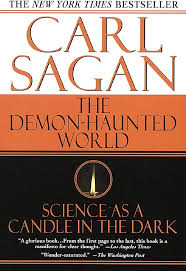
And that brings me to another piece of writing I’ve encountered recently.  It’s a passage from the book The Demon-Haunted World (1995) by the late, great American astrophysicist and writer Carl Sagan, which I’ve seen quoted on several people’s social-media pages.  Sagan’s mid-1990s fears about a near-future America were, shall we say, troublingly prescient.


“I have a foreboding of an America in my children’s or grandchildren’s time — when the United States is a service and information economy; when nearly all the manufacturing industries have slipped away to other countries; when awesome technological powers are in the hands of a very few, and no one representing the public interest can even grasp the issues; when the people have lost the ability to set their own agendas or knowledgeably question those in authority; when, clutching our crystals and nervously consulting our horoscopes, our critical faculties in decline, unable to distinguish between what feels good and what’s true, we slide, almost without noticing, back into superstition and darkness…


“The dumbing down of American is most evident in the slow decay of substantive content in the enormously influential media, the 30 second soundbites (now down to 10 seconds or less), lowest common denominator programming, credulous presentations on pseudoscience and superstition, but especially a kind of celebration of ignorance”


Awesome technological powers in the hands of a very few…  Public representatives unable to grasp the issues…  Critical faculties in decline…  Dumbing down…  Soundbites…  Pseudoscience…  Superstition…  Yes, Carl, you nailed it.  I’m glad, though, that you (and Umberto Eco) aren’t around to witness the ultimate, apocalyptic celebration of ignorance that’s erupted with the advent of Trump Mark II.


© Random House