M. John Harrison’s endgame


© Serpent’s Tail


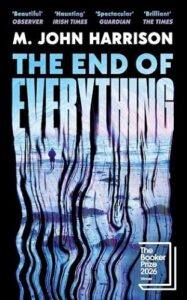
Recently, I was halfway through a novel when suddenly the novel was announced as the winner of 2026’s Booker Prize.  What a surprise.  I’d started reading M. John Harrison’s The End of Everything (2026) knowing that it was on the prize’s shortlist – this was stated on its cover – but it was so unique, riffing on old tropes of the science-fiction genre whilst doing new, unexpected and plain weird things with those tropes, that I’d assumed its chances of winning were zero.


Indeed, it was more the weirdness than the science-fictional aspects of The End of Everything that convinced me it had no chance.  The British literary establishment is famously snobby towards science fiction, and genre writing of any type, but lately the Booker has gone to books that can be (even if their authors aren’t wild about the idea) classified as sci-fi – Margaret Atwood’s The Testaments (2019), Paul Lynch’s Prophet Song (2023) and Samantha Harvey’s Orbital (2024).  The End of Everything, however, simply seemed too odd to win.


Harrison was as surprised as I was that he’d bagged the Booker.  Interviewed in the Observer, he said of the prize-giving ceremony, “I was enjoying it up until I heard my name, and then I had a moment of utter terror, realising that I had to go up onto the podium…”  His panic was partly due to “the fact that I had taken three days to write a very short speech about something that I didn’t think I was going to get, trying to fill it with authenticity when it wasn’t authentic.”


I’ve been aware of Harrison for a long time but read his work only sporadically.  As a teenager, I came across his writings in the influential science-fiction publication New Worlds.  In the 1960s it’d been a monthly magazine that promoted ‘new wave’ science fiction, i.e., eschewing the tropes of traditional sci-fi, like spaceships, alien planets, robots and intergalactic empires, and instead embracing more literary and experimental content and prose-styles, 1960s counter-culture, the modern media landscape, the soft sciences, radical politics, feminism….  Basically, anything likely to get up the noses of science fiction’s conservative old guard who’d made their names writing more straightforward, escapist fare in the 1930s, 1940s and 1950s.  When I read New Worlds, in the 1970s, it was being published four times a year in paperback form and in it I discovered reviews and essays penned by Harrison.


It’s fair to say he was not a fan of the afore-mentioned traditional science fiction, with its afore-mentioned spaceships, alien planets, robots and intergalactic empires.  I seem to remember him giving a right old kicking to a novel by the American sci-fi author Poul Anderson, whom I mentioned on this blog a few posts ago.


I also saw him in an episode of the 1979 BBC documentary series Time Out of Mind, which looked at the lives and works of science fiction writers.  Episode 3 was about Michael Moorcock who, as well as being a prolific and innovative writer of science fiction and fantasy, edited New Worlds.  For the episode, he insisted on being interviewed with Harrison present.  Thus, while Moorcock was slagging off writers of old-school science fiction, Harrison chimed in with criticisms of his own, that, for instance, those old guys had no ‘sense of irony’.  The episode of Time Out of Mind can be viewed on YouTube here.  It’s fun seeing the 1979 Harrison looking so young and boyish compared to the still-sprightly but rather Gandalfian figure he cuts today.


Soon afterwards, I encountered Harrison’s short story The Ice Monkey in a volume of horror stories, edited by Ramsey Campbell, entitled New Terrors 2 (1980).  The Ice Monkey made a big impression on me.  It arguably has an element of the supernatural – the ornamental monkey of the title may, like a pin-pierced voodoo doll, have initiated a tragic accident – but the real horror resides in the circumstances of one of the main characters, who has a broken marriage behind him.  It’s a ‘kitchen-sink’ kind of horror, something that was very new to me at the time.  The story is also about rock climbing, an activity Harrison indulged in for much of his life.  He only gave up climbing a few years ago.  “I stopped just about at the end of Covid.  I was getting tired, physically tired, which I think was simply to do with age.  I was halfway up a wet piece of gritstone somewhere outside Sheffield, and I suddenly thought, ‘I’m wet, I’m cold, I’m tired, my hands are all cut up.  Why am I doing this?  What sensible person would do this?’”
 

© Bruce Pennington / New English Library


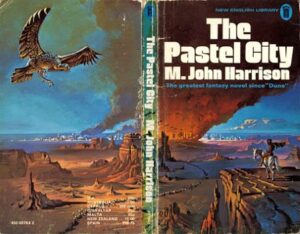
In the decades since, I’ve read his 1971 ‘dying earth’ fantasy novel The Pastel City, the first book in his Viriconium sequence, which caught my eye on a second-hand bookshop shelf because of its gorgeous cover by the artist Bruce Pennington; and his 2006 novel Light, a space opera (of sorts) that’s the first volume in his Kefahuchi Tract trilogy; and his 2017 collection of short fiction, You Should Come With Me Now.  I’m glad I read that last book because the strange stories in it helped prepare me for The End of Everything.


The End of Everything is set in a near-future Britain where an alien invasion is in progress. The invaders are called the iGhetti and they seem to manifest themselves as ‘tall writhing bursts of light’.  Quite how and why they arrived on earth is a mystery: “Competing authorities associated the iGhetti with dark matter or the banking crisis of the late 2000s, while others believed it to be less an invasion than a ‘re-enchantment of the world’, a process of spiritual tourism and gentrification pursued by advanced civilisations from a mooted ninth planet.  More popularly, they were seen as having ‘come out of the internet’: indeed, this was the favoured theory of the internet itself…”


In Britain, the iGhetti seem concentrated around the City of London, against which the authorities – what’s left of them – stage constant military assaults.  Meanwhile, their presence is apparently the cause of hallucinogenic episodes, euphemistically called ‘bad patches’, in people’s consciousness.  They’ve also seemingly caused Britain to lose all contact with the rest of Europe, which is referred to as a ‘lost continent’.  That doesn’t deter shiploads of Britons from regularly setting sail into a misty English Channel optimistically thinking there’s still something to find on the other side of it.


Perhaps most alarmingly, the iGhetti appear to have seeded the sea with organisms – ‘artefacts’ – that start off as small blobby things but rapidly evolve, sometimes into human forms with the power of speech.  One of the book’s characters, Philip Tennent, makes a living as a beachcomber in the East Sussex seaside resort of Dalston-on-Sea.  He collects such artefacts when they’re washed ashore and sells them to interested parties.  His customers include a man called Hampson, who uses artefacts in gruesome scientific experiments aimed at making contact with the iGhetti – Hampson is “the beachcomber’s call of last resort, a man no one liked, or liked to deal with.  No one liked what he did with the things they sold him.”


The End of Everything’s plot begins with Philip retrieving an artefact that evolves with unsettling speed and becomes unsettlingly human.  He hooks up with his aunt, Marnie, an artist whose lifelong feistiness and rebelliousness are starting to manifest themselves in extreme ways now that she’s succumbing to dementia.  And the three of them, Philip, Marnie and the artefact, set off on a road trip.  The events that follow unfold through the prism of the weirdness that the iGhetti have unleashed upon the world.


I’ve described the plot in tentative language – ‘seem to’, ‘appear to’, ‘apparently’, ‘seemingly’, ‘perhaps’ – because none of the characters have much clue about what’s going on.  Harrison has stated that he doesn’t like ‘the over-explanation of everything’ in fiction and pointed out that upheaval in real life is frequently under-explained.  It isn’t like in traditional science fiction stories where the Martians invade, humanity reacts, the invasion ends, and everyone immediately knows what’s happened.  Rather, there’s confusion – people not knowing when the disaster or upheaval has started or ended, not knowing it’s happened at all because it hasn’t impacted on them, trying to ‘keep calm and carry on’, being in denial about it, being taken in by conspiracy theories, and so on.  The climate emergency, which is wreaking havoc around us right now, is a good example of that.

 

From wikipedia.org / YouTube.com / © Virtual Futures


The End of Everything’s premise of a catastrophe happening and causing reality to fray around it recalls the works of J.G. Ballard, one of my all-time favourite writers and someone who was an influence on Harrison.  But while Ballard’s fiction often took place in exotic locales, in the forests of Cameroon or on Pacific atolls or in gated communities in southern France, Harrison bases his catastrophe in some very British – very English – settings: in crumbling, fading seaside towns.


You get such details as ‘the concrete paths and slipways of the old sea defences’ or ‘a hot snacks van that operated from a viewpoint car park above the shingle line’ or beaches consisting of ‘pebbles patched with open sand, rimmed with weeds and rubbish, evening primrose, sparse sea buckthorn, the trickle of a sewage overflow, an abandoned ice cream parlour’ or, most memorably, the benches along the seafronts with their memorial plaques, which are almost always dedicated to old men.  At one point Marnie believes she sees “the ghosts of old men drawn out to sea, released from the mysterious dawn-to-dusk confinement of their commemorative benches along the north shore, to rise until they face out towards the lost continent.”


Obviously, those seaside settings imbue The End of Everything with an oh-so-British melancholia and slightly seedy, slightly pathetic nostalgia.  And this makes me feel it’s a more personal and inward-looking book than some critics have made out – critics who’ve seized on the ‘big things’ in the plot and read them as metaphors, like the ‘lost continent’ symbolising Brexit or the artefacts symbolising the recent intrusion of AI into our lives.  (The artefact that Philip and Marnie end up with resembles an LLM because, as it develops, it gobbles up the sensory input and information around it, learns to speak and eventually becomes quite garrulous.)


I’m more inclined to think that the book is about Marnie and her weakening mental faculties.  How much of the confusion sown by the iGhetti is simply the result of her own, accelerating dementia, with past and present, fantasy and reality, becoming increasingly muddled?  The suspicion that we might have blundered into Marnie’s unstable private universe is augmented by the fact she’s an artist and, in his descriptions, Harrison makes repeated references to artists: Canaletto, Giorgio de Chirico, H.R. Giger, Henry Moore, Pablo Picasso.  Marnie would no doubt interpret the world around her in the same way, likening it to the works of painters and sculptors.


Because it’s won the Booker, lots of people will be buying and starting to read The End of Everything just now, which is excellent news for Harrison’s bank account.  I wonder, however, how many of them will actually finish the novel and, if they do, how many will actually like it.  Personally, I didn’t find it an easy read.  But finally – by the end of everything – I thought it was wonderful.

 

From YouTube.com / © BBC

Democracy dies in Donald-grovelling


From wikipedia.org / © The Washington Post


“What would you say to Epstein survivors…?”


“You are so bad.  You are the worst reporter.  No wonder CNN has no ratings.  She’s a young woman.  I don’t think I’ve ever seen you smile.   They should be ashamed of you.”


On February 4th, CNN reporter Kaitlan Collins was cut off in the middle of a question about the victims of Jeffrey Epstein, notorious paedophile, human trafficker and friend to the rich and famous, at a White House press conference.  Cutting her off was President Donald Trump, coincidentally someone who receives, according to the New York Times, 38,000 mentions in the Epstein files so far released by the US Department of Justice.  Evidently, in Trump’s mind, you need to smile when you ask questions about victims of paedophilia and human trafficking.


I find his objection ironic considering that for the last 21 years Trump’s been married to Melania Trump, a woman on whose visage – gimlet-eyed and as smooth, hard and unyielding as an iron bedpan – anything resembling a smile rarely flickers.  Obviously, though, if you were expected to share a marital bed with Trump, your face wouldn’t be projecting sunbeams and rainbows either.


Lately, Melania Trump has been in the news because of the release of a new documentary movie about her.  Entitled Melania, it focuses on her during the run-up to her husband’s second inauguration as president.  Jeff Bezos’s Amazon paid 40 million dollars for the rights to the documentary – 28 million of that reportedly going straight into Ms. Trump’s pocket – and another 35 million to advertise it.


Reviews of Melania have not been, shall we say, overly enthusiastic.  The last time I checked the review aggregate site Rotten Tomatoes, its ‘Tomato-meter’ had it at seven percent.  William Thomas at Empire magazine advised, “Do try not to choke on your popcorn.”  Sean Burns at North Shore Movies observed, “At least Leni Riefenstahl could frame a shot.”  Mark Kermode at Kermode and Mayo’s Take – The Brand New Podcast described it as “the most depressing experience I have ever had in the cinema.”  He added, “I mean, I’ve seen A Serbian Film (2010), I’ve seen Cannibal Holocaust (1980), I have never felt this depressed…  I thought it was absolutely repugnant.”


By the way, the director of Melania is Brett Ratner, who in 2017 was accused of sexual assault and harassment by six women, accusations he’s denied.  In photos recently released from the Epstein files, he appears sitting on a sofa beside the late, loathsome paedophile, both of them cuddling young women.  The women’s faces are blocked to protect their identities, so you can’t tell how young they are.


I should also say that Melania made seven million dollars on its opening weekend, a decent haul for a documentary.  Obviously, it appeals to a certain audience in the USA, i.e., cultish MAGA dingbats so worshipful of her husband they’d spend a fortune on eBay to acquire pieces of his used toilet paper, which they’d then frame and hang prominently in their living rooms.  However, it still looks like it’ll be a long time before Amazon recoups anything like the 75 million dollars it invested in the movie.


From wikipedia.org / © White House


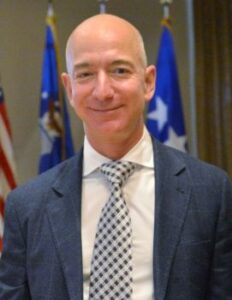
In totally unconnected developments during Trump’s first year as 47th president, the Orange One signed an executive order relaxing environmental rules about space launches (benefiting Bezos’s private space venture Blue Origin); signed an order preventing US states from enforcing their own AI regulations (benefiting Bezos’s AI start-up Project Prometheus); and generally created a oligarch-friendly climate that’s allowed Bezos and fellow magnificoes Elon Musk and Mark Zuckerberg to increase their collective wealth by approximately 250 billion dollars.


But I don’t know why Bezos would take a financial hit by getting involved in Melania, a vanity project that nobody apart from those hardcore MAGA nutters would pay money to see.  I really don’t know.


In other, totally unconnected news last week, the Washington Post, a once-respected newspaper whose motto is ‘Democracy dies in darkness’, and which broke the story about the Watergate scandal that brought down Richard Nixon’s presidency in 1974, has announced a ‘strategic reset’.  This reset involves showing a third of its current workforce the door.  It’s also “ending the current iteration of its popular sports desk… restructuring its local coverage, reducing its international reporting operation, cutting its books desk and suspending its flagship daily news podcast Post Reports.”  The loss of the Washington Post’s books desk means it’ll no longer publish its literary review supplement Book World.


The Washington Post has been on a downward spiral this past year, a spiral of its – or its proprietor’s – own making.  Previously, and unsurprisingly, it’d not been enamoured with Trump.  As 2024’s presidential race neared election day, however, and with Trump looking likely to regain the White House and launch his glorious new thousand-year Reich, the Washington Post’s editorial board was ordered not to publish an editorial endorsing Kamala Harris, Trump’s rival for the presidency.  As a result, more than 200,000 disgusted readers – eight percent of its 2.5 million-strong readership – cancelled their digital subscriptions to the newspaper.


After the announcement of the Washington Post‘s downsizing, its legendary Watergate  reporter Bob Woodward lamented, “I am crushed that so many of my beloved colleagues have lost their jobs and our readers have been given less news and sound analysis.  They deserve more.”  Meanwhile, Trump’s Communications Director Steve Cheung crowed on Twitter, “Just a reminder that printing fake news is not a profitable business model.”


Earlier, the Washington Post’s proprietor had defended his decision to have the newspaper sit on the fence before the 2024 election, which’d started the rot.  He wrote: “Presidential endorsements do nothing to tip the scales of an election…  What presidential endorsements actually do is create a perception of bias.  A perception of non-independence.  Ending them is a principled decision, and it’s the right one.”  Aye, right.  That’s the principled thing to do.  When there’s a choice between a candidate who’s a convicted criminal and convicted sexual abuser and a candidate who isn’t, you say nothing.  Heaven forbid anyone perceives you as being biased and non-independent.


From wikipedia.org / © Van Ha, US Space Force


And who’s the proprietor of the Washington Post?  Oh look, it’s Jeff Bezos.  Funny that he should take a hit by alienating his newspaper’s natural readership and sending it down the toilet, just as he took a hit by shelling out 75 million dollars for a dud like the Melania movie.  It’s almost like he has an ulterior motive.  Almost like he’s trying to… curry favour with someone.


But seriously.  A while ago, I posted about “an unholy alliance of authoritarians, kleptocrats, fascists, media tycoons, tech bros and oil barons”, working hard “at stripping freedoms from those of us living in societies that,  until now, have retained some freedoms; at transferring another huge chunk of wealth from our dwindling coffers to their swelling coffers; and at burning and poisoning the planet we live on in their quest for profits whilst aggressively pushing the line that any science questioning this policy is a ‘hoax’.”  You see that here.  Bezos grovelling to Trump by financing his missus’s dreadful movie and nuking the Washington Post.  As a reward, Trump throwing him a few legislative and financial scraps from the White House table so he can carry on making pots of money for himself.


And with Bezos and his ilk embracing automation and Artificial Intelligence to maximise profits by eliminating human employees, and salaries, the future looks grim.  Journalists will soon go the way of lamplighters, elevator operators, switchboard operators and video store clerks.  News copy will be written by AI technology, controlled by billionaires, who’ll make sure that copy panders to their interests and those of their political allies.  And if there’s bad news they can’t avoid reporting, it’ll be blamed on those people not plugged into their extreme-right-wing, white-Christian-nationalist gestalt: blacks, Latinos, Muslims, Jews, atheists, gays, trans-people, liberals, socialists, trade unionists.


Education will be similar.  Teachers will disappear too and kids will be taught by AI, with the likes of Elon Musk deciding what’s in the curriculum.  Indeed, Musk has done a deal with El Salvador’s government to “bring his artificial intelligence company’s chatbot, Grok, to more than 1 million students across the country… to ‘deploy’ the chatbot to more than 5,000 public schools in an ‘AI-powered education program’.”  Yes, that’s Grok, the lovable chatbot that praises Hitler and puts tweens in tiny bikinis for the gratification of paedophiles, coming to a school near you to teach your kids.


The stinking rich and stinking powerful won’t only hoard wealth – they’ll hoard information too, whilst making sure only small, approved increments of it leak down to the masses they regard as their serfs and inferiors.  Especially manipulated will be scientific information about the climate catastrophe posing an increasing threat to our civilisation’s survival on this planet.  So that their environmentally-ruinous cash-generating projects, like power-guzzling and water-guzzling AI data centres, escape censure, they’ll suppress this information or bury it under an avalanche of counter-arguing pseudoscientific gibberish, or not collect it in the first place.


But let’s end positively.  While it’s sickening to watch America’s business magnates, corporations, media organisations, law firms and universities bend over supinely and lick Trump’s gruesome arse, the way ordinary Americans have reacted to his policies gives glimmers of hope.


© MS NOW


I’m thinking especially of Minneapolis.  Since December, the city has been overrun and brutalised by up to 3000 of Trump’s masked, violent, badly-trained thugs from Immigration and Customs (ICE) and Customs and Border Patrol.  Ostensibly, they came to crack down on fraud allegedly committed by Minneapolis’s Somali-American community.  In reality, as Wikipedia reports, they’ve assaulted, harassed and detained people  “on the basis of their alleged or suspected immigration status”, including “restaurant, airport and hotel workers, Target employees, children and families, Native Americans, students and commuters”, many of whom “have been US citizens, legal residents with work authorisation, or asylum seekers.”


This has disastrously impacted on the city’s businesses, schools and whole social fabric.  ICE was accused of violating at least 96 court orders during four weeks in January alone; and they’ve executed two citizens during peaceful protests, Renee Good on January 7th and Alex Pretti on January 24th.


Obviously, the operation was designed to intimidate Minneapolis – whose state governor is Tim Walz, Kamala’s running mate against Trump in 2024 – and intimidate liberal-leaning cities generally.  But local people are having none of it.  They’ve protested peacefully, organized strikes, alerted neigbours about approaching ICE patrols, monitored and filmed their activities, and provided support for people at risk from those activities by helping them get to their schools and places of worship unmolested, running errands for them and raising money for them.  They’ve stood by their fellow citizens in a display of decent, old-fashioned community values – values Trump would despise if his reptile brain could ever understand them in the first place.


One thing that particularly impressed and moved me was a viral clip showing a white-bearded old man protesting against ICE on a snowbound and teargas-fogged Minneapolis street on January 24th.  When a reporter and camera crew approached him, he raged, “I’m just angry.  I’m 70 years old and I’m f**king angry.”  Then, wearing neither mask nor goggles, he strode off through a billowing wall of teargas.


That furious but defiant old-timer, it transpired, was Greg Ketter, founder and proprietor of the Minneapolis independent bookstore DreamHaven Books and Comics.  The renowned sci-fi and fantasy writer Harlan Ellison once described DreamHaven as “a book-seeker’s cave of miracles”.


I find it inspiring to see a man who’s devoted a lifetime to books taking a stand against Trump, someone who brags about not reading as if it’s a badge of honour.  And by extension, against Trump’s billionaire toadies, currently trying to create an AI dystopia wherein novels and other human art-forms are replaced by soulless, AI-generated slop.  And against Trump’s toady at Amazon, Jeff Bezos, who’s just axed the Washington Post’s Book World, one of the very few literary supplements the American newspaper industry had left.


From wikipedia.org / © DreamHaven Books & Comics