30 years on, it’s still the worst toilet in Scotland


© Channel Four Films / PolyGram Filmed Entertainment


Just over a year ago, I posted on this blog about the sad closure of The Projector, Singapore’s alternative cinema.  According to a statement on the cinema’s Facebook page, this was caused by “rising operational costs, shifting audience habits, and the global decline in cinema attendance,” factors that had “made sustaining an independent model in Singapore especially challenging.”  The Projector was the one venue in the city-state where you could see, on a big screen, independent and arthouse films, ones that were generally offbeat, ones focused on minorities and not necessarily made in the handful of big international languages.  It also offered opportunities to watch older movies in a cinema, for example, ones by Alfred Hitchcock, Akira Kurosawa and David Lynch.  Though sometimes it showed modern Hollywood and Chinese blockbusters too.


The Projector operated at two locations, the Cineleisure shopping mall on Grange Road and the Golden Mile Tower on Beach Road.  Happily, this year, a new cinema called The Filmhouse has started doing business in The Projector’s Golden Mile Tower premises and has a similar agenda of showing films you wouldn’t otherwise see in Singaporean cinemas.  According to Wikipedia, The Filmhouse retains “certain key team members and features” from The Projector.


Last week, I made my first visit to The Filmhouse and was pleased to find it busy.  It’s a smaller operation than The Projector with, as far as I can ascertain, just two screens, but probably that makes more financial sense – a non-mainstream cinema can’t afford to have many overheads.  The lobby contained a bar, comfortable seats and, most importantly, a relaxed and friendly ambience.



When I went into one of the halls and found my seat, I was slightly disappointed that, before the movie started, the short film warning patrons to keep their phones silent and refrain from using them during the show wasn’t the famous one used by The Projector.  That had footage from the super-schlocky Turkish science-fiction movie Dünyayı Kurtaran Adam, better known as Turkish Star Wars, and featured ‘Turkish Luke Skywalker’ training for battle by smashing his big fists repeatedly against a desert boulder.  You were warned that if you violated the cinema’s policy on phone-use, you would suffer punishment similar to that being inflicted on the rock.


Still, The Filmhouse’s anti-phone film is cute enough.  It has a brief clip of the late David Lynch telling us, “You have a very good heart.’  Then we’re asked to prove Lynch right about our hearts by turning off or muting our devices and not spoiling anyone else’s enjoyment of the movie with them.


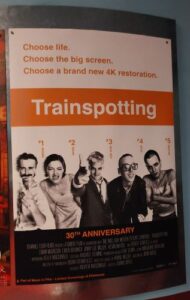
Anyway, what was the film I went to see?  It was a 30th-anniversary showing of Danny Boyle’s Trainspotting (1996), freshly spruced up for cinematic re-release.  As the movie poster’s tagline announced: “Choose life.  Choose the big screen.  Choose a brand new 4K restoration.”


At the time of its release, Trainspotting caught the zeitgeist of mid-1990s Britain, obsessed with Britpop and all things Cool Britannia.  Yes, how long ago that all seems now.  To be honest, it annoyed me in some ways that the movie got lumped in with the Britpop / Cool Britannia thing, even if the filmmakers opportunistically loaded its soundtrack with music of the time, by bands such as Pulp, Blur, Sleeper, Elastica, Leftfield and Underworld.  That said, the two songs that defined the film, Iggy Pop’s Lust for Life from 1977 and Lou Reed’s Perfect Day from 1972, had nothing to do with 1990s Britain.


To me Trainspotting sprang from an earlier, darker and less glamorous era than the one of Damien Hirst’s formaldehyde shark, Geri Halliwell’s Union Jack mini-skirt and Blur-versus-Oasis – namely, the mid-to-late 1980s, when Edinburgh’s boom in heroin use and the subsequent, resultant HIV / AIDS epidemic led to the city being dubbed ‘the AIDS capital of Europe’.


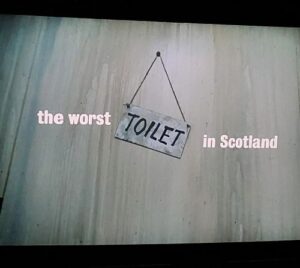
This became material for the book that inspired the film, Irvine Welsh’s novel Trainspotting (1993), which is an altogether bleaker and rougher-edged piece of work than Boyle’s cinematic version.  Though of course the film isn’t without its bleak or rough-edged moments either.  The worst toilet in Scotland, anyone?
 

© Channel Four Films / PolyGram Filmed Entertainment


Still, I’m not complaining too much.  I think both Trainspotting the book and Trainspotting the movie are great and are classics in their respective fields, 1990s Scottish literature and 1990s British cinema.  But after 30 years, how would the latter work hold up?


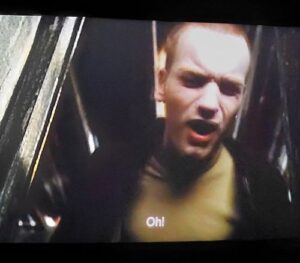
Pretty well, I thought, though the animatronic zombie-baby that Renton (Ewan McGregor) imagines crawling across the ceiling during a traumatic ‘cold turkey’ episode looks terrible now.  Mind you, it looked ropey enough in 1996.


I wondered how, in these days of extreme anxiety about sex predators preying on children, the gag about Renton meeting Diane (Kelly Macdonald) in a nightclub, going home with her and discovering the next day that she’s still at school would come across.  Not as ickily as I feared.  Diane is clearly the one doing the manipulating and Renton is properly horrified when he learns how old she is really.  Plus, McDonald’s true age at the time, 20, means the sequence’s punchline, when Diane appears in her school uniform, is cringily funny but – thankfully – a bit unbelievable.


Meanwhile, I winced at the scene following the death of Tommy (Kevin McKidd), where a grieving Spud (Ewan Bremner) pays tribute to his late friend by singing Two Little Boys – a song popularised by, and forever associated with, the Australian entertainer, TV personality and artist Rolf Harris, who had a smash-hit with it in 1969.  In 2014, Harris hit the headlines when he was found guilty of sexually assaulting four underage girls.  But to be fair to Two Little Boys, it was around long before Harris got his hands on it.  It was written in 1903 by composer Theodore F. Morse and lyricist Edward Madden.


The Singaporean audience I saw Trainspotting with certainly enjoyed it, even though I wondered how a film about heroin addicts would go down in a country with some of the strictest anti-drugs laws in the world.  If Trainspotting had taken place in Singapore, the drug dealing characters in it like ‘Mother Superior’ (Peter Mullan) and Mikey Forrester (Welsh in a cameo) would have been executed long ago.  Much of it they found funny, which is appropriate because the film is essentially a (very black) comedy.  The Worst Toilet in Scotland sequence and the one where the hapless Spud spectacularly soils the bedsheets in the house of this girlfriend Gail’s (Shirley Henderson) parents, then manages to scatter the contents of those bedsheets across Gail, her parents and their kitchen, elicited guffaws.
 

© Channel Four Films / PolyGram Filmed Entertainment


Also getting laughs was Renton’s famous ‘It’s shite being Scottish’ rant.  He may have hit a chord with the audience when he raged, “Some hate the English.  I don’t.  They’re just wankers.  We, on the other hand, are colonised by wankers!”  The Singaporeans, of course, were once colonised by the English too – though, technically, as part of the British Empire, they were colonised by the Scots and Welsh as well.


On the other hand, I must have been the only person in the cinema-hall chuckling during the references to and jokes about Sean Connery.  (“Do you shee the beasht?  Have you got it in your shights?”  “Clear enough, Missh Moneypenny!  This should preshent no shignificant problemsh”)  Most folk there were about half my age and I guess ‘Big Sean’ is unknown to the younger generation.


One thing I felt about seeing Trainspotting 30 years on was that now the Britpop musical soundtrack sounds quaint rather than cutting edge, and now that I know the punchlines to all the jokes about jobbies, Sean Connery and so on, its depiction of heroin addiction is more on-the-nose.  Without the film’s cultural baggage distracting me, I better perceived the horribleness of the characters’ situations.  Like when baby Dawn – whose zombie-fied form Renton will hallucinate about later – dies from neglect and her parents, Sick-Boy and Allison (Susan Vidler), after a moment’s anguish, greedily reach for the syringes, needles and smack again.  Or when Tommy – who was originally the healthiest and most level-headed of the gang – becomes ruinously addicted and, while he lies ravaged on a mattress, a conscience-stricken Renton tries to apologise for getting him hooked on the stuff.  Tommy pays the apology no heed and is interested only in getting money for his next fix.


Another thing I noticed in 2026 about Trainspotting is that, for a film supposed to be the greatest one ever set in Edinburgh, you see very little of Edinburgh in it.  You have the famous opening scene where Renton, Spud and Sick-Boy try to shoplift in (the now long-gone) John Menzies bookstore on Princes Street and are chased along the thoroughfare by security, with Renton making a last, doomed break for freedom down Calton Road and under Waterloo Place.  But that’s all.  The streets, side-streets, bunker-like nightclubs, pub-interiors and blighted junkies’ dens could be anywhere.  Though that’s hardly surprising considering it was partly funded by the Glasgow Film Fund and most of it was shot in Glasgow.


Compare that with the sequel, T2: Trainspotting (2017), which was partly based on Irvine Welsh’s literary follow-up Porno (2003), also used some bits from the novel Trainspotting that didn’t get into the first film, and also featured stuff from scriptwriter John Hodge’s own imagination – like the psychotic Frank Begbie (Robert Carlyle) staging an escape from Saughton Prison.  In T2, you get to see the Royal Mile, the Grassmarket, Cockburn Street, Harvey Nichols, the Scottish Parliament, the tram system, the Forth Road Bridge and Salisbury Crags.  It’s practically a love-letter to the Scottish capital.


Still, a few months ago, I was in Edinburgh and found myself walking down Calton Road.  And my immediate reation was, “Hey, this is where Ewan McGregor ran and got caught in Trainspotting!”  So one little piece of the city, at least, was immortalised by the original film.
 

Now expose it to garlic, holy water and sunlight


From wikipedia.org / © Eva Rinaldi


A while ago on this blog, I conducted the following thought-experiment.  Imagine that current trends result in the world becoming a globally-warmed, war-ravaged hellhole inhabited by only a few surviving remnants of humanity.  But those remnants somehow manage to lay their hands on a time machine and realise they can send an assassin back in time, in the manner of the James Cameron / Arnold Schwarzenegger movie The Terminator (1984).  Who would they have their assassin target in, say, the late 20th century to change the course of history and prevent the world from turning into crap?


As I mused at the time, “The young Donald Trump?  The young Vladimir Putin…?  Neither.  I suspect those guys would be considered small beer compared to the one the time-travelling assassin from the future would really go after…  Rupert Murdoch.”


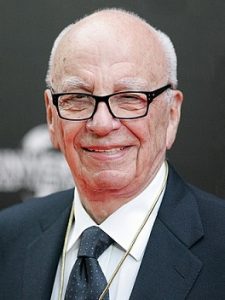
Wizened 92-year-old media mogul Murdoch was recently in the news because he announced his decision to step down as head of News Corp and the Fox Corporation in favour of his son Lachlan.  Murdoch certainly looks his age, but it sometimes felt like he was going to live forever and keep running his media empire forever.  Regular nocturnal blood-meals sucked from the throats of helpless victims are evidently good for the constitution.  That said, lately, the old monster had begun to look a little vulnerable, both in his business dealings and in his personal life.


April this year saw his Fox News network fork out nearly 790 million dollars to settle a lawsuit brought against it by the voting-equipment company Dominion.  This was after the network told outrageous porkies about the company switching votes in the 2020 US presidential election so that Donald Trump wouldn’t win it.  Among the guff peddled by Fox was the claim that the company was owned by Venezuelans and had experience of swinging elections for the late Hugo Chavez.


Meanwhile, though old Rupe had once wooed the ladies with confident charm, like an extremely shrivelled George Clooney, he’s also looked less sure-footed on the romantic front recently.  In 2022, he ended his fourth marriage, to Jerry Hall, by unchivalrously sending her an email to inform her that she’d been dumped.  Hall was unsurprisingly miffed, as during the Covid-19 pandemic she’d gone out of her way to ensure her aged husband stayed isolated and avoided getting the virus, which for someone of his years would probably have been a death sentence.  Earlier this year, he announced his engagement to former radio host Ann Lesley Smith, but this lasted just two weeks.  That’s even shorter than a Liz Truss premiership.  Apparently, Murdoch started to panic at Smith’s loopy evangelical-Christian pronouncements, which included the assertion that Tucker Carlson was ‘a messenger from God.’


But you can’t keep an old horn-dog down.  Rupe is currently engaged again, this time to Elena Zhukova, who was once married to the Russian billionaire – don’t mention the ‘O’ word – Alexander Zhukova.  At this rate, Murdoch will have got himself betrothed 16 more times before he reaches treble-figures.


© Prana Film / Film Arts Guild


Now that Murdoch has stepped back from the media-controlling activities that have kept him busy for the past 71 years, ever since the age of 21 when he inherited an Adelaide newspaper, the News, from his dad, what legacy does he leave?  If he had a shred of conscience, morality and decency – which of course he doesn’t have, which makes this an academic statement – he’d surely howl in despair and incarcerate himself in a Trappist monastery for the rest of his days to do penance for his multiple sins.  Or just top himself.  Murdoch’s media operations have, over decades, caused massive harm to the well-being of humanity.


He pushed the rapacious neoliberal agenda of Margaret Thatcher and Ronald Reagan in the 1980s, with its credo that greed is good, the market should be worshipped and the financial safety nets and infrastructure that held societies together, and looked after their most vulnerable members, weren’t worth bothering about.  Thatcher said it all when she declared in 1987, “There is no such thing as society.”  His outlets have gone to great lengths to ignore and discredit the overwhelming scientific evidence that manmade climate change is happening and poses a terrifying threat to our civilisation’s future.  In Australia, a country that’s already baking and burning as the climate catastrophe unfolds, Murdoch newspapers like the Australian and Sydney’s Daily Telegraph cheer-led right-wing moon-howler Tony Abbott into power in 2013 – Abbott once dismissed climate change as ‘absolute crap’.  And in the USA, Murdoch has used Fox News to build up a vast, paranoid, delusional, far-right-wing ecosystem whereby millions of gullible people now accept the lies of Donald Trump as gospel truth.  Fox could very well see to it that Trump wins the presidency again in 2024.  At which point, the world’s biggest superpower will make the transition into authoritarianism.


Murdoch is truly the man with the reverse-Midas touch.  Everything he sticks his finger in turns into manure.  Yet this never seems to stop him generating huge amounts of money, so he’s happy.  No wonder his son James, that rare thing indeed, a Murdoch with a conscience, quit the board of News Corp in 2020, sickened by the horrors his old man had empowered.


In the UK, Murdoch has long exerted his toxic influence through the swathe of national newspapers he owns: the Times, Sunday Times, Financial Times, Sun and Sun on Sunday.  His reign of terror began when he acquired the Sun in 1969.  The history of that particular tabloid since then, when it hasn’t devoted itself to gleeful, lowest-common-denominator stupidity with headlines like ‘WEREWOLF SEIZED IN SOUTHEND’ and ‘FREDDIE STARR ATE MY HAMSTER’, has been an unrelenting saga of horribleness.


In the 1980s, when the Sun was under the stewardship of the repugnant Kelvin MacKenzie, it revelled in homophobia and gloated over the AIDS epidemic, which it dubbed the ‘gay plague’ and insinuated straight people had nothing to worry about.  It catered for the ‘dirty mac’ brigade with its ‘page three’ girls, at least one of whom, Samantha Fox, was only 16 when it displayed her topless.  And it lied through its teeth about the behaviour of Liverpool football fans at the 1988 Hillsborough Disaster, to cover up the failings of the police that day.  That led an embargo of the Sun in Merseyside, which is still in force now.  If only the British population generally treated the rag with the same contempt that the Scousers do.  (I also admired the attitude of the late playwright Dennis Potter, whom the Sun dubbed ‘Old Flaky’ on account of his crippling psoriasis.  When he was diagnosed with pancreatic cancer, he named his cancer ‘Rupert’.)


More recently, the Sun provided a platform for Katie Hopkins, someone even more repellent than MacKenzie, who likened migrants to ‘cockroaches’ and advocated the use of gunboats to stop them.  And its incessant abuse of the European Union, European countries and European people (‘frogs’ and ‘krauts’ to a man and woman) climaxed with the newspaper’s enthusiastic support for Brexit – ‘BELEAVE IN BRITAIN’, its front page declared on the day of the referendum in 2016.  It was no surprise that Murdoch welcomed Brexit, regardless of the economic, diplomatic and reputational damage it inflicted on the UK.  He famously commented that while he could impose his will on one country’s leader, at No 10 Downing Street, he wasn’t powerful enough to do that with the combined force of 28 countries’ leaders, in Brussels.


From dailysabah.com / © Sun


Meanwhile, during the noughties, the Sun’s sister paper, the News of the World, under the editorship of flame-haired gorgon Rebakah Brooks, was so determinedly on the sniff for a good story that it hacked into the phones of, among others, murdered schoolgirl Milly Dowler, dead British soldiers and victims of the 2005 London bombings.  This proved too much for even its ghoulish proprietor and he axed the News of the World in 2011.  Mind you, he soon replaced it with the Sun on Sunday, so not much changed.


With the Sun leading the way, Britain’s other, supposedly more ‘respectable’ right-wing newspapers – the Daily Telegraph, Daily Mail and Daily Express – happily dived into the same midden of lies, slander and xenophobia, with the result that over the past half-century the popular press in Britain has done much to cheapen public discourse, making it shrill, prurient, mean-spirited and pig-ignorant.  Murdoch can also take credit for inspiring the birth, or spawning, of alleged news channel GB News in 2021, which clearly wanted to become the British equivalent of his ghastly Fox News.  The conspiracy theories it peddled about the Covid-19 pandemic and Covid-19 vaccines, often voiced by that havering bawbag Neil Oliver, mirror the work Fox News did in the USA to make people resistant to vaccinating themselves against the virus.  The fact that Murdoch was one of the first people on the planet to get the vaccine, yet he happily let his media outlets promote scepticism of it among their audience – who tended to be older and more at risk from Covid-19 – shows his ethics are non-existent.


Sadly, in Britain, non-Conservative politicians are so frightened of Murdoch’s newspapers that they feel obliged to cosy up to him.  In the late 1990s, Labour Party leader Tony Blair got so thick with Murdoch that he became godfather to one of Murdoch’s kids.  In return, the Sun displayed the front-page headline ‘THE SUN BACKS BLAIR’ prior to the 1997 general election that saw him win power.  Murdoch’s newspapers subsequently supported Blair during his participation in the 2003 invasion of Iraq, an operation founded on lies and resulting in disaster.  I have no doubt that Keir Starmer, the current Labour Party leader, and basically Tony-Blair-lite, will prostate himself before Murdoch in a similar, craven manner.


Though the Nosferatu-esque Murdoch is no longer at the helm of the media empire he’s built, he’s made it clear that he still intends to exert influence from the sidelines.  And his son Lachlan is such a piece of work it sounds like that empire will conduct its business with even more malevolence in the future.  The fact that Lachlan has just appointed Tony ‘climate-change-is-crap’ Abbott to the Fox board doesn’t bode well.


When Murdoch informed his employees of his decision to step down, he told them to “make the most of this great opportunity to improve the world we live in.”  Really, Rupe?  Improve?  You did nothing to improve the world.  Rather, your shitty news outlets helped turn it into a sewer.


© Prana Film / Film Arts Guild

Still ruled by the Queen


© EMI / Elektra Records


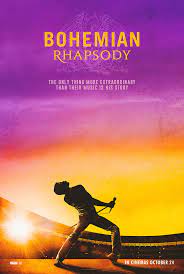
Back in 2018, I found myself in a Colombo pub one evening having a blether with Suresh De Silva, the vocalist and co-founder of the Sri Lankan heavy metal band Stigmata.  Within seconds of the start of our conversation De Silva had asked me if I’d seen Bohemian Rhapsody, the movie biopic of the 1970s / 1980s rock band Queen, which’d been released in Colombo cinemas a few weeks earlier.  The unexpectedness of the question threw me a little.  It also reminded me of the hugeness of the phenomenon that is Queen.


It’s a phenomenon that transcends place.  National boundaries seem not to matter when it comes to liking Queen.  Meeting a Sri Lankan heavy metaller in 2018 who wanted to talk about the band wasn’t my first experience of this.  I remember working long ago at a language school in the UK that had weekend discos for its kids.  At one point there were a lot of self-consciously trendy and streetwise teenagers from Milan at the school and the DJ who oversaw that weekend’s disco thought he’d please his audience by playing then-modish big beat, drums and bass, UK garage and hard trance tunes.  But he ended up nearly causing a riot.  What did those trendy Italian teens want him to play? I Want to Break Free by Queen.  All bloody evening.


Their popularity also transcends time.  They remain fabulously popular today even though they’ve been creatively inert since 1991, when their singer Freddie Mercury passed away from AIDS.


I find this interesting because back in the days when they were a properly functioning band, friends of mine who considered themselves serious and knowledgeable connoisseurs of music would tell me that though they tried to be broad-minded, they just couldn’t stomach bloody Queen, whom they saw as purveyors of bloated, corny, stomp-along, guitar-twiddling shite.  Meanwhile, other folk, who bought at most three CDs a year and barely knew the difference between Elvis Costello, Elvis Presley and Reg Presley – the majority of the British population in other words – believed Queen were the absolute bees’ knees.


Incidentally, it seemed ironic to me how popular Queen were in the 1970s and 1980s among guys who were unreconstructed, macho and laddish and who, in all likelihood, were pretty homophobic too.  They were liable to punch you in the face if you suggested they were into anything that might be classified as ‘gay’ culture.  But after a few moments of hearing the unashamedly camp Freddie Mercury crooning, “Oooh, you make me live… / Oooh, you’re my best friend!”, they’d be hugging each other, shedding sentimental tears and singing along in emotion-cracked voices.


© 20th Century Fox / Regency Enterprises / GK Films


I wasn’t greatly impressed by Bohemian Rhapsody when I caught up with it, sometime after speaking to Suresh De Silva.  It takes many liberties with the truth.  For example, the band weren’t on the wane before their barnstorming appearance at the 1985 Live Aid concert at Wembley Stadium, which the film claims pulled them back from the brink.  On the contrary, during the previous year and following the release of their 1984 album The Works, I remember them being as popular and prominent as ever.  And there was no big emotional moment before they took the Wembley stage when Freddie told his bandmates he was HIV positive.  In reality, he didn’t know this until 1987.


Meanwhile the film airbrushes away the band’s real-life moral warts and carbuncles. We get nothing about, for instance, their misguided and money-fuelled decision to play at the Sun City Super Bowl in Bophuthatswana, South Africa, at the height of the apartheid era.  This act of unprincipled greed earned them a ban by the British Musicians’ Union.  Also doused in a tankerload of whitewash is the issue of Freddie’s promiscuity.  In 1984, the real Freddie bragged to the DJ Paul Gambaccini with hedonistic and, considering the times, reckless abandon: “Darling, my attitude is ‘f**k it’.  I’m doing everything with everybody.”  But in Bohemian Rhapsody he’s presented as a victim, insecure about his sexuality and led astray by his personal manager Paul Prenter, who introduces him to a world of partying, orgy-ing and general dissolution.


Still, the sequence in the film with Mike Myers as a (fictional) record executive called Ray Foster, who’s aghast at the idea that Bohemian Rhapsody-the-song should be released as a single, is funny.  “It goes on forever.  Six bloody minutes!”  To which Freddie retorts: “I pity your wife if you think six minutes is forever.”


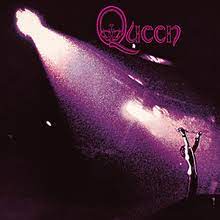
Personally, I thought 1970s Queen were great.  They produced albums like Sheer Heart Attack (1974), A Night at the Opera (1975), A Day at the Races (1976) and News of the World (1977) that were studded with classic songs and, though they sometimes felt all over the place stylistically, were admirable for trying to explore a wide range of musical genres, everything from music-hall singalongs and salsa-y Spanish guitar workouts to blues and jazz and even, with 1974’s Stone Cold Crazy, nascent speed metal.  The rip-roaring Death on Two Legs, which kicks off A Night at the Opera, is one of my favourite songs ever.


But for me they seemed to lose their creative mojo at the beginning of the 1980s.  The last song by them that I liked was probably their 1981 duet with David Bowie, Under Pressure.  Actually, I didn’t think much of Under Pressure at the time, but it’s grown on me since then.  It’s certainly a zillion times better than Vanilla Ice’s dire 1990 single Ice Ice Baby, which appropriated Under Pressure’s memorably nagging bassline.  (I remember being at a Saturday-night disco in my hometown in Scotland – the clubhouse of Peebles Rugby Club to be precise – when the DJ put on Ice Ice Baby.  The bassline started and everyone cheered and hurried onto the dance floor, thinking it was Queen and David Bowie.  Then the lyrics started: “Yo!  Let’s kick it!  Ice, ice baby…”  Everyone threw up their hands in horror and shouted, “Och, shite!  It’s Vanilla Ice!”  The dance floor immediately cleared again.)


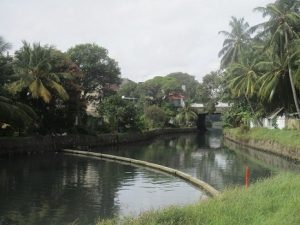
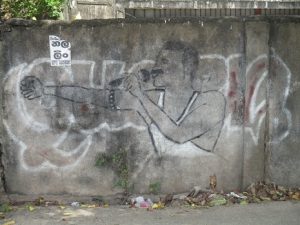
Anyway, a few days ago, taking advantage of the fact that Sri Lanka’s most recent Covid-19 lockdown has been lifted, I went for a walk and ended up at the area where Colombo’s Dehiwala Canal meets with the Indian Ocean. It’s a pleasantly grassy and leafy neighbourhood although, thanks to the condition of the water in the canal, it’s a bit smelly too.  And lo and behold, on a wall standing at the canal’s southern bank, I saw further evidence of the global love for Queen.


Yes, it was a mural of Freddie Mercury in his moustached, short-haired, white-vested Live Aid incarnation, which presumably someone had painted after seeing Bohemian Rhapsody in 2018.


As I’ve suggested in this post, I have mixed feelings about Queen overall.  But the fact that in the 21st century a Sri Lankan graffiti artist was inspired to paint their iconic vocalist and master showman on an out-of-the-way, canal-side wall makes me feel strangely happy.