10 scary pictures for Halloween 2026


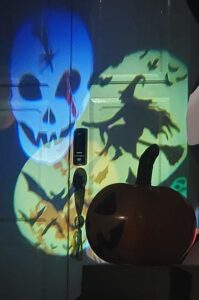
For the past month, in keeping with it being the season of Halloween, I’ve been putting spooky and horror-related entries on this blog.  Well, today is October 31st, 2026 – Halloween itself.  As is my custom, I will celebrate the occasion with a post where I talk about ten pieces of creepy or scary artwork that have caught my eye since Halloween last year.  Incidentally, the photographs above are of the façade, at the moment, of a house in the Singaporean street where I live.  The folk there seem to really love Halloween.


First, to get you in the mood, here’s a vintage American Halloween card featuring some impish-looking demons and some pumpkin lanterns that disconcertingly possess real eyes and mouths.  According to the Public Domain Review, “Halloween and picture postcards have a shared history, and both captured the anglophone imagination at the turn of the twentieth century.  As the October 31st festival began to emerge in its modern guise thanks, in part, to an influx of immigrants from the British Isles in the United States, picture postcards entered their so-called ‘golden era’, ca. 1905–1915.  Rarely seen or used in the US before 1893, an estimated 900 million postcards had been mailed two decades later.”
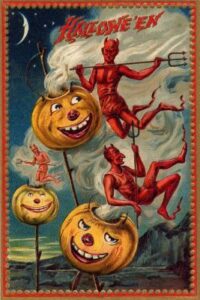
 

From publicdomainpictures.net


If you find the smiles on those pumpkins unsettling, brace yourself for the smile in the picture that’s coming next.  It’s a detail from a leaf of the Hungarian-Anjou Legendary, an illustrated 14th-century, Latin-language manuscript about the lives of 58 saints.  This leaf, which now resides at the Morgan Library and Museum in New York, provides information on St Bartholomew, including information on his grisly fate.  Reportedly, the Armenian prince Astyages flayed him alive.  Because of this, Christian art often depicts Saint Bartholomew as carrying around his own, removed skin – see his appearance in Michelangelo’s The Last Judgement (1536-41) or the very anatomical statue of him by Marco d’Agrate.


But the Hungarian-Anjou Legendary detail is the most gruesome depiction of him I’ve seen.  As I’ve said, it’s the grin on the unfortunate saint’s face that makes it truly disturbing (though it doesn’t help that his freshly sliced-off face is hanging down at the side).  I suppose if you’d just had your face flayed off, you wouldn’t have much choice about grinning either.  By the way, it seems something of a sick joke that Bartholomew ended up as the patron saint of, among other people, tanners.
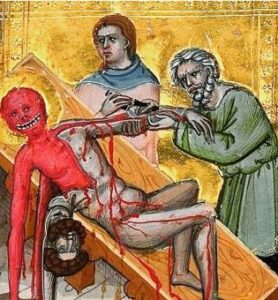
 

From the Morgan Library and Museum


Also religious-themed is the following work from Italian artist (and accomplished freestyle wrestler) Paolo Girardi, who has a lengthy entry in the Encyclopaedia Metallum: The Metal Archives website because of the artwork he’s done for many heavy metal bands – most prolifically for the Colombian thrash-and-black-metal band Inquisition and the awesomely-named Italian black-and-death-metal one Blasphemophagher.  This particularly striking example of Girardi’s talents is one I’ve seen on Pinterest, Reddit and TikTok but I can’t find its name.  As far as I can tell, it doesn’t seem to be artwork for an album cover.  What to make of it?  I interpret it as representing a madman’s dream of the apocalypse, with his head opening spectacularly above his (noticeably Christ-like) face to reveal a bubbling hellscape where there rampages the seven-headed beast from the Book of Revelation.
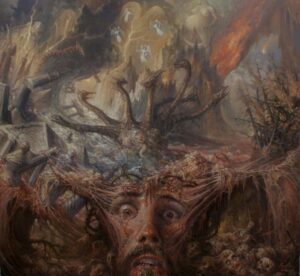
 

From imgur.com / © Paolo Girardi


Girardi’s dragon-like seven-headed beast puts me in mind of King Ghidorah, the dragon-like three-headed kaiju – giant monsters in Japanese cinema that specialise in demolishing cities – who’s regarded as the deadliest foe to have faced Godzilla, the greatest of all kaiju.  Godzilla is having yet another moment, thanks to the recent release of Takashi Yamazaki’s Godzilla Minus Zero (in which, I understand, King Ghidorah also features).  During the course of countless movies since the 1950s, there’s been times when Godzilla has come dangerously close to being cuddly and domesticated – he’s acquired a voice (in 1972’s Godzilla vs. Gigan) and become a dad (in 1967’s Son of Godzilla) and his battles with other kaiju have frequently sunk to the comical level of a Big-Daddy-versus-Giant-Haystacks pro-wrestling bout.  It’s sometimes been easy to forget he was originally meant to be massively dangerous and frightening.


But massively dangerous and frightening is how Godzilla looks in the next picture I’ve chosen.  It comes from a four-issue, comic-book mini-series appropriately called The Horror of Godzilla, which debuted in July this year.  It’s drawn by the excellent Australian artist Tristan Jones, whose previous work has involved other well-known cultural properties such as Alien, Ghostbusters and Teenage Mutant Ninja Turtles.  Perhaps most intriguingly, he’s illustrated a comic-book prequel to the 1997 Sam Neill space-horror movie Event Horizon.
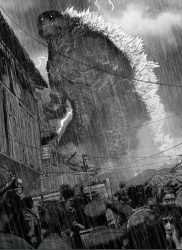
 

© IDW Publishing / Tristan Jones


I’ve just said that Tristan Jones has worked in the universe of the Alien movies.  That brings me to my next pick, which belongs to the first Alien-related artwork I ever saw.  It’s a picture from the 64-page graphic-novel adaptation of the 1979 original Alien film directed by Ridley Scott, Alien: The Illustrated Story, which was drawn by Walt Simonson, written by Archie Goodwin and published in 1979 too.  I never owned it, but I remember spending half-an-hour in a branch of the (now-defunct) Scottish bookshop John Menzies, perusing a copy of it – and grimacing at the book’s violent frames, which had a volcanic level of bloodiness, far more than what was actually shown in the film.  This frame exemplifies Simonson in all his sanguinary enthusiasm.  And yes, it depicts the film’s most notorious scene, wherein the baby alien decides to vacate John Hurt’s chest.
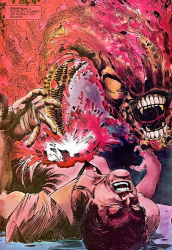
 

© Heavy Metal Communications / Titan Books / Walt SImonson


The Catalonian artist Manuel Perez Clemente, who painted under the name of Sanjulian and who sadly passed away in the middle of this month, did some film-related work too, for example, a cover of the venerable and pioneering horror-movie magazine Famous Monsters of Filmland (1958-83).  However, Sanjulian is probably best-known for his work on the horror comic-strip magazines put out by Warren Publishing (who also published Famous Monsters) – Creepy (1964-83), Eerie (1968-83) and Vampirella (1969-present).  I don’t know where the following item originates – I came across it on the website for DMR Books, in a tribute to Sanjulian they posted following his death.  It’s a cemetery-set monster-mash that showcases the gloriously pulpy style of much of his art.  Incidentally, the skull-faced miscreant lurking at the picture’s bottom looks a lot like Dr Anton Phibes, the character played by Vincent Price in the movies The Abominable Dr Phibes (1971) and Dr Phibes Rises Again (1972).
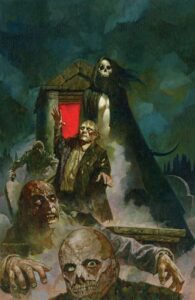
 

From DMR Books


Speaking of Vincent Price, the great horror-movie star appeared in several films in the early-to-mid-1960s that were based on the works of Edgar Allan Poe and directed by Roger Corman.  These included the 1963 movie The Raven, which had a made-up story about dueling magicians (from the pen of Richard Matheson) with the title of Poe’s most famous poem cheekily tagged onto it.  At least during the film Price got to recite the poem in his impeccably mellifluous voice.


Anyway, here’s one of 24 illustrations that the celebrated 19th-century French artist Gustav Dore drew for the poem The Raven shortly before his death in 1883.  It’s inspired by the lines “…I stood there wondering, fearing / Doubting, dreaming dreams no mortal ever dared to dream before…”  Dore’s imagining of the dreams no mortal dared to dream before involves the Angel of Death sitting atop the globe amid the mess of his robes and scythe.  Strictly speaking, the raven hasn’t yet appeared in the poem’s narrative, but you can spy him flying furtively past.
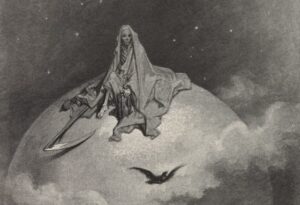
 

From poestories.com


Also in 1963, Roger Corman found time to make X: The Man with the X-Ray Eyes, about a scientist (Ray Milland) who develops eye-drops that can expand the range of human vision, treats his own eyes with them and finds himself able to see deeper and deeper into the fabric of reality.  First, he can see through people’s clothes, which is a bit sleazy.  Then he can see through skin and flesh and identify internal injuries, which is medically useful.  However, by the movie’s end, he’s able to see into the centre of the universe, where he observes ‘an eye that sees us all’, which is definitely freaky.  (The hallucinogenic script was by Ray Russell.)


The following picture by the late Austrian artist Rudolph Sieber-Lonati reminds me of that ‘eye that sees us all’.  It’s an outstanding piece of visual cosmic horror – cosmic horror being a school of macabre writing that emphasizes the puniness and insignificance of human beings whilst suggesting there are vast and terrifying forces in the universe that could destroy us all in a split-second if the notion took them.
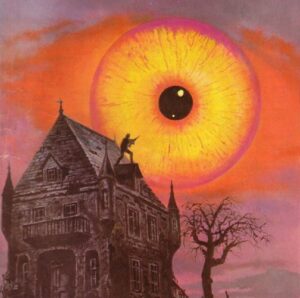
 

From facebook.com/CuthuluCo


From cosmic horror to folk horror, which Wikipedia describes as “a subgenre of horror film and horror fiction that uses elements of folklore to invoke fear and foreboding.  Typical elements include a rural setting, isolation, and themes of superstition, folk religion, paganism, sacrifice and the dark aspects of nature.”


This is a handsome illustration called Witches’ Sabbath, which I discovered on Etsy.  There’s always something darkly jolly about paintings and drawings of witches heading to the sabbath – they have a look of anticipation on their faces that tells you they’re planning to really party and have a good time.  Maddeningly, I can’t find any details on where this piece came from.  The accompanying blurb on Etsy claims it “was originally commissioned by the band Widow from Italy. It shows the Maiden, the Mother and the Crone flying, performing a ritual and reminding the viewer of their own mortality.”  I know there’s an Italian band called Void Widow, but I don’t think this is connected with them.
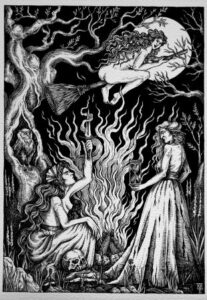
 

From etsy.com 


For my tenth picture, I’ve selected the cover illustration for a Japanese edition of a collection of stories by the English writer Algernon Blackwood, which all feature Blackwood’s psychic investigator John Silence.  The artist responsible is the remarkable surrealist and fantasy illustrator Tadami Yamada; and the scene depicted is from the story Ancient Sorceries, wherein a hapless English traveller finds himself trapped in a remote French town whose inhabitants turn out to be… not werewolves, but were-cats.  As far as I can remember, the story doesn’t take place at Halloween, but the sight of Yamada’s grey-blue cats levitating through the moonlit air gives it a pleasing Halloween-y vibe.
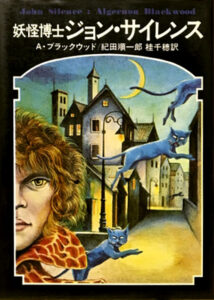
 

From kokusho.co.jp / © Kokusho Kankōkai / Tadami Yamada


Oh yes…  Here’s an extra, eleventh picture in recognition of the fact that this Halloween marks exactly one century since the death of the illusionist and escapologist Harry Houdini.  He died on October 31st, 1926, from peritonitis – possibly caused by appendicitis, possibly caused by blows to the abdomen he’d received nine days earlier.  I love the posters advertising the shows of the great magicians of the early 20th century, like Howard Thurston and Harry Kellar, which were adorned with ghosts, demons and skeletons, hinting that the magicians’ powers weren’t necessarily stage illusions and might be linked to the supernatural and occult.


This poster for a Houdini show at the Lyceum Theatre in Paterson, New Jersy, however, restricts the supernatural stuff to a few spectral spirits billowing out of some wanly-coloured flames.  Houdini was a total sceptic about spiritualism and the paranormal – as the poster’s wording says, “Do spirits return?  Houdini says no – and proves it” – so maybe the lack of flamboyance is deliberate.
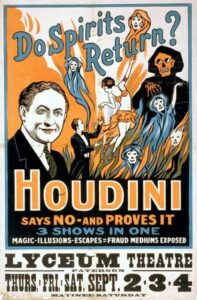
 

From wildabouthoudini.com


Anyway, I wish you all a better Halloween than Harry Houdini had a century ago.  Happy Halloween!
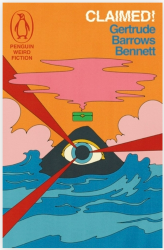
Weird Penguin: Claimed!


© Penguin Books


In 2024, Penguin Books launched its Weird Fiction series.  So far, this series has consisted of five classic titles: Robert Chambers’ The King in Yellow (1895); William Hope Hodgeson’s The House on the Borderland (1908); Gertrude Barrows Bennett’s Claimed! (1920); Algernon Blackwood’s Ancient Sorceries; and a collection of well-known stories of the weird by the likes of Edgar Allan Poe, H.P. Lovecraft, W.W. Jacobs, May Sinclair, M.R. James and Sir Arthur Conan Doyle called Weird Fiction: An Anthology (2024).  When I saw these books on sale in my local bookstore, I bought the two by Gertrude Barrows Bennett and Algernon Blackwood, which I hadn’t read before.


A while back, I posted my thoughts on Blackwood’s Ancient Sorceries.  Here’s what I made of Bennett’s Claimed!


While the content of Ancient Sorceries could be described as horror with a strong dose of the weird, Claimed! is a banquet of weirdness with the occasional plate of horror placed here and there.  It’s a short novel whose plot hinges around a strange box – “an oblong, bluish-green box, about a dozen inches long by half as many wide, highly polished, but severely simple of workmanship.  Its sole decoration was a single short line of characters belonging to some foreign language, which had apparently been incised across the top with an engineer’s tool and the lines filled in with scarlet enamel.”  The box won’t open and the inscription has a disconcerting habit of disappearing from its top surface and reappearing on its bottom surface, making those who possess it wonder if they’d turned the thing upside down without remembering doing so.


Ownership of the box passes from a mad sailor to a shopkeeper, who soon becomes mad, and then to a wealthy and irascible old industrialist called J.J. Robinson.  The latter doesn’t quite tip over into madness, but he certainly develops an unhealthy obsession with the box and with deciphering its secrets.  After an assault by a mysterious nighttime intruder, Robinson is left ailing and bedridden, though he insists on keeping the box by his side: “…he sank back, clasping the thing right to his breast…  ‘I got it!’ he croaked.  ‘What I want I get, and – what I get I keep! They can’t take it away from – old Jesse Robinson!  Nobody – can take it!  You – hear me?’”


At this point, Robinson’s niece Leilah and a young doctor called John Vanaman get involved in the strangeness while they try to care for the stricken but uncooperative old man.  Vanaman realises something odd is afoot when he sits by the slumbering Robinson’s bed one night and has a vision whereby a sea-tide seems to sluice in under the door and across the floor, even though he’s “sitting in the bedroom on the second floor of a house in Tremont, over fifty miles from the Atlantic shore.”


Even worse, something unspeakable enters the room with that impossible tide: “That which was in the room beneath the tide, and which had pushed the tide hither – before it, now gathered, took form, and rose up, sudden and monstrous…  Exactly what shape it had, Vanaman could not later clearly remember.  He could recall only his own fear and intuitive sense of it as a thing of awful force and of a potential destructiveness terrific beyond finite comprehension.”


Bennett sets up this scenario in the first 20 pages of the novel and it’s great, phantasmagorical stuff.  Alas, the mid-section of the book is less gripping.  There are a few incidents that set the pulse racing, such as a mysterious suicide and a bit where a hapless spiritualist tries to help, only to get her come-uppance.  But mainly it’s about the romance that inevitably brews between Leilah and Vanaman while they look after Robinson and try to work out what’s wrong with him.  As the straightforward, clean-cut hero and heroine of the story, they aren’t terribly interesting – and neither is their romance.


However, after the plot has become bogged down in Robinson’s mansion, page 65 sees a dramatic and welcome shift of gears.  Restored, the old man informs Vanaman: “We’re going to sea, my son.”  The action then shifts to a ship Robinson has chartered in order “to meet the party that wants my property, fair and square.”  He’s referring to the people, or beings, who created the box and who belonged to an ancient land that long ago sank below the ocean during a natural cataclysm.  In due course, we’re introduced to the Jack-London-esque character of the ship’s master, Captain Tom Porter – “well known and liked among the blunt, outspoken fraternity of his own kind” – and his hardy crew.  Happily, these new characters and the new locale give the novel a second wind.


There follows an unexpected abduction, a stirring nautical chase, and an impressively psychedelic finale wherein the protagonists cross a portal in time and space.  And this ties up all the mysteries surrounding the box…  Well, at least, I think it does.  For a 127-page novel, there’s been an awful lot going on.


One nice thing about Claimed! was that it introduced me to its remarkable author, whom I hadn’t heard of before.  The Minneapolis-born Gertrude Barrows Bennett spent her adult life working as a stenographer, but for three years from 1917 to 1920 – a fraught period when she had to support both a daughter and an invalid mother – she also earned money as a writer.  She had short stories and novellas published in magazines like Argosy and All-Story Weekly and produced four novels: The Citadel of Fear (1918), The Heads of Cerberus (1919), Avalon (1919) and finally Claimed!  According to her Wikipedia entry, her writing ceased when her mother passed away and she was suddenly under less financial pressure.


Brief though her writing career was, Bennett did enough for the noted science-fiction critic and historian Sam Moskowitz to hail her as “the great woman writer of science fiction in the period between Mary Wollstonecraft Shelley and C.L. Moore.”  And though there’s debate about whether or not the legendary H.P. Lovecraft – who started his writing career around the same time she did – was aware of and influenced by Gertrude Barrows Bennett, there’s so much mind-boggling weirdness present in Claimed! that it wouldn’t surprise me if he was.


From philsp.com

Weird Penguin: Ancient Sorceries


© Penguin Books


In 2024 Penguin books inaugurated its Weird Fiction series, which to date has seen the republication of five venerable titles: Robert Chambers’ The King in Yellow (1895), William Hope Hodgson’s The House on the Borderland (1908), Gertrude Barrows Bennett’s Claimed! (1920), Algernon Blackwood’s Ancient Sorceries and a collection, Weird Fiction: An Anthology (2024).  Well, I assume Weird Fiction: An Anthology is a new collection, but it consists of some venerable short stories.


I’d already read those first two novels and most of the tales in the anthology, whose line-up includes such well-kent scribblers as Edgar Allan Poe, H.P. Lovecraft, W.W. Jacobs, May Sinclair, M.R. James and Sir Arthur Conan Doyle.  But I hadn’t read the Bennett and Blackwood books.  Recently, their striking covers – illustrated in pastel colours, especially pink – caught my eye while I was in a Singaporean bookshop I frequent, Kinokuniya Books in Orchard Road’s Takashimaya Shopping Centre, and I wasted no time in buying them.


Here are my thoughts on the volume by Algernon Blackwood.  I’ll write about the Gertrude Barrows Bennet one later.


Ancient Sorceries contains five stories, the title one plus A Psychical Invasion, The Nemesis of Fire, Secret Worship and A Victim of Higher Space.  All feature Dr John Silence, described in the book’s blurb as “Physician Extraordinary… the greatest occult detective of the age.”  Yes, Silence is what in modern parlance we’d call a ‘paranormal investigator’ – but when the paranormal manifests itself in malevolent forms, he also battles against it.


Series of stories about occult detectives have been common in horror fiction… and I have to say I have a problem with them.  That problem is one of believability.  You can swallow the notion of the hero having one dramatic encounter with the supernatural in one story, maybe even of them having a second dramatic encounter with it in a second story.  But when that hero deals in story after story with supernatural jiggery-pokery, cropping up in different forms – ghosts, werewolves, poltergeists, whatever – it becomes almost impossible to take seriously.  That’s especially so when you consider how most human beings go through their lives with no contact at all with what might be defined as ‘occult’ or ‘paranormal’.  (During my many years on the planet, I’ve had one strange experience, lasting all of half-a-minute, which I couldn’t explain and which, if I was so inclined, I could attribute to the supernatural.)  This means a writer of such tales has to show a great deal of skill in making them seem plausible.


Also implausible is the idea that the occult detective, a mortal human being, can constantly take on dark forces of immense, unnatural power and triumph over them.  The success rate for the heroes of these stories suggests that the forces of darkness are, in reality, pretty weak sauce.


The afore-mentioned William Hope Hodgson wrote stories about an occult detective called Carnacki the Ghost Finder, first published as a collection in 1913.  He managed, I feel, to get away with it.  Hope Hodgson helped make his tales more believable by interspersing the ones where the threat was genuinely supernatural with ones where, Scooby Doo-style, it turned out to be a hoax.  Also, his usual narrative device – Carnacki told each story to a group of mates with whom he’d just had dinner – helped too, since it’s possible Carnacki could be exaggerating what happened or even just making it up.


On the other hand, I’ve read a few stories that the prolific pulp writer Seabury Quinn wrote about a French occult detective called Jules de Grandin and found them bloody awful.  (It doesn’t help that de Grandin’s patois – “Sang du diable…!  Behold what is there, my friend…  Parbleu, he was caduo – mad as a hatter, this one, or I am much mistaken!” – is closer to Inspector Clouseau than Hercule Poirot.)


Usually, the best I can hope for is to regard the stories as out-and-out fantasies – which is the case with Manley Wade Wellman’s stories of Silver John, set in the Appalachian Mountains.  Or as ‘silly but fun’ – the reaction I had to Alice and Claude Askew’s stories about Aylmer Vance (‘Ghost-seer’).  But in no way do I find them scary.


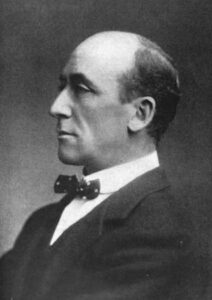
Blackwood, in his day a celebrated author, journalist, broadcaster and, generally, someone who ‘lived the life’ – his CV includes stints as a farmer, hotelier, barman, model, secretary, businessman and violin teacher and he was also a Theosophist and eager outdoorsman – has a big reputation as a writer of chilling stories.  The literary critic S.T. Joshi lauded his fiction as “more consistently meritorious than any weird writer’s except Dunsany’s”, and anything by him I’ve read before now I’ve found impressive.  I was thus looking forward to seeing how he would tackle this subgenre and its believability issue.


From wikipedia.org / © The Outlook


In fact, I’m afraid the trouble with a couple of the stories in Ancient Stories is that Blackwood is so keen to make them appear believable that he over-compensates.  They end up with more prose in them is necessary.  They would have been more digestible if they’d been a dozen pages shorter.


The title story, Ancient Sorceries, is a case in point. Dr John Silence doesn’t feature much in this one.  He just interviews its main character, Arthur Vezin, about some strange experiences and passes comment at the end.  Vezin was travelling by train across northern France when, impulsively, he decided to get off at a remote station, stay in the locality for the night and resume his journey the next day.  (A quiet sort, Vezin had been put off his train journey by the unwelcome presence of many noisy tourists, mainly ‘unredeemed holiday English’.)  Vezin ended up staying in a little town that seemed normal on the surface but, of course, had weird things going on underneath.  A mysterious mental torpor began to affect him.  Rather than get the next day’s train, he remained in the town longer and longer and became increasingly listless:


“It was, I think on the fifth day – though in his detail his story sometimes varied – that he made a definite discovery, which increased his alarm and brought him up to a rather sharp climax…  At the best of times he was never very positive, always negative rather, compliant and acquiescent; yet, when necessity arose, he was capable of reasonably vigorous action and could take a strongish decision.  The discovery he now made that brought him up with such a sharp turn was that this power had positively dwindled to nothing.  He found it impossible to make up his mind…”


Alas, Blackwood’s description of Vezin’s gradual – very gradual – descent into this torpor goes on for too long.  He’s trying to make it sound realistic and credible, but as you read it over several pages, you feel a similar torpor taking possession of your senses.  Things admittedly liven up near the end, but the climax feels like it’s been a long time coming.


Also guilty of this is The Nemesis of Fire, whose action takes place on a remote English country estate, involves artefacts from ancient Egypt and features a fearsome fiery phenomenon that causes things, and people, to burst into flames.  This is narrated by one of Silence’s associates and immediately we’re reminded of a Sherlock Holmes story being told by Holmes’ loyal sidekick, Dr Watson.


This time, too much prose is spent describing, and adulating, Silence’s character.  For example: “His voice had that quiet mastery in it which leads men to face death with a sort of happiness and pride.  I would have followed him anywhere at that moment.  At the same time his words conveyed a sense of dread seriousness.  I caught the thrill of his confidence; but also, in this broad light of day, I felt the measure of alarm that lay behind.”  Yes, this helps us believe Silence is a remarkable man, capable of taking on and defeating supernatural horrors.  But again, it goes on too long.  Sir Arthur Conan Doyle made it plain that Watson greatly admired Holmes, but did so economically and didn’t let it get in the way of the actual story.


That said, the other three tales in this volume are fine.  The Psychical Invasion is a sturdy haunted-house story that benefits from a novel idea.  Rather than bring a team of ghost-hunters with him into the house, Silence comes accompanied by a cat and dog – working on the belief that animals are more sensitive to the paranormal than humans.


Secret Worship is about a man returning to a monastic school in the mountains of southern Germany where he studied as a child – again, this is a ‘Silence-lite’ entry where the detective remains in the background most of the time – and is increasingly disturbed by the hospitality he gets from the brothers / teachers there.  I thought it was the strongest story of the lot, a masterpiece of mounting unease.


The last tale, A Victim of Higher Space, is agreeably wonky and I wonder if a young Ian McEwan read it prior to writing his short story Solid Geometry, which featured in his early collection First Love, Last Rites (1975).


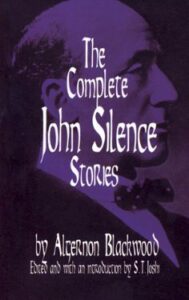
One thing that’s slightly annoying about this book is its incompleteness.  For some reason it omits a sixth Silence story, The Camp of God.  This is included in an earlier collection, The Complete John Silence Stories (2011), which comes with an introduction by S.T. Joshi.  I can’t understand how a publishing company as mighty as Penguin allowed that sixth instalment to slip through the net.


© Dover Publications

Jim Mountfield takes to the trees


© Spiral Tower Press


Jim Mountfield, the pseudonym under which I write horror stories, has been on a roll this month – which, appropriately enough, is October, the month of Halloween.  Already in October 2023 he’s had short stories appear in the online publication Schlock! Webzine and in the collection Nightmare Fuel: Mind Terrors 2023.  Now he’s just had a third story, entitled The Shelterbelt, published in Issue 3 of the magazine Witch House.


As its title implies, The Shelterbelt concerns a plantation of trees grown next to a property to shield it against the elements.  In the story, the property is a farm in a remote part of southern Scotland.  I didn’t have to look far for inspiration for The Shelterbelt.  In 1977, my parents sold our farm in Northern Ireland and purchased and moved to a new farm in southern Scotland, near the town of Peebles.  But the steading we found ourselves living in was hardly ‘new’ – it was a dilapidated and bleak-looking place at the time, with scarcely a tree anywhere, which was unfortunate because the steading was in a north-south-running valley and in the pathway of any bad weather borne by the north wind.  Several times during our first few winters there, we had to dig our way out from our front door, so heavily had snow been piled against it.  How long ago that seems now in these globally-warmed times…


My Dad immediately decided to create a shelterbelt on the northern side of the steading.  I still remember the day when he, my Mum and a good friend from Northern Ireland, Hugh Buchanon, planted the saplings.  Maybe I remember it because I discovered then how seriously my Dad – who was normally relaxed and easy-going – took his work.  He was very exacting.  He was very particular about how far apart those saplings were placed – not too close, not too distant.  After an hour of listening to him, my Mum and Hugh looked ready to plant him along with the trees.


Meanwhile, a literary influence for The Shelterbelt is the 1914 short story Ancient Lights by the author, broadcaster and occultist Algernon Blackwood.  And I’d be lying if I said a certain 1973 movie, about an uptight, virginal, Free Presbyterian policeman investigating a possible case of human sacrifice on a remote Scottish island, didn’t provide a little inspiration too.


For more information about Witch House magazine, click here.  And Issue 3, containing my story and a dozen others, can be downloaded here for free.