© Vintage
I’d assumed I was long past the age where I could get really, really excited about books. If I had to compile a list of my favourite 20 books of all time, I would expect everything on it to be stuff I’d read in my teens, twenties or, at a stretch, my thirties: James Joyce’s Ulysses (1922), Walter Scott’s The Bride of Lammermoor (1819), Malcolm Lowry’s Under the Volcano (1947), Mervyn Peake’s Gormenghast trilogy (1946-59}, etc. I still read a fair bit, but nothing I peruse these days seems to generate the same frisson that certain books did in me during my youth.
I wouldn’t completely agree with the legendary blues singer and musician B.B. King when, in 1969, he sang The Thrill is Gone. But I would say the thrill survives in a reduced capacity. You get older, you become less impressionable, and nothing surprises you anymore. Or so I thought.
I was surprised when, a couple of years back, I read the books in Bernard Cornwell’s Warlord trilogy (1995-97), about King Arthur, and found myself entranced by them – so much so that when I got to the final volume, 1997’s Excalibur, I wrote on this blog that I was “almost reluctant to read it because I’d come to know so well, even love, the characters from the earlier two books – and this being the King Arthur legend, I was aware things wouldn’t end happily for them.” It’d been a long time indeed since a series of book had had such an effect on me.
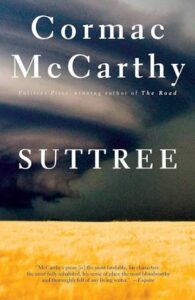
Now the same thing has happened with Cormac McCarthy’s semi-autobiographical novel Suttree (1979). A few pages in, I realised I was reading a very special book – for me, anyway – and I consumed the rest of it with a passion. And I imagine that in my top-20 books list, one of the entries that I read during the first half of my life has just been demoted from it and Suttree has taken its place. Yes, I reckoned McCarthy’s novel was that good.
Before I continue talking about Suttree, a warning – there will be spoilers.
The novel recounts the adventures, and misadventures, of a young man called Cornelius Suttree while he lives on a houseboat on the Tennessee River by the rundown edge of Knoxville in the early 1950s. He ekes out a living fishing and selling his catches at the local market. He also fraternises with the neighbourhood’s underclass, a rogue’s gallery of misfits, eccentrics, down-and-outs and mad people. McCarthy, who died in 2023, was not one for giving interviews, so I assume it’s never been determined how much of Suttree is autobiographical. I’d imagine, though, that the novel – written over 20 years – is at least partly inspired by the period of his marriage to Lee Holleman in the 1960s when, according to his Wikipedia entry, “McCarthy moved to what Holleman’s obituary calls ‘a shack with no heat and running water in the foothills of the Smoky Mountains outside of Knoxviille.’”
As the narrative unfolds, we learn about Suttree’s past. He’s from a well-to-do family and his lifestyle choices haven’t pleased his father. In a letter to him, that father states his belief that “the world is run by those willing to take the responsibility for the running of it. If it is life that you feel you are missing I can tell you where to find it. In the law courts, in business, in government. There is nothing occurring in the streets. Nothing but a dumbshow composed of the helpless and the impotent.” We also learn that he’d been in a marriage that, ultimately, he’d run away from. More on that in a minute.
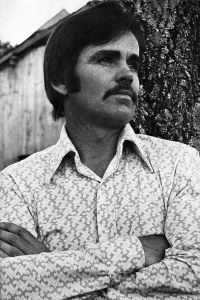
Incidentally, we get clues that Suttree is quite a handsome devil – as McCarthy himself was in his young days. At one point he and some mates get into a catastrophic brawl in a dodgy Knoxville dance-place: “Before they reached the door someone hit him in the head with a bottle… He must have fallen foul of yet other hands afterwards because when he woke in the hospital he had a broken finger, three broken ribs, a mouthful of loose teeth and one missing.” Though he’s now gap-toothed, Suttree has the following conversation with a nurse: “You created quite a sensation.” “What, among the inmates?” “No, silly. Among the nurses.”
From wikipedia.org / © Evening Star Books
I’ve used the word ‘narrative’ but Suttree doesn’t have the structure of a typical novel. It’s rambling and episodic, really a patchwork of vignettes and short stories featuring the same characters in the same setting. The reader takes pleasure in the randomness of it, not knowing what grotesqueness, hilarity, idiocy, beauty, horror, weirdness or, indeed, moment of sheer poetry is going to appear next.
A couple of the longer ‘short stories’ see Suttree leave Knoxville, temporarily, with painful results. In one episode, he discovers that the son he left behind has died and sets off to attend his funeral, even though he has barely any money. When he gets to his destination, his former wife and in-laws, and indeed the whole community, react to him with contempt and hatred. He only leaves the town alive thanks to the begrudging intervention of its sheriff, who opines: “You, my good buddy, are a 14-carat plated son of a bitch. That’s what your problem is… Now I’m goin to do you a favour. Against my better judgement. And it’s not goin to make me no friends. I’m goin to drive your stinkin ass to the bus station and give you an opportunity to get out of here.”
Another time, a chancer called Reese and his family arrive on the scene. This symbolically occurs during a flood, when all sorts of flotsam and jetsam are being washed past Suttree’s houseboat: “Next came looming out of the yellow mist a patchwork shack composed of old slats and tarpaper and tin snuff signs all mounted in wild haphazard upon a derelict barge and turning with the keelless rotations of a drunken bear…” Reese inadvertently befriends Reese, his wife and his children, who inhabit that barge-shack and, for all his worldly wisdom, gets suckered into helping Reese with a get-rich scheme we know is doomed from the start. They travel upriver and begin fishing for mussels, believing there’s money to be made from selling their shells and pearls. Though there’s a little light, with Suttree romancing Reese’s daughter, what follows is mostly a gruelling litany of hardship, futility and, finally, tragedy.
However, much of the book simply records Suttree’s interactions with the characters who live, fish and scavenge around him. They’re an intriguing bunch even if you don’t envy them their existences. They include the Ragpicker – his title says it all – who claims not to believe in God because “I got no reason to think he believes in me”; Daddy Watson, a former railwayman happy to tell Suttree about the gory train crashes he witnessed during his working life; Ab Jones, a black man who with his wife Dolly runs an illicit bar on another houseboat and whose defiant nature invariably gets him into trouble; Mother She, an ancient and decrepit witch who provides the novel with its most hallucinatory episode; Michael, a native American fisherman whom Suttree briefly befriends; and Red Callahan, who ‘s perhaps the closest thing in Suttree to the psychotic Francis Begbie in Irvine Welsh’s Trainspotting (1993), another episodic book about a bunch of misfits living in punishing circumstances.
One part of Suttree that’s particularly Welsh-like – i.e., simultaneously horrible and funny – concerns a male prostitute called Leonard. He enlists Suttree’s reluctant help to dispose of the corpse of his father, which his family has kept hidden at home for months, pretending the old man is still alive so they can keep collecting his social security money. At one point during the operation, Suttree protests, “That’s the awfullest stink I ever smelted.” Leonard retorts, “That‘s the biggest reason we had to get him out of the house.”
Apart from Suttree, though, the most prominent character is the chaotic Gene Harrogate, a youth whom Suttree first encounters while they’re both in prison – Harrogate for the unusual crime of sneaking into a watermelon field near his home, cutting holes in the crop and then having intercourse with them. (As the stunned farmer says, “You ain’t goin to believe this… Somebody has been f*ckin my watermelons.”) Following his release, Harrogate takes up residence in Suttree’s neighbourhood, living “under the final concrete arches of the viaduct where they ran to earth… The earth was cool and naked and dry. Here some bones. Broken glass. A few stray dog-turds… there was never a retreat so secluded.”

From pixabay.com / © Riedlinger
Suttree becomes his surrogate big brother, trying to rein in his wildest and daftest impulses and having to mop up after him when his antics end in disaster. He’s remarkably patient, considering how madcap Harrogate’s schemes are. At one point, the lad learns he can earn a dollar for every dead bat he finds and hands into Knoxville’s medical authorities, who are keen to monitor rabies in the local chiropteran population. Soon Harrogate is firing poisoned pellets into the air from his skiff, at dusk, hoping the swooping bats will mistake them for insects. “Bats had begun to drop everywhere from the heavens. Little leatherwinged creatures struggling in the river…” More spectacular, and no more successful, is a project he devises after finding a cave / tunnel system that takes him under Knoxville – where, he believes, he can dynamite his way into the vault of the city treasury.
Incidents like these make Suttree the funniest of McCarthy’s books. Although folk who’ve read Child of God (1973), or Blood Meridian (1985), or The Road (2006) would probably argue that having more laughs than the norm in McCarthy’s oeuvre is not a particularly high bar. Anyway, I found myself guffawing loudly in places.
The prose oscillates between Joycean flamboyance and Hemingway-esque precision. The opening paragraph reads: “Dear friend now in the dusty clockless hours of the town when the streets lie black and steaming of the wake of the watertrucks and now when the drunks and the homeless have washed up in the lee of walls in alleys or abandoned lots and cats go forth highshouldered and lean in the grim perimeters about, now in these sootblacked brink or cobbled corridors where lightwire shadows make a gothic harp of cellar doors no soul shall walk save you.”
In contrast, after Suttree’s friend J-Bone informs him of his son’s death, McCarthy describes the moment thus: “Suttree set his cup down and looked out of the window. There was a small pool of spilled cream on the marble countertop at his elbow and flies were crouched about it lapping like cats. He got up and went out.” Some may find this disparity in writing styles off-putting. I have to say, for me, the combination is like catnip.
Unflinchingly, the book explores a harsh, brutal but somehow fascinating world, one whose inhabitants certainly suffer, yet you also understand the hold that world exerts over them – through the moments of peace and calm, the occasional pleasures, the camaraderie, the satisfaction of knowing you’re not bound by the rules and regulations of conventional society. But it’s also a transitory world where nothing lasts for long, including the people living in it. As the book progresses, characters get killed, get permanently incarcerated (in the prison or asylum) or simply vanish. As you near the book’s end, you wonder what Suttree’s choice will be. Will he decide to stay here and become a casualty too, or will he try to escape?
But if he does escape, you suspect his experiences on the river will haunt him for his remaining days. Just as Cormac McCarthy’s experiences of poverty and desperate living in Tennessee haunted him for 20 years and informed this marvellous novel.

From pixabay.com / © Leoleobobeo