Musical genres I don’t like


From pixabay.com / © Fietzfotos


In recent years, I’ve tried to follow the adage, “If you don’t have anything nice to say, don’t say anything at all.”  Therefore, rather than write about books, films, TV shows, etc., I thought were bad and slag them off, I’ve tried to focus on works I thought were good and be positive in my vibes.


However, I got out of the wrong side of the bed this morning and feel grumpy.  So, here’s a post radiating unapologetic negativity – about some genres of music that I always thought were a bit, or a lot, rubbish.  But my diatribes will also mention some honourable exceptions, thus leavening the darkness with a little sunshine.


Jazz

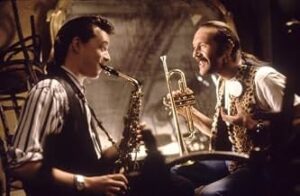
There’s a sizeable segment of the world’s music-loving population who think jazz music is the bees’ knees.  But it never did much for me.  In fact, I agree with Jimmy Rabbitte, the youthful Svengali behind the band in The Commitments (1991).  After Dean the saxophone player starts sneaking jazz bits into the band’s soul sound, Jimmy confronts him while he’s having a pee at a urinal and declares, “Jazz is musical wanking!  If you want to wank, use that thing in your hand, not your sax!


© Beacon Pictures / 20th Century Fox


It’s surprising because I love blues music, another musical genre that grew out of the culture of the American south’s black population in the early 20th century.  Yes, I can happily spend all day listening to my collection of records by bluesmen and women like John Lee Hooker, Lightnin’ Hopkins, Memphis Minnie, Freddy King, Bessie Smith, Howling Wolf and so on.  But jazz?  It strikes me as ponderous and leaves me cold.


I suspect part of my beef against jazz is powered by the fact that certain people I’ve known over the years who were into the genre were, frankly, pretentious and annoying.  This includes two ladies I’ve encountered, at different times and in different places, who fancied themselves as jazz chanteuses, fronted bands and did that ‘scat’ singing thing where they drooled ‘shooby dooby doo-wah’ into a microphone all evening thinking it made them the epitome of cool.  It didn’t.  (By the way, anyone acquainted with me when I lived in Sapporo in the 1990s, please note – the above rant does not apply to the well-known jazz fans Gordon Ents and William Green, whom I knew back then and regarded as really good guys.)


Honourable exceptions: I think Ethiopian jazz is brilliant.  Its jazziness is suffused with Middle Eastern sounds and rhythms, making it sublimely trippy.
 

© Ritz Records


Country and Irish

I know many folk dislike country and western music on account of some of its practitioners and fans being right-wing, red-necked and, well, a bit racist, and on account of its seemingly limited subject matter: trucks, trains, prisons, farms, horses, beer, heartbreak and patriotism.  But such generalisations do the genre a disservice.  It’s also produced some great artists: Johnny Cash, Hank Williams, Willie Nelson, Gram Parsons, Kris Kristofferson and the saintly and now sadly departed Dolly Parton.


But country and Irish music, which Wikipedia defines as “a musical sub-culture in Ireland formed by mixing North American country-style music with Irish influences” that “emerged from Ireland’s showband scene, where local bands would play American pop standards tailored to Irish sensibilities”?  Sheesh!  I find it an aural puree.  All the interesting, gritty bits (symbolised by Johnny, Hank, Willie, Gram and co. above) have been removed and what’s left are some easy-on-the-ears twangy guitars, jaunty accordions and cheery female choruses and a bloke from Athlone or Letterkenny crooning about tractors, or hayfields, or going to church, or – that great country and Irish staple – ‘mammy’.


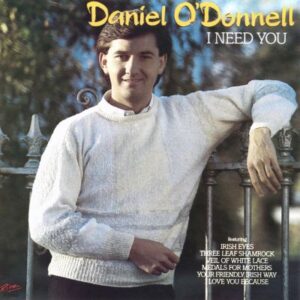
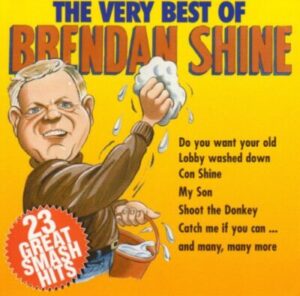
My own, late mother was into country and Irish music and her record player gave heavy rotation to the likes of Foster and Allen and the inimitable Brendan Shine, which explains why I’m so scarred.  If you can listen to Brendan Shine’s 1981 opus Spuds (“Spuds, spuds, spuds! / Ah, these spuds are really great / Good oul Irish spuds / Are on everybody’s plate!”) all the way through without having a breakdown, you’re made of sterner stuff than I am.  At least my mum wasn’t that keen on the country-and-Irish superstar and knitwear-clad cultural juggernaut that is Daniel O’Donnell.  O’Donnell’s reputed to have sold 10 to 15 million records globally and was parodied in the 1998 Father Ted episode Night of the Nearly Dead, in which a much-loved singer called Eoin McLove visits Craggy Island and bluntly informs Ted, “I have no willy.”


Honourable exceptions: I’m not wild about the music, but Philomena Begley can certainly sing.
 

From wikipedia.org / © Atlantic Records


Prog rock

Prog rock, or to give it its full title, progressive rock, was initially essayed by bands in the early 1970s like Emerson, Lake and Palmer, Jethro Tull, Yes, Pink Floyd after Sid Barrett left and Genesis before Phil Collins took over.  It had guitar solos and keyboard solos that twiddled on forever because the musicians wanted to convince everyone that, no, they weren’t just dumbass rock or pop musicians but proper artistes pushing boundaries by fusing rock with classical music and (eek!) jazz.  Much of it is unlistenable to me.  I agree with John Peel, who once observed, “the one distinguishing feature about early-70s progressive rock was that it didn’t progress.”  Anyway, by the mid-1970s, God decided that enough was enough and created punk rock, which seemed to put an end to it.  (Though Marillion popped up in the 1980s and the genre lives on today.)


Honourable exceptions: Okay, I’ve been facetious.  I have a few nice things to say about prog rock too.  Firstly, looking at Wikipedia’s List of Progressive Rock Bands, I see many names on it whom I actually like.  However, while those bands may have been prog-rock-tinged at times, I view them as essentially playing different types of music: Hawkwind (space rock), Can (Krautrock), Rush (hard rock and heavy metal), Ozric Tentacles (psychedelic rock), etc.  Secondly, you can’t deny that, judiciously used, the music of prog rock bands has enlivened many movies – see Michael Mann’s use of Tangerine Dream on his soundtracks, or Dario Argento’s use of Goblin on his, or Vangelis’s contribution to Blade Runner (1982), or how that bit from Mike Oldfield’s Tubular Bells (1971) turned up brilliantly in The Exorcist (1973).  And thirdly, among albums by latter-day prog rock bands, I thought Porcupine Tree’s Fear of a Blank Planet (2007) was wonderful.
 

From wikipedia.org / © RSO Records


Disco

I don’t hate disco.  I was just never into it.  So sorry, ABBA, Chic, KC and the Sunshine Band and Earth, Wind and Fire.  The problem, of course, is that to be a fan of disco music, you have to be a fan of dancing, and as I have always danced like I possessed two left feet, that’s excluded me from the culture.


Incidentally, it’s weirdly ironic – considering how disco was a big thing among the black, Latino and gay communities in the late 1970s – that two legendary disco bands have been tarnished by associating with intolerant far-right-wing politicians recently.  Admittedly, these are modern incarnations of the bands, i.e., with hardly any of the original line-ups remaining in them.  A version of Boney M has been in talks to perform at this month’s conference by Nigel Farage’s Reform Party, while a version of Village People played at inaugural events for Donald Trump in 2025.  Of course, Village People’s YMCA (1978) is much-loved by Trump, who dances to it at every opportunity – arthritically shuffling about whilst joggling his little fists in front of him like he’s trying to milk a levitating cow.


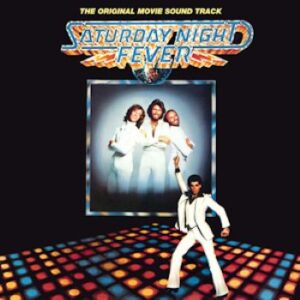
Honourable exceptions: The Bee Gees’ Stayin’ Alive (1977) is a sprightly tune, though I like it even more in this mash-up with AC/DC’s Back in Black (1980) from Wax Audio.


Right, I’ve released some of that yellow bile from my system, am feeling better and will end this post here.  But stay tuned.  I’ll be writing about more musical genres I can’t stand soon.  (Hint: we’re getting near the 1980s…)
 

© Beaumex Music
Even bloodsuckers get the blues


© Warner Bros / Proximity Media


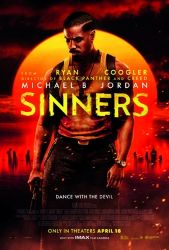
A few days ago my partner and I went to see Sinners, the new horror-cum-gangster film directed, written and co-produced by Ryan Coogler.  Here are my thoughts on it.  And before I go any further, a word of warning: there will be spoilers.


To be honest, I wasn’t expecting a great deal, as I’d heard something about its plot and it sounded horribly like 1996’s Robert Rodriguez-directed, Quentin Tarantino-scripted From Dusk till Dawn.  Although a few misguided souls nowadays look back on that film as a neglected and misunderstood classic, I have to say I f**king hated it.  In part, this was because From Dusk till Dawn began so well, as a nastily-effective little crime thriller wherein two fleeing bank-robbing brothers (Tarantino and George Clooney) kidnap a pastor (Harvey Keitel) and his family and force them to smuggle them over the US / Mexico border.  Disappointingly, things then go south in all senses of the phrase.  The group arrives at a mysterious Mexican bar called the Titty Twister where the staff and many of the patrons prove to be – surprise! – vampires.  The rest of the film is a ludicrous, tongue-in-cheek splatterfest where the humans battle against waves of bloodsucking undead.  While From Dusk Till Dawn’s sudden change of tone has been praised in some quarters for its audacity, I found it a vertiginous plunge into cheesy bollocks.


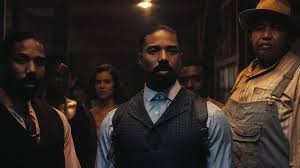
Anyway, the structure of Sinners is not dissimilar.  Its first half plays out as a period gangster story, then vampires show up and its latter half becomes an exercise in horror.  Set in the Mississippi Delta in 1932, it’s about the homecoming of black gangster twin brothers Stack and Smoke (both played by Michael B. Jordan) who’ve recently left Chicago where, it’s suggested, they worked for Al Capone.  On their home turf, they embark on a new project – purchasing a disused sawmill and turning it into a juke joint, i.e.. a place for live music, dancing, drinking and gambling whose customers are from the local African American community.


To ensure the juke joint’s opening night is a success, they staff it with trusted friends, family members and associates: Smoke’s ex-wife, the occult-dabbling Annie (Wunmi Mosaku), and Chinese shopkeepers Grace (Li Jun Li) and Bo (Yao) to handle the catering; hulking buddy Cornbread (Omar Miller) to man the door; and boozy old bluesman Delta Slim (Delroy Lindo), slinky singer Pearline (Jayme Lawson) and young, startlingly-talented guitarist Sammie (Miles Caton) to provide the music.


© Warner Bros / Proximity Media


Despite a few obstacles – two thieves who soon regret tangling with the take-no-prisoners Stack, the fact that the sawmill’s former owner is head of the local chapter of the Ku Klux Klan, and the disapproval of Sammie’s dad, a preacher who believes music is only virtuous if it’s used to further the word of the Lord – the juke joint opens, pulls in the crowds and is soon swinging.  And then the vampires arrive.


Yes, I was dreading this moment – because I had really enjoyed the non-fantastical part of the film.  Coogler did a great job depicting the minutiae of the 1932 Mississippi Delta.  This was a world where the black population was just a couple of generations removed from the official slavery of the Confederacy and most of them now toiled in the racket that was sharecropping, a form of unofficial slavery.  At the same time, they were crafting a musical culture, the blues, that would ultimately revolutionise American and global music through its influence on rock and roll.  One touch among many that I liked here was the portrayal of the Chinese shopkeepers, Grace and Bo, who thanks to their ethnicity are able to run stores in both districts of the Mississippi town of Clarksdale, the black one and the white one.


Anyway, when the vampires show up, does the film turn to shite as From Dusk till Dawn did?  Thankfully, no.  Coogler provides some foreshadowing to prepare us for the twist, so it doesn’t come as a credibility-straining bolt from the blue.  During the opening sequence, a voice-over talks about certain types of music being “so pure it can pierce the veil between life and death, past and future” and attract supernatural creatures – an idea that’s echoed later when the vampires admit Sammie’s miraculous guitar-playing has drawn them to the juke joint.  (Even before the vampires arrive, Coogler treats us to a phantasmagorical sequence where Sammie’s playing seems to conjure up among the dancing crowd the spectres of music past and future – West African shamans, Chinese Xiqu performers, hip-hop DJs and an electric guitarist who looks like he’s a member of George Clinton’s P-Funk collective.)


Also preparing viewers for the tonal switch is an earlier sequence where a white man, Remmick (Jack O’Connell), flees from a squad of Choctaw Native Americans and takes refuge in a cabin inhabited by a hard-up white couple.  The pursuing Native Americans politely warn the couple that they’re sheltering something evil.  But as KKK robes are visible inside the cabin, it’s no surprise that the couple believe the story of their white visitor rather than that of the ‘Injuns’.  Noticing the sun is setting, and with a shotgun pointed at them, the Choctaw decide discretion is the better part of valour and retreat.  Which leaves Remmick to reveal himself as a vampire and infect his two saviours.


Coogler leaves this bit of world-building unexplored – which makes it wonderfully intriguing.  Why are the Choctaw acting as vampire hunters?  It also reminds me of the start of John Carpenter’s The Thing (1982), where a dog – actually the titular thing in canine form – is chased by a pair of wrathful Norwegians in a helicopter.  Compared to the Norwegians, though, the Native Americans are more pragmatic and level-headed.


© Warner Bros / Proximity Media


Later, Remmick and the vampirised Klan couple appear on the threshold of Smoke and Stack’s new juke joint, bearing musical instruments and pleading to be let in (“We heard tell of a party”) so that they can have a jamming session with Sammie.  Sinners makes much of the belief that to get onto a premises, a vampire has to be invited – and Smoke and Stack, suspicious of white folks, are in no hurry to invite this trio inside.  So they bide their time outside, biting and vampirising anyone who goes home early or nips out of the building for a pee.  While they wait for their opportunity to get inside, their numbers grow…


In a smart move, Coogler makes Remmick Irish and gives him a taste for music as strong as his taste for blood.  So, lurking outside, the vampires knock out a few tunes themselves – a charming version of the Irish / Scottish folk number Wild Mountain Thyme, for instance, and when there’s enough of them to stage a full-scale vampire hooley, a raucous rendition of Rocky Road to Dublin, during which Remmick indulges in some step-dancing.  This makes being a vampire look like fun and Remmick, entreating the folks in the juke joint to surrender to him and his horde, makes a persuasive-sounding case for being vampirised.  Once you’re a vampire, it doesn’t matter what skin-tone you have.  Black vampires are treated no worse than white ones: “This world already left you for dead.  I can save you from your fate.  I am your way out.”


There’s a snag, of course.  Remmick, as the Count Dracula / Mr. Barlow-style lead vampire, calls the shots and his minions have to do his bidding.  Indeed, they seem parts of a giant hive-mind – evidenced by their chorused singing of Rocky Road to Dublin, which contrasts with the individuality Sammie expresses with his guitar.  And Remmick’s interest in Sammie and his music isn’t motivated by an impulse of sharing but by a desire to assimilate them.


It’s fun to speculate who or what Remmick symbolizes.  When he makes his first pitch at the juke joint’s door, begging to be let inside while Sammie, Delta Slim and Pearline perform, I was reminded of those white British rock-and-roll bands of the 1960s, like the Rolling Stones, the Animals and the Yardbirds.  Influenced by the likes of Robert Johnson and Muddy Waters, they started their careers desperate to play blues music and become known as bluesmen themselves.  Which prompted Sonny Boy Williamson II to quip caustically: “These English boys want to play the blues real bad… And they do, real bad.”


But maybe it makes more sense to compare Remmick to the white-owned American music industry.  His hunger for Sammie parallels how that industry gobbled up black artists, of blues, jazz, gospel, soul, funk, whatever, and made a fortune off their music whilst giving them as little credit, money and control over their work as possible.  Often, their songs ended up being sung by someone else, someone white – see Pat Boone singing a version of Little Richard’s Tutti Frutti just five months after its release in 1955 – with precious few royalties making it their way.


Incidentally, late on, Remmick comes out with a sob story about how he was persecuted and deprived of his land in Ireland – presumably at the hands of the British and presumably back in the days when he was still human.  That a victim of oppression has become a supernatural killing machine, one with a fascistic disregard for the lives of the people he feeds on, is Coogler’s way of reminding us that many poor white people, treated like dirt in their home countries, emigrated to other parts of the world where they treated indigenous people and black people like dirt too.  It’s a sad reflection on human nature that people near the bottom of the pile have a psychological need to believe there are people even further down the pile whom they can mistreat and regard as inferior.  Though this observation would no doubt delight Elon Musk, who recently grumbled that the “fundamental weakness of Western civilization is empathy”.


I’ve spent a lot of time analysing Sinners but I should also say it’s a supremely entertaining movie.  It’s exciting, scary, funny and atmospheric.  Furthermore, it proves a point that many filmmakers overlook – if you want a horror film to grip an audience, give them likeable and sympathetic characters to identify with.  That way, they have an investment in those characters and things feel much more tense when bad stuff starts happening.


© Cedric Burnside Project

© Silvertone Records


It goes without saying that the soundtrack is great too.  I’m particularly pleased to see that Cedric Burnside had a hand in performing some of the blues tunes – I attended a cool gig by Burnside at the Edinburgh Jazz and Blues Festival in 2015 and afterwards got his signature on a CD as a present for one of my mates.  Also, don’t rush off when the credits start rolling at the end.  There’s still a scene to come, one set in the early 1990s and featuring the venerable bluesman Buddy Guy.  (By a coincidence I saw Guy perform in the early 1990s, though obviously the early-1990s Guy in Sinners is a good bit older than the one I witnessed.)  It’s a coda that’s both sinister and affecting.


And the acting is excellent.  Michael B. Jordan is impressive in the twin roles of Smoke and Stack.  I soon forgot that both characters were being played by the same person.  It’s a pleasure seeing Delroy Lindo again, whom I fondly remember as the villain in the 1995 adaptation of Elmore Leonard’s Get Shorty and from numerous Spike Lee movies.  And as Sammie, Michael Caton is a revelation.  He’s young and naïve, as the script demands, but he’s blessed with a deep, prematurely-old voice that totally persuades you this lad can sing and play the blues.


One thing about the casting, though.  Jack O’Connell is perfectly fine as Remmick.  But since the character is a scary old monster who’s Irish and musical, I don’t know why they didn’t cast the obvious candidate for the role: Van Morrison.


© Warner Bros / Proximity Media

Ian McEwan’s Saturday: Tony Blair and tone-deaf


© Vintage


“The butcher boy gets a bauble,” was my reaction to the news that former UK Prime Minister Tony Blair was to be made ‘a Knight Companion of the Most Noble Order of the Garter’, whatever that means, in the Queen’s New Year Honours List.  I call Blair ‘the butcher boy’ because of his role in the invasion of Iraq, which happened during his watch in 2003.  The invasion was launched to depose Saddam Hussein who, it was claimed, possessed Weapons of Mass Destruction.  However, these WMDs turned out to not actually exist and it became obvious that Blair and his invasion partner George W. Bush had spun a web of lies beforehand to make people believe that they did.


And it wasn’t just the WMDs that didn’t exist.  Since the invasion took place, up until the beginning of 2021, due to ‘coalition and insurgent military action’ and subsequent ‘sectarian violence and criminal violence’, between 185,000 and 209,000 Iraqi civilians are estimated to have stopped existing too – their deaths the direct and indirect results of Blair and Bush’s actions.


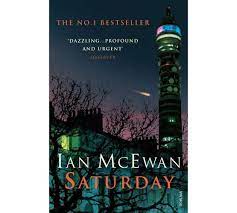
Actually, I’d been thinking about Tony Blair and Iraq before word came through of Blair’s ennoblement, because late last year I read Ian McEwan’s 2005 novel Saturday.  This describes 24 hours in the life of a middle-aged, London-based neurosurgeon called Henry Perowne, starting on the morning of Saturday, February 15th, 2003.  In real life, that date saw the biggest political demonstration in British history.  A million people took to the streets of London in an anti-war protest organised by the Stop the War Coalition, the Campaign for Nuclear Disarmament and the Muslim Association of Britain.  Blair, of course, had a messianic belief in his own rightness and ignored the many arguments against war voiced by the protestors, and just over a month later Britain joined the USA and its allies in starting hostilities against Iraq.  The demonstration forms a backdrop to the events in McEwan’s novel and the forthcoming invasion is prominent in the thoughts and conversations of its characters.


I was a big fan of McEwan during my youth.  This was while he was in a weird, morbid, modern-gothic phase and wrote the novel The Cement Garden (1978) and the short stories collected in First Love, Last Rites (1975) and In Between the Sheets (1978).  Thereafter, McEwan became more wholesome and respectable and found success and acclaim as a writer of mainstream literature.  Saturday is only the third novel I’ve read by McEwan since he stopped being ghoulish. The others were The Child in Time (1987), which I enjoyed with some reservations, and Atonement (2001), which I thought was excellent, although a later allegation of plagiarism tarnished it a bit for me.  However, while I’ve generally reacted positively to McEwan’s work, I found Saturday problematic.  It seemed naïve in the statements it was making.  Also, its depiction of its central characters I found downright annoying.


From wikipedia.org / © Thesupermat


The day described in Saturday begins before dawn.  Perowne gets out of bed and notices an object that he first assumes is ‘a meteor burning out in the London sky’. He realises, though, that it’s a plane with an engine on fire, which makes him wonder if he’s witnessing an act of terrorism – terrorism being on everyone’s minds since events in New York a year-and-a-half earlier.  But it turns out that he’s seen an accidental fire on board a cargo plane, which manages to make an emergency landing at Heathrow.  Reassured, he gets on what’s been planned for the day ahead.


His first engagement is at a sports centre where he has a game of squash with his anaesthetist, an American called Jay Strauss.  Then he visits his mother, stricken with dementia in a care home, and does some shopping for a family gathering at his house that evening.  In addition to Perowne and his wife Rosalind, the get-together is attended by their daughter Daisy, son Theo and Rosalind’s father, the quaintly named John Grammaticus.  Later that night, he gets an urgent request from Strauss to perform some emergency surgery: “We got an extradural, male, mid-twenties, fell down the stairs… a depressed fracture right over the sinus…  I want someone senior in here and you’re the nearest.  Plus you’re the best.”


However, two more incidents make the day darker.  On his way to play squash, a distracted policeman allows Perowne to drive along Tottenham Court Road, officially closed off for the anti-war demonstration – with the result that he prangs another car coming out of a side-street, whose driver didn’t expect him to be there.  When he gets out to speak to the other car’s three occupants, Perowne realises the men are criminals, ready to beat him up if he doesn’t immediately pay for the damage their car has suffered.  But he also notices that the leader of the trio, a man called Baxter, is showing symptoms of a serious neurological disorder.  Using his knowledge of the illness, Perowne is able to distract and disorientate Baxter long enough to get back into his car and escape.


But that isn’t the end of it.  That evening, just after Perowne has welcomed his family into his house, a vengeful Baxter and one of his henchmen burst in and hold them at knifepoint.  There ensues violence, threatened violence and sexual humiliation, before Perowne and his son Theo manage to repel the invaders.  Baxter is thrown down some stairs, knocked unconscious and taken away in an ambulance.  When the phone call comes from Strauss, Perowne realises the injured man he’s being asked to operate on is Baxter, who traumatised his family a short time ago. As he prepares to leave, Rosalind demands, “You’re not thinking about doing something, about some sort of revenge are you?”


“Of course not,” Perowne replies, and proves to be as good as his word.


As McEwan was in 2003, Perowne is in favour of the Iraq invasion.  He’s not as gung-ho as Strauss, who grumbles about the protestors, “They dislike your Prime Minister, but boy do they f*cking loathe my President,” or indeed as Baxter, who snarls at them in an aside, “Horrible rabble.  Sponging off the country they hate.”  But to his daughter Daisy, who takes part in the day’s demonstration, he says: “No rational person is for war.  But in five years’ time we might not regret it.  I’d love to see the end of Saddam.  You’re right.  It could be a disaster.  But it could be the end of a disaster and the beginning of something better.”  Perowne has been influenced by the testimony of an Iraqi patient of his, an academic called Miri Taleb.  Saddam’s secret police once arrested Taleb and subjected him to ten months of physical and mental torment: “Even on the day of his release he didn’t discover what the charges were against him.”


Elsewhere, McEwan’s descriptions of the anti-war protestors seem a bit patronising: “The general cheerfulness Perowne finds baffling.  There are whole families, ones in various sizes of bright red coats, clearly under instructions to hold hands; and students, and a coachful of greying ladies in quilted anoraks and stout shoes.  The Women’s Institute, perhaps…  The scene has an air of innocence and English dottiness.”  Mind you, years later in an interview with Channel 4 News, McEwan admitted that he’d changed his opinion about the war and felt that the marchers in 2003 were ‘vindicated’.


From aa.com.tr


While I read Saturday, I tried to work out the significance of the villainous Baxter.  Was he a metaphor for Saddam Hussein and his brutal regime?  Or was Baxter’s intrusion into the Perownes’ home a metaphor for terrorism, erupting without warning in everyday life, destroying all notions of normality and security for its victims?  And what’s to be made of Perowne’s eventual decision to do the decent thing, operate on Baxter and save his life?  I got the impression Perowne represented McEwan’s ideal of an enlightened, democratic, liberal West, intervening in Iraq but doing so with everyone’s best interests at heart, including the Iraqis.  Unfortunately, the ‘ignorance, arrogance, neglect, stubbornness, panic, haste and denial’ displayed by Iraq’s Western occupiers following the invasion, which rapidly turned the country into a failed state, showed this to be a pipe dream.  The USA, Britain and their allies were a hell of a lot less benevolent, magnanimous and expert at what they were doing in Iraq than Henry Perowne was in the operating theatre.


If the political statement McEwan seems to make in Saturday is wishful thinking, certainly in hindsight, I was more troubled by the lack of self-awareness displayed by the main characters.  Fair enough, as a London neurosurgeon, Perowne is going to be a wealthy man.  His car, McEwan notes, is a “silver Mercedes S500 with cream upholstery – and he’s no longer embarrassed by it.  He doesn’t even love it – it’s simply a sensuous part of what he regards as his overgenerous share of the world’s goods.”


But his son Theo is an up-and-coming blues guitarist.  His mother arranged for him to get lessons from Jack Bruce, no less.  “Through Bruce, Theo met some of the legendary figures.  He was allowed to sit in on a Clapton masterclass.  Long John Baldry came over from Canada for a reunion…  By some accident Theo jammed for several minutes with Ronnie Wood and met his older brother Art…”  So, while most kids his age are worrying about entry-level jobs, rents and college fees, Theo, through his family wealth and connections, gets stupendous opportunities to develop his skills playing music – ironically, a type of music that was invented by impoverished black people living in America’s rural south.


Similarly, Perowne’s daughter Daisy is a graduate of Oxford University and a poetess who’s just had a collection of poems published.  It no doubt helps that her grandfather, John Grammaticus, is a famous English poet who lives in a chateau in France.  Though both lauded and loaded, the old man is bitter about how the world has treated him: “John minded when Spender and not he was knighted, when Raine not Grammaticus got the editorship at Faber, when he lost the Oxford Professorship of Poetry to Fenton, when Hughes and later Motion were preferred as Poets Laureate, and above all when it was Heaney who got the Nobel.”


I may have missed it in Saturday, but I don’t remember the Perownes reflecting on their good fortune, on having so much in a world where many people have so little.  It’s especially galling that Theo and Daisy, whom we’re supposed to like as characters, don’t acknowledge their luck in having fulfilling, creative lives, doing the things they enjoy doing, that most people their age can’t have because they lack the wealth, security, support, time and connections.  Perhaps once, back when many of Theo’s British-blues heroes were youngsters from working-class or lower-middle-class backgrounds, Britain offered some social mobility and the arts weren’t necessarily the preserve of the elite.  But that’s hardly the case in 21st century Britain, when money, poshness and who-you-know seems to be prerequisites for careers in music (Florence Welch, Mumford and Sons, James Blunt), acting (Cumberbatch, Hiddleston, Pattinson, various Foxes) and literature (while the 2003 and 2013 Granta lists of ‘Best Young British Novelists’ showed some ethnic diversity, about 60% of those novelists had still attended Oxford or Cambridge Universities).


I’d assumed McEwan would use Baxter, who’d obviously never had the opportunities gifted to Theo and Daisy, as an instrument to comment on this when he crashes into the Perownes’ comfortable world.   However, the ‘home invasion’ section of Saturday is relatively brief and the bitter commentary I expected didn’t appear.  Baxter gets strangely emotional after he forces Daisy to recite a poem to him, Matthew Arnold’s Dover Beach, but that’s all.


This muted acceptance of the advantages enjoyed by the Perowne family irritated me most about Saturday.  In this respect, it seems as tone-deaf as Tony Blair was about the war that the novel ruminates on.


From change.org