30 years on, it’s still the worst toilet in Scotland


© Channel Four Films / PolyGram Filmed Entertainment


Just over a year ago, I posted on this blog about the sad closure of The Projector, Singapore’s alternative cinema.  According to a statement on the cinema’s Facebook page, this was caused by “rising operational costs, shifting audience habits, and the global decline in cinema attendance,” factors that had “made sustaining an independent model in Singapore especially challenging.”  The Projector was the one venue in the city-state where you could see, on a big screen, independent and arthouse films, ones that were generally offbeat, ones focused on minorities and not necessarily made in the handful of big international languages.  It also offered opportunities to watch older movies in a cinema, for example, ones by Alfred Hitchcock, Akira Kurosawa and David Lynch.  Though sometimes it showed modern Hollywood and Chinese blockbusters too.


The Projector operated at two locations, the Cineleisure shopping mall on Grange Road and the Golden Mile Tower on Beach Road.  Happily, this year, a new cinema called The Filmhouse has started doing business in The Projector’s Golden Mile Tower premises and has a similar agenda of showing films you wouldn’t otherwise see in Singaporean cinemas.  According to Wikipedia, The Filmhouse retains “certain key team members and features” from The Projector.


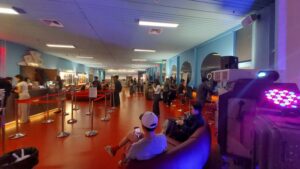
Last week, I made my first visit to The Filmhouse and was pleased to find it busy.  It’s a smaller operation than The Projector with, as far as I can ascertain, just two screens, but probably that makes more financial sense – a non-mainstream cinema can’t afford to have many overheads.  The lobby contained a bar, comfortable seats and, most importantly, a relaxed and friendly ambience.


When I went into one of the halls and found my seat, I was slightly disappointed that, before the movie started, the short film warning patrons to keep their phones silent and refrain from using them during the show wasn’t the famous one used by The Projector.  That had footage from the super-schlocky Turkish science-fiction movie Dünyayı Kurtaran Adam, better known as Turkish Star Wars, and featured ‘Turkish Luke Skywalker’ training for battle by smashing his big fists repeatedly against a desert boulder.  You were warned that if you violated the cinema’s policy on phone-use, you would suffer punishment similar to that being inflicted on the rock.


Still, The Filmhouse’s anti-phone film is cute enough.  It has a brief clip of the late David Lynch telling us, “You have a very good heart.’  Then we’re asked to prove Lynch right about our hearts by turning off or muting our devices and not spoiling anyone else’s enjoyment of the movie with them.


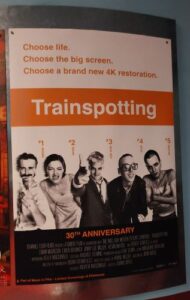
Anyway, what was the film I went to see?  It was a 30th-anniversary showing of Danny Boyle’s Trainspotting (1996), freshly spruced up for cinematic re-release.  As the movie poster’s tagline announced: “Choose life.  Choose the big screen.  Choose a brand new 4K restoration.”


At the time of its release, Trainspotting caught the zeitgeist of mid-1990s Britain, obsessed with Britpop and all things Cool Britannia.  Yes, how long ago that all seems now.  To be honest, it annoyed me in some ways that the movie got lumped in with the Britpop / Cool Britannia thing, even if the filmmakers opportunistically loaded its soundtrack with music of the time, by bands such as Pulp, Blur, Sleeper, Elastica, Leftfield and Underworld.  That said, the two songs that defined the film, Iggy Pop’s Lust for Life from 1977 and Lou Reed’s Perfect Day from 1972, had nothing to do with 1990s Britain.


To me Trainspotting sprang from an earlier, darker and less glamorous era than the one of Damien Hirst’s formaldehyde shark, Geri Halliwell’s Union Jack mini-skirt and Blur-versus-Oasis – namely, the mid-to-late 1980s, when Edinburgh’s boom in heroin use and the subsequent, resultant HIV / AIDS epidemic led to the city being dubbed ‘the AIDS capital of Europe’.


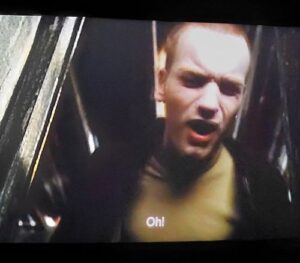
This became material for the book that inspired the film, Irvine Welsh’s novel Trainspotting (1993), which is an altogether bleaker and rougher-edged piece of work than Boyle’s cinematic version.  Though of course the film isn’t without its bleak or rough-edged moments either.  The worst toilet in Scotland, anyone?
 

© Channel Four Films / PolyGram Filmed Entertainment


Still, I’m not complaining too much.  I think both Trainspotting the book and Trainspotting the movie are great and are classics in their respective fields, 1990s Scottish literature and 1990s British cinema.  But after 30 years, how would the latter work hold up?


Pretty well, I thought, though the animatronic zombie-baby that Renton (Ewan McGregor) imagines crawling across the ceiling during a traumatic ‘cold turkey’ episode looks terrible now.  Mind you, it looked ropey enough in 1996.


I wondered how, in these days of extreme anxiety about sex predators preying on children, the gag about Renton meeting Diane (Kelly Macdonald) in a nightclub, going home with her and discovering the next day that she’s still at school would come across.  Not as ickily as I feared.  Diane is clearly the one doing the manipulating and Renton is properly horrified when he learns how old she is really.  Plus, McDonald’s true age at the time, 20, means the sequence’s punchline, when Diane appears in her school uniform, is cringily funny but – thankfully – a bit unbelievable.


Meanwhile, I winced at the scene following the death of Tommy (Kevin McKidd), where a grieving Spud (Ewan Bremner) pays tribute to his late friend by singing Two Little Boys – a song popularised by, and forever associated with, the Australian entertainer, TV personality and artist Rolf Harris, who had a smash-hit with it in 1969.  In 2014, Harris hit the headlines when he was found guilty of sexually assaulting four underage girls.  But to be fair to Two Little Boys, it was around long before Harris got his hands on it.  It was written in 1903 by composer Theodore F. Morse and lyricist Edward Madden.


The Singaporean audience I saw Trainspotting with certainly enjoyed it, even though I wondered how a film about heroin addicts would go down in a country with some of the strictest anti-drugs laws in the world.  If Trainspotting had taken place in Singapore, the drug dealing characters in it like ‘Mother Superior’ (Peter Mullan) and Mikey Forrester (Welsh in a cameo) would have been executed long ago.  Much of it they found funny, which is appropriate because the film is essentially a (very black) comedy.  The Worst Toilet in Scotland sequence and the one where the hapless Spud spectacularly soils the bedsheets in the house of this girlfriend Gail’s (Shirley Henderson) parents, then manages to scatter the contents of those bedsheets across Gail, her parents and their kitchen, elicited guffaws.

 

© Channel Four Films / PolyGram Filmed Entertainment


Also getting laughs was Renton’s famous ‘It’s shite being Scottish’ rant.  He may have hit a chord with the audience when he raged, “Some hate the English.  I don’t.  They’re just wankers.  We, on the other hand, are colonised by wankers!”  The Singaporeans, of course, were once colonised by the English too – though, technically, as part of the British Empire, they were colonised by the Scots and Welsh as well.


On the other hand, I must have been the only person in the cinema-hall chuckling during the references to and jokes about Sean Connery.  (“Do you shee the beasht?  Have you got it in your shights?”  “Clear enough, Missh Moneypenny!  This should preshent no shignificant problemsh”)  Most folk there were about half my age and I guess ‘Big Sean’ is unknown to the younger generation.


One thing I felt about seeing Trainspotting 30 years on was that now the Britpop musical soundtrack sounds quaint rather than cutting edge, and now that I know the punchlines to all the jokes about jobbies, Sean Connery and so on, its depiction of heroin addiction is more on-the-nose.  Without the film’s cultural baggage distracting me, I better perceived the horribleness of the characters’ situations.  Like when baby Dawn – whose zombie-fied form Renton will hallucinate about later – dies from neglect and her parents, Sick-Boy and Allison (Susan Vidler), after a moment’s anguish, greedily reach for the syringes, needles and smack again.  Or when Tommy – who was originally the healthiest and most level-headed of the gang – becomes ruinously addicted and, while he lies ravaged on a mattress, a conscience-stricken Renton tries to apologise for getting him hooked on the stuff.  Tommy pays the apology no heed and is interested only in getting money for his next fix.


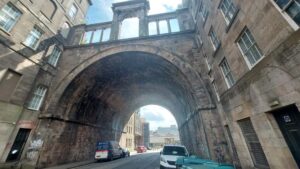
Another thing I noticed in 2026 about Trainspotting is that, for a film supposed to be the greatest one ever set in Edinburgh, you see very little of Edinburgh in it.  You have the famous opening scene where Renton, Spud and Sick-Boy try to shoplift in (the now long-gone) John Menzies bookstore on Princes Street and are chased along the thoroughfare by security, with Renton making a last, doomed break for freedom down Calton Road and under Waterloo Place.  But that’s all.  The streets, side-streets, bunker-like nightclubs, pub-interiors and blighted junkies’ dens could be anywhere.  Though that’s hardly surprising considering it was partly funded by the Glasgow Film Fund and most of it was shot in Glasgow.


Compare that with the sequel, T2: Trainspotting (2017), which was partly based on Irvine Welsh’s literary follow-up Porno (2003), also used some bits from the novel Trainspotting that didn’t get into the first film, and also featured stuff from scriptwriter John Hodge’s own imagination – like the psychotic Frank Begbie (Robert Carlyle) staging an escape from Saughton Prison.  In T2, you get to see the Royal Mile, the Grassmarket, Cockburn Street, Harvey Nichols, the Scottish Parliament, the tram system, the Forth Road Bridge and Salisbury Crags.  It’s practically a love-letter to the Scottish capital.


Still, a few months ago, I was in Edinburgh and found myself walking down Calton Road.  And my immediate reation was, “Hey, this is where Ewan McGregor ran and got caught in Trainspotting!”  So one little piece of the city, at least, was immortalised by the original film.
 

Buck Rogers in the 21st century


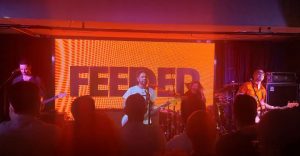
After the rock band Feeder – consisting of Welsh vocalist and guitarist Grant Nicholas, Welsh drummer Jon Lee and Japanese bassist Taka Hirose – appeared in the 1990s, I bought their first few albums: Polythene (1997), Yesterday Went Too Soon (1999) and Echo Park (2001).  I enjoyed them at the time, but don’t remember much about them now – just a few songs like High (1997) and their biggest hit, Buck Rogers (2001).


After Echo Park, I stopped listening to Feeder.  This wasn’t because of a decline in their musical quality.  I moved around a lot in the 2000s and 2010s and lost touch with many of the bands I’d been into during the previous decade.  Often I was living in countries where it was impossible to hear about and buy new music by Western rock bands.  And YouTube isn’t much help if you’re somewhere with little or zero Internet connectivity.


Also – in an echo of the tragedy that befell fellow Welsh rockers the Manic Street Preachers – Feeder lost their drummer Jon Lee when he committed suicide in 2002.  I actually suspected the band had called it a day after that.  However, now I’ve done some research, I see that Nicholas and Hirose have soldiered on and produced nine further albums to date.


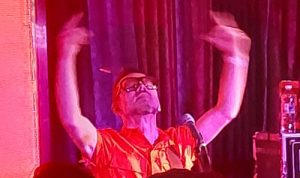
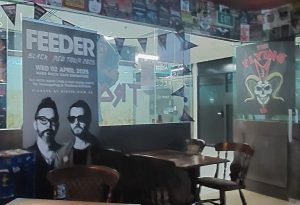
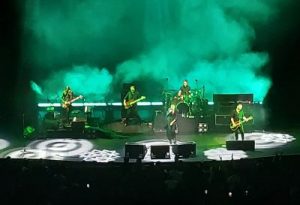
Anyway, it was recently announced that, as part of their current Black / Red tour, Feeder would perform at Singapore’s Hard Rock Café on April 2nd.  Though the band are now officially a two-man outfit, Nicholas and Hirose are accompanied by rhythm guitarist and backing vocalist Tommy Gleason and drummer Geoff Holroyde.  So, I purchased a ticket and, come April 2nd, got myself along to the Hard Rock Café.


This was the second gig I’ve attended at that venue.  With uncanny symmetry, the previous band I saw there was another Celtic one who came to prominence during the Britpop era playing indie / punky rock music, Northern Ireland’s Ash.  Consequently, I couldn’t help but compare this Feeder gig with the Ash one… and it seemed slightly inferior.


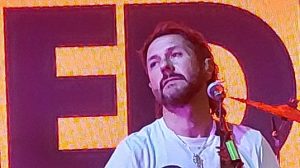
For one thing, it was shorter.  Feeder played for 80 minutes.  I think they could have chucked in a couple of extra songs to get the gig to the hour-and-a-half mark.  A more important issue, though, was the crowd.  Ash had attracted a good mixture of Western expatriates and Singaporeans, who’d bopped to the band’s songs with great enthusiasm.  The Feeder audience, however, consisted mostly of expats in their thirties and forties and they were, frankly, a bit lame.  Stuck at the back of the crowd, I found myself staring across a sea of sensible T-shirts, slightly-greying hair, bald-spots, baseball caps (strategically placed to conceal bald-spots) and shaven scalps (strategically shaven to camouflage bald-spots).  When they were at their most enthusiastic, they reacted to the music by, well, jiggling a bit.  (Admittedly, that’s what I did – I jiggled a bit.  But I have an excuse.  I’m a frail old man now.)  I felt sorry for Grant Nicholas when he suggested, “Let’s get a 1990s mosh-pit going…”, and nothing happened.


My mood was also dampened by the fact that the gig took place in the Hard Rock Café – surrounded by such holy rock-and-roll artefacts as J.J. Cale’s guitar, Michael Jackson’s cymbals and, er, the drumkit of Rob Blotzer from RATT.  Yes, with the café’s tables and chairs removed for the evening, you get the feeling you’re in a small, sweaty, standing-room-only venue where the band are just a few yards away.  That intimacy is great (and uncommon in Singapore).  However, the Hard Rock Café doesn’t have a stage – or, if it does, it has no stage to speak of.  It looks like the bands play on a strip of floor at one end of the main room.  Thus, even if you aren’t far from the performers, you won’t see much of them over the heads of the spectators at the very front.


There’s the matter too of having to pay Hard Rock Café prices for your drinks.  A pint of Carlsberg set me back a blood-curdling 28 Singaporean dollars, which is 16 British pounds sterling.


Still, despite the subdued crowd and the problems with the venue, once I relaxed and focused only on the show, I did enjoy it.  Bravely, Feeder didn’t go down the easy route of pandering to 1990s nostalgia, which is currently modish thanks to the hype over this summer’s reunion tour by the Gallagher siblings, and they played just four songs off those first three albums I mentioned earlier – though the songs were well-received and Buck Rogers inevitably got a good reception late on in the set.  On the other hand, they devoted more than half their set to material off their three most recent albums, Tallulah (2019), Torpedo (2022) and Black / Red (2024) and it was absolutely fine.  The standout for me was their 2024 song Playing with Fire – I definitely prefer Feeder when they’re being heavier and Playing with Fire was a good essay in heaviness.


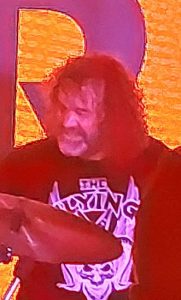
Kudos, by the way, to drummer Geoff Holroyde (who looks like a slightly-better-groomed Alan Moore) for wearing a Flying V Bar T-shirt and thus giving a plug to Singapore’s premier heavy metal pub.  Mind you, I was in the Flying V a week earlier and they had a big banner up promoting tonight’s gig, so perhaps he was just returning the compliment.


No way-sis


From wikipedia.org / © Will Fresch


I’ve just Googled ‘the universe’s smallest sub-atomic particle’ and been told that, from what we currently know, the title belongs to those classes of particles known as quarks and leptons.  So, let me say that even a quark, or a lepton, is considerably bigger than the amount of enthusiasm I can summon about the news that legendary 1990s rock band Oasis have reformed and will embark on a five-city / 17-gig tour of Wales, England, Scotland and Ireland in the summer of 2025.  (The tour has already sold out, which suggests some folk are more enthusiastic about the reunion than I am.)


Oasis have not been a thing since 2009, when the arguing, quarrelling, sniping and feuding that’d always featured in the relationship between the band’s two mainstays, Mancunian siblings Noel and Liam Gallagher, finally went supernova – as opposed to going Champagne Supernova – resulting in the band’s break-up and the pair not sharing a stage or studio since.  From 2009 until recently, they’ve only acknowledged each other’s existence by flinging insults.  Liam, the younger and less cerebral Gallagher, has frequently called his older brother a ‘potato’ and referred to his post-Oasis band the High Flying Birds as the ‘High Flying Smurfs’.  Noel, meanwhile, has memorably described his little brother as “a man with a fork in a world of soup.”


Oasis first appeared on my radar in the mid-1990s, when I was working at Hokkai-Gakuen University in Sapporo, capital of the northern Japanese island of Hokkaido.  A student approached me one day and inquired if I was ‘Bra’ or ‘O-aaa-sis’.  (No, I’m not trying to indulge in Sofia Coppola-style mockery of how Japanese people speak English – I’m simply describing how the student, with her pronunciation, sounded to me at the time.  I’m sure my Japanese sounded even weirder to her.)  I realised she wasn’t referring to a lady’s undergarment but to British rock / pop band Blur.  She was also talking about Oasis, with whom – if the British press was to be believed at the time – Blur were locked in the bitterest and most vitriolic rivalry since the Hatfields and the McCoys.  (Noel Gallagher once remarked, “I wish Blur were dead, John Lennon was alive and the Beatles would reform.”)  Not very familiar with either band – there was no Internet in those days and it was much harder to keep up with events in the UK – I visited Sapporo’s Tower Records soon after and bought a couple of their albums.


How would I answer that student?  Was I Blur or Oasis?


© Creation Records


The Oasis album I bought was 1994’s Definitely Maybe and by my reckoning it’s a very good record.  It’s not particularly innovative, with the ghosts of the Beatles, T-Rex and Slade never far away, but it has several memorable toe-tappers and stompers like Columbia and Supersonic and one genuinely great track, Live Forever.  The latter made me think that if I was a teenager, I could seriously fall in love with these guys.  The song encapsulates those feelings of hope and optimism you have in your teens, no matter how humble or ordinary your origins, about your whole life being ahead of you and great things possibly awaiting – no more so than when the refrain kicks in near the end, “Gonna live forever!”


The songs of rock’s previous big thing, the Seattle-centred grunge movement, had been introspective, melancholic, downright miserable at times, and on April 5th, 1994, less than five months before Definitely Maybe’s release, its biggest star Kurt Cobain had blown his brains out.  So, in Britain at least, young music fans must have been ready for something more joyous.


Hope was also in the air politically.  After a decade-and-a-half of Britain being ruled by the Conservative party – peachy for anyone living in booming, investment-heavy south-east England, crap for anyone living in the now-post-industrial rest of the country – and with the current Tory government of John Major looking clueless, a brighter future seemed to be on the cards.  The Labour Party was reinventing itself as ‘New Labour’ and, mindful of the prevailing Zeitgeist, its shiny, photogenic young leader was keen to rub shoulders with Oasis, Blur and other representatives of the country’s burgeoning new rock scene that’d become known as ‘Britpop’.  That smiley, nice-seeming Prime Minister-in-waiting was called Tony Blair…  Well, okay.  We know how that worked out.


From wikipedia.org / © Raph_PH


I also acquired Blur’s Parklife (1994) and liked it less.  If Oasis drew on the Beatles for inspiration, then the spark for Parklife-era Blur was another 1960s British band, the Kinks.  This resulted in a number of chirpy, quirky songs that I found irritating and made me agree with Noel Gallagher, who slagged them off as ‘chimney-sweep music’.  That said, the title song (‘Shitelife’ as Liam once dubbed it), which has actor Phil Daniels babbling non-stop while singer Damon Albarn shouts “Parklife!” every so often, has been stuck in my head ever since.  Even today, when I find myself in a work-meeting with a superior who drones on endlessly, their voice dripping with meaningless corporate jargon, I have to fight off the urge to shout “Parklife!” at half-minute intervals.


Anyhow, though I  regarded Blur’s album as the weaker one, I still liked them.  This was because I could remember seeing them live – at London’s Brixton Academy back in 1992, when hardly anyone had heard of them, on a bill that also included the Jesus and Mary Chain, My Bloody Valentine and Dinosaur Jr.  I thought they’d been all right.


So, during the Blur vs. Oasis wars, I ended up neutral.


The 1990s continued.  So did Oasis, Blur and the Britpop craze, which spawned dozens of bands I only have vague memories of now: Cast, Kula Shakur, Ocean Colour Scene, Heavy Stereo, Sleeper, Echobelly, Dodgy, Menswear, Mansun…  Actually, I’ll admit to having a strange fondness for Mansun’s song Take It Easy Chicken.


© Creation Records


In 1995 Oasis unveiled their second album, (What’s the Story) Morning Glory?, which went on to sell 22 million copies worldwide and became one of the decade’s most acclaimed records.  I wasn’t impressed, though.  The opening number (and first single) Roll with It seemed shockingly generic to me – no wonder Damon Albarn nicknamed them ‘Oasis Quo’ – and it also spawned one of the world’s worst jokes: “Why did Oasis choose soup on the menu?  Because they got a roll with it.”  Some people adore the anthemic Don’t Look Back in Anger and Champagne Supernova but I’ve always found them overwrought.  And while initially I thought the ballad Wonderwall was quite nice, I got sick of it after hearing it for the 10,000th time.  (My partner and I were in a restaurant a fortnight ago when, from a speaker, Liam started intoning, “Today is gonna be the day…”  We groaned and rolled our eyes.)


(What’s the Story) Morning Glory?’s huge, if in my opinion undeserved, success meant Oasis became even more of a rock-and-roll behemoth, doing all the customary rock-and-roll things.  Cocaine-fuelled excess?  Check.  Infighting?  Check.  Disappearing drummers?  Check.  Hanging out with Johnny Depp?  Check.  Marrying Patsy Kensit?  Check.  With so much going on, it was inevitable that the band’s third album, 1997’s Be Here Now, would (a) be presaged with more, over-the-top hype than ever and (b) prove a bloated disappointment whose sales were only a third of those of its predecessor.  It brought the band’s ascendancy to an abrupt end and helped pop the bubble of Britpop itself.  Afterwards, Oasis made more albums and I think I’ve heard most of them.  But I can’t remember a single song off them.


© Creation Records


The band’s boorish, obnoxious image put me off them too.  And when people criticise Oasis for boorishness and obnoxiousness, it’s basically Liam they’re complaining about.  While some of the abuse he’s doled out raises a smile – grumbling, for instance, that Florence Welch from Florence and the Machine “sounds like someone’s stood on her f**king foot” – there’s other stuff he’s said and done that just makes him seem like an arsehole.  An incident at Q magazine’s awards ceremony in 2000 where he heckled Kylie Minogue by yelling ‘lesbian!’ at her is also a reminder that, over the years, a fair amount of homophobia has issued from the younger Gallagher’s gob.


Yet, despite this, many journalists and critics have given Liam an easy ride – even when they’ve been on the receiving end of his loutishness.  One possible reason why is the belief that because he comes from an ‘authentic’ working-class background in Manchester, Liam is somehow the ‘authentic’ voice of the working class.  Therefore, if you criticise his antics, you’re being ‘class-ist’.  Indeed, this argument has re-ignited in the wake of the news about 2025’s reunion tour.  The British media is suddenly full of commentators accusing other commentators, ones not delighted by Oasis’s return, of being snobbish and anti-working class.


But I don’t think any of this holds water.  For one thing, I’ve known working-class people who’ve also been unimpressed by Liam’s yobbishness.  And, in my time, I’ve seen plenty of middle-class and upper-class people make knobheads of themselves, and their social status didn’t make me think they were any less arseholey than the Oasis frontman.


From wikipedia.org / © Alexander Frick


Tellingly, Mark Lanegan – singer with 1990s grunge band the Screaming Trees and somebody whose upbringing in Ellensburg, Washington, sounds much tougher than the Gallaghers’ in Manchester – didn’t have a high opinion of Gallagher the Younger.  In his 2020 autobiography Sing Backwards and Weep, Lanegan recalls how in 1996 the Screaming Trees supported Oasis during a North American tour.  At the tour’s start, Liam accosted Lanegan with a mocking cry of “Howling Branches!” – Howling Branches, Screaming Trees, get it?  Lanegan described his response thus: “‘F**k off, you stupid f**king idiot’ was my brief blasé retort, spoken as if to a bothersome mosquito.”


This was not the beginning of a beautiful friendship.  Lanegan came to detest Liam so much that he wrote: “I couldn’t believe someone hadn’t beaten, knifed, or shot him to death by now, such was the reckless, witless, and despotic nature of his insufferable façade.”


So, I wasn’t subject to even a fleeting moment of temptation to spend hours in a Ticketmaster queue and shell out eye-watering sums of money to see Oasis perform next summer.  As far as I’m concerned, the band have only one really decent album behind them.  Besides, I’m not sure they’ll even make it through the tour.  Noel may well bail out before the end, deciding that occupying the same airspace as his tosser-ish brother again is more than his sanity is worth.


© Food Records / Virgin Records


Finally, returning to the old Blur-Oasis rivalry, I have to say I’m now in the Blur camp.  I think they’re the better band because, in the end, they’ve produced more good songs that Oasis have: This is a Low (1994), He Thought of Cars, The Universal (both 1995), Beetlebum, Song 2, Death of a Party (all 1997), Coffee & TV (1999), Out of Time (2003)…  Incidentally, given that Oasis were always supposed to be hard-men northerners while Blur were poncy, studenty southerners, the video for The Universal, inspired by Stanley Kubrick’s A Clockwork Orange (1971), makes Blur look far more disturbing than their Mancunian adversaries ever looked.  Damon Albarn and co. make great Droogs.


But if I had to choose one band that represented the peak of Britpop, it wouldn’t be Blur or Oasis.  No, it’d be Sheffield’s Pulp, led by the sublimely sly Jarvis Cocker.  Pulp’s Common People (1995), for instance, brilliantly captures one of the indignities of being working class – that of having moneyed people trying to ‘slum it’ by hanging out with you in order to look cool.  No wonder that in 2004 Common People received the ultimate accolade – William Shatner sang a cover version of it.  I can’t imagine the former Captain Kirk ever wanting to wrap his tonsils around Wonderwall.


© Island Records

The per-Suede-er


At first glance, the pairing of the Manic Street Preachers and Suede at the concert I attended at Singapore’s Star Theatre on November 22nd seemed the musical equivalent of Neil Simon’s play The Odd Couple (1965).  Famous for their left-wing politics, the Manics got together as a band while they were at a comprehensive school in south Wales and they’ve forged a sound described by their Wikipedia page as variously ‘alternative’, ‘hard’, ‘punk’ and ‘glam’ rock.  The founders of Suede, on the other hand, put their band together while they were at University College London.  They were influenced by David Bowie and Roxy Music and their Wikipedia page describes their music with, among other things, the dreaded term ‘arthouse rock’.


Yes, as a former London university-student, Brett Anderson, Suede’s singer, lyricist and general lynchpin, seemed to me far removed from James Dean Bradfield and the other working-class Welsh lads in the Manic Street Preachers.  Which is unfair of me, as Anderson is actually the son of a taxi-driver.  (Maybe the name ‘Brett’ makes me biased.  The only other Brett I can think of is Lord Brett Sinclair, the posh playboy aristocrat played by Roger Moore in that dreadful / brilliant old TV show from 1972, The Persuaders.)


Still, in certain ways, the two bands are similar.  Both achieved success in the early 1990s, shortly before the advent of the Britpop movement that briefly set the world – or, at least, set those excitable hacks in the English media – on fire.  And instead of worshipping 1960s outfits like the Beatles and the Kinks, like the Britpop musicians did, the Manics and Suede were inspired by other things, such as the aforementioned punk rock and David Bowie.


Anyway, having experienced the Manics on the evening of the 22nd, I then sat through an hour-and-a-half of Suede.  And I was surprised.  I’d never seen the band before and I’d assumed that Brett Anderson was a cerebral, aesthetic type, not given to extroversion.  At least, that was the impression I’d got from interviews with him I’d read.  (I also seem to remember reading an interview that he’d conducted once, with one of his heroes, Brian Eno.)  So, I didn’t expect him to be the showman that he was tonight.  He strutted around, dropped dramatically onto his knees, perched himself on top of the front stage lights, and a couple of times descended into the stalls, where he prowled between the stage and the barrier holding back the audience.  He even went behind the barrier and into the audience.  He was a pretty belligerent in his showmanship too, constantly getting the crowd going, goading them to sing along and clap their hands.  This was Freddie Mercury with attitude.


The set-list was weighted with songs from their eponymous first album, released in 1993, and their most recent album, 2022’s Autofiction, which between them accounted for more than half the numbers played.  Autofiction has been described as a ‘back-to-basics triumph’ and its songs slotted in seamlessly with the jagged, urgent sound of early 1990s classics like Animal Nitrate, Metal Mickey and So Young.  Since Anderson is now in his fifties, with So Young he must be starting to feel like the Who’s Roger Daltrey every time he sings the ‘Hope I die before I get old’ line from 1965’s My Generation.


I was slightly disappointed that almost nothing was featured from 1994’s Dog Man Star, Suede’s second album, which is my favourite thing among their output.  Mind you, the one item from Dog Man Star that was played, The Wild Ones, was certainly memorable.  Anderson performed it by himself, on acoustic guitar, and made it even more memorable by preceding it with a rant at certain members of the audience who were filming the show on their phones.  He pleaded: “It’s so much better if you could possibly put your phones down…  Put your f**king phones down.  If you want to film, go to the back.  Don’t take up space out here.  These people want to have fun.  If you want to stare at you f**king phone, go to the f**king back.  Am I right…?  It just kills the gig.”


Being at the rear end, and at the very top, of the auditorium – from where the theatre’s lower level had looked so densely flecked with dots of phone-light that I sometimes felt I was flying over a city at night-time – I hadn’t been able to see precisely what Anderson was doing during his forays into the stalls.  However, according to the following day’s report in the Straits Times newspaper, he’d “tussled with a front-row male audience member, demanding that he put down his device” and “leapt over the barricade… confronted those in the front section of the venue who were busy filming him… started pushing fans’ hands down, grabbing phones off them, and putting them on the floor.”


Well, good on Brett Anderson, I say.  These days at concerts there seems to exist a great divide.  On one side of it are folk who simply want to experience and lose themselves in the live-music performance.  On the other side are numpties with one arm permanently hoicked up in the air, with a hand clutching the latest slab of technology from Motorola, Sony, Apple or Nokia, with eyes fastened on a tiny screen where tinier figures move around on a stage, with a mind focused only on getting the clips despatched to social-media platforms as swiftly as possible to show off to their ‘followers’.  I know which side of that gulf I’m on.  The other side can just f**k off into the sea.


Anyway, that piece of drama merely added to the emotionality and intensity of the Suede experience.  The band produced a glorious clangour of noise that,  thanks to the Star Theatre’s excellent acoustics, reached me and rattled me even at the very back of the venue.  I still had ghostly reverberations from Animal Nitrate in my ears while I travelled home on the Singapore MRT.


This being my first-ever Suede concert, and not having heard their music for many years, I hadn’t known what to expect during the second leg of tonight’s show.  But yes, I ended up per-Suede-ed.