

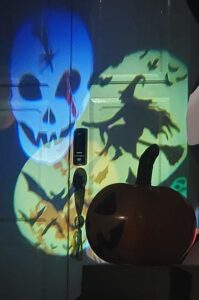
For the past month, in keeping with it being the season of Halloween, I’ve been putting spooky and horror-related entries on this blog. Well, today is October 31st, 2026 – Halloween itself. As is my custom, I will celebrate the occasion with a post where I talk about ten pieces of creepy or scary artwork that have caught my eye since Halloween last year. Incidentally, the photographs above are of the façade, at the moment, of a house in the Singaporean street where I live. The folk there seem to really love Halloween.
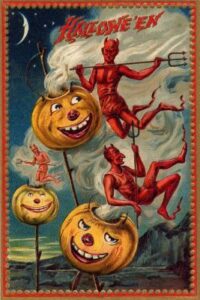
First, to get you in the mood, here’s a vintage American Halloween card featuring some impish-looking demons and some pumpkin lanterns that disconcertingly possess real eyes and mouths. According to the Public Domain Review, “Halloween and picture postcards have a shared history, and both captured the anglophone imagination at the turn of the twentieth century. As the October 31st festival began to emerge in its modern guise thanks, in part, to an influx of immigrants from the British Isles in the United States, picture postcards entered their so-called ‘golden era’, ca. 1905–1915. Rarely seen or used in the US before 1893, an estimated 900 million postcards had been mailed two decades later.”
If you find the smiles on those pumpkins unsettling, brace yourself for the smile in the picture that’s coming next. It’s a detail from a leaf of the Hungarian-Anjou Legendary, an illustrated 14th-century, Latin-language manuscript about the lives of 58 saints. This leaf, which now resides at the Morgan Library and Museum in New York, provides information on St Bartholomew, including information on his grisly fate. Reportedly, the Armenian prince Astyages flayed him alive. Because of this, Christian art often depicts Saint Bartholomew as carrying around his own, removed skin – see his appearance in Michelangelo’s The Last Judgement (1536-41) or the very anatomical statue of him by Marco d’Agrate.
But the Hungarian-Anjou Legendary detail is the most gruesome depiction of him I’ve seen. As I’ve said, it’s the grin on the unfortunate saint’s face that makes it truly disturbing (though it doesn’t help that his freshly sliced-off face is hanging down at the side). I suppose if you’d just had your face flayed off, you wouldn’t have much choice about grinning either. By the way, it seems something of a sick joke that Bartholomew ended up as the patron saint of, among other people, tanners.
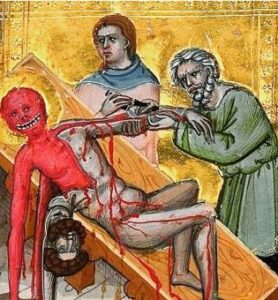
From the Morgan Library and Museum
Also religious-themed is the following work from Italian artist (and accomplished freestyle wrestler) Paolo Girardi, who has a lengthy entry in the Encyclopaedia Metallum: The Metal Archives website because of the artwork he’s done for many heavy metal bands – most prolifically for the Colombian thrash-and-black-metal band Inquisition and the awesomely-named Italian black-and-death-metal one Blasphemophagher. This particularly striking example of Girardi’s talents is one I’ve seen on Pinterest, Reddit and TikTok but I can’t find its name. As far as I can tell, it doesn’t seem to be artwork for an album cover. What to make of it? I interpret it as representing a madman’s dream of the apocalypse, with his head opening spectacularly above his (noticeably Christ-like) face to reveal a bubbling hellscape where there rampages the seven-headed beast from the Book of Revelation.
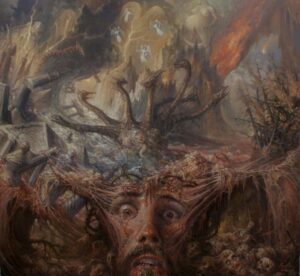
From imgur.com / © Paolo Girardi
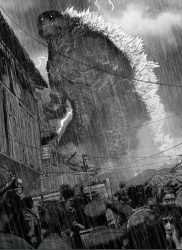
Girardi’s dragon-like seven-headed beast puts me in mind of King Ghidorah, the dragon-like three-headed kaiju – giant monsters in Japanese cinema that specialise in demolishing cities – who’s regarded as the deadliest foe to have faced Godzilla, the greatest of all kaiju. Godzilla is having yet another moment, thanks to the recent release of Takashi Yamazaki’s Godzilla Minus Zero (in which, I understand, King Ghidorah also features). During the course of countless movies since the 1950s, there’s been times when Godzilla has come dangerously close to being cuddly and domesticated – he’s acquired a voice (in 1972’s Godzilla vs. Gigan) and become a dad (in 1967’s Son of Godzilla) and his battles with other kaiju have frequently sunk to the comical level of a Big-Daddy-versus-Giant-Haystacks pro-wrestling bout. It’s sometimes been easy to forget he was originally meant to be massively dangerous and frightening.
But massively dangerous and frightening is how Godzilla looks in the next picture I’ve chosen. It comes from a four-issue, comic-book mini-series appropriately called The Horror of Godzilla, which debuted in July this year. It’s drawn by the excellent Australian artist Tristan Jones, whose previous work has involved other well-known cultural properties such as Alien, Ghostbusters and Teenage Mutant Ninja Turtles. Perhaps most intriguingly, he’s illustrated a comic-book prequel to the 1997 Sam Neill space-horror movie Event Horizon.
© IDW Publishing / Tristan Jones
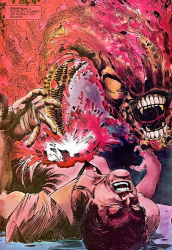
I’ve just said that Tristan Jones has worked in the universe of the Alien movies. That brings me to my next pick, which belongs to the first Alien-related artwork I ever saw. It’s a picture from the 64-page graphic-novel adaptation of the 1979 original Alien film directed by Ridley Scott, Alien: The Illustrated Story, which was drawn by Walt Simonson, written by Archie Goodwin and published in 1979 too. I never owned it, but I remember spending half-an-hour in a branch of the (now-defunct) Scottish bookshop John Menzies, perusing a copy of it – and grimacing at the book’s violent frames, which had a volcanic level of bloodiness, far more than what was actually shown in the film. This frame exemplifies Simonson in all his sanguinary enthusiasm. And yes, it depicts the film’s most notorious scene, wherein the baby alien decides to vacate John Hurt’s chest.
© Heavy Metal Communications / Titan Books / Walt SImonson
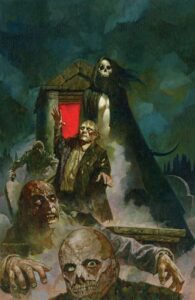
The Catalonian artist Manuel Perez Clemente, who painted under the name of Sanjulian and who sadly passed away in the middle of this month, did some film-related work too, for example, a cover of the venerable and pioneering horror-movie magazine Famous Monsters of Filmland (1958-83). However, Sanjulian is probably best-known for his work on the horror comic-strip magazines put out by Warren Publishing (who also published Famous Monsters) – Creepy (1964-83), Eerie (1968-83) and Vampirella (1969-present). I don’t know where the following item originates – I came across it on the website for DMR Books, in a tribute to Sanjulian they posted following his death. It’s a cemetery-set monster-mash that showcases the gloriously pulpy style of much of his art. Incidentally, the skull-faced miscreant lurking at the picture’s bottom looks a lot like Dr Anton Phibes, the character played by Vincent Price in the movies The Abominable Dr Phibes (1971) and Dr Phibes Rises Again (1972).
From DMR Books
Speaking of Vincent Price, the great horror-movie star appeared in several films in the early-to-mid-1960s that were based on the works of Edgar Allan Poe and directed by Roger Corman. These included the 1963 movie The Raven, which had a made-up story about dueling magicians (from the pen of Richard Matheson) with the title of Poe’s most famous poem cheekily tagged onto it. At least during the film Price got to recite the poem in his impeccably mellifluous voice.
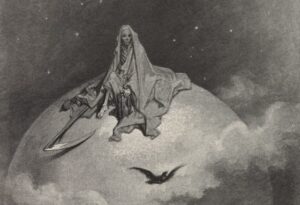
Anyway, here’s one of 24 illustrations that the celebrated 19th-century French artist Gustav Dore drew for the poem The Raven shortly before his death in 1883. It’s inspired by the lines “…I stood there wondering, fearing / Doubting, dreaming dreams no mortal ever dared to dream before…” Dore’s imagining of the dreams no mortal dared to dream before involves the Angel of Death sitting atop the globe amid the mess of his robes and scythe. Strictly speaking, the raven hasn’t yet appeared in the poem’s narrative, but you can spy him flying furtively past.
From poestories.com
Also in 1963, Roger Corman found time to make X: The Man with the X-Ray Eyes, about a scientist (Ray Milland) who develops eye-drops that can expand the range of human vision, treats his own eyes with them and finds himself able to see deeper and deeper into the fabric of reality. First, he can see through people’s clothes, which is a bit sleazy. Then he can see through skin and flesh and identify internal injuries, which is medically useful. However, by the movie’s end, he’s able to see into the centre of the universe, where he observes ‘an eye that sees us all’, which is definitely freaky. (The hallucinogenic script was by Ray Russell.)
The following picture by the late Austrian artist Rudolph Sieber-Lonati reminds me of that ‘eye that sees us all’. It’s an outstanding piece of visual cosmic horror – cosmic horror being a school of macabre writing that emphasizes the puniness and insignificance of human beings whilst suggesting there are vast and terrifying forces in the universe that could destroy us all in a split-second if the notion took them.
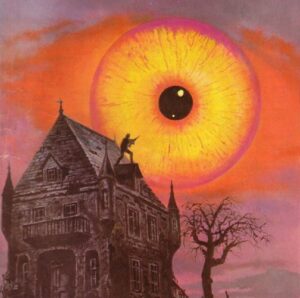
From cosmic horror to folk horror, which Wikipedia describes as “a subgenre of horror film and horror fiction that uses elements of folklore to invoke fear and foreboding. Typical elements include a rural setting, isolation, and themes of superstition, folk religion, paganism, sacrifice and the dark aspects of nature.”
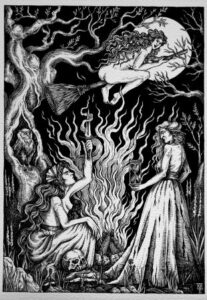
This is a handsome illustration called Witches’ Sabbath, which I discovered on Etsy. There’s always something darkly jolly about paintings and drawings of witches heading to the sabbath – they have a look of anticipation on their faces that tells you they’re planning to really party and have a good time. Maddeningly, I can’t find any details on where this piece came from. The accompanying blurb on Etsy claims it “was originally commissioned by the band Widow from Italy. It shows the Maiden, the Mother and the Crone flying, performing a ritual and reminding the viewer of their own mortality.” I know there’s an Italian band called Void Widow, but I don’t think this is connected with them.
From etsy.com
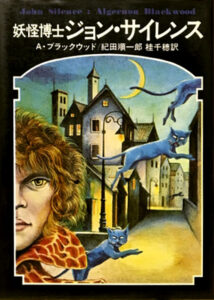
For my tenth picture, I’ve selected the cover illustration for a Japanese edition of a collection of stories by the English writer Algernon Blackwood, which all feature Blackwood’s psychic investigator John Silence. The artist responsible is the remarkable surrealist and fantasy illustrator Tadami Yamada; and the scene depicted is from the story Ancient Sorceries, wherein a hapless English traveller finds himself trapped in a remote French town whose inhabitants turn out to be… not werewolves, but were-cats. As far as I can remember, the story doesn’t take place at Halloween, but the sight of Yamada’s grey-blue cats levitating through the moonlit air gives it a pleasing Halloween-y vibe.
From kokusho.co.jp / © Kokusho Kankōkai / Tadami Yamada
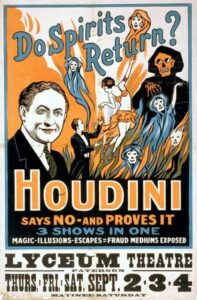
Oh yes… Here’s an extra, eleventh picture in recognition of the fact that this Halloween marks exactly one century since the death of the illusionist and escapologist Harry Houdini. He died on October 31st, 1926, from peritonitis – possibly caused by appendicitis, possibly caused by blows to the abdomen he’d received nine days earlier. I love the posters advertising the shows of the great magicians of the early 20th century, like Howard Thurston and Harry Kellar, which were adorned with ghosts, demons and skeletons, hinting that the magicians’ powers weren’t necessarily stage illusions and might be linked to the supernatural and occult.
This poster for a Houdini show at the Lyceum Theatre in Paterson, New Jersy, however, restricts the supernatural stuff to a few spectral spirits billowing out of some wanly-coloured flames. Houdini was a total sceptic about spiritualism and the paranormal – as the poster’s wording says, “Do spirits return? Houdini says no – and proves it” – so maybe the lack of flamboyance is deliberate.
From wildabouthoudini.com
Anyway, I wish you all a better Halloween than Harry Houdini enjoyed a century ago. Happy Halloween!