Black magic and black ops


© Cork University Press


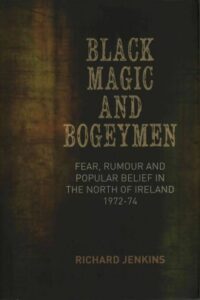
A few posts ago, I mentioned the Satanic panic that seized Northern Ireland in late 1973 and early 1974.  As Halloween is nearly upon us, I thought I would republish the following, which is a slightly revised version of something I wrote a decade ago, after I’d read Richard Jenkins’s book on the topic, Black Magic and Bogeymen (2014).


When I was eight years old, I lived in a tiny village near the border between Counties Tyrone and Fermanagh in Northern Ireland.  Thinking back, I suspect that when my neighbours saw me they’d whisper, “Look… There’s the most gullible child in the village.”


They probably thought I was gullible because I readily believed any old guff people told me, especially relating to things that, scientifically speaking, didn’t exist – i.e., manifestations of the supernatural.


I was a sucker for ghost stories.  For instance, an uncle once told me about the Cooneen Ghost – a tale involving a local family who supposedly were tormented by poltergeist-type knockings on the doors and windows of their house.  When they tried to escape the entity by emigrating to North America, it travelled with them.  The phantom knockings continued in their cabin on board the ship and then at their house in the New World.  After hearing that, I lived in dread of hearing similar knockings on the doors and windows of my house.


I also believed that fairies were real because a girl in my primary-school class had assured me that once her mother had been in the family’s stick-house (Northern Irish for ‘wood-shed’) when she’d heard crying sounds coming from a block of wood.  Presumably these were made by a fairy whose home was in the tree that’d been chopped down for the timber.


I even believed in banshees for a while because an older boy spun me a yarn about how, one night long ago, his father had heard a hideous screeching noise out in the darkness; and very soon afterwards, someone well-known to his father died unexpectedly.


So you can imagine my alarm one day when a couple of my primary-school classmates started talking about devil worshippers being active not only in Northern Ireland, but in the town of Enniskillen a few miles along the road from us.  They talked about a family in Enniskillen who, according to rumour, drew all the curtains in their house as soon as it got dark and then spent the night performing black-magic rituals.  They described the carcasses of freshly-sacrificed goats that’d been discovered beside the River Erne in Enniskillen with their hearts removed.  Most alarmingly, they claimed a child, about our age, had been abducted by devil worshippers and later been found dead and cut into pieces.  I swallowed every word of this and took it as gospel truth.


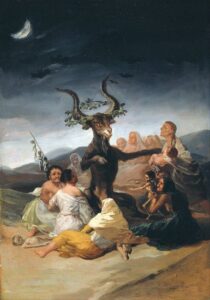
Talking of the gospel, I’ll say in my defence that I belonged to a fairly religious community of Northern Irish Protestants.  We were a paradox.  On one hand, we prided ourselves on being rational and not superstitious, seemingly unlike the Roman Catholics, with their talk about saints, visions and weeping statues; but on the other hand we believed everything that was said to have happened in the Bible because it was the Word of God.  And since the Bible said the devil existed – he did exist.  Our local clergyman confirmed this.  I remember him telling us sternly during a Sunday sermon that if you believed in the existence of God, you had to believe in the existence of the devil too.
 

From wikipedia.org


So if the devil was real, surely it followed that evil people who worshipped him by slaughtering humans and animals were also real?


During the decades since, I often wondered how my primary-school classmates got hold of those grisly stories about devil worship in early-1970s Northern Ireland.  Well, I finally found the answer when I read Black Magic and Bogeymen, a 2014 book by Richard Jenkins, Professor of Sociology at the University of Sheffield and a one-time undergraduate at Queen’s University in Belfast.  This investigates a “wave of rumours about black magic, Satanism, animal sacrifice and child abduction” that “swept across the north of Ireland in late 1973 and early 1974.”


According to Jenkins, “(b)etween 5th August and mid-December 1973, sixty-five items about witchcraft and black magic appeared in the mainstream press north and south of the Irish border: news reports, features, editorials, letters to the editor, church reports, and what appeared to be religious announcements…  Most of the reporting concerned the east of the province: Belfast and counties Antrim, Armagh and Down…  The reports peaked between mid-October and the third week in November, clustering around Hallowe’en.”


At their height, these reports seemed to reflect genuine panic in parts of Northern Ireland – adults concerned that their children might be kidnapped and sacrificed, and children generally scared witless.  (I was one of them.)  As Jenkins observes, children were also among the worst culprits for spreading the rumours.  They “seem to have actively elaborated or invented stories about bad people doing bad things” and were “likely to have contributed to the meagre ‘tangible evidence’ of supposed witchcraft and black magic practices.”


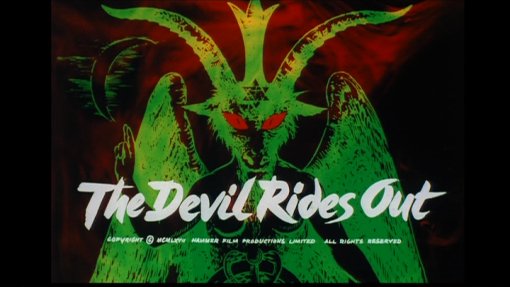
Jenkins explores the many factors likely to have fostered these stories of devil worship, black magic and ‘witchcraft’.  (My apologies to any Wiccans or other practitioners of white or pagan magic reading this, but to 1970s Northern Ireland’s Protestants and Catholics, witchcraft was devil worship and vice-versa: end of.)  He describes the heightened interest in the occult in Western culture at the time, signified by such things as the sensational black-magic novels of Dennis Wheatley and high-profile movies like Rosemary’s Baby (1968) and The Exorcist (1973).  He devotes a chapter too to “the supernatural lore that was part of the enchanted world-views that could be encountered in Northern Ireland in the early 1970s” and no doubt made some people believe the rumours more readily – supernatural lore that includes not just the ghosts, fairies and banshees that so worried my eight-year-old self, but also traditions of faith and folk healing and a great enthusiasm for celebrating Hallowe’en.


Obviously, something that casts a huge shadow over Jenkins’ subject matter is the Northern Irish Troubles.  In their fourth year when the rumours began, the Troubles had already claimed an appalling toll – 467 people killed in 1972 alone.  Jenkins discusses how “social conflicts may be symbolised and re-worked in supernatural imagery and stories, not least in threats such as witchcraft and fears of spiritual jeopardy”.  The Troubles figured in the rumours in more tangible ways too, for example, through tales of teenagers getting embroiled in the occult after “trying to contact the souls of those killed in the Troubles, using Ouija boards or other methods.”


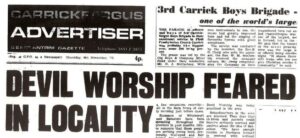
Jenkins attributes considerable blame for the scare to the province’s local newspapers, which generally reported the stories with ‘very modest facts’ that were ‘inflated and misrepresented’, ‘framed with unconnected material’ and ‘ornamented by apparently authoritative, if somewhat imprecise, anonymous information.’  Admittedly, those newspapers were under massive pressure.  A few years earlier their main stories had been about ‘livestock sales’ and ‘the Women’s Institute’ but now they were regularly covering ‘intimidation, murder and mayhem.’  Thus, standards weren’t high among their beleaguered journalists.
 

© Carrickfergus Advertiser


Fascinatingly, another possible culprit identified is the British Army, which depending on your political viewpoint was then in the province as protectors or oppressors, as peacekeepers or occupiers.  Jenkins provides evidence suggesting the army was happy to stir the pot of black-magic rumours.   It conducted ‘black propaganda’ operations promoting the belief that, yes, diabolical things were going on and religious and / or superstitious Northern Irish parents should keep their offspring off the streets at night.  On those streets, they were actually unlikely to tangle with devil worshippers; but they could tangle with paramilitaries or the security forces.


Jenkins prints an interview conducted in 1993 with the legendary Intelligence officer and ‘psychological warfare’ expert Colin Wallace, who claims he and his men went around Northern Irish properties mocking them up with magic circles, esoteric symbols, blood, bones, candles and inverted crosses to make it look like unspeakable rituals had taken place in them.


Tragically, one element in the stories was real – the child who, my classmates had told me, had been ‘cut to pieces’.   Jenkins devotes a chapter to the murder of ten-year-old Brian McDermott.  Brian was reported missing from his home in east Belfast at the start of September 1973 and his remains, ‘burned, mutilated and partially dismembered’, were discovered in the River Lagan a week later.  Although the police dismissed the idea that the murder was the result of some occult ritual, Jenkins notes how “a ‘black magic’ interpretation of the murder of Brian McDermott became an established tale of the Northern Irish Troubles.”  Officially the crime remains unsolved.  According to the journalist Martin Dillon, British Army Intelligence suspected the killer as being John McKeague (himself killed in 1982), one of the conflict’s most notorious and feared loyalist terrorists.  However, the fact that McKeague was in prison at the time of the murder casts doubt on his culpability.


Richard Jenkins conducts his investigations with academic thoroughness, analysing certain stories and rumours from different perspectives as he goes through the various actors in the drama – the Troubles, religion, superstitious belief, the media, the army, etc.  His approach is exhaustive and may seem exhausting to the casual reader.  However, I found Black Magic and Bogeymen fascinating – well, I was there at the time – and it’s surely the last word on the subject.


Returning to my own experience, I recall being asked in December 1973 if I wanted to go to the Christmas pantomime being held at Enniskillen High School and telling my parents flatly that no, I didn’t, because Enniskillen was full of witches and devil worshippers.  My Dad went ballistic at me for believing such ‘a pack of nonsense’ and then demanded to know who’d told me those stories.  I gave him the names of my guilty classmates.  “More fool you,” he raged, “for listening to them slabbering eejits!”  And that was that.  I stopped worrying and agreed to go to the pantomime.  Somehow, that angry burst of rationality from my Dad cured me of my fears.


Surprisingly, decades later, I remember my Dad – who originally hailed from Country Cavan in the Irish Republic – having a whiskey with an old Irish friend.  The pair of them started talking about their childhood in the Irish countryside and how, once the sun went down, their family members would tell ghost stories.


“I’m not kidding,” marvelled my Dad.  “After dark, you’d be too terrified to step outside the house.”


“I think,” said his friend, “that was why they told us them stories.”


Which proves I wasn’t the first member of the family to be troubled by tales of ghosts, fairies, banshees, black magic and bogeymen.
 

© Hammer Films / Seven Arts Productions / 20th Century Fox

Happy belated birthday, Patrick


© Pan Macmillan


A month ago, I planned to post something on this blog in honour of the great Irish writer Patrick McCabe, who celebrated his 70th birthday on March 27th.  Somehow, though, I forgot all about it and the Happy-Birthday-Patrick post didn’t appear.  I must have been distracted by something else near the end of March – probably the latest atrocity or lunacy perpetrated by Donald Trump’s administration in the USA.  I can’t remember what.  The atrocities and lunacies have come thick and fast since the Orange Jobby’s inauguration as the 47th American president and it’s impossible to keep track of them.


Anyway, here’s that post now.  Be warned that it contains many spoilers for McCabe’s books.


Patrick McCabe hails from the town of Clones (pronounced ‘klo-nis’, not as in the 2002 Star Wars movie Attack of the Clones) in County Monaghan, just over the border from Northern Ireland.  Clones is famous as the birthplace of boxer Barry McGuigan, known during his pugilistic career as ‘the Clones Cyclone’, though I suspect McCabe was more intrigued by the exploits of another famous, or infamous, native of the town, Alexander Pearce, the convict, serial escapee and alleged cannibal who was hung in Van Diemen’s Land (now Tasmania) in 1824.


Clones and the surrounding countryside are obviously influential on McCabe’s writing and that explains some of the affinity I feel for it – Clones is only a 35-minute drive from Enniskillen in County Fermanagh, where I was born and went to school. Though Clones is in the Irish Republic and Enniskillen is in Northern Ireland, part of the United Kingdom, and as a result the political and cultural vibes aren’t quite the same, there’s nonetheless much in his books I can relate to: how his characters think, behave and speak and how they deal with, or fail to deal with, the frustrations and absurdities that their environment assails them with.


Also, McCabe’s books can be very funny and very dark, frequently at the same time.  If there’s anything I find irresistible, it’s the combination of humour and darkness, done well.


The most famous of McCabe’s books is 1992’s The Butcher Boy, which won the Irish Times’ Irish Literature Prize and was shortlisted for the Booker Prize.  Like Alasdair Gray’s Lanark (1981) and Irvine Welsh’s Trainspotting (1993), it made such a splash that it both overshadowed his other works and became the measuring stick against which they were all compared.  However, while Lanark and Trainspotting were Gray and Welsh’s first published books, The Butcher Boy was McCabe’s fourth.  It followed the children’s book The Adventures of Shay Mouse (1985) and the novels Music on Clinton Street (1987) and Carn (1989).  That last book is set in a small Irish town, the Carn of the title, that’s clearly a fictional stand-in for Clones and it’s the only one of his early works that I’ve read.


© Picador Books


Actually, I read Carn after I’d read The Butcher Boy, and for a long time I thought it was published after The Butcher Boy too.  Maybe Carn feels like a subsequent book because The Butcher Boy is set in the early 1960s, while Carn’s plot spans the 1960s, 1970s and 1980s.  Amusingly, late on, McCabe describes how the townsfolk of Carn have become addicted to the brash American TV soap opera Dallas (1978-91) and are talking about J.R. Ewing and co. as if they’re real people.


Carn tells the tale both of two women, Sadie and Josie, who are trapped in the town in different ways – one drudges in the local meat-packing factory, the other is an outcast who returns after a long exile – and of the town itself, experiencing economic growth in the 1960s, witnessing nearby Northern Ireland going insane in the 1970s, and suffering economic decline in the 1980s.  At one point, Josie reflects on the changes, on how “a huddled clump of windswept grey buildings split in two by a muddied main street, had somehow been spirited away and supplanted by a thriving, bustling place which bore no resemblance whatever to it.”  Carn isn’t McCabe’s best work, but its blend of sadness, tenderness, bleakness and humour makes it an interesting blueprint for what was to follow.


The Butcher Boy is a more claustrophobic read than Carn because we’re stuck inside the head of its main character, psychotic youngster Francie Brady.  Told by Francie in the first person, we quickly realise he’s an unreliable narrator.  Indeed, the opening line spells it out: “When I was a young lad twenty or thirty or forty years ago I lived in a small town where they were all after me on account of what I done on Mrs Nugent.”  This isn’t unreliable narration in the style of Kazuo Ishiguro where it gradually dawns on you that the reality isn’t quite as it’s being presented.  It’s unreliable narration where you know fine well the vile and cruel things that are really going on, despite Francie’s deluded blathering, and you read on with (metaphorically) your fingers over your eyes, waiting for the excruciating moment when the penny finally drops.


This happens several times.  Francie’s friendship with a comparatively normal lad called Joe Purcell clearly frays much more quickly than Francie thinks it does.  Francie clings to the belief they’re best buddies even when it’s obvious Joe is repelled by the sight of him.  Also, after the deaths of his parents, Francie becomes obsessed with a story he’d heard from his father, Benny, about their honeymoon in the seaside town of Bundoran.  As Benny told it, he and Francie’s mother were young, beautiful and blissfully in love.  We just know from what we’ve seen of Benny, a drunken brute of a man, that the reality was horribly different.  Francie, though, believes in the ideal until he finally goes asking questions at the Bundoran boarding house his parents stayed in.  Only then does he realise the hideous truth.


© Picador Books


Worst of all is an earlier episode where Francie calms down for a while, works in the local abattoir and lives at home with Benny, who’s – supposedly – still alive at the time.  But Benny is oddly subdued and it’s evident to the reader that he’s died of alcoholism and is slowly decomposing into the sofa.  Francie, in his madness, doesn’t twig on until several months later when the police come calling.


Incidentally…  No disrespect to Patrick McCabe, but I have a wee quibble about the book’s continuity.  Francie mentions watching that hoary old American sci-fi TV series Voyage to the Bottom of the Sea, which was produced by Irwin Allen and ran from 1964 to 1968.  But the book’s later action takes place against the potentially-apocalyptic background of the Cuban Missile Crisis, which occurred in 1962, two years before Voyage to the Bottom of the Sea debuted on television.  Maybe McCabe was thinking of the movie that inspired the TV show, released in 1961?


In 1997, The Butcher Boy was filmed by Neil Jordan, a writer-director who with movies like Angel (1982), Mona Lisa (1986) and The Crying Game (1992) has a knack similar to McCabe’s for taking the dreary and mundane and creating something out-of-the-ordinary with it.  Though with Jordan, what’s created is closer to magical realism.  With McCabe, it’s gothic.  The film follows the book fairly faithfully, with a few small embellishments – I liked Sinead O’Connor cameoing as the Virgin Mary.  However, just by being a film, it’s a less suffocating experience, as we’re seeing events as bystanders, not inside from the cockpit of Francie’s head.  Incidentally, McCabe appears among the cast playing the town drunk, Jimmy the Skite.


© Picador Books


I’ve read claims that Francie’s mental unravelling is meant to symbolise Ireland’s fragile and precarious sense of identity, moving from colonial status to independence and having to navigate such momentous events as the permissive swinging 1960s and the Troubles in Northern Ireland.  But to me McCabe’s next book, The Dead School (1995), is more obviously about that.  It pits Old Ireland – represented by Raphael Bell, the pious, patriotic and upstanding master of a boys’ boarding school – against Young Ireland – represented by Malachy Dudgeon, a product of a dysfunctional family and a member of a younger, less conservative and more fun-loving generation than Raphael’s.  Malachy becomes a teacher and ends up working at Raphael’s school, with disastrous consequences for both of them.  Later, when their paths cross again, things are even worse – one is mad, the other an alcoholic.  The Dead School describes a collision of two different eras, and two antagonistic Irish mindsets, and the result is as unpretty as The Butcher Boy.


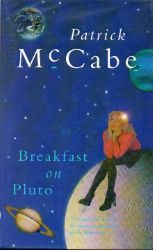
After the darkness of those two books, I was ready for Breakfast on Pluto (1998), which also made it onto the Booker Prize shortlist.  This recounts the early-1970s adventures of Patrick ‘Pussy’ Brady, described in contemporary reviews as a ‘gay transvestite’ though now I suppose she’d be called a transwoman.  Pussy leaves her Irish hometown and heads to London in search of her biological mother, who’d abandoned her when she was a baby.  Overshadowing everything are the Troubles that have recently bloodily erupted in Northern Ireland and are making their presence felt in London too, thanks to bombing campaigns by the IRA.  With Irish terrorist violence on the menu, Breakfast on Pluto may not sound a barrel of laughs, but I found it hilarious thanks to Pussy’s droll way of describing things.  I also found it curiously uplifting.  Despite having many indignities inflicted upon her, Pussy is a trooper who keeps on going.


Breakfast on Pluto was filmed in 2005, again courtesy of Neil Jordan.  The movie version is a bit too long and episodic, but it’s mightily enjoyable and has a lighter, breezier feel than the book.  Cillian ‘Oppenheimer’ Murphy plays the main character, whose name is changed from ‘Pussy’ to the less provocative ‘Kitten’.  This is one of several alterations Jordan makes.  Kitten’s first lover – whom McCabe depicted as a crooked Irish politician in the mould of Charles Haughey – becomes a singer in a rock band, played by Gavin Friday, real-life singer of the Virgin Prunes.  And generally, Jordan glams things up with some pleasantly nostalgic references to early-1970s popular culture.  For instance, the film features both Wombles and Daleks, which I don’t recall being in the original.  McCabe has a cameo in this too, playing a schoolteacher who freaks out when the young Kitten asks him for advice on how to have a sex change.  Sadly, though, Breakfast on Pluto is one of Jordan’s more underrated and neglected films.


© Picador Books


A year after Breakfast on Pluto, McCabe published a short-story collection, Mondo Desperado. The stories’ titles, like My Friend Bruce Lee, I Ordained the Devil and The Boils of Thomas Gully, tell you what to expect – more of that inimitable McCabe cocktail of the humdrum, absurd, grotesque, macabre and howlingly funny.  Deserving special mention is the opening story, Hot Nights at the Go-Go Lounge, which memorably begins: “It’s hard to figure out how in a small town like this a mature woman of twenty-eight years could get herself mixed up with a bunch of deadbeat swingers, but that is exactly what happened to Cora Bunyan and I should know because she was my wife.”


After that, I lost track of McCabe’s books for a while.  To date, there’s been seven more I haven’t read: Emerald Gems of Ireland (2001), Call Me the Breeze (2003), Winterwood (2006) – which Irvine Welsh reviewed admiringly in the Guardian – The Holy City (2009), Hello and Goodbye (2013), The Big Yaroo (2019) and Poguemahone (2022).  A few years back, however, I did read his 2010 novel The Stray Sod Country, which I thought was wonderful.  It features another of McCabe’s exquisitely-drawn Irish small towns.  This time, the action takes place mostly in the late 1950s, around the time of the launch of Sputnik 2 in 1957 and the Munich air disaster in 1958 – though there are jumps forward in time to add perspective to the 1950s-set plot.


The Stray Sod Country has an omniscient and sinister narrator.  This, we learn, is a malevolent supernatural being called a fetch, which has a dismaying fondness for entering the minds of humans, corrupting them and encouraging them to do harm to others.  Sneakily, the fetch foments and escalates feuds between the townspeople.  Thus, for example, a rivalry, then hatred, develops between Golly Murray, wife of the town’s barber, and Blossom Foster, wife of its bank manager.  Meanwhile, in a fit of priestly jealousy worthy of Father Ted (1995-98), local cleric Father Hand fulminates against his old rival Father Peyton, ‘the infuriatingly smug Mayo toady’, now a ‘celebrity priest of Hollywood, America’ who associates with Frank Sinatra.  But he’d be better advised to worry about a disgraced schoolteacher called James A. Reilly.  Father Hand had him run out of town for kissing a male pupil.  Reilly is living as a vagrant in the nearby bog, nursing his wrath whilst in possession of an Enfield rifle from the Irish Civil War, and he’s fertile ground for the fetch.


I felt McCabe portrayed the cast of small-town eccentrics populating The Stray Sod Country with more affection than usual.  And he seemed to have a genuine love for the time and place depicted.  Perhaps the great man was mellowing with age?


So, I wish Patrick McCabe all the best as he enters his eighth decade.  Barry McGuigan may be the Clones Cyclone, but in literary terms McCabe is the Clones Hurricane – a hurricane of the homespun, the hideous and the hilarious.


© Bloomsbury Publishing

Nostalgic wallows 3: the Ritz Cinema, Enniskillen


From Old Enniskillen / © Neil P. Reid


Two things inspired me to write this.  Firstly, I recently discovered that the Ritz Cinema in Enniskillen, Northern Ireland, began business in 1954, making 2024 the 70th anniversary of its opening.  Secondly, I discovered that the Walt Disney live-action movie The Island at the Top of the World, the first film I saw in the Ritz or in any cinema, was released in 1974 – a half-century ago.


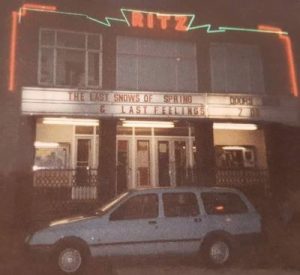
The Ritz was located on Enniskillen’s Forthill Street, next to the Railway Hotel and opposite and along from the local ‘mart’, as agricultural markets are called in Ireland.  It struck me as a distinctive building during my visits to Enniskillen.  I usually accompanied my mum on shopping trips, though she didn’t bring me to traipse around the shops with her.  The town centre, with the main shops, was a control zone, which meant if you parked your car there you needed to leave someone sitting inside it.  The 1970s were the most violent years of Northern Ireland’s Troubles, with the province’s retailing areas under threat from car-bombs. The security forces reasoned that if parked cars had people inside them, they were unlikely to be rigged to explode.  So that was my function – to prove our car wouldn’t blow up while my mum was shopping.


Anyway, the Ritz’s façade was a two-storey rectangle of red brick, with three archways at street level opening into a narrow veranda before the building’s entrance-doors, and with three big windows above.  It was particularly striking when lit at night.  Its upper half acquired an Art Deco-like frame of illuminated red and white neon, with the name ‘Ritz’ emblazoned in red capitals at the very top.


From an early age I was eager to get inside this mysterious and exotic-looking building, but there were problems.  I lived in a village called Kilskeery that was nine miles from Enniskillen.  To see a film in the Ritz one evening, I’d have to persuade my parents to make an 18-mile round-trip – or 36 miles if they took me, returned home and then went to collect me again when the film was done.  And unfortunately my parents weren’t film enthusiasts.  My mum had last gone to the ‘pictures’, as they were called in those days, to see a Tarzan movie.  I suspect it’d been one of the late-1950s series starring Gordon Scott as the yodelling, loincloth-wearing, vine-swinging jungle man.  My dad, meanwhile, never hinted at when he’d last been in a cinema.  He didn’t call it going to the ‘pictures’ but to the ‘flicks’ – an even older term dating back to the 1920s, when silent, black-and-white films had flickered on the screens. So I assumed it’d been a long time ago indeed.


© Walt Disney Productions / Buena Vista Distribution


As I grew older and read the What’s On pages of the local newspaper, the Impartial Reporter, and saw the films that were showing at the Ritz, I waged a verbal war of attrition against my parents, begging them to let me go to the cinema to see such items as Bedknobs and Broomsticks (1971), The Poseidon Adventure (1972), The Golden Voyage of Sinbad (1973), Disney’s animated version of Robin Hood (1973) and Roger Moore’s first Bond move, Live and Let Die (1973).  Long before the Internet and YouTube, my only idea of what those films were like came from brief clips of them I’d seen on a kids’ TV quiz-show called Screen Test (1970-84), in which the contestants would watch excerpts from films, including newly-released ones, and then answer questions about them that tested their powers of observation and memory.  The clips, predictably, were gathered from the films’ most exciting bits, which convinced me they were equally exciting for their entire running times and were thus the best things ever.


In the mid-1970s, having seen a bit of The Island at the Top of the World on Screen Test, and read in the newspaper that it was about to play at the Ritz, I resumed my pleading – and, finally, my parents gave in.  Or rather, they talked my Uncle Robin into taking me to see it.  I got what I wanted, and my parents didn’t have to go anywhere near the Ritz themselves, so it was a win-win solution.  Except, of course, for Uncle Robin.  My mother’s younger brother, Robin was a kindly and infinitely patient man, who usually got saddled with having to amuse and entertain the kids at family get-togethers.  He had to listen to an immense amount of rubbish from me – I’d bombard him with questions like, “If Mytek the Mighty from the Valiant comic had a fight with the crew of the Seaview from Voyage to the Bottom of the Sea, who would win?”  (More than 30 years later, on the day of my mother’s funeral, I noticed my young niece and nephew instinctively making a beeline for him.  Nothing’s changed, I thought.)


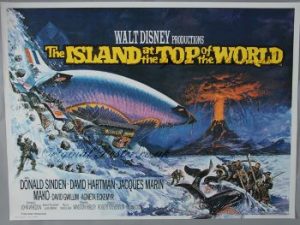
The fateful evening arrived.  Uncle Robin escorted me into the Ritz and bought  us tickets for balcony seats.  And The Island at the Top of the World, a piece of undemanding hokum in which a crusty Englishman played by  Donald Sinden charters an airship, travels to the North Pole in search of his missing explorer son, and discovers a lost world heated by volcanic activity and populated by Vikings, became the first film I ever saw in a cinema.  Well, actually, it wasn’t the first film.  No, that honour belongs to a documentary, whose title I don’t remember, about Ghana.


In the 1970s, going to the cinema in the United Kingdom – Northern Ireland was and still is a part of the UK, though a contested part – was an endurance test.  The main film, the one you’d paid money to see, came at the end of what was innocuously called a ‘full supporting programme’.  This programme usually consisted of a couple of tedious documentaries, travelogues or ‘experimental’ short films, ‘quota-quickies’ that were apparently made and shoehorned into cinema schedules as a way of keeping British filmmaking personnel in employment and keeping the British film industry alive.  So, totally desperate to see some Donald-Sinden-in-an-airship-versus-Vikings action, I had to sit through a very dull documentary about modern-day Ghana.  Then came a weird dialogue-free short film about two boys tormenting each other on the roof of a block of flats, which even my mild-mannered Uncle Robin, normally reluctant to criticise, said was a load of rubbish.


With all that out of the way, surely now Donald Sinden and his airship would be swooping up to the North Pole to take on those pesky Vikings.  Right?  Wrong.  Presaged by the irritating, parping Pearl and Dean music, there followed a bunch of crackling, washed-out-looking commercials for eateries, car dealers and other businesses in Enniskillen – all, we were assured, just “yards from this cinema.”  At some point too, the houselights came on and we were exhorted to go down to the front and buy some confectionary from the usherette.  And furthermore,  there were the trailers for forthcoming films to get through…


© Hammer Films / Shaw Brothers


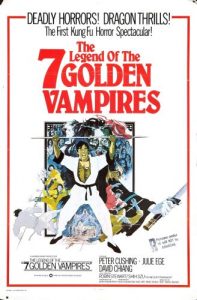
In fact, for me, the trailers were one of the evening’s highlights.  In 1970s Northern Ireland, at least, it was common practice for cinemas to show trailers for AA-rated (14 plus) and even X-rated  (18 plus) movies before screenings of ones deemed suitable for all ages, like the Disney production we’d come to see.  So, the Ritz aired a trailer for the Shaw Brothers / Hammer kung fu-horror film Legend of the Seven Golden Vampires, which was on the following week.  In this, Count Dracula relocates to 19th century China and takes over a cult of Chinese vampires.  Dracula’s old enemy Van Helsing and a team of local martial-arts experts have to hunt the bloodsuckers down.  I thought this trailer was the best two-and-a-half minutes of celluloid I’d laid eyes on.  I mean, kung fu fighting and vampires!  When veteran horror star Peter Cushing shouted to martial arts expert David Chan, “Strike at their hearts!”, I wanted to punch my hand in the air and shout, “YES!”


Even after that, it still wasn’t time for The Island at the Top of the World.  This was because Disney had released it as the second part of a double-bill, the first part being a 25-minute cartoon called Winnie the Pooh and Tigger Too.  But I found the Pooh cartoon entertaining.  And then, at long last, Donald Sinden boarded his airship and flew to the Viking-infested North Pole.  Like nearly all the films I saw in a cinema at an impressionable young age, I thought the movie was awesome – though no doubt if I watched Island now, it would seem a lot less good.  (In the 50 years since, I’ve avoided watching it again for that reason.)  I walked out of the Ritz that evening feeling exhilarated – though the stuff about Ghana and the weird kids on top of the block of flats left me feeling slightly bemused too.


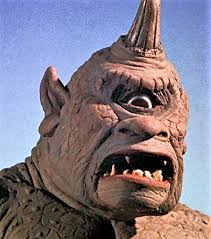
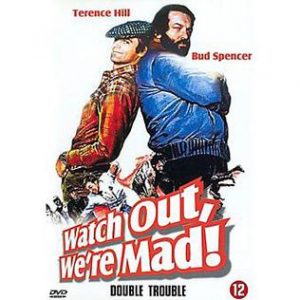
My second visit to the cinema was to see the 1975 re-release of The Seventh Voyage of Sinbad (1958), which featured monsters brought to life by the stop-motion-animation of special-effects wizard Ray Harryhausen.  It was a lot easier to persuade my parents to let me go to this one.  Noting that the Railway Hotel was next door to the Ritz, my Dad arranged to meet a farming mate (who’d done business earlier in the mart across the road) in the hotel bar.  He dropped me at the cinema entrance, had a chat and a drink with his mate, and picked me up afterwards.  In fact, Seventh Voyage was also part of a double-bill – the other half being the Italian comedy Watch Out, We’re Mad!, in which comic duo Bud Spencer and Terence Hill (real names Carlo Pedersoli and Mario Girotti) defended a funfair and its staff against some Mafia-type gangsters.  This involved much comic fisticuffs and slapstick violence.  It hardly constituted Kubrickian cinematic brilliance, but it seemed to my 10-year-old self the best movie ever.  Also, though I’d watched Ray Harryhausen’s giant animated creatures on TV before, it was epic seeing  them in Seventh Voyage on a big screen.  So, I left the Ritz feeling well-satisfied that evening too.


© Morningside Productions / Columbia Pictures

© Columbia Pictures


To make things even better, the trailers that evening included ones for Norman Jewison’s essay in science-fictional sporting violence  Rollerball (1975), and Gary Sherman’s cannibalistic-mutants-roaming-the-London-Underground horror classic Death Line (1972).


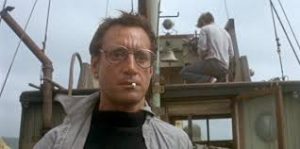
Another memorable Ritz visit came a year later when Steven Spielberg’s Jaws (1975) surfaced at the cinema.  For this, I was again entrusted to Uncle Robin.  When we got there, we were astonished to see a queue snaking back from the entrance and along Forthill Street.  “I’ve never seen a queue at the Ritz before!” marvelled my uncle.  I had a sense that something seismic was happening – which was true, for Jaws marked the advent of huge, crowd-pleasing blockbusters and special-effects-laden franchises, plus the arrival of Spielberg, George Lucas and a generation of young filmmakers happy to give the public what they wanted, big-budget-style.  It would eventually usher in the era of the multiplex cinema, which consigned the Ritz and similar small-scale cinemas to the dustbin, but more on that later.


Jaws was the first movie I saw in a cinema crammed to the bulwarks with people.  Everyone was entranced by the events on the screen.  As the communal sense of excitement heightened, their reactions became increasingly dramatic.   And with Jaws, you had John Williams’ minimalist but brilliant theme music cranking up the audience’s feeling of apprehension and dread too: Duh… Duh!  Duh… Duh!  Duh, duh, duh, duh…


When the head of the unfortunate fisherman Ben Gardner dropped into view under his wrecked boat, squishily minus an eye, the auditorium filled with a whooshing noise that sounded like a great gust of wind – and then, all that breath inhaled, it was released again as a cacophony of screams.  Later, when the shark popped his big face out of the water in front of the unsuspecting Chief Brody (Roy Scheider), prompting the famous quip, “You’re gonna need a bigger boat,” there was another chorus  of screams – though this time tempered with laughter, because the moment was funny as well as scary.  I know it has a lot to do with me being 11 years old at the time, but I can’t think of another cinematic experience in my life as exciting or visceral.


© Zanuck/Brown Company / Universal Pictures


My relationship with the Ritz ended soon afterwards, for in February 1977 my family moved from Northern Ireland to Scotland, settling close to the town of Peebles in the Scottish Borders.  In fact, we lived only half-a-mile out of the town, and because Peebles High Street was home to a cinema called the Playhouse, I was suddenly able to see new films much more often.  Tragically, this happy state of affairs lasted just seven months, for in September that same year the Playhouse closed down.  After that, the nearest cinema – also called the Playhouse – was in the town of Penicuik ten miles north of Peebles.  Hence, suddenly, my filmgoing situation became even worse than it’d been in Northern Ireland.


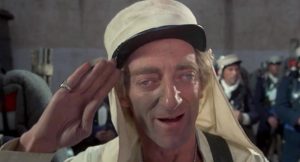
I occasionally returned to Northern Ireland to see relatives in the hinterlands of Enniskillen, so I got a few further opportunities to pop into the Ritz.  For example, I remember going to see Marty Feldman‘s spoof of Foreign Legion movies, The Last Remake of Beau Geste (1977).  I mainly remember it because a woman sitting in the row behind me would erupt into ear-splittingly loud, hysterical laughter every time the bug-eyed Feldman – who suffered from Graves’ ophthalmopathy – appeared onscreen.  That was very weird.


© Universal Pictures


During the 1970s and 1980s, TV ownership, then the invention of video cassettes and VCRs, and then the coming of multiplex cinemas – which started in 1985 with the opening of Milton Keynes’ ten-screen The Point – all contributed to the demise of small-town, single-screen cinemas in the UK.  The Ritz lasted longer than most, not shutting its doors until 1992.


Remarkably, the building – pitifully boarded up – still stands.  Or at least, it still did in 2022, which is when the image of it currently on Google Maps was taken.  The also-derelict Railway Hotel next door, where my Dad hung out after he’d dropped me off to see The Seventh Voyage of Sinbad, looks even more pitiful, closed off behind corrugated iron.  They’re monuments – melancholy ones – to the days when taking a seat in a cinema auditorium seemed one of the most thrilling moments in my life.


And when I had Donald Sinden to look forward to, voyaging in an airship to the North Pole to take on Vikings, how could it not be thrilling?


© Walt Disney Productions / Buena Vista Distribution