30 years on, it’s still the worst toilet in Scotland


© Channel Four Films / PolyGram Filmed Entertainment


Just over a year ago, I posted on this blog about the sad closure of The Projector, Singapore’s alternative cinema.  According to a statement on the cinema’s Facebook page, this was caused by “rising operational costs, shifting audience habits, and the global decline in cinema attendance,” factors that had “made sustaining an independent model in Singapore especially challenging.”  The Projector was the one venue in the city-state where you could see, on a big screen, independent and arthouse films, ones that were generally offbeat, ones focused on minorities and not necessarily made in the handful of big international languages.  It also offered opportunities to watch older movies in a cinema, for example, ones by Alfred Hitchcock, Akira Kurosawa and David Lynch.  Though sometimes it showed modern Hollywood and Chinese blockbusters too.


The Projector operated at two locations, the Cineleisure shopping mall on Grange Road and the Golden Mile Tower on Beach Road.  Happily, this year, a new cinema called The Filmhouse has started doing business in The Projector’s Golden Mile Tower premises and has a similar agenda of showing films you wouldn’t otherwise see in Singaporean cinemas.  According to Wikipedia, The Filmhouse retains “certain key team members and features” from The Projector.


Last week, I made my first visit to The Filmhouse and was pleased to find it busy.  It’s a smaller operation than The Projector with, as far as I can ascertain, just two screens, but probably that makes more financial sense – a non-mainstream cinema can’t afford to have many overheads.  The lobby contained a bar, comfortable seats and, most importantly, a relaxed and friendly ambience.



When I went into one of the halls and found my seat, I was slightly disappointed that, before the movie started, the short film warning patrons to keep their phones silent and refrain from using them during the show wasn’t the famous one used by The Projector.  That had footage from the super-schlocky Turkish science-fiction movie Dünyayı Kurtaran Adam, better known as Turkish Star Wars, and featured ‘Turkish Luke Skywalker’ training for battle by smashing his big fists repeatedly against a desert boulder.  You were warned that if you violated the cinema’s policy on phone-use, you would suffer punishment similar to that being inflicted on the rock.


Still, The Filmhouse’s anti-phone film is cute enough.  It has a brief clip of the late David Lynch telling us, “You have a very good heart.’  Then we’re asked to prove Lynch right about our hearts by turning off or muting our devices and not spoiling anyone else’s enjoyment of the movie with them.


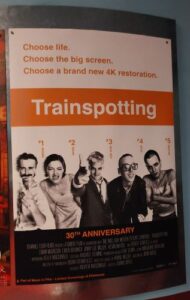
Anyway, what was the film I went to see?  It was a 30th-anniversary showing of Danny Boyle’s Trainspotting (1996), freshly spruced up for cinematic re-release.  As the movie poster’s tagline announced: “Choose life.  Choose the big screen.  Choose a brand new 4K restoration.”


At the time of its release, Trainspotting caught the zeitgeist of mid-1990s Britain, obsessed with Britpop and all things Cool Britannia.  Yes, how long ago that all seems now.  To be honest, it annoyed me in some ways that the movie got lumped in with the Britpop / Cool Britannia thing, even if the filmmakers opportunistically loaded its soundtrack with music of the time, by bands such as Pulp, Blur, Sleeper, Elastica, Leftfield and Underworld.  That said, the two songs that defined the film, Iggy Pop’s Lust for Life from 1977 and Lou Reed’s Perfect Day from 1972, had nothing to do with 1990s Britain.


To me Trainspotting sprang from an earlier, darker and less glamorous era than the one of Damien Hirst’s formaldehyde shark, Geri Halliwell’s Union Jack mini-skirt and Blur-versus-Oasis – namely, the mid-to-late 1980s, when Edinburgh’s boom in heroin use and the subsequent, resultant HIV / AIDS epidemic led to the city being dubbed ‘the AIDS capital of Europe’.


This became material for the book that inspired the film, Irvine Welsh’s novel Trainspotting (1993), which is an altogether bleaker and rougher-edged piece of work than Boyle’s cinematic version.  Though of course the film isn’t without its bleak or rough-edged moments either.  The worst toilet in Scotland, anyone?
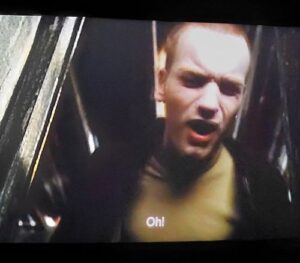
 

© Channel Four Films / PolyGram Filmed Entertainment


Still, I’m not complaining too much.  I think both Trainspotting the book and Trainspotting the movie are great and are classics in their respective fields, 1990s Scottish literature and 1990s British cinema.  But after 30 years, how would the latter work hold up?


Pretty well, I thought, though the animatronic zombie-baby that Renton (Ewan McGregor) imagines crawling across the ceiling during a traumatic ‘cold turkey’ episode looks terrible now.  Mind you, it looked ropey enough in 1996.


I wondered how, in these days of extreme anxiety about sex predators preying on children, the gag about Renton meeting Diane (Kelly Macdonald) in a nightclub, going home with her and discovering the next day that she’s still at school would come across.  Not as ickily as I feared.  Diane is clearly the one doing the manipulating and Renton is properly horrified when he learns how old she is really.  Plus, McDonald’s true age at the time, 20, means the sequence’s punchline, when Diane appears in her school uniform, is cringily funny but – thankfully – a bit unbelievable.


Meanwhile, I winced at the scene following the death of Tommy (Kevin McKidd), where a grieving Spud (Ewan Bremner) pays tribute to his late friend by singing Two Little Boys – a song popularised by, and forever associated with, the Australian entertainer, TV personality and artist Rolf Harris, who had a smash-hit with it in 1969.  In 2014, Harris hit the headlines when he was found guilty of sexually assaulting four underage girls.  But to be fair to Two Little Boys, it was around long before Harris got his hands on it.  It was written in 1903 by composer Theodore F. Morse and lyricist Edward Madden.


The Singaporean audience I saw Trainspotting with certainly enjoyed it, even though I wondered how a film about heroin addicts would go down in a country with some of the strictest anti-drugs laws in the world.  If Trainspotting had taken place in Singapore, the drug dealing characters in it like ‘Mother Superior’ (Peter Mullan) and Mikey Forrester (Welsh in a cameo) would have been executed long ago.  Much of it they found funny, which is appropriate because the film is essentially a (very black) comedy.  The Worst Toilet in Scotland sequence and the one where the hapless Spud spectacularly soils the bedsheets in the house of this girlfriend Gail’s (Shirley Henderson) parents, then manages to scatter the contents of those bedsheets across Gail, her parents and their kitchen, elicited guffaws.
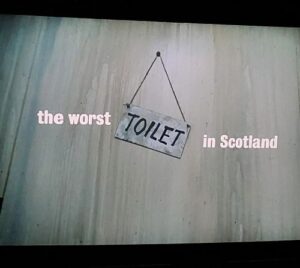
 

© Channel Four Films / PolyGram Filmed Entertainment


Also getting laughs was Renton’s famous ‘It’s shite being Scottish’ rant.  He may have hit a chord with the audience when he raged, “Some hate the English.  I don’t.  They’re just wankers.  We, on the other hand, are colonised by wankers!”  The Singaporeans, of course, were once colonised by the English too – though, technically, as part of the British Empire, they were colonised by the Scots and Welsh as well.


On the other hand, I must have been the only person in the cinema-hall chuckling during the references to and jokes about Sean Connery.  (“Do you shee the beasht?  Have you got it in your shights?”  “Clear enough, Missh Moneypenny!  This should preshent no shignificant problemsh”)  Most folk there were about half my age and I guess ‘Big Sean’ is unknown to the younger generation.


One thing I felt about seeing Trainspotting 30 years on was that now the Britpop musical soundtrack sounds quaint rather than cutting edge, and now that I know the punchlines to all the jokes about jobbies, Sean Connery and so on, its depiction of heroin addiction is more on-the-nose.  Without the film’s cultural baggage distracting me, I better perceived the horribleness of the characters’ situations.  Like when baby Dawn – whose zombie-fied form Renton will hallucinate about later – dies from neglect and her parents, Sick-Boy and Allison (Susan Vidler), after a moment’s anguish, greedily reach for the syringes, needles and smack again.  Or when Tommy – who was originally the healthiest and most level-headed of the gang – becomes ruinously addicted and, while he lies ravaged on a mattress, a conscience-stricken Renton tries to apologise for getting him hooked on the stuff.  Tommy pays the apology no heed and is interested only in getting money for his next fix.


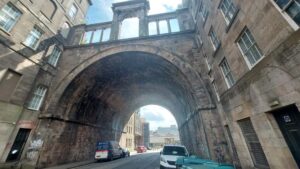
Another thing I noticed in 2026 about Trainspotting is that, for a film supposed to be the greatest one ever set in Edinburgh, you see very little of Edinburgh in it.  You have the famous opening scene where Renton, Spud and Sick-Boy try to shoplift in (the now long-gone) John Menzies bookstore on Princes Street and are chased along the thoroughfare by security, with Renton making a last, doomed break for freedom down Calton Road and under Waterloo Place.  But that’s all.  The streets, side-streets, bunker-like nightclubs, pub-interiors and blighted junkies’ dens could be anywhere.  Though that’s hardly surprising considering it was partly funded by the Glasgow Film Fund and most of it was shot in Glasgow.


Compare that with the sequel, T2: Trainspotting (2017), which was partly based on Irvine Welsh’s literary follow-up Porno (2003), also used some bits from the novel Trainspotting that didn’t get into the first film, and also featured stuff from scriptwriter John Hodge’s own imagination – like the psychotic Frank Begbie (Robert Carlyle) staging an escape from Saughton Prison.  In T2, you get to see the Royal Mile, the Grassmarket, Cockburn Street, Harvey Nichols, the Scottish Parliament, the tram system, the Forth Road Bridge and Salisbury Crags.  It’s practically a love-letter to the Scottish capital.


Still, a few months ago, I was in Edinburgh and found myself walking down Calton Road.  And my immediate reation was, “Hey, this is where Ewan McGregor ran and got caught in Trainspotting!”  So one little piece of the city, at least, was immortalised by the original film.
 

James Bond Island


© Eon Productions / United Artists


A while ago, my partner and I holidayed in the town of Khao Lak, 60 kilometres from the southeastern Thai resort of Phuket.  We saw a brochure for a boat tour in the nearby Ao Phang Nga National Park, which encompasses a large, island-strewn bay in the Andaman Sea.  Among the islands visited by the tour was Khao Phing Kan, a location used during the filming of the 1974 James Bond film, The Man with the Golden Gun.  It’s now popularly known as ‘James Bond Island’.


Regular readers of this blog will know I’m a connoisseur of all things Bond-related, especially the movies and the original books written by Ian Fleming.  So, could I resist an opportunity to visit James Bond island?  Of course not.


Not, I should add, that I’m a fan of The Man with the Golden Gun.  I think it’s one of the worst films in the Bond franchise.  It has Roger Moore in the main role, in only his second outing as 007 but already looking tired – you’re already waiting impatiently for him to regenerate into Timothy Dalton.  It has Britt Ekland, required to fill out a bikini but not to do any acting.  It has Hervé Villechaize as diminutive henchman Nick Nack (“Dom Perignon soixante-quatre”) – according to Moore, Villechaize was a lecherous wee pain-in-the-neck in real life.  It has Clifton James as redneck comedy-relief American policeman Sheriff Pepper, who happens to be holidaying in Asia when he bumps into Bond – he refuses to have his picture taken with a local elephant, telling Mrs. Pepper: “We’re Demy-crats, Maybelle!”  Democrats?  That’s a surprise.  And it has Lulu hollering the inuendo-riddled theme song: “He’s got a powerful weapon / He charges a million a shot!”


In fact, there are only two good things in The Man with the Golden Gun.  One is its villain, the impeccable Christopher Lee as the super-hitman Francisco Scaramanga: “Come, come, Mr. Bond. You disappoint me.  You get as much fulfilment out of killing as I do, so why don’t you admit it?”  The other is the spectacular scenery.  Scaramanga’s island hideaway is supposed to be in waters belonging to ‘Red China’, but the sequence where Bond approaches it in a seaplane was filmed in Ao Phang Nga National Park, with Khao Phing Kan standing in for Scaramanga HQ.


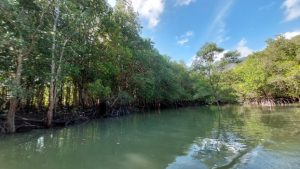
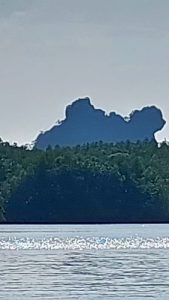
Even if I had hated James Bond Island, the boat trip out to it, which first involved traversing a warren of creeks with mangrove trees cramming their sides, and then passing some of the bay’s islands – giant, towering rocks, their summits and all but their steepest slopes cloaked tightly in trees – was enough to make the day worthwhile.  Those islands, which’d looked pretty spectacular during The Man with the Golden Gun’s airborne scenes, with the cameras tracking Bond’s seaplane, seemed absolutely awesome when I was looking up at them from sea-level.  Among the things I compared the fantastic shapes of these islands to in my notebook entries that day were: ‘fangs’, ‘ruined, vegetation-shrouded fortresses’, ‘herds of grazing prehistoric beasts’, ‘monstrous haystacks’, ‘mossy tombstones’ and ‘giant standing stones’.  We passed one vaguely curved island with curious round protuberances on either side, like ears.  Our guide said it was nicknamed ‘The Dog’.


As it turned out, we spent just 25 minutes on James Bond Island, which felt an adequate length of time.  It was very busy with tourists.  We guessed as much when we approached it and saw the great number of long boats, with varnished hulls and club-shaped bows, lined along its landing area.  If Scaramanga was around today, he’d be erecting angry signs saying GET OFF MY LAND in response to the hordes of visitors.  Maybe even firing volleys of his legendary golden bullets at the trespassers.


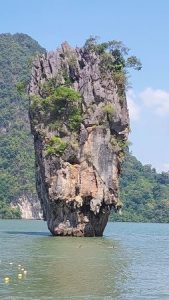
Despite the crowds, I was delighted to see Ko Ta Pu, the 20-foot-high, precarious-looking limestone rock that stands off the island’s shore and is shaped like an extracted tooth.  In The Man with the Golden Gun, Scaramanga – who, unconvincingly, is depicted as a pioneer of green energy as well as a deadly hitman – has solar panels extend up from the top of Ko Ta Pu and collect enough sun’s energy to power an energy-beam gun, with which he destroys Bond’s seaplane.  Getting a photo of this remarkable stub of rock was difficult, with so many people posing for selfies in front of it.  But I managed in the end.


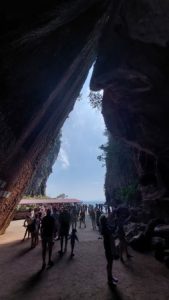
The island’s other striking feature is a huge, triangular opening behind the main beach, caused by seismic action. A giant slab of rock apparently broke free and ended up tilting steeply against the rest of the rock-mass there. Beneath it, looking up at its bulk and angles, you have a lurking fear it could topple the rest of the way and pulverize everything below, you included.  It was here that we incurred the wrath of a large, bikinied and ignorant Western woman who’d been posing lasciviously for multiple photos in front of the formation and didn’t appreciate us strolling into her camera-frame.


As well as being infested with tourists, the island’s main beach was infested with stalls selling tourist tat.  I was disappointed that no 007-themed merchandise was on sale – not even replicas of Christopher Lee’s golden gun.  I guess then-Bond-producers Cubby Broccoli and Albert Saltzman refused to license the Bond brand to the Thai tourist authorities and the vendors here could sell only generic, er, nick-nacks…  Weirdly, one Western-movie item that was on sale were figurines of Groot, the tree-like creature that features in the Guardians of the Galaxy (2014-23) movies.  That’s because if you look at Ko Ta Pu long enough, you begin to see its resemblance to the head of Groot.


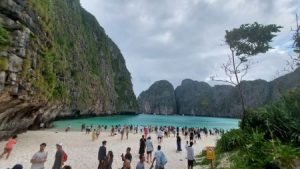
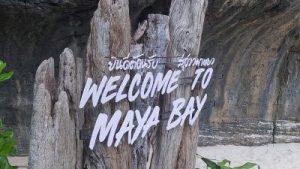
In fact, Khao Phing Kan, James Bond Island, wasn’t the only movie-connected island we visited in the Andaman Sea.  A few days later, we went on a second boat trip, this time to the Phi-Phi-Phi Islands south of Ao Phang Nga National Park.  One of the stops we made there was at Ko Phi Phi Lee, home to the now-famous Maya Bay.


© Figment Films / 20th Century Fox


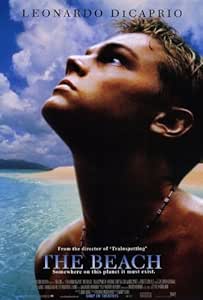
This was where in 2000 Danny Boyle filmed The Beach, based on the 1996 novel of the same name by Alex Garland.  This movie was troubled in a couple of different ways.  Originally, Ewan McGregor was lined up to star in it but, to his disgust, he was ultimately passed over in favour of Leonardo DiCaprio, then seen as a much more bankable actor because he’d played the hero in James Cameron’s world-beating Titanic (1998).  This led to McGregor falling out with Boyle and the pair didn’t talk to each other for many years afterwards.  More seriously, it was alleged that during production the filmmakers caused serious damage to Maya Beach’s ecosystems by ‘landscaping’ – i.e., bulldozering – part of it to make it more ‘paradise-like’.


We arrived at the northern side of Ko Phi Phi Lee and disembarked onto a precariously swaying, floating quay.  Then, filing along a slightly elevated wooden walkway – no doubt there to prevent the sand, soil, rocks and plants being pulverized under the feet of countless visitors – we made our way into the island’s interior.  The walkway was divided into two narrow lanes, with tourists streaming along in both directions.   It arrived at a wider wooden platform in the middle of the island, where there were facilities such as toilets, souvenir stalls and eateries and where you could step down onto the surrounding ground.  Two further walkways bifurcated off on its far side, both leading to the bay.  We followed the slightly less busy one.


Maya Bay itself was certainly picturesque, its white sand and turquoise water encircled by high cliffs and crags.  But it swarmed with the inevitable tourists, taking the inevitable photos and selfies.  Our guide told us we should visit it at the time of Chinese New Year.  Then, apparently, it gets really busy.


Although The Beach received middling reviews, it was reasonably successful – enough for it to cause the heavy tourist traffic to Ko Phi Phi Lee and Maya Beach.  Things got so bad that in 2018 the Thai government banned all tourists from it, so that work could be done to restore its now-shattered environment.  It wasn’t reopened to visitors until 2022, at the tail-end of the Covid-19 pandemic.  Tour groups, like ours, are allowed only an hour on the island, and it also gets a two-month, tourist-free breather every year, from August 1st to October 1st.


This makes me wonder what would have happened if Danny Boyle had made The Beach with Ewan McGregor, rather less of a draw than Leonardo DiCaprio.  (Sorry, Ewan.)  It would have meant: (1) a less successful film, seen by fewer people; (2) fewer tourists flocking to Maya Bay, which would have put it under less environmental strain; and (3) Trainspotting 2 (2017) being made years earlier than it was, because Boyle and McGregor would never have fallen out and then needed ages to make up.  Win-win all round, I’d say.


Cinematic heroes 6: James Cosmo


© Icon Productions / Ladd Company / Paramount Pictures 


I’ve just realised that it’s the 30th anniversary of the release of Mel Gibson’s woad-slathered and not-entirely-historically-accurate epic Braveheart (1995).  This was the movie that added the battle-cry “FREEE-DOM!” to the chorus of things you hear outside Scottish pubs at closing time (along with “SHUT YER PUSS!” and “I’M OOT MA FACE!”).  Thus, it seems an appropriate time to post this tribute to one of the very best things in Braveheart, James Cosmo.


I’ll make no bones about it.  I f**king love the mighty Scottish character actor James Cosmo.


These days the hulking, craggy and formidable Cosmo – whose visage is usually bedecked with long white tresses of hair and a moustache that on anyone else would suggest ‘ageing hippy’, but on him suggest ‘someone you really don’t want to mess with’ – seems most familiar when he’s clad in armour and wielding a broadsword.  He’s carved a profitable niche for himself playing characters in movies and TV shows set in the ancient world, the Middle Ages and medieval fantasy lands, such as Highlander (1986), Braveheart (1995), Ivanhoe (1997), Cleopatra (1999), Troy (2004), The Lost Legion (2007), Game of Thrones (2011-2013), Hammer of the Gods (2013), BenHur (2016), Outlaw / King (2018) and The Last Redemption (2024)  However, Cosmo, who was born in Clydebank and attended the Royal Scottish Academy of Music and Dramatic Art and the Bristol Old Vic Drama School, worked long and hard on television before he cornered the market for playing grizzled bear-like warriors in historical and fantasy epics.


He earned his acting spurs during the 1960s, 1970s and 1980s in a long line of TV shows and TV plays.  The better-known titles he appeared in include Doctor Finlay’s Casebook (1965 & 69), Softly Softly (1969), UFO (1971), The Persuaders (1971), Sutherland’s Law (1972), Quiller (1975), Survivors (1976), George and Mildred (1977), The Sweeney (1978), The Onedin Line (1979), The Professionals (1979), Strangers (1981), Minder (1984) and Fairly Secret Army (1984).  The most distinguished TV productions from this time to feature Cosmo were probably Nigel Kneale’s haunted-house-cum-sci-fi-horror-story The Stone Tape (1972) – its influence is detectable in many films and TV shows made since then, including the recent In the Earth (2021) and Enys Men (2022) – and the 1974 Play for Today adaptation of John McGrath’s The Cheviot, the Stag and the Black, Black Oil, the most important piece of political theatre to surface in Scotland during the 1970s.


© Hammer Films / ITC Entertainment


I was in my mid-teens when I started to notice Cosmo as an actor.  He played a villain in an episode of The Hammer House of Horror (1980), which climaxed with him driving a cleaver into the skull of the fragrant Julia Foster, something that must have shocked those viewers who remembered her from the wholesome 1968 musical with Tommy Steele, Half a Sixpence.  That grisly scene made a big impression on me, although nothing compared to the impression it obviously made on Julia Foster.  He also appeared in 1981’s The Nightmare Man, a cheap but creepy BBC mini-series scripted by the great TV writer Robert Holmes about a mysterious killer stalking a fogbound Scottish island.  The Nightmare Man saw Cosmo in good company, as the cast also included Celia Imrie, James Warwick, Tom Watson and an equally craggy Scottish character actor, the late Maurice Roeves.


By the late 1980s Cosmo was becoming the go-to guy if you needed an imposing Scottish hard man in your production.  For example, he appeared in Brond, a 1987 Channel 4 adaptation of the novel by Frederic Lindsay, set in Glasgow and a thriller involving conspiracies and terrorism.  It tells the story of a hapless innocent, played by a very young John Hannah, who falls under the influence of the mysterious and sinister Brond of the title and ends up being accused of carrying out a political assassination.  Brond is played by the portly and menacing Stratford Johns, although Cosmo is no less intimidating as Primo, the silent, lethal hulk who acts as Brond’s henchman.  Two years later Cosmo had a similar role in the glossy Glasgow-set BBC thriller The Justice Game, in which this time he terrorised Dennis Lawson – yes, Wedge Antilles in the original Star Wars trilogy (1977-83) and real-life uncle of Ewan MacGregor.


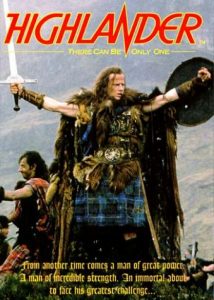
Meanwhile, in 1986, Cosmo had appeared in Russell Mulcahy’s Highlander, the fantasy movie about immortal beings feuding throughout human historyHe plays a member of the MacLeod clan in the medieval Scottish Highlands and he helps Christopher Lambert to escape when their superstitious fellow clansmen get alarmed about how, within hours, Lambert’s battle-wounds miraculously heal up.  Not only does Lambert turn out to be one of the immortals but he’s also the world’s most French-sounding Scotsman.  Later in the movie he encounters Sean Connery, who’s another immortal and also the world’s most Scottish-sounding Spaniard.  (The scene where Lambert explains to Connery what a haggis is has to be heard to be believed.)  Totally scatty, but loveable, I suspect Highlander was the movie that helped Cosmo secure the sweaty, muddy sword-and-sandals roles he became well-known for in the 1990s and 2000s.


© Thorn EMI Screen Entertainment / 20th Century Fox


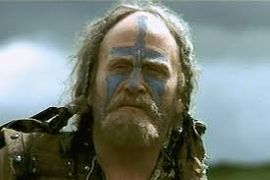
The key sword-and-sandals role for Cosmo arrived in 1995 with the Mel Gibson-directed, Mel-Gibson-starring Braveheart, in which he plays Campbell, father of Hamish, best friend to 13th / 14th-century Scottish freedom-fighter William Wallace.  Playing Hamish is the huge, ursine Brendan Gleeson, who later found fame in Michael McDonagh’s glorious 2008 comedy-thriller In Bruges.  If anyone is even huger and more ursine-looking than Gleeson and could convincingly play his dad, it’s Cosmo.  In reality, the two actors are only seven years apart in age.


Seven years old is also about the age that Isabella of France would have been in real life during the events depicted in Braveheart.  In the film, she’s played by Sophie Marceau (in her late twenties at the time), is presented as English King Edward I’s daughter-in-law and has a sizzling romance with Gibson’s Wallace.  This sums up the film’s cavalier disregard for historical accuracy.  (It also gave stand-up comedian Stewart Lee material for a routine about William Wallace being a paedophile, which he bravely delivered in Glasgow.)  The film is also anti-English to a degree that wouldn’t be acceptable against any other ethnic, national or cultural group in a Hollywood movie.  But in the film’s defence I’ll say that the battle scenes, for their time, were excellent.  And the supporting cast that Gibson assembled – Cosmo, Gleeson, Marceau, David O’Hara, Patrick McGoohan, Catherine McCormack, Angus McFadyen, Ian Bannen – is excellent too.


As Campbell Senior, Cosmo comes across as a near-unstoppable force of nature.  He gets skewered with an arrow at the initial uprising in Lanark but ignores that and carries on fighting.  He gets his hand chopped off at the Battle of Stirling but ignores that and carries on fighting too.  Even when someone embeds an axe in his stomach at the Battle of Falkirk, he keeps going long enough to deliver a moving farewell speech to Gleeson.


A year later Cosmo appeared in Danny Boyle’s Trainspotting, the movie that gave the world an equally potent image of Scotland, if a rather different one from that given by Braveheart.  In fact, Trainspotting, based on the 1993 novel of the same name by Irvine Welsh, is the modern-urban-Scottish-junkie yin to Braveheart’s heroic-medieval-Scottish-warrior yang.  In Trainspotting, he plays another dad, this time of Ewan MacGregor’s Renton character, a junkie so desperate for his next fix that he’ll crawl into the shit-encrusted bowl of the Worst Toilet in Scotland to get it.


While it’s nice to see his face in the film, Cosmo is kept very much in the background.  Gratifyingly, he got more to do when Boyle, MacGregor and the rest of the Trainspotting crew finally reunited in 2017 to make Trainspotting 2, based loosely on parts of Welsh’s original novel that were left out of the first film and on its 2002 literary sequel PornoTrainspotting 2 concludes — in an ending that radically differs from that of Porno — with Renton deciding home is the best place for him.  So he gives his now-widowed father a hug and moves into the latter’s spare bedroom (where, of course, he promptly starts dancing to Iggy Pop’s 1977 classic, Lust for Life).


© Material Pictures / Highland Midgie / Amazon Studios


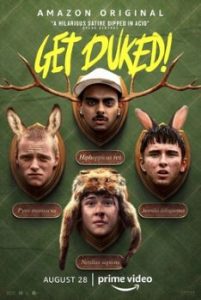
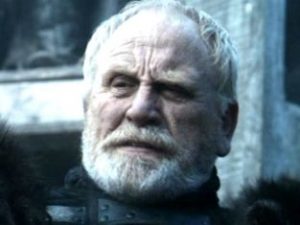
After Braveheart, Cosmo was kept busy with sword-wielding roles, including 12 episodes as Jeor Mormont in Game of Thrones.  However, he’s also become something of a fixture in recent British and Irish horror / thriller movies – he’s appeared in Urban Ghost Story (1998), Outcast (2009), The Glass Man (2011), Citadel (2012), January (2015), Dark Signal (2016), Malevolent (2018), The Hole in the Ground (2019), Get Duked! (2019), The Kindred (2022) and The Beast Within (2024).  Of these, I enjoyed the horror-comedy Get Duked! the most.  It’s the story of four lads tramping around in the Scottish Highlands whilst trying to earn their Duke of Edinburgh Award – and realising they’re being hunted by a weird pair of aristocratic psychopaths (played by Eddie Izzard and Georgie Glen).  Cosmo turns up in it as a farmer the boys encounter in the course of their misadventures.


It’s normal for secondary characters in horror films to be nothing but cannon fodder – they soon get killed off to ratchet up suspense and demonstrate the power and evilness of the monster or villain.  But Get Duked! makes those secondary characters interesting, keeps them around and has a lot of fun with them.  Which is smart because it has a splendid supporting cast: Cosmo, Jonathan Aris and, as bumbling police officers, Kate Dickie, Alice Lowe and another veteran Scottish actor, Brian Pettifer.  Despite first being sighted in a boiler suit and at the wheel of a tractor, Cosmo’s character proves to have a side not normally associated with Highland farmers.  He has a fondness for certain hallucinogenic substances and is soon grooving to a mix CD that the lads give him.


Unexpectedly, Cosmo has a further speciality, which is for playing Santa Claus.  According to his IMDB profile he’s now filled the furry boots of Saint Nick on three different occasions, most famously in the 2005 Disney version of C.S. Lewis’s The Lion, the Witch and the Wardrobe.


He’s a pleasingly ubiquitous and varied performer.  In the past decade I’ve seen him in things as different as SS-GB (2017), the BBC drama serial based on Len Deighton’s 1978 alternative-history thriller and set in a Nazi-Germany-controlled London in 1941; Wonder Woman (2017), one of the few decent DC Comics movie adaptations, in which he plays Field Marshal Douglas Haig; and the HBO miniseries Chernobyl (2019), where he’s one of the miners drafted in to dig a tunnel under the stricken plant’s melted uranium and prevent it from leaking into the Black Sea.  His IMDb page currently lists no fewer than eight upcoming projects, so clearly he’s keeping busy.  Meanwhile, on the non-acting side, he was a contestant in the 2017 series of Celebrity Big Brother and has recently been doing a speaking tour entitled An Evening With James Cosmo.


Though he’s well into his eighth decade, James Cosmo looks as daunting as ever.  His visage, bulk and general demeanour suggest a man whom you definitely don’t want to give any cheek to.  And if you are foolhardy enough to give him cheek, he’ll probably kebab you on a long rusty medieval pike and simultaneously slash your throat with a sgian dubh.  That’s the sort of guy I’d like to be when I become eligible for my bus-pass.


© HBO Entertainment / Television 360

Remember the Ally-mo


© BBC


It’s come to my attention that a football World Cup is in progress.  Time, then, to dust down and repost the following item, which surfaces on this blog every four years when the competition is underway to decide the global champions of the ‘beautiful game’.


One unsettling feature of growing older is that when an anniversary arrives and you think back to the original event, you feel shocked when you realise how much time separates now and then.  The other week, the 2022 World Cup competition began in Qatar, and it’s just occurred to me that the 1978 World Cup in Argentina took place 44 whole years and eleven whole World Cups ago.  It’s almost traumatic to realise how much time has elapsed.


However, if you’re old enough to remember the 1978 Argentinian World Cup and you were in Scotland at the time, you’ll testify that the event itself was traumatic.


For those of you who’re unacquainted with the topic…  What happened in 1978 was that of the four national football teams in the UK, Scotland was the only one to qualify for Argentina.  And the country had a team that, on paper, looked like it might achieve something.  It boasted players from some of the mightiest football clubs in Britain: for example, from Manchester United (Martin Buchan, Gordon McQueen, Lou Macari, Joe Jordan), Liverpool (Graham Souness, the legendary Kenny Dalgleish), Glasgow Rangers (Derek Johnstone, Tom Forsyth, Sandy Jardine), Nottingham Forest (Kenny Burns, John Robertson, Archie Gemmill) and, er, Partick Thistle (Alan Rough).  And in charge of these remarkable players was a manager called Ally MacLeod, who was remarkable in his own way.  Though not necessarily in the right way.


From the Independent / © Getty Images


Ally had been emboldened by wins in 1977 over the European champions Czechoslovakia and over the Auld Enemy, England.  The game against England concluded with the Scottish fans swarming onto the pitch at Wembley and digging up clods of the turf and breaking the goalposts into wee pieces to bring home as souvenirs, much to the horror of the English commentators and much to the hilarity of everyone in Scotland.  He then began to talk up his team’s chances in Argentina.  When early in 1978 Scotland failed to win the Home International championship involving England, Wales and Northern Ireland, Ally shrugged it off with the tantalising comment that the championship’s title “could be dwarfed by the World Cup.”  Such statements, and Ally’s general air of swagger and optimism – “My name is Ally MacLeod,” he announced when he became Scotland manager, “and I am a born winner!” – acted like catnip to both football fans and the hacks working on the sports pages of Scotland’s newspapers.


As the World Cup approached, a heady sense of expectation began to infect the Scottish population.  Folk started to believe that the Argentinian World Cup would be a jamboree of Scottish footballing genius, culminating in Ally and the gang lifting the trophy.  No wonder a carpet company cannily signed Ally to do a commercial where he sat on one of their rugs whilst dressed as a gaucho, which was 1970s Britain’s idea of what everybody in Argentina looked like.  This led to a priceless incident where, just before he departed for Argentina, Ally was accosted by an exuberant fan who announced, “Ally, see the day after your commercial?  My ma bought one o they carpets!”


Ally was indeed a great salesman.  He could truly market the brand.  Unfortunately, that was not quite the same as delivering the goods.


Even one of my favourite rock bands, the Australian (but mostly Scottish-born) AC/DC, got in on the act and played a gig in 1978 at Glasgow Apollo Theatre wearing Scotland football strips.  Also getting in on the act was the Scottish comedian Andy Cameron, who recorded a song called Ally’s Tartan Army that soon rode high in the charts.  It contained such catchy, if posthumously cringeworthy, lines as: “And we’re fairly shake them up / When we win the World Cup / Cos Scotland’s got the greatest football team!


From pinterest.co.uk


Being in Scotland in the spring of 1978 and watching this happen was disconcerting for me.  The year before, my family had moved from Northern Ireland and taken up residency in a farm near the Scottish town of Peebles.  I’d assumed that the Scots were a stoical, down-to-earth lot, not given to flights of fancy.  But then, all-of-a-sudden, they’d succumbed to this madness about Ally MacLeod, winning the World Cup and having the greatest football team in the universe.  What was going on?  I found it particularly noticeable the day before Scotland played Northern Ireland in the Home Internationals.  When I walked into a meeting of the local Scouts that evening, all the other (Scottish) scouts had an insane glint in their eyes and were gleefully predicting how Scotland was going to slaughter, dismember and stomp on the grave of poor, lowly Northern Ireland the next day.  As it turned out, all Scotland could manage with Northern Ireland was a 1-1 draw, much to my satisfaction.


Still, over time, the madness seemed to seep into even my non-ethnically Scottish soul.  Hey, I thought, it would be cool to live in the country that’d won the World Cup, wouldn’t it?


After a delirious send-off at Hampden Stadium where 30,000 Scotland fans whooped and screamed as if their team had just come back from Argentina clutching the World Cup trophy, Ally’s Tartan Army flew out and got ready for their first game of the competition’s first round, which was against Peru.  The evening that the game was on TV, I missed the beginning of it for my dad had sent me out to move some cows from one field to another.  I was in the middle of moving those cows when I heard a huge rumbling roar.  It was like how I’d imagine the approach of a tsunami to sound.  I needed a few seconds to realise I was hearing cheering coming from the town, a half-mile away beyond the last of my parents’ fields.  It was the sound of 5000-odd people in Peebles celebrating Joe Jordan knocking in a first goal for Scotland in the game’s 14th minute.  Gosh, I thought, it’s startedScotland really are going to win the World Cup!


I completed my task, hurried back to the house and hunkered down in front of the television next to my younger brother, who’d really caught the Scotland World Cup bug and was watching the match with avid excitement.  Scarcely had I arrived there when, just before half-time, Peru equalised.  Then in the second half Peru scored two more, so that by the game’s end Scotland had been beaten 3-1.  In a pathetic attempt to hide my disappointment, I pretended that, being Northern Irish, I hadn’t really been supporting Scotland and I thought their defeat was funny.  So I turned around and started laughing at my brother.  I stopped, though, when I realised he was in floods of tears.  However, my mother had already seen me laughing at him and she gave me a deserved bollocking for making him even more upset.


Next up for Scotland was Iran, an unstable country in the early throes of a revolution.  Scotland was surely going to win this one, right?  Wrong.  The team played so badly that they scraped a 1-1 draw and that was only because an Iranian player called Eskandarian scored an own-goal.  This game was famous for its images of a totally-deflated Ally Macleod sitting hunched over in the Scotland dugout, his hands clamped over the top of his skull in an attempt to shut out the world – “Ally trying to dismantle his head,” as one wag described it later.


© Daily Record


To heighten the misery, the Scottish striker Willie Johnston was sent home after failing a drugs test.  Other football players have suffered drugs scandals, most notably the cocaine-snorting Diego Maradona.  But the hapless Johnston wasn’t even caught taking a glamorous, hedonistic drug.  He tested positive for Reacitivan, a medication prescribed to him because he had hay fever.  Poor old Willie might as well have been busted for taking Benylin Chesty Cough Mixture.


By now the Scotland situation was looking grim.  Also grim was the atmosphere at Peebles High School.  One guy in my class told me there was a record shop in Glasgow that was now selling copies of Ally’s Tartan Army by Andy Cameron for a penny each, so that disgruntled punters could make a public display of smashing them into vinyl slivers on the pavement outside.  Meanwhile, a girl told me she couldn’t bear to drink Scotland’s national fizzy drink Irn Bru any more, because its name sounded it too much like ‘Iran Peru’.  Lessons with our English teacher, Iain Jenkins, strayed off the topic of Shakespeare and became lengthy post-mortem discussions about what was going horribly wrong in Argentina.


In fact, I remember us doing some creative writing one day and then Iain Jenkins reading out a poem that a mischievous pupil from south of the border – England – had just penned about Scotland’s faltering World Cup campaign.  It contained the memorable line, “Poor Ally will have to emigrate to the moon” and the even more memorable couplet, “Willie Johnston is over the hill / That’s why he’s on the pill.”


To get through to the World Cup’s next round, Scotland now had to beat the Netherlands… and beat them by three goals.  There seemed zero chance of that happening.  From the dire way the Scots were playing, it looked much more likely that the Dutch would murder them.  Yet it was against the Dutch – who’d eventually make it to the competition’s final – that Scotland managed a victory.  Indeed, they were 3-1 up at one point in the game and if they’d knocked in another goal they could have lived to fight another day.   Alas, it wasn’t to be.  The Dutch eventually pulled one back, making the final score 3-2.  Scotland had won, but not by enough to stop them going home early.


Still, the game produced a brilliant Scottish goal by the diminutive Nottingham Forest player Archie Gemmill.  It was the best goal of that World Cup and possibly the greatest World Cup goal ever.  Incidentally, it’s also the goal whose footage is intercut with the hectic sex sequence in Danny Boyle’s Trainspotting (1995).  No wonder a dazed Ewan MacGregor murmurs at the end of it, “I haven’t felt that good since Archie Gemmill scored against Holland in 1978!”  Though I’m pretty sure that back in 1978 the Scottish football commentator Archie Macpherson didn’t really exclaim, as he does in Trainspotting, “A penetrating goal for Scotland!”


Thus, Scotland was out of the World Cup but with, technically, a wee bit of pride salvaged.  Sadly, such was the hype that’d accompanied them to Argentina that their campaign didn’t feel like anything other than an absolute disaster.  The day after the Holland game, I remember a classmate, the local postman’s son, coming into class.  He pulled out a tartan scarf, waved it around for five seconds and said flatly and unenthusiastically, “See that?  We beat Holland.  Magic.”  Then he put the scarf back in his bag and zipped it up again.  And nobody at school seemed to talk about Scotland, Argentina and the World Cup ever again.


Mind you, later that summer, I returned to Northern Ireland for a holiday.  People there seemed to view me as 100% Scottish now and they didn’t stop tearing the piss out of me about how crap Scotland had played in Argentina.


From twitter.com


But let’s be fair to Ally MacLeod, who died in 2004.  In popular Scottish mythology he’s often depicted as a vainglorious balloon, bragging that his team would win the World Cup, and then win the next World Cup, and probably the Ryder Cup, the Stanley Cup, the America’s Cup, the Ashes and the Tour de France as well.  But I’ve scoured the Internet and been unable to find most of the hyperbolic quotes that I’ve heard attributed to him.  It’s fairer to say that he made a few tactless comments and exuded a lot of optimism, which the overheated imaginations of fans and journalists turned into mass hysteria.  In the dispirited environment of post-World Cup Scotland, though, nobody wanted to admit their own culpability and poor Ally became the scapegoat.


Anyway, if you can ignore the hubris and focus only on the football, Ally’s 1978 squad didn’t do that badly.  Yes, they had two duff games but they only lost one of those, and then they achieved a win against the eventual finalists.  If the cards had fallen differently elsewhere in their first-round group, they might have got through to the competition’s next stage; and, having had their wake-up call, performed better.  Other teams in other World Cups have done so with the same first-round record of one win, one draw and one defeat – including England.


Much has been blamed on that ill-fated World Cup campaign.  People have found significance in how it came shortly before the 1979 referendum on creating a devolved Scottish parliament, which died a death because of apathy.  The Scottish public voted for the parliament, but not in sufficiently high numbers.  It’s tempting to join those two dots, but I’m inclined to blame this collapse in Scottish political willpower at the end of the decade on factors a lot more complex than Ally MacLeod bullshitting us a bit about football in 1978.


One thing that can be attributed to 1978 is the evolution of the Scotland football team’s travelling support, the Tartan Army.  Thanks to the bitter lessons learnt then, modern Scotland fans have dumped any belligerent, nationalistic sense of expectation and have gone about the (often thankless) task of supporting Scotland with humour, irony, self-deprecation and a determination to have a good time no matter how bad the results.  As a result, they’re now one of the most popular sets of fans in the world.


Actually, when Scotland played England several years ago at Wembley, I saw a picture of some Scottish fans posing in Trafalgar Square with a life-sized cut-out of Ally MacLeod they’d brought along.   That made me smile.  With his erratic management skills and over-exuberant PR skills, the daft bugger put us through the wringer in 1978.  But it’s nice to know his spirit still gets invited to the party.


From the Guardian / © Dan Kitwood, Getty Images

© Daily Record