Attack ‘n’ Byrne


In the past few weeks I’ve been fortunate enough to attend two of the best musical concerts I’ve ever experienced.  Both took place at Singapore’s Star Theatre.


On July 29th, the Star hosted the English trip-hop collective Massive Attack.  Formed in Bristol in 1988 by Robert ‘3D’ Del Naja, Grant ‘Daddy G’ Marshall, Adrian ‘Tricky’ Thaws and Andre ‘Mushroom’ Vowles, Massive Attack is less massive in terms of members nowadays.  Only 3D and Daddy G remain, Tricky and Mushroom having left in 1995 and 1999 respectively.  What we got on July 29th still sounded massive, though.


In the 1990s, I loved the band.  Their three albums from that decade, Blue Lines (1991), Protection (1994) and Mezzanine (1999), are all-time favourites of mine.  I found their sound irresistible: its hypnotic melodies, its measured pace, its building crescendos, its atmospherics, its lurking orchestral grandeur – composer John Barry never seemed far away – and, unpinning everything, its relentless drums and basslines.  After hearing them, I had a hard time getting songs like the soaring Unfinished Symphony or the sublimely restless Safe from Harm from Blue Lines, or the haunting Teardrop from Mezzanine, out of my head.


My ultimate Massive Attack song, though, was Mezzanine’s Angel, which after a slow but remorseless build-up lets fly two minutes and 19 seconds in.  That’s the best crescendo in music ever.  It would make a terrific accompaniment to a movie sequence where there’s a brooding sense of unease, then an explosion of action.  It has been used in films, actually, but the only one I’ve heard it in was the forgettable 2004 remake of Robert Aldrich’s The Flight of the Phoenix (1965).  I know it turned up in Guy Ritchie’s Snatch (2000) too, but I’ve never watched that one.


The one time I saw them live during the 1990s was in insalubrious circumstances.  They played at the now-defunct Scottish music festival T in the Park in 1999.  The crowd was boozed-up and raucous and I’d been at the front of it all afternoon, before they performed, watching earlier bands on the bill.  These included the then-popular rock band Reef.  While Reef were playing, someone bodysurfed past me and accidentally struck me in the head with a boot.  A week previously, I’d been the victim of an assault, which resulted in me getting multiple stitches in the back of my head in an A and E department.  The body-surfer’s boot opened those stitches and blood leaked out everywhere, including down my face.  Consequently, when Massive Attack came on, I looked like I’d just strolled off the set of a horror movie.


It didn’t help that a crowd-member then flung a bottle at the stage, which smashed down close to their frequent collaborator, the reggae roots singer Horace Andy.  They continued playing, but looked extremely pissed off.  (They should have followed the example of Jim Kerr, the frontman of Simple Minds.  Supposedly, once, when somebody chucked a bottle at Simple Minds during a Parisian gig, he told the crowd, “I hope whoever threw that dies of cancer.”)
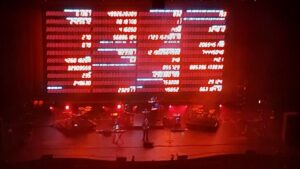


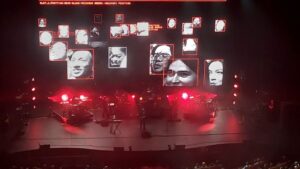
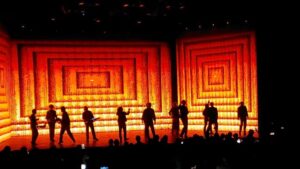
So, what a contrast to see them again, 27 years later, from a vantage point high in the circle of the grand and comfortable Star Theatre.  On the stage, 3D, Daddy G and their team of travelling musicians were ensconced, in near-darkness for much of the time, among their instruments and consoles while the theatrics were provided by dazzling visuals that materialised on giant screens above them to accompany each song.  In fact, ‘visuals’ is too lame a word to describe what the audience saw.  A reviewer in Australian Musician wrote that the band used “monolithic LED screens, archival footage, political imagery and dreamlike sequences to create a constantly shifting portrait of a world where personal freedom, privacy and even human emotion are increasingly commodified.”


As the visuals shifted wrenchingly from the picturesque Swiss lakeside city of Zug (where much equity money ends up, apparently) to Africa and impoverished locals having to dig up precious minerals in wretched  conditions, from worrying graphics illustrating the global reach of mass surveillance to gibbering headlines about celebrities, from Peter Thiel quotations about why democracy is a bad idea to bald statements that could have come from 1984’s Ministry of Truth (‘WHAT IS PURPOSE?’), I was reminded of the work of radical documentary filmmaker Adam Curtis.  Later, I learnt that Curtis and the band have enjoyed a long association and he worked with them to put these digital displays and film clips together.


Not that the visual show was entirely serious.  I was delighted to see the great horror actor Bruce Campbell get chased through a cabin by the forces of darkness in The Evil Dead (1982) while a message flashed up telling us we can’t escape ‘the algorithm’.  Later, another great horror actor, Boris Karloff, appeared as the title character in The Mask of Fu Manchu (1932) in an ironic commentary on the West’s tendency to blame China for everything.  (See Covid-19.)
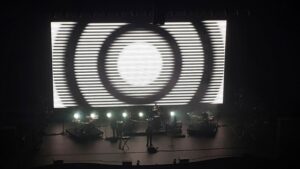


Musically, it was superb.  The crowd gave roars of appreciation for Horace Andy, singing on three tracks, including – yes! – Angel; and for other longtime collaborators Deborah Miller,  singing on Unfinished Symphony and Safe From Harm, and Elizabeth Fraser, who did vocal duties on Mezzanine’s Black Milk and Group Four and a cover of Tim Buckley’s Song to the Siren (1970).  Fraser also brought the evening to a perfect close with the final song, Teardrop.


The gig was overshadowed by an incident at the end when, briefly, 3D and Daddy G brandished a Palestinian flag onstage.  Singapore’s Straits Times newspaper reported that this broke a local law forbidding “the public display of foreign national emblems without a permit or exemption.”  Afterwards, according to the Times, the authorities released a statement saying, “…the police… administered stern warnings to both men for the offences of Section 3 of the Foreign National Emblems (Control of Display) Act and Section 16 of the Public Order Act,” and “both men will be banned from re-entering Singapore.”  The BBC, meanwhile, quoted an official spokesman as saying Singapore’s police “take a serious view of acts which could potentially harm the racial and religious harmony in Singapore”.


This leaves me with mixed feelings.  I believe people should be free to express their opinions, so long as that expression doesn’t cause innocent parties any harm, and I don’t see how two 60-something men holding a flag for a few seconds in a theatre full of Massive Attack fans could cause much harm.  However, I also believe in the old adage, ‘When in Rome, do as the Romans do’.  Singaporeans are proud of the stable, prosperous, multicultural society they’ve created, in a region that, elsewhere, has often been troubled by ethnic and religious conflicts.  For many people, having strict laws outlawing the display of foreign flags (and eliminating any possibility they could be used to stir up trouble) is a price worth paying.  I didn’t see much sympathy for the band on local Internet discussion-forums, where the sentiment was largely, “Bloody foreigners, coming over here, breaking our laws.”  “Good riddance to bad rubbish,” said one commentator, evidently not a fan.


It’s worth noting that the UK authorities have given Massive Attack a hard time too for their pro-Palestinian sympathies.  3D was arrested in Trafalgar Square in April this year for carrying a sign expressing support for the proscribed, allegedly terrorist group Palestine Action.


Anyway, this furore obscures the fact that the concert itself was exceptional.



Then on August 7th, singer-songwriter David Byrne – one-time vocalist and guitarist with legendary American new-wave band Talking Heads – performed at the Star to promote his 2025 solo album Who is the Sky?  This gig didn’t begin well for me.  When I bought my ticket via Ticketmaster, I got an email warning me not to try to enter the venue using a screenshot of it.  I should have the ticket open in my Ticketmaster account, on my phone, ready for security staff to scan its QR code.  Just before I set off for the Star, I discovered the link in the email was taking me not to the David Byrne ticket in my account, but to the Massive Attack one from 10 days earlier.  This kept happening on my phone only.  When I clicked the link on my computer, I was taken to the correct ticket.  Finally, exasperated, I took a screenshot of the Byrne one on my computer and sent it to my phone, as proof I’d at least bought the ticket.


When I explained the problem to the ladies at the Ticketmaster table outside the Theatre entrance, they told me to use the screenshot on my phone.


“But your instructions said…”


“Just use it!”


The security lady looked at me tetchily when I presented the screenshot, but she scanned its QR code and it was accepted.  I was in.
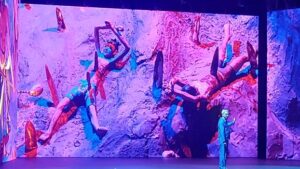


I wasn’t only me suffering technical difficulties.  The gig was scheduled to start at eight o’clock but nothing happened onstage for another half-hour – except for a few minutes when David Byrne himself walked into view.  He explained that some glitches were delaying proceedings and, by way of apology, entertained us with some sightseeing photos he’d taken that day in Singapore.  He did this with much enthusiasm.  His photos appeared on big screens above him and included one taken at Singapore’s marvellous Haw Par Villa, where you can stroll through a giant diorama depicting the 10 Courts of Hell from Chinese and Buddhist mythology.  That photo depicted sinners impaled bloodily on a ‘hill of knives’, which Byrne cheerfully informed us was the afterlife punishment awaiting people who charge too much interest on loans.  You know, bankers.


Byrne came across as someone with genuine interest in the places he travelled to and his good humour was greatly engaging.  I’d always thought he was decent, but after this episode I decided he was an absolutely top bloke.


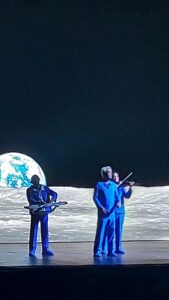
During the delay I’d observed how the stage was empty.  It contained no instruments or equipment.  When the gig finally started, I understood why.  After the opening number, a static rendition of the 1979 Talking Heads song Heaven, which Byrne sang accompanied by two musicians playing a violin and portable keyboard (while the earth rose majestically through space on the screens behind), the show really became a show – a dance one as well as a musical one.


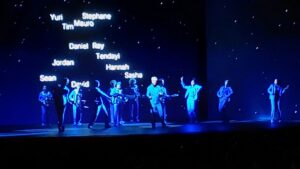
For each song, Byrne and eleven blue-clad co-performers went through a set of choreographed moves.  Six of the eleven were dancers and background singers.  The other five were musicians, carrying their instruments with them – guitars and keyboards, drums such as a tom-tom, timbale, snare drum and marching bass drum, and, when the song required, a violin or saxophone.  The musicians especially impressed me, keeping focused on where they were going as well as on what they were playing.  Meanwhile, the screens conjured up various backdrops: American suburbia, a forest, a skyscape, psychedelic patterns, a disorientating video where the same performers followed the same moves they were currently doing onstage but wearing animal-heads.
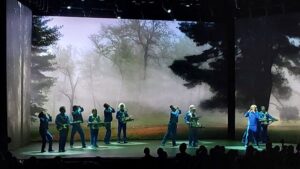


It felt part Broadway musical, part cheerleader routine, part circus (with Byrne as the ringmaster), part parade by a marching band.  Byrne even reminded me at times of Willy Wonka, orchestrating his co-performers like Oompa Loompas.  (I have to say, though, that with his blonde hair and cheery demeanour, Byrne looked more like Peter Isherwell, the sinister, ultimately incompetent billionaire played by Mark Rylance in the 2021 end-of-the-world movie Don’t Look Up.)  It’s also pretty astonishing how Byrne can do all this, seemingly effortlessly, at the age of 74.


With a plethora of drums, the music was percussion-heavy, which suited the catchy rhythms of Byrne’s solo songs perfectly.  I wondered if his Talking Heads songs would come across as well, but they did.  Several (including 1985’s And She Was) were performed during the first half of the set, before the focus switched to his solo stuff.  Then, near the end, out came the biggest Talking Heads numbers: Psycho Killer (1977), Life During Wartime (1979), Once in a Lifetime (1981) and Burning Down the House (1983).  Psycho Killer got the biggest reaction from the crowd, who inevitably chanted “Fa-fa-faa-fa-fa, fa-fa-faa-fa-fa!” in unison.  But I think it’s Once in a Lifetime that’s my favourite in Byrne’s oeuvre.  I remember first hearing it on Top of the Pops (1964-2006) when I was 16 and thinking it was bloody weird.  A week later, when I heard it again, I was hooked.


Anyway, this was a wonderful concert too.  Maybe not quite a once-in-a-lifetime experience, but not far off one.
 

The literary Bond revisited: Colonel Sun


© Vintage Publishing


Here’s the latest in a series of posts wherein I look at the original James Bond novels and short-story collections from the 1950s and 1960s.  This time, however, I’m looking at a Bond novel that wasn’t written by Ian Fleming.  It’s 1968’s Colonel Sun, by Kingsley Amis.  Why?  Well, I slagged off Amis’s The Old Devils (1986) on this blog a few months ago, and I feel a bit guilty about giving poor old Kingsley a (verbal) kicking then.  So here’s my take on Colonel Sun, which I believe is much better.


In some ways, the 21st century has been a difficult time for James Bond.  On the film front, the new century began with one of the worst Bond movies ever, 2002’s Die Another Day, an ignoble end to Pierce Brosnan’s tenure in the role.  And, though the franchise was steadied with the recruitment of Daniel Craig and a more serious, mature and sensitive approach to the character, trouble never felt far away.  See, for example, the long periods between productions – six years from Spectre (2015) to No Time to Die (2021) – and Craig’s well-publicised reluctance to play Bond again after Spectre.  And the fact that, in the most recent movie, the filmmakers took the unprecedented step of – MASSIVE SPOILER AHEAD! – killing him off at the end.


Plus, there’s been much talk in recent years about Bond’s ‘obsolescence’.  The thinking goes that as a privileged, white, stuck-up, sexist macho-man rooted in the early decades of the Cold War, Bond has become embarrassingly anachronistic in our more socially-aware era today.  Laurie Penny, for instance, said as much in a New Statesman article in 2015.  There’s a parallel argument that in the high-tech modern world Bond is obsolescent too.  This was even referred to in Spectre, when Bond is faced with a new, tech-obsessed superior called C (Andrew Scott).  C vows to “bring British intelligence out of the dark ages, into the light” and argues that “an agent in the field”, like 007, can’t “last long against all those drones and satellites.”


And yet, no matter how unfashionable Bond might be nowadays, you can’t deny that well-regarded modern writers are still keen to follow in Ian Fleming’s footsteps and have a go at writing new Bond novels.  These include Sebastian Foulkes (with 2008’s Devil May Care), Jeffery Deaver (with 2011’s Carte Blanche), William Boyd (with 2013’s Solo) and Anthony Horowitz (with 2015’s Trigger Mortis and 2018’s Forever and a Day).  Long before Foulkes, Deaver, Boyd and Horowitz got in on the act, though, another writer attempted to construct a novel around Fleming’s legendary superspy.


In 1968, just four years after Fleming’s death, Kingsley Amis wrote a Bond adventure called Colonel Sun and published it under the pseudonym Robert Markham.  By then, Amis was a big noise in British letters thanks to works like 1954’s Lucky Jim and 1960’s Take a Girl Like You.  I should say my 2015 Vintage Classics edition of Colonel Sun makes no mention of Robert Markham on its cover and advertises it unapologetically as a Kingsley Amis novel.  Anyway, before I offer my thoughts on Colonel Sun, here’s another spoilers warning.  There are lots of them ahead…


© Ian Fleming Publications


The novel is set a little while after the events of Fleming’s Bond swansong, The Man with the Golden Gun (1965), which Amis is rumoured to have polished up when Fleming died before he could revise it himself.  It begins with an audacious attempt by some unidentified villains to kidnap both Bond and his secret-service boss M.  They’re only half-successful.  M is abducted and whisked out of England, but Bond manages to elude his would-be abductors and is tasked with tracking M down.  He soon homes in on an island in the Aegean Sea.  There, M is being held by a Chinese officer, ‘Colonel Sun Liang-tan of the Special Activities Committee, People’s Liberation Army’.


The Colonel has a dastardly plan.  The Soviet Union is hosting a secret international conference in the area and Sun plans to destroy it and the delegates in a mortar attack, the blame for which will then be pinned on Britain.  Sun intends to make it look like one of the last mortars blew up accidentally, before firing, and leave Bond and M’s dead, but still identifiable, bodies in the wreckage.  Thus, China will benefit from the discrediting not only of the USSR for sloppy security, but also of the UK for warmongering.


To rescue M and thwart Sun’s scheme, Bond joins forces with a woman called Ariadne Alexandrou, a Greek communist who’s been working for the Soviets; and a Greek World War II veteran called Niko Litsas who, after fighting Nazis, fought communists during the 1946-49 Greek Civil War.  Amis discreetly skates over Britain’s sorry role in this episode of Greek history.  In 1944 the British government decided to back the anti-communist faction in Greece against the left-leaning one, even though the former faction contained many Nazi sympathisers and collaborators and the latter contained many partisans who’d fought for the Allies.  Despite their ideological differences, the trio bond – ouch – and are soon prowling the Aegean Sea in a vessel called The Altair whilst figuring a way of taking the fight to Sun and his many henchmen.


Amis’s plot is generic and a few things don’t make sense.  For example, why does Sun want to plant the elderly and normally deskbound M at the scene of the crime?  This is the literary M we’re talking about, not the feistier and more empowered cinematic version played by the likes of Judi Dench and Ralph Fiennes.  Wouldn’t it look more believable if the body of another, physically-able British agent was found there next to Bond’s?  It’s hard to see this as anything more than a perfunctory excuse for the novel’s main gimmick, the kidnapping of M.


But Colonel Sun is still good entertainment and feels more credible as a Bond novel than the other non-Fleming Bonds I’ve read.  For one thing, unlike the rather bland villains in most of the 21st century Bond-novels I mentioned above, Colonel Sun makes a memorable baddie.


© Methuen


Yes, he belongs to a long tradition of Oriental supervillains found in pulpy colonial adventure fiction – Sax Rohmer’s Fu Manchu books being the most notorious examples.  He’s not even the first bad guy in the Bond canon to follow this dubious blueprint, an honour that belongs to the titular character of Fleming’s Dr No (1957).  But Sun is splendidly eccentric.  He’s irritatingly polite and addresses friends and foes alike by their first names.  He also sees himself as an Anglophile: “Sun did not share his colleagues’ often-expressed contempt… for everything British.  He was fond of many aspects of their culture and considered it regrettable in some ways that that culture had such a short time left.”


Then there’s his penchant for torture.  Near the novel’s end, just before he lays into Bond with an array of kitchen utensils (‘knives, skewers, broom-straws’), he explains: “True sadism has nothing whatever to do with sex.  The intimacy I was referring to is moral and spiritual, the union of two souls in a rather mystical way.”  Later still, he surprises us when he confesses to Bond that “I didn’t feel like a god when I was torturing you back there.  I felt sick and guilty and ashamed.”


Admittedly, I could have done without the linguistic quirk that Amis gives him.  Thanks to his “quick ear and passionate desire to learn” English and a “total ignorance of the British dialect pattern”, he’s ended up with a bizarre accent combining the “tones of Manchester, Glasgow, Liverpool, Belfast, Newcastle, Cardiff and several sorts of London…”  As a result, every time Colonel Sun opens his mouth in the book, I imagine his voice sounding like an Artificial Intelligence one created from a dataset involving Liam Gallagher, Billy Connolly, Ringo Starr, Van Morrison, Jimmy Nail, Charlotte Church and Ray Winstone.


Colonel Sun also feels like a proper Bond novel because Kingsley Amis’s authorial voice doesn’t sound that different from Ian Fleming’s.  Putting it more crudely, it feels closer to the originals than the modern pastiches do because Amis was as much of a curmudgeonly snob as Fleming was.  By the 1960s, Bond’s rarefied world of Bentleys, dinner jackets and private members’ clubs were on their way out; and Amis bellyaches about it as you’d imagine Fleming would.  When Bond drives through some English farmland, he writes: “Places like this would last longest as memorials of what England had once been.  As if to contradict this idea, there appeared ahead of him a B.E.A. Trident newly taken off from London Airport, full of tourists bringing their fish-and-chip culture to the Spanish resorts, to Portugal’s lovely Algarve province, and now… as far as Morocco.”


Also activating Amis’s Licence to Grump is the prospect of the great, fish-and-chip-loving unwashed discovering the Greek islands.  Describing a waterfront, he observes: “At the near end were whitewashed cottages with blue or tan shutters and doors, then a grocery, a ship’s supplier, harbour offices, a tavérna with a faded green awning.  No neon, no cars, no souvenir shops.  Not yet.”


Still, some aspects of Colonel Sun are surprisingly liberal, considering Amis’s cranky right-wing politics.  Adriane, the book’s heroine, is resourceful and able to look after herself and Bond comes across as less of a sexist boor than one might expect.  Meanwhile, some Soviet characters are depicted sympathetically: for example, Gordienko, Moscow’s man in Athens, who believes Bond’s warnings that something fishy is afoot and will have bad consequences for both their countries; and Yermolov, the pragmatic, vodka-loving dignitary who at the end expresses the USSR’s gratitude to Bond for foiling Sun’s plan.  Indeed, Yermolov feels like a prototype for the tough but avuncular General Gogol, the KGB head played by Walter Gottel, who appeared in every Bond movie from The Spy Who Loved Me (1977) to The Living Daylights (1987).  In Colonel Sun, Yermolov even offers Bond the Order of the Red Banner; just as Gogol awards Roger Moore (‘Comrade Bond’) the Order of Lenin at the end of 1985’s A View to a Kill.


© Eon Productions


But before we assume that old Kingsley has gone all hippy-dippy and peace-and-love, we should bear in mind that the Soviets are the good guys here only comparatively – because the bad guys are the Chinese.  The novel even postulates that the West and the Soviet Union are on the brink of working together because of the increasing threat posed by China.  Richard Nixon’s jaunt to China in 1972 must have knocked that notion on the head.  Happily, by the time of the 1997 Bond movie Tomorrow Never Dies, which has Pierce Brosnan joining forces with Michelle Yeoh to take on Rupert Murdoch, sorry, an evil, fictional media mogul played by Jonathan Pryce, the Bond-verse had decided that the Chinese could be good guys too.


While Colonel Sun has never been filmed, it’s interesting how a few of its ideas have turned up in the Bond movies.  The kidnapping of M was a key plot element in 1999’s Tomorrow Never Dies, while a villain called Colonel Tan-Sun Moon features in Die Another Day.  And if Colonel Sun’s musings during the book’s climactic torture scene sound familiar – “Torture is easy, on a superficial level.  A man can watch himself being disembowelled and derive great horror from the experience, but it’s still going on at a distance…  a man lives inside his head.  That’s where the seed of his soul is…  So James, I’m going to penetrate to where you are.  To the inside of your head….” – it’s because they were used as dialogue in Spectre, during the scene where Christoph Waltz violates Daniel Craig’s skull using a torture device that looks like a dentist’s drill on a robotic tentacle.


In Spectre, Waltz’s character is revealed as being none other than Ernst Stavro Blofeld.  Having James Bond’s great arch-enemy borrow his best lines?  Colonel Sun would have been flattered.


© Eon Productions

A Lee-centennial


© British Lion Films


The British actor Sir Christopher Lee, who was born on this day exactly 100 years ago, was a man who embodied evil to generations of film-goers.  He played Lord Summerisle, Dracula, Fu Manchu, Rasputin, Scaramanga, Comte de Rochefort, Frankenstein’s monster, the mummy, Doctor Jekyll and Mr Hyde, Blind Pew, Saruman, Count Dooku, the Jabberwocky, the Devil and, in the 2008 adaptation of Terry Pratchett’s The Colour of Magic, Death himself.  But up until his passing in 2015, I didn’t so much regard him as the embodiment of evil as one of the coolest people on the planet.


Lee did a lot during his 93 years and not just in terms of acting – though his movie resume was awesome, with some 275 titles to his name by the time he entered his tenth decade.


He was, incidentally, an incredibly literary actor too, because his massive film and television CV contained adaptations of stories by Lewis Carroll, Agatha Christie, Sir Arthur Conan Doyle, Roald Dahl, Alexandre Dumas, Rider Haggard, Washington Irving, H.P. Lovecraft, Mervyn Peake, Edgar Allan Poe, Sax Rohmer, Sir Walter Scott, Mary Shelley, Robert Louis Stevenson, Bram Stoker and Jules Verne.  In real life, he was step-cousin of James Bond’s creator, Ian Fleming; and by the time Peter Jackson got around to filming the Lord of the Rings trilogy (2002-2004), he could boast that he was the only member of the movies’ cast and crew who’d actually met J.R.R. Tolkien.  He was also good friends with Robert Bloch, author of Psycho (1959), the fabulous Ray Bradbury, and posh occult-thriller-writer Dennis Wheatley, whose potboiler The Devil Rides Out Lee would persuade Hammer Films to adapt to celluloid in 1968.  And he was one of the last people alive who could claim to have met M.R. James, the greatest ghost story writer in English literature.  As a lad Lee encountered James, who was then Provost of Eton College, when his family tried, unsuccessfully, to enrol him there.  Lee obviously didn’t hold his failure to get into Eton against James because in 2000 he played the writer in the BBC miniseries Ghost Stories for Christmas.


Before getting into acting in the late 1940s, Lee did military service during World War II, which included attachments with the Special Operations Executive and the Long Range Desert Patrol , the forerunner to the SAS.  He kept schtum about what he actually did with them.  Decades later, though, he may have unintentionally dropped a hint about his secret wartime activities to Peter Jackson when, on set, he discreetly advised the Kiwi director about the sound a dying man would really make if he’d just had a knife planted in his back.


His first years as an actor did not see much success, due to his being too tall (six-foot-four) and too foreign-looking (he had Italian ancestry).  During this period he at least learned how to swordfight, a skill he drew on when appearing in various low-budget swashbucklers.  During the making of one such film, 1955’s The Dark Avenger, the famously sozzled Errol Flynn nearly hacked off Lee’s little finger; although later Lee got revenge when, during a TV shoot with the same actor, a slightly-misaimed sword-thrust knocked off Flynn’s toupee, much to the Hollywood star’s mortification and no doubt to everyone else’s amusement.  Incidentally, I love the fact that Lee could boast of being the only actor in history who’d conducted sword fights with Errol Flynn and Yoda.


© 20th Century Fox


And I’ve read somewhere that when he made the swashbuckler The Scarlet Blade for Hammer Films in 1963, Lee taught a young Oliver Reed the basics of sword-fighting.  I’m sure fight-choreographer William Hobbs and the stunt crew who worked on The Three Musketeers a decade later quietly cursed Lee for this.  (Lee starred alongside Reed in the film, playing the memorably eye-patched Comte de Rochefort.)  From all accounts, the ever-enthusiastic Ollie threw himself into the Musketeers’ sword-fights like a whirling dervish, and eventually one stuntman had to ‘accidentally’ stab him in the hand and put him out of action before he killed someone.


In 1956 and 1957 Lee got two gigs for Hammer films that’d change his fortunes and make him a star – playing the monster in The Curse of Frankenstein and then, on the strength of that, Bram Stoker’s famous vampire count in Dracula.  Apparently, Hammer wanted originally to hire the hulking comedic actor Bernard Bresslaw to play Frankenstein’s monster.  I suppose there’s a parallel universe out there somewhere where Bresslaw actually got the job; so that the man we know as Little Heap in Carry On Cowboy (1965), Bernie Lugg in Carry On Camping (1969) and Peter Potter in Carry On Girls (1973) went on in that universe to play Count Dooku in the Star Wars movies and Saruman the White in the Lord of the Rings ones.


Playing Baron Frankenstein in The Curse of Frankenstein and Van Helsing in Dracula was the legendary Peter Cushing and he and Lee would hit it off immediately, become best mates and make another 18 films together, in which for much of the time they did bad things to each other.  As a mad-scientist-cum-asylum-keeper in The Creeping Flesh (1972), Lee brought a monster to life and then, after the monster had attacked Cushing and driven him insane with terror, he coolly incarcerated Cushing in his asylum.  Whereas in The Satanic Rites of Dracula (1973) Cushing chased him, as Dracula, through a prickly hawthorn bush – hawthorns are apparently harmful to vampires and the experience, Lee recalled in his autobiography Tall, Dark and Gruesome (1977), left him ‘shedding genuine Lee blood like a garden sprinkler’ – before impaling him on a sharp, uprooted fence-post.  Meanwhile, the 1972 British-Spanish movie Horror Express featured a decomposing ape-man fossil that’d come back to life, was possessed by an alien force and had the power to suck people’s brains out through their eyeballs.  It was such an evil motherf***er that Lee and Cushing had to join forces, for once, to defeat it.


© Granada Films


Lee was famously uncomfortable about being branded a horror-movie star and about being associated with Dracula, an association that might thwart his ambitions for a serious acting career.  He did, though, play the character another six times for Hammer, and an eighth time in the Spanish production El Conde Dracula.  Tweeting a tribute to him when he passed away, Stephen King said, “He was the King of the Vampires.”  So sorry, Sir Christopher, but when the man who wrote Salem’s Lot (1975) says you’re the King of the Vampires, you’re the King of the Vampires.


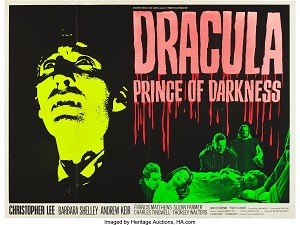
As Dracula, he got to bite Barbara Shelley, Barbara Ewing, Linda Hayden, Anouska Hempel, Marcia Hunt, Caroline Munro and Valerie Van Ost.  Last-minute interventions by Peter Cushing in Dracula AD 1972 (1972) and The Satanic Rites of Dracula (1973) prevented him from biting Stephanie Beacham and Joanna Lumley, which must have been frustrating.  Meanwhile, the 1965 movie Dracula, Prince of Darkness was the first really scary horror movie I ever saw, on TV, back when I was eight or nine years old.  I’d watched old horror films made by Universal Studios in the 1940s, like House of Frankenstein (1944) and House of Dracula (1945), in which everything was discreetly black-and-white and bloodless, so I wasn’t prepared for an early scene in Dracula, Prince of Darkness where Lee / the count is revived during a ceremony that involves a luckless traveller (Charles Tingwell) being suspended upside-down over a coffin and having his throat cut.  The sight and sound of the blood splattering noisily onto the supposedly dead vampire’s ashes traumatised me.


© Warner Pathé / Hammer Films


Thanks to Hammer’s success in the horror genre, the late 1950s, 1960s and early 1970s saw a boom in British, usually gothic, horror filmmaking.  And during that boom, Lee did many memorable, often evil, things.  He drove his car into Michael Gough and squidged off Gough’s hand in Doctor Terror’s House of Horrors (1965).  He forced Vincent Price to immerse himself in a vat of acid in Scream and Scream Again (1969).  He turned up as a snobbish senior-civil-servant type and tormented Donald Pleasance in Deathline (1972).


Lee was probably Britain’s most linguistic actor, speaking German, French, Italian and Spanish and also knowing a bit of Swedish, Russian and Greek.  Thus, he also found it easy to find employment making horror movies on mainland Europe, where the gothic tradition was raunchier, more lurid and looser in its plot logic than its counterpart in Britain.  He worked with the Italian maestro Mario Bava in 1963’s The Whip and the Body and on several occasions with the fascinatingly prolific, but erratic, Spanish director Jess Franco.  Despite Franco’s cheeky habit of shooting scenes with Lee and then inserting them into a totally different and usually pornographic movie – something Lee would only discover later, when he strolled past a blue-movie theatre in Soho and noticed that he was starring in something like Eugenie and the Story of her Journey into Perversion (1970) – Lee held the Spaniard in esteem and championed his work at a time it wasn’t fashionable to do so.  Since his death in 2013, Franco’s reputation has improved and art-house director Peter Strickland’s movie The Duke of Burgundy (2014) is a tribute, in part, to him.


Franco directed the later entries in a series of movies about Fu Manchu that Lee made in the 1960s, in which he played Sax Rohmer’s supervillain in un-PC Oriental makeup and spent his time barking orders at Chinese minions, who were usually played by Burt Kwouk.  As well as retaining some of the racism that was prominent in Rohmer’s books, the series generally wasn’t up to much in terms of quality.  However, the film’s endings have always haunted me.  Invariably, Fu Manchu’s secret headquarters would blow up and then Lee’s voice would boom imperiously through the smoke, “The world will hear of me again!”


© Eon Productions


In the early 1970s, Lee finally got opportunities to make the sort of films he wanted to make, including Richard Lester’s two Musketeers movies (1974 and 1975); the ninth official Bond movie The Man with the Golden Gun (1975), in which he taunted Roger Moore, “You work for peanuts – a hearty well-done from Her Majesty the Queen and a pittance of a pension.  Apart from that, we are the same.  To us, Mr Bond.  We are the best…  Oh come, come, Mr Bond.  You get as much fulfilment out of killing as I do, so why don’t you admit it?”; and Billy Wilder’s The Private Life of Sherlock Holmes (1970), regarded by many as the best attempt at bringing Sir Arthur Conan Doyle’s deerstalker-wearing super-sleuth to the screen.


In that latter film, Lee played Holmes’s snooty brother Mycroft.  Lee also played Sherlock Holmes himself several times, including in a couple of early-1990s TV movies with Dr Watson played by the impeccable Patrick Macnee, whom decades earlier had been Lee’s schoolmate at Summer Fields School in Oxford.  And he played Henry Baskerville in the 1959 Hammer adaptation of The Hound of the Baskervilles, which had Peter Cushing in the role of Holmes.  But for some strange reason, nobody ever thought of casting Lee as Professor Moriarty.


In 1973, he also played Lord Summerisle in The Wicker Man, a film that needs no introduction from me.  Actually, next year is the film’s fiftieth anniversary.  I trust the Scottish Tourist Board will celebrate this fact on May 1st, 2023, by lighting lots of wicker men, with lots of sanctimonious, virginal, Free Presbyterian policemen inside them, along the coasts of Scotland.


Later in the 1970s, no longer so typecast in horror movies and with the British film industry on its deathbed, Lee decamped to Hollywood.  He ended up appearing in some big-budget puddings like dire 1977 disaster movie Airport 77 and Steven Spielberg’s supposed comedy 1941 (1979), but at least he was able to rub shoulders with icons such as Muhammad Ali and John Belushi.  And he didn’t, strictly speaking, stop appearing in horror movies.  He was in the likes of House of the Long Shadows (1982), The Howling II: Your Sister is a Werewolf (1985), The Funny Man (1994) and Talos the Mummy (1998).  Amusingly, Lee usually explained this by arguing that these weren’t really horror films.  The Howling II: Your Sister is a Werewolf wasn’t a horror film?  Aye, right.


© New Line Cinema / WingNut Films


Though he never relented in his workload, it wasn’t until the 1990s that Lee experienced a late-term career renaissance – no doubt because many of the nerdish kids who’d sneaked into cinemas or stayed up late in front of the TV to watch his old horror movies had now grown up, become major players in the film industry and were only too happy to cast him in their movies: Joe Dante, John Landis, Martin Scorsese, George Lucas, Peter Jackson and Tim Burton.  Hence his roles in two of the biggest franchises in cinematic history, the Star Wars and the Lord of the Rings / Hobbit ones, plus five movies directed by Burton.


When he was in his eighties, Lee must have wondered if there were any territories left for him to conquer – and he realised that yes, there was one.  Heavy metal!  He had a fine baritone singing voice but only occasionally in his film career, for example, in The Wicker Man and The Return of Captain Invincible (1983), did he get a chance to show it off.  In the mid-noughties, however, he started recording with symphonic / power-metal bands Rhapsody of Fire and Manowar and soon after he was releasing his own metal albums such as Charlemagne: By the Sword and the Cross and Charlemagne: The Omens of Death, which had contributions by guitarist Hedras Ramos and Judas Priest’s Richie Faulkner.  He also released two collections of Christmas songs, done heavy-metal style.  The festive season will never seem the same after you’ve heard Lee thundering his way through The Little Drummer Boy with electric guitars caterwauling in the background.


© Charlemagne Productions Ltd


Obviously, the heavy metal community, which sees itself as a crowd of badasses, was flattered when the cinema’s supreme badass – Lord Summerisle, Dracula, Fu Manchu, Rasputin, etc. – elected to join them and they welcomed Lee with open arms.  They even gave him, as the genre’s oldest practitioner, the Spirit of Metal Award at the Metal Hammer Golden Gods ceremony in 2010.


So: singing heavy metal, speaking eight languages, being perhaps the 20th century’s greatest screen villain and, probably, bayoneting Nazis to death.  Was there anything this man couldn’t do?  Well, it seems the only thing he couldn’t quite manage was to live forever.  Mind you, for someone who spent his cinema career dying – even when he penned his autobiography in his mid-fifties, he reckoned he’d been killed onscreen more than any other actor in history – but kept coming back, it feels a bit odd to be writing about Christopher Lee in the past tense.


Actually, if anybody wants to congregate in a Carpathian castle after dark and perform a blood-soaked ritual to resurrect the great man, I’m up for it.


From the Independent