
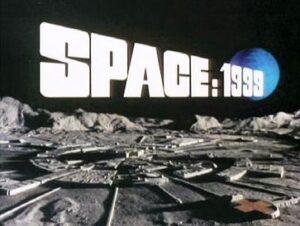
From wikipedia.org / © Group Three Productions
Here’s the second half of my account of things that scared me, to the point of scarring me, when I was wee.
Space: 1999 – Dragon’s Domain (1975)
Even as a kid, I knew the TV show Space: 1999 was silly. I already had enough awareness of science to realise the ridiculousness of its premise – a titanic explosion on the moon in the then-future year of 1999 sends it, and 300 human beings crewing a base there called Moonbase Alpha, careering out of earth’s orbit and into deep space. Particularly ridiculous was how every second episode the moon hurtled into a new solar system and came close enough to an earth-type planet for the Moonbase Alpha folk to explore it. Space: 1999 depicted the universe as a giant pinball machine with the moon bouncing between earth-type planets like the silver ball bouncing between the machine’s flippers and bumpers.
And yet… A Space: 1999 episode called Dragon’s Domain petrified me. It has the runaway moon approaching a sinister graveyard of abandoned spaceships in which a horrifying, one-eyed, tentacled monstrosity lurks. Okay, seen today, the monster in Dragon’s Domain doesn’t impress, being a mass of wavy tentacles obviously animated by wires. But the barrage of things that accompany it still inspire fear – it initially materialises as a swirling pattern of lights, it makes hideous shrieking noises and its victims are battered by gusts of wind. Most horribly, moments after those victims are dragged into its maw, they’re spat out again as desiccated corpses, apparently drained of all their moisture.
There’s something about the episode’s ineluctability that got me too. It focuses on a Moonbase Alpha member (Gianni Garko) who’s encountered the monster before. While he was captaining a mission into deep space, it ate his crew and only he managed to escape. Now stuck on the moon after its unexpected departure from earth’s orbit, fate has cruelly decreed that he’ll meet the thing again.
The pictures in The Horrific World of Monsters (1974)
I might have been terrified by monsters like that Space: 1999 one, but I was also fascinated by them and in the mid-1970s I bought a hardcover, kids-orientated book called The Horrific World of Monsters by Dulan Barber. This provided an A-Z of monsters from myth, folklore, cryptozoology, movies, TV and comics.
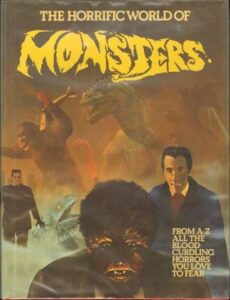
© Marshall Cavendish
Lavishly illustrated, a couple of the book’s page-sized movie-stills troubled me, lodged themselves in my psyche and occasionally caused me nightmares. These depicted the mummy, played by Lon Chaney Jr in 1944’s The Mummy’s Ghost, throttling a victim; a fanged, hairy Michael Landon pouncing on a victim in I was a Teenage Werewolf (1957); and, in unflinching close-up, the title character of The Return of the Fly (1959), the second film in the series about a scientist experimenting with a teleportation device who gets his molecules mixed up with those of a fly and acquires a massive, insectile head. Just as well it wasn’t a close-up of Jeff Goldblum from late in David Cronenberg’s 1986 remake of The Fly. That sight would have left me gibbering.
Eventually, I sold the book to a schoolmate called Geoff Simmons, who was a gifted artist and who used some of its illustrations as inspiration for pictures – I remember him showing me one he’d drawn based on the mummy. Geoff is now a graphic designer (and also a community historian) in London. I’d like to think The Horrific World of Monsters played a small part in shaping his future career.
Bodega Bay gets attacked in The Birds (1963)
By the mid-1970s, someone had informed me that the Americans and Russians both had ‘bombs that could blow up the world’, so I had a new thing to worry about – the end of humanity. Accordingly, apocalyptic movies frightened the bejesus out of me. For example, Steve Sekely’s Day of the Triffids (1963), a cheap adaptation of John Wyndham’s 1951 novel, scared me with its depiction of a world where nearly everyone has gone blind. Even at 10 years old, unfortunately, I could tell how shoddy its special effects were, especially the ones involving the triffids.
But the apocalyptic movie that traumatised me was 1963’s The Birds, directed by the impeccable Alfred Hitchcock and based on a 1952 short story by the equally impeccable Daphne du Maurier. Most traumatic for me was the part where Tippi Hedren and Rod Taylor find themselves in a diner in the middle of the little coastal town of Bodega Bay, trying to convince the locals – who react with varying degrees of scepticism – that the area’s feathered population is behaving very strangely. After seven minutes of conversation that mingles humour with growing unease, and is brilliantly performed by character actors like Doreen Lang (as an increasingly frightened mother), Charles McGraw (as a gruff fisherman), Ethel Griffies (as an elderly, know-all ornithologist) and Karl Swenson (as a Bible-quoting Irish drunkard), all hell breaks loose.
Multitudinous seagulls swoop down and cars and petrol pumps explode (thanks to fuel spewing from a dropped hose), more cars crash, horses run wild and many townspeople get clawed and pecked. Hedren spends a nightmarish minute trapped inside a telephone booth with birds, plus one unlucky human victim, smashing into its sides. Taylor rescues her and gets her into the diner again, but… The atmosphere there is suddenly less welcoming.
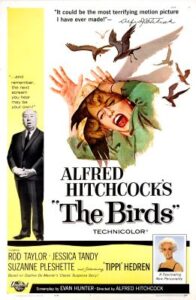
From wikipedia.com / © Universal Pictures
Hitchcock’s orchestration of this blew me away. The telephone-booth bit was possibly the first time I’d been exposed to what film-fans would describe as ‘pure cinema’. But Taylor and Hedren’s return to the diner provides the chilling coup de grâce. The people inside are cowering in terror, including Griffies’s no-longer-cocky ornithologist, and already a superstitious irrationality is taking hold of them. This crystalises when a now-crazed Lang accuses Hedren of, basically, being a witch: “Who are you?” What are you? Where did you come from? I think you’re the cause of all this. I think you’re evil. Evil!” No doubt a young Stephen King was taking notes at this point. Similar things happen in his 1980 novella The Mist, with many of its characters reacting to another apocalyptic event by succumbing to medieval-style hysteria.
Doctor Who – The Seeds of Doom, episode 4 (1976)
I could write a whole article based only on moments from the BBC’s long running science-fiction / fantasy / horror series Doctor Who (1963-89, 2005-25) that scared me: the shop dummies coming to life in the serial Spearhead from Space (1970); the killer plastic chair in Terror of the Autons (1971); the murderous Morris dancers in The Daemons (1971); a scaly hand appearing over a boat’s gunwale in The Sea Devils (1972); an infected crewman removing his hand from his pocket and revealing it transformed into a slab of glistening green slime (okay, it’s really green-painted bubble-wrap, but hardly anyone at the time knew what bubble-wrap was) in The Ark in Space (1975)… But scariest of all was the 1976 serial The Seeds of Doom, about alien seed-pods that infect humans and transform them into malevolent, carnivorous plant-monsters. Episode 4 of The Seeds of Doom, to be precise.
One alien pod becomes the possession of an insane millionaire plant-lover called Harrison Chase – played by character actor Tony Beckley, who’d been in The Italian Job (1969) and Get Carter (1971) – and at the start of episode 4 it germinates, infecting one of Chase’s minions, a hapless botanist called Arnold Keeler (Mark Jones). Ignoring Keeler’s pleas to be taken to a hospital, Chase has him chained to a bed, purring in delight, “The rate of increase is astonishing… Protein absorption from the animal, of course… We shall have to give you some food soon… You’re changing into a plant, Keeler… a marvellous new species of plant!”
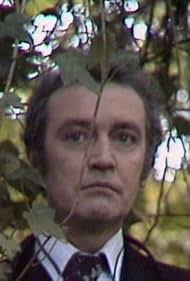
© BBC
With Keeler turning green, then fibrous, then tentacular, and Chase trying to speed up the metamorphosis by feeding him pieces of raw meat, what I was witnessing here was the icky sub-genre of horror known as ‘body horror’. But it was the performances of Beckley and Jones, one disturbingly malevolent, the other distressingly pathetic, that truly conveyed the horribleness of the situation.
Legend Horror Classics, issue 4 (1976)
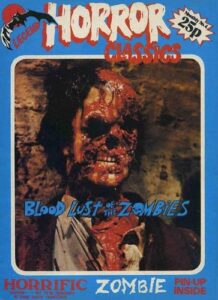
The same impulse that made me buy The Horrific World of Monsters inspired me to purchase issue 4 of a British film magazine called Legend Horror Classics, edited by Gent Shaw, who’d also edited the scary-movie magazine World of Horror in 1974-75. Issue 4 of Legend Horror Classics was devoted to zombies, which until then I’d understood to be dead people brought back to life by voodoo and put to work on Caribbean sugar plantations. By the 1970s, however, thanks to the influence of George A. Romero’s Night of the Living Dead (1968), zombie stories and films had become less voodoo-reliant and a lot grislier and more visceral. This issue contained several gruesome photos that, like those in the Monsters book, gave me nightmares.
However… Since then, I’ve discovered, indignantly, that the yuckiest pictures in the issue weren’t actually from zombie movies! There was one of the mouldering, prehistoric ape-creature inhabited by an evil alien intelligence in the Christopher Lee / Peter Cushing horror film Horror Express (1972); and one of a rotting corpse (not reanimated as a zombie) from another 1972 movie featuring Christopher Lee, Deathline. If you’re reading this, Gent Shaw, I’m accusing you of breaking the Trade Descriptions Act.
© Legend Publishing
The Nationwide report about the Hexham Heads (1976)
The Hexham heads were two little stone heads, possibly Celtic in origin, discovered in the northeast English town of Hexham in 1971. Reputedly, the heads triggered paranormal activity in the homes of whoever had custody of them. And that paranormal activity manifested itself spectacularly in the form of a werewolf that was glimpsed stalking through their homes after dark.
Infamously, Nationwide (1969-83) – normally a family-friendly TV current-affairs programme, which aired on the BBC every weekday evening after six o’clock – featured a report on the story in 1976. The makers of the report had the not-so-family-friendly idea of spicing it up with ghastly screams, images of severed human heads and an unexpected jump-cut of Oliver Reed lurching towards the camera in 1961’s Curse of the Werewolf. This approach traumatised every kid who happened to be watching, me included.
One eyewitness reported seeing the Hexham Heads werewolf after arriving home late at night – allegedly she spotted it prowling about her dark house before she switched on the lights. Soon afterwards, my family moved from Northern Ireland to Scotland. My parents frequently received invitations to Sunday lunch and dinner at the homes of Northern Irish folk they knew directly, or knew as friends of friends, who were now living in Scotland. After much food, whisky and blethering, we wouldn’t get home until late on Sunday evening. While my parents unlocked the front door and we entered a black, silent house, I’d think of the Nationwide report and wonder, “What if there’s a werewolf waiting in there?”

From wikipedia.org / © Archaeology Data Service / Dr Anne Ross
Footage of that legendary 1976 TV report on the Hexham Heads was long believed lost but it’s now been discovered and restored – see here and here.
Jon Voight’s dream at the end of Deliverance (1972)
By the time I was 12, I believed I was a mature, hardened type who’d seen everything and couldn’t be frightened anymore. But then on TV one evening I watched John Boorman’s Deliverance (1972), about four Atlanta business men whose canoeing holiday in remote north Georgia turns into an ordeal, and was freaked out by it.
Oddly, it wasn’t the notorious sequence where some hillbillies rape Ned Beatty’s character and insist that he squeals ‘like a pig’ that upset me most. Maybe I wasn’t old enough to fully understand what was happening. No, it was the bit near the end where Jon Voigt’s character has a nightmare about the river they canoed on – which has since been dammed and turned into a lake – and sees a pale, bloated hand rising out of its water. The image of that emerging hand haunted me for weeks afterwards. I obviously wasn’t as tough as I thought I was.

© Elmer Enterprises / Warner Bros.
Thinking about it, I suppose I must have been a complete scaredy-cat whose childhood was one long procession of moments of terror. So now, half-a-century later, why do I write short horror stories under the penname of Jim Mountfield? I’ve had nearly 70 such stories published.
Perhaps it’s a case of ‘if you can’t beat ’em, join ‘em.”