More musical genres I don’t like


From wikipedia.org / © Michael Spencer


It’s time to put poison pen to paper, or poison fingers to keyboard, and release more bile about more types of music I can’t stand.  Having poured scorn on jazz, country and Irish, prog rock and disco music in my previous post, I’ll now address another four musical genres that I’d sooner poke a sharpened stick into my ear than listen to. And first up is…


New romantic

Just into my teens, in the late 1970s and early 1980s, I naively thought it was a great time to like music.  Punk had recently happened and on its heels had arrived the new wave bands.  Even on mainstream outlets, such as the BBC’s Radio 1 and its flagship TV music-show Top of the Pops (1964-2006), you regularly heard the likes of Blondie, the Jam, Elvis Costello and the Attractions, Ian Dury and the Blockheads, the Boomtown Rats, Talking Heads, the Undertones and Martha and the Muffins.  Some of these artists ranked highly in the singles and albums charts and a few even made it to number one.  Thus, frequently, the period had a nice correlation between what was popular and what sounded good.


It couldn’t last.  Indeed, I remember the moment things changed.  Early in 1981, I was watching an episode of Tiswas, the anarchic Saturday-morning kids’ TV show, when presenter Chris Tarrant said words to the effect of, “Here’s a video of a song by a great new band called Duran Duran!”  Then I found myself staring at my TV screen in bafflement, trying to make sense of the figures of Simon Le Bon, Nick Rhodes and Andy, John and Roger Taylor, wearing puffy and frilly shirts, sporting floppy fringes and slathered in make-up, while they cavorted to the strains of Planet Earth.  The new romantic craze had begun.  The horror!
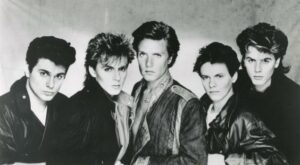
 

From wikipedia.org / © Ben Aris / Capitol Records


Thereafter came a flood: Spandau Ballet, Culture Club, Wham, Visage, A Flock of Seagulls, Classix Nouveaux, Kajagoogoo, the Thompson Twins, Tears for Fears, all of whom drove me up the walls.  Vacuous songs.  Production qualities that might have sounded hi-tech in the 1980s but just sound dated now, all dinky drums and plinky keyboards.  A smug dedication to style over substance, with the performers lavishly dressed and expensively coiffured.  Maybe I’m giving them more social significance than they deserved, but they seemed to personify the flash-your-cash, greed-is-good ethos of the Thatcherite 1980s.


Now you can reply to my moaning by saying, “Well, if you didn’t like them, you didn’t have to listen to them!”  But actually, back then, you did.  For a couple of years, the new romantic bands were everywhere,  On the radio.  On TV.  On the covers of glossy new teenybop magazines like Smash Hits and Number One.  In the newspapers – never more so than when the Sun famously ran the headline, ‘BOY GEORGE’S BIG SECRET: I PREFER A CUP OF TEA TO SEX’.


Things got particularly bad in 1984-85, during my second year as a student at Aberdeen University, when to make ends meet I worked in a nightclub called Ritzy’s three or four evenings a week.  I was a member of its floor-staff and the club’s DJ liked his new romantic records.  It was truly gruelling to have to collect glasses and empty ashtrays whilst being blasted by Spandau Ballet crooning their way through True (1983), and then Wham chirping Wake Me Up Before You Go-Go (1984), and then Simon Le Bon conspicuously failing to hit the high notes in Duran Duran’s Wild Boys (1984), and then, oh joy, Boy George ruminating, “War, war is stupid, and people are stupid…” in Culture Club’s The War Song (1984).  Happy memories…  Not.


Honourable exceptions: David Sylvian’s outfit Japan were sometimes called a new romantic band and I thought they were pretty good.  And I liked Adam and the Ants, at least, up until Adam Ant turned into a dandy highwayman.  And though I’ve just given Duran Duran a kicking, I’ll admit that their late-career hit Ordinary World (1992) is a lovely song.  In fact, Ordinary World has featured in not one, but two textbook examples of how to use pop music effectively in movies – Matthew Vaughan’s stylish gangster film The Layer Cake (2004) and Nia DaCosta’s superb zombie flick 28 Years Later: The Bone Temple (2026).
 

From wikipedia.org / © Capitol Records


Hair metal

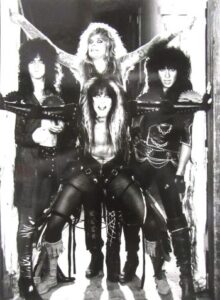
During the first half of the 1980s, it wasn’t easy being a heavy metal fan, as I was.  Heavy metal had a serious image problem then.  Both conservatives and left-wingers regarded it as music made for disreputable, juvenile, sexist, dumbly hedonistic louts.  It didn’t help that metal’s most visible sub-genre at the time was all of those things.  There’s nothing wrong with being disreputable, but hair metal was also juvenile, sexist, dumbly hedonistic and loutish.  (And at the same time, kind of lame – I’ll get to that in a minute.)


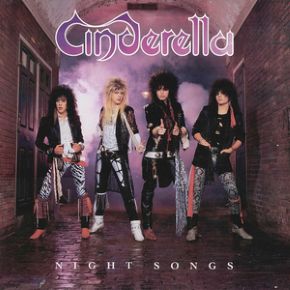
Actually, its practitioners referred to the music as ‘glam metal’ but, given the extravagant, backcombed locks they sported, and the amount of hairspray they used, I prefer the more dismissive moniker ‘hair metal’.  The movement received other disdainful nicknames too, which is a testimony to how disliked it was.  The bands – Mötley Crüe (who added umlauts to their name not because they liked listening to Motörhead, but because they liked drinking Löwenbräu), Quiet Riot, W.A.S.P., Ratt, Poison, Warrant, Dokken, Cinderella – were sneeringly called ‘poodle-heads’.  Their sound was also described as ‘butt rock’.


Clad in spandex, caked in make-up, jangling with accessories and balancing on their bonces the aforementioned ‘big’ hair, whilst singing songs whose lyrics sounded like they’d been written by Frank Kelly’s Father Jack Hackett character in Father Ted (1995-98) – see Mötley Crüe’s Girls, Girls, Girls (1987) – they were bloody awful.  To my ears, they weren’t even that metal.  They used poppy guitar riffs and harmonies and churned out an ungodly number of power ballads.


A decade earlier, God had put an end to the foolishness of prog rock by creating punk music.  Thankfully, around 1988 or so, He again decided enough was enough and created grunge.  Once kids started listening to Kurt Cobain and co, the poodle-heads became history.  Incidentally, there’s a 2005 song by the surreal English indie band Half Man Half Biscuit called Upon Westminster Bridge whose lyrics sum up my feelings about hair metal.  It goes “Oh help me Mrs Medlicott / I don’t know what to do / I’ve only got three bullets / And there’s four of Mötley Crüe.


Honourable exceptions: Guns n’ Roses.  That’s it.
 

From wikipedia.org / © Mercury Records


Thankfully, after hair metal’s demise, heavy metal couldn’t possibly produce another sub-genre that was so horrible.  Could it?  Well…


Nu metal

“I’d rather have my eyelids pulled out than listen to nu metal,” David Mustaine, the frontman of Megadeth, once remarked.  Which is ironic, considering that the one time I saw Megadeth play live, in Chicago in 1995, the support bands included Korn, an outfit credited with helping to kickstart nu metal in the first place.


Mustaine’s disdain for nu metal is typical of many in the traditional heavy metal community, who thought the music of Korn, Limp Bizkit, Linkin Park, the Deftones, Disturbed, Alien Ant Farm, Papa Roach, etc., sucked because it incorporated influences from hip-hop while neglecting the established staples of heavy metal, such as guitar solos.  Mustaine was particularly sore about nu metal’s absence of guitar solos: “I’m talking about the bands that wouldn’t do guitar solos. Guys who get out there and they’d do rhythms and stuff but they’d never do a guitar solo…”


Well, I don’t mind heavy metal music not having guitar solos and certainly don’t mind it being influenced by hip-hop.  Indeed, I love some of the bands who tried to fuse the two genres before the existence of nu metal (and inadvertently became the inspiration for it): Faith No More, the early Beastie Boys and the mighty Rage Against the Machine.  In fact, RATM’s Tom Morello has stated: “For better or worse, Rage Against the Machine seemed to have planted the seeds for the genre that sprung up known as nu metal.  My apologies.”


But I found most nu metal music to be a pain in the arse, a crime against the ears and an affront to the intelligence.  The first – and by far the worst – negative about it was the toxic, misogynistic, bro-y energy it seemed to generate in its heyday.  As Tom Morello observed, “the ethos of it tended to be… anti-woman and fratty.”  This reached its nadir at the Woodstock 1999 festival when, during a Saturday evening performance by Limp Bizkit, the crowd erupted into an orgy of vandalism, violence and sexual assault.

 

From wikipedia.org / © Ruzov Dimitry


Add to that its fashion sense, or lack of one.  Every nu metal band looks a nightmarish collision of chin beards, frosted tips, dreadlocks, shaven scalps, piercings, tattoos, baseball caps, beanies, cargo pants, baggy shorts, hoodies, sports tops and white socks.  Plus the lyrics which, when they aren’t being misogynistic, are being whiny.  The New Musical Express once summarised them as: “I hate my daddy wah wah I’m drowning do you know how it feels to be face down in a rotting corpse drownin’ in blood so ashamed of who I am… wah wah wah wah.”


Honourable exceptions: I like some stuff by Korn, Slipknot and System of a Down.


Emo

The journalist Gavin Baddeley described emo in his 2015 book Street Culture as ‘punk for kids not ashamed of being smart or showing their feelings… The look was a blend of preppy punk and geek chic… the attitude one of angst, unabashed awkwardness and frustration, making it a powerful draw for smart teenaged misfits.”  He also detailed emo fashions: “…tight black jeans and skinny-fit band t-shirts, sneakers… piercings and tattoos… plenty of black hair-dye and eyeliner…”


Well, I have difficulty telling the difference between emo and another, equally black-clad sub-culture, goth.  Yes, I know emo is supposed to have its roots in the American hardcore punk scene in the 1980s, whereas goth was a melancholy offshoot of an older punk scene, the UK one in the late 1970s.  But all the same…  I can’t help but think of a 2013 episode of the TV cartoon-show South Park in which the Goth Kids try to explain the distinction to a child-protection officer: “A goth believes that, deep down, the world is totally f*cked up, but an emo believes that, deep down, they are totally f*cked up…  Emos are more prone to suicide but goths are more prone to be depressed that so many people commit suicide…  Goths’ darkness is nihilistic whereas emos’ is cynical…  Wait, I thought we were cynical…”


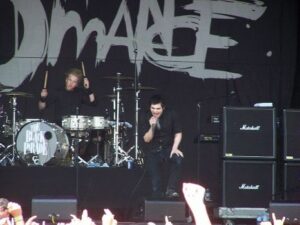
Anyway, I’ve nothing against the sub-culture of emo and its adherents.  My beef is that emo bands – like My Chemical Romance, Funeral for a Friend, Fall Out Boy, Jimmy Eat World, Paramore – simply do nothing for me.  Sorry.


Honourable exceptions: I’ve seen Death Cab for Cutie described, in their early years, as an emo band, and I like them.

 

From wikipedia.org / © Jezebel Parker


And now I have all that worked out of my system, I’ll hopefully return to writing about nicer subjects shortly.

No way-sis


From wikipedia.org / © Will Fresch


I’ve just Googled ‘the universe’s smallest sub-atomic particle’ and been told that, from what we currently know, the title belongs to those classes of particles known as quarks and leptons.  So, let me say that even a quark, or a lepton, is considerably bigger than the amount of enthusiasm I can summon about the news that legendary 1990s rock band Oasis have reformed and will embark on a five-city / 17-gig tour of Wales, England, Scotland and Ireland in the summer of 2025.  (The tour has already sold out, which suggests some folk are more enthusiastic about the reunion than I am.)


Oasis have not been a thing since 2009, when the arguing, quarrelling, sniping and feuding that’d always featured in the relationship between the band’s two mainstays, Mancunian siblings Noel and Liam Gallagher, finally went supernova – as opposed to going Champagne Supernova – resulting in the band’s break-up and the pair not sharing a stage or studio since.  From 2009 until recently, they’ve only acknowledged each other’s existence by flinging insults.  Liam, the younger and less cerebral Gallagher, has frequently called his older brother a ‘potato’ and referred to his post-Oasis band the High Flying Birds as the ‘High Flying Smurfs’.  Noel, meanwhile, has memorably described his little brother as “a man with a fork in a world of soup.”


Oasis first appeared on my radar in the mid-1990s, when I was working at Hokkai-Gakuen University in Sapporo, capital of the northern Japanese island of Hokkaido.  A student approached me one day and inquired if I was ‘Bra’ or ‘O-aaa-sis’.  (No, I’m not trying to indulge in Sofia Coppola-style mockery of how Japanese people speak English – I’m simply describing how the student, with her pronunciation, sounded to me at the time.  I’m sure my Japanese sounded even weirder to her.)  I realised she wasn’t referring to a lady’s undergarment but to British rock / pop band Blur.  She was also talking about Oasis, with whom – if the British press was to be believed at the time – Blur were locked in the bitterest and most vitriolic rivalry since the Hatfields and the McCoys.  (Noel Gallagher once remarked, “I wish Blur were dead, John Lennon was alive and the Beatles would reform.”)  Not very familiar with either band – there was no Internet in those days and it was much harder to keep up with events in the UK – I visited Sapporo’s Tower Records soon after and bought a couple of their albums.


How would I answer that student?  Was I Blur or Oasis?


© Creation Records


The Oasis album I bought was 1994’s Definitely Maybe and by my reckoning it’s a very good record.  It’s not particularly innovative, with the ghosts of the Beatles, T-Rex and Slade never far away, but it has several memorable toe-tappers and stompers like Columbia and Supersonic and one genuinely great track, Live Forever.  The latter made me think that if I was a teenager, I could seriously fall in love with these guys.  The song encapsulates those feelings of hope and optimism you have in your teens, no matter how humble or ordinary your origins, about your whole life being ahead of you and great things possibly awaiting – no more so than when the refrain kicks in near the end, “Gonna live forever!”


The songs of rock’s previous big thing, the Seattle-centred grunge movement, had been introspective, melancholic, downright miserable at times, and on April 5th, 1994, less than five months before Definitely Maybe’s release, its biggest star Kurt Cobain had blown his brains out.  So, in Britain at least, young music fans must have been ready for something more joyous.


Hope was also in the air politically.  After a decade-and-a-half of Britain being ruled by the Conservative party – peachy for anyone living in booming, investment-heavy south-east England, crap for anyone living in the now-post-industrial rest of the country – and with the current Tory government of John Major looking clueless, a brighter future seemed to be on the cards.  The Labour Party was reinventing itself as ‘New Labour’ and, mindful of the prevailing Zeitgeist, its shiny, photogenic young leader was keen to rub shoulders with Oasis, Blur and other representatives of the country’s burgeoning new rock scene that’d become known as ‘Britpop’.  That smiley, nice-seeming Prime Minister-in-waiting was called Tony Blair…  Well, okay.  We know how that worked out.


From wikipedia.org / © Raph_PH


I also acquired Blur’s Parklife (1994) and liked it less.  If Oasis drew on the Beatles for inspiration, then the spark for Parklife-era Blur was another 1960s British band, the Kinks.  This resulted in a number of chirpy, quirky songs that I found irritating and made me agree with Noel Gallagher, who slagged them off as ‘chimney-sweep music’.  That said, the title song (‘Shitelife’ as Liam once dubbed it), which has actor Phil Daniels babbling non-stop while singer Damon Albarn shouts “Parklife!” every so often, has been stuck in my head ever since.  Even today, when I find myself in a work-meeting with a superior who drones on endlessly, their voice dripping with meaningless corporate jargon, I have to fight off the urge to shout “Parklife!” at half-minute intervals.


Anyhow, though I  regarded Blur’s album as the weaker one, I still liked them.  This was because I could remember seeing them live – at London’s Brixton Academy back in 1992, when hardly anyone had heard of them, on a bill that also included the Jesus and Mary Chain, My Bloody Valentine and Dinosaur Jr.  I thought they’d been all right.


So, during the Blur vs. Oasis wars, I ended up neutral.


The 1990s continued.  So did Oasis, Blur and the Britpop craze, which spawned dozens of bands I only have vague memories of now: Cast, Kula Shakur, Ocean Colour Scene, Heavy Stereo, Sleeper, Echobelly, Dodgy, Menswear, Mansun…  Actually, I’ll admit to having a strange fondness for Mansun’s song Take It Easy Chicken.


© Creation Records


In 1995 Oasis unveiled their second album, (What’s the Story) Morning Glory?, which went on to sell 22 million copies worldwide and became one of the decade’s most acclaimed records.  I wasn’t impressed, though.  The opening number (and first single) Roll with It seemed shockingly generic to me – no wonder Damon Albarn nicknamed them ‘Oasis Quo’ – and it also spawned one of the world’s worst jokes: “Why did Oasis choose soup on the menu?  Because they got a roll with it.”  Some people adore the anthemic Don’t Look Back in Anger and Champagne Supernova but I’ve always found them overwrought.  And while initially I thought the ballad Wonderwall was quite nice, I got sick of it after hearing it for the 10,000th time.  (My partner and I were in a restaurant a fortnight ago when, from a speaker, Liam started intoning, “Today is gonna be the day…”  We groaned and rolled our eyes.)


(What’s the Story) Morning Glory?’s huge, if in my opinion undeserved, success meant Oasis became even more of a rock-and-roll behemoth, doing all the customary rock-and-roll things.  Cocaine-fuelled excess?  Check.  Infighting?  Check.  Disappearing drummers?  Check.  Hanging out with Johnny Depp?  Check.  Marrying Patsy Kensit?  Check.  With so much going on, it was inevitable that the band’s third album, 1997’s Be Here Now, would (a) be presaged with more, over-the-top hype than ever and (b) prove a bloated disappointment whose sales were only a third of those of its predecessor.  It brought the band’s ascendancy to an abrupt end and helped pop the bubble of Britpop itself.  Afterwards, Oasis made more albums and I think I’ve heard most of them.  But I can’t remember a single song off them.


© Creation Records


The band’s boorish, obnoxious image put me off them too.  And when people criticise Oasis for boorishness and obnoxiousness, it’s basically Liam they’re complaining about.  While some of the abuse he’s doled out raises a smile – grumbling, for instance, that Florence Welch from Florence and the Machine “sounds like someone’s stood on her f**king foot” – there’s other stuff he’s said and done that just makes him seem like an arsehole.  An incident at Q magazine’s awards ceremony in 2000 where he heckled Kylie Minogue by yelling ‘lesbian!’ at her is also a reminder that, over the years, a fair amount of homophobia has issued from the younger Gallagher’s gob.


Yet, despite this, many journalists and critics have given Liam an easy ride – even when they’ve been on the receiving end of his loutishness.  One possible reason why is the belief that because he comes from an ‘authentic’ working-class background in Manchester, Liam is somehow the ‘authentic’ voice of the working class.  Therefore, if you criticise his antics, you’re being ‘class-ist’.  Indeed, this argument has re-ignited in the wake of the news about 2025’s reunion tour.  The British media is suddenly full of commentators accusing other commentators, ones not delighted by Oasis’s return, of being snobbish and anti-working class.


But I don’t think any of this holds water.  For one thing, I’ve known working-class people who’ve also been unimpressed by Liam’s yobbishness.  And, in my time, I’ve seen plenty of middle-class and upper-class people make knobheads of themselves, and their social status didn’t make me think they were any less arseholey than the Oasis frontman.


From wikipedia.org / © Alexander Frick


Tellingly, Mark Lanegan – singer with 1990s grunge band the Screaming Trees and somebody whose upbringing in Ellensburg, Washington, sounds much tougher than the Gallaghers’ in Manchester – didn’t have a high opinion of Gallagher the Younger.  In his 2020 autobiography Sing Backwards and Weep, Lanegan recalls how in 1996 the Screaming Trees supported Oasis during a North American tour.  At the tour’s start, Liam accosted Lanegan with a mocking cry of “Howling Branches!” – Howling Branches, Screaming Trees, get it?  Lanegan described his response thus: “‘F**k off, you stupid f**king idiot’ was my brief blasé retort, spoken as if to a bothersome mosquito.”


This was not the beginning of a beautiful friendship.  Lanegan came to detest Liam so much that he wrote: “I couldn’t believe someone hadn’t beaten, knifed, or shot him to death by now, such was the reckless, witless, and despotic nature of his insufferable façade.”


So, I wasn’t subject to even a fleeting moment of temptation to spend hours in a Ticketmaster queue and shell out eye-watering sums of money to see Oasis perform next summer.  As far as I’m concerned, the band have only one really decent album behind them.  Besides, I’m not sure they’ll even make it through the tour.  Noel may well bail out before the end, deciding that occupying the same airspace as his tosser-ish brother again is more than his sanity is worth.


© Food Records / Virgin Records


Finally, returning to the old Blur-Oasis rivalry, I have to say I’m now in the Blur camp.  I think they’re the better band because, in the end, they’ve produced more good songs that Oasis have: This is a Low (1994), He Thought of Cars, The Universal (both 1995), Beetlebum, Song 2, Death of a Party (all 1997), Coffee & TV (1999), Out of Time (2003)…  Incidentally, given that Oasis were always supposed to be hard-men northerners while Blur were poncy, studenty southerners, the video for The Universal, inspired by Stanley Kubrick’s A Clockwork Orange (1971), makes Blur look far more disturbing than their Mancunian adversaries ever looked.  Damon Albarn and co. make great Droogs.


But if I had to choose one band that represented the peak of Britpop, it wouldn’t be Blur or Oasis.  No, it’d be Sheffield’s Pulp, led by the sublimely sly Jarvis Cocker.  Pulp’s Common People (1995), for instance, brilliantly captures one of the indignities of being working class – that of having moneyed people trying to ‘slum it’ by hanging out with you in order to look cool.  No wonder that in 2004 Common People received the ultimate accolade – William Shatner sang a cover version of it.  I can’t imagine the former Captain Kirk ever wanting to wrap his tonsils around Wonderwall.


© Island Records

Look backwards and wince


© White Rabbit


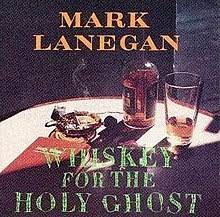
Sing Backwards and Weep, the autobiography of singer, songwriter, musician and poet Mark Lanegan, was published in 2020, two years before Lanegan’s untimely death.  It’s not a book to read if you want to know about the creative processes that went into Lanegan’s impressive body of work.  This included being vocalist with the grunge band the Screaming Trees for 16 years, contributing to alternative / stoner rock band Queens of the Stone Age during their glory years of the early noughties, being one half of the Gutter Twins with the Afghan Whigs’ Greg Dulli, and producing a dozen solo albums – of which, in my opinion, Whiskey for the Holy Ghost (1994), Bubblegum (2004) and Blues Funeral (2012) are particularly excellent.  Lanegan also seemed to be the world’s most prolific collaborator, working with an array of musicians and bands that included Moby, the Breeders, Melissa Auf der Maur, the Eagles of Death Metal, Tinariwen, Hey Colossus, Cult of Luna, the Manic Street Preachers and Belle and Sebastian’s Isobel Campbell.


No, you get little insight into that in Sing Backwards and Weep.  What you get is a lot, at times a non-stop barrage, of despair and degradation that’s often of a drug-fuelled nature. This is mingled with much bile directed at other people, including many working in the music industry, and much loathing directed at himself.  But while there were passages of Sing Backwards and Weep that I read wincing, the equivalent of how I’d watch a gruelling horror film through my fingers, I did end up feeling this was one of the best rock-music bios I’d ever come across.


In terms of grimness, the book hits the ground running. Lanegan introduces himself as being “from a long line of coal miners, loggers, bootleggers, South Dakotan dirt farmers, criminals, convicts and hillbillies of the roughest, most ignorant sort”, and says of his hometown Ellensburg in Washington state: “I hated this dead-end redneck town, hated the ignorant right-wing, white-trash hay farmers and cattlemen talking constantly about the weather, hated the constant battering wind that blew the putrid smell of cow shit everywhere.”  He detested his mother, a feeling that she reciprocated.  While he was much fonder of his father, the man had an alcohol problem and was distant, ineffectual and incapable of controlling his son.


The young Lanegan predictably became a delinquent.  At the age of eighteen he narrowly avoided spending a year-and-a-half in prison, the rap-sheet he’d accrued by then including “vandalism, car prowling, multiple counts of illegal dumping of garbage, trespassing, 26 tickets for underage drinking, shoplifting alcohol, possession of marijuana, bicycle theft, tool theft, theft of car parts, theft of motorcycle parts, urinating in public, theft of beer keg and taps, insurance fraud, theft of car stereos, public drunkenness, breaking and entering, possession of stolen property, and… a disorderly conduct charge.”


In 1984 Lanegan joined local band the Screaming Trees. This was hardly a moment of epiphany, where he forgot the misery of existence and instead discovered the transcendental joys of creativity and art.  Far from it.  A long time passed before Lanegan became happy with the Trees’ music.  Until then, he felt, “Our records were a shitty mishmash of half-baked ideas and catchy tunes derailed by the stupidest of lyrics.”  Also, his relationship with the band’s guitarist / songwriter Lee Conner was adversarial to say the least.  “Lee was completely inept socially and expected the world to come to him, something that was never going to happen.”  An incident on tour where Conner received a severe electric shock from a broken light-bulb on the frame of a dressing-room mirror is both darkly hilarious and indicative of the scorn Lanegan felt for him: “He flopped like a fish on a line and I saw blue light coming out of the wall as he electrocuted himself on the broken filament…  I howled with maniacal glee.”


From wikipedia.org / Copyright unknown


Yet the Trees were, as the adage goes, ‘in the right place at the right time’.  Elsewhere in Washington state, in its capital Seattle, the world-conquering musical movement that’d become known as ‘grunge’ was gathering momentum and the Trees would find themselves one of its leading bands – though grunge was a label Lanegan despised.  He got a glimpse of what was on the way when an up-and-coming band called Nirvana performed in his hometown: “Perhaps one of the best bands I’d ever seen, in the f**king Ellensburg Public Library no less.”  This was the start of a close friendship with the gifted and charismatic but troubled Kurt Cobain.  When Nirvana later became the biggest rock band on the planet, Lanegan observes how Cobain “was disgusted by the pedestal he’d been set atop and the ass-kissing sycophants he encountered at every turn.”  After Cobain’s suicide in 1994, he writes: “I was lost in the darkest, most depressing regret and self-loathing I’d ever experienced.”


After relocating to Seattle, Lanegan also bonded with Layne Staley, the singer of fellow grunge outfit Alice in Chains: “one of the most naturally hilarious, magical, mischievous, and intelligent people I’d ever met.”  Staley would die in 2002, another victim of the apparent ‘curse of grunge-band singers’ that’d struck down Cobain and would later claim Scott Weiland of the Stone Temple Pilots in 2015, Chris Cornell of Soundgarden in 2017 and Lanegan himself in 2022.


Thus, things get pretty awful during the course of Sing Backwards and Weep, for Lanegan’s friends and associates and for Lanegan himself, but it’s a remarkably funny book too.  Funny in a macabre way, obviously.  Many of Lanegan’s most amusing anecdotes involve famous people.  There’s James Garner, star of television’s The Rockford Files (1974-80), who’s a guest on an episode of Jay Leno’s The Tonight Show in 1993 where the Screaming Trees give a disastrous live performance.  Afterwards, when Lanegan is persuaded to sit down with Leno and his guests, Garner grasps his hand and says, “How you doing, young fella?  I’m Jim.  That wasn’t bad, young fella.  It coulda been a lot worse!”


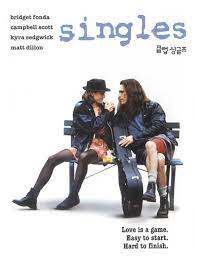
There’s the film star Matt Dillon, victim of an arson attack by Lanegan: “…while drinking together post-gig in a NYC bar, I stuck my lit cigarette into the pocket of Matt Dillon’s suit jacket when his back was turned and set it on fire as I walked away.”  The reason for this?  Dillon had appeared in the 1992 movie Singles, Hollywood’s attempt to cash in on the grunge phenomenon, which Lanegan considered “a lame and sap-filled farce of a movie… To me, it may as well have been the Spice Girls film.”


© Warner Bros


There’s a funny anecdote about Nick Cave, who’s in Seattle and arrives at Lanegan’s door to make a drugs transaction – by this point Lanegan was selling drugs from his apartment, to everyone from ‘street people, mostly Eritrean and Ethiopian migrants’ to ‘traveling rock bands’, and spending the profits on heroin.  He’d attracted the ire of his neighbours and was ‘especially despised by a young goth couple whose door was directly opposite mine.’  After the sale, “the couple just happened to be unlocking their door and entering their apartment. As we stepped out, they caught a glimpse of Cave standing there in his three-piece suit, his iconic jet-black pompadour perfectly in place, and almost broke their necks doing a double take.”


However, the laugh-out-loud highlight of the book is the chapter where Lanegan recounts what happened in September 1996 when the Screaming Trees took part in a North American tour as support to then Britpop superstars Oasis.  It would be an understatement to say that Lanegan and the Oasis singer and notorious gobshite Liam Gallagher didn’t hit it off.  At the tour’s start, Gallagher accosted Lanegan with a mocking cry of “Howling Branches!”, which prompted the response, “F**k off, you stupid f**king idiot” – ‘spoken as if to a bothersome mosquito.’  Predictably, Gallagher took this badly.  Lanegan’s disdain for the lippy Mancunian increased when he heard that Gallagher had insulted one of his idols, Neil Young.  “It was one thing to be a prick to me, but how dare that son of a bitch be rude to Neil?”


Lanegan fills the chapter with hilarious anti-Gallagher invective: “He had probably been a low-life c**ksucker his entire life.  Maybe he’d been a bedwetter, shit his pants at school, or been cut from the football squad as a youngster and never gotten over it.  I couldn’t believe someone hadn’t beaten, knifed, or shot him to death by now, such was the reckless, witless, and despotic nature of his insufferable façade.”  After Gallagher seemingly promised that there’d be a physical reckoning between the two of them in Miami, the final gig of the tour, Lanegan got so wound-up in his hatred that, one day in a taxi, he poured his heart out about it to the driver.  The taxi driver had him swap a ten-dollar bill for a roll of quarters and advised him: “Keep these in your fist and the next time you see him, break his f**king jaw.”


Alas, the Miami showdown never happened, for Oasis curtailed the tour and flew back to England early.  While it’s more likely that internal tensions within Oasis at the time were responsible for this, Lanegan believed it was because of Gallagher’s fear of the drubbing he was going to get: “That phony motherf**ker had pissed his pants and gone home to mama before I had a chance to blow this whole thing up myself.”


But the laughs in Sing Backwards and Weep come amid much darkness. Lanegan’s self-loathing is a recurring motif.  When he was with Cobain, he felt he was an “actively negative presence in the life of this beautiful and talented man, who instead of showing him any positive guidance, consistently chose to take the low road so that I could continue to stay high…”  Reflecting on his knack for sabotaging any opportunities to find success and happiness, he muses, “…I was an expert on trading gold for garbage.”


© Sub Pop


This isn’t just melodramatic, self-obsessed whining.  Events described throughout the book give ample justification for Lanegan’s low opinion of himself.  Particularly bleak are the final pages, which see him reduced to homelessness – sleeping ‘under a dingy blue tarp I had pulled out of a dumpster’ – and dependent on selling drugs and robbing shops to survive.  This comes to an end only through interventions by Cobain’s widow Courtney Love and Guns ‘N’ Roses bassist Duff McKagan, which get Lanegan into a Californian drug-treatment programme and then into accommodation and employment.


However, it’s a chapter before that, entitled Ice Cold European Funhouse and detailing part of a Screaming Trees tour in the late 1990s that incorporated Sheffield, Bristol, Essen, Amsterdam and London, that really illustrates the depths Lanegan had sunk to.  By this point, he was so blighted by his addictions that his bandmates “had begun to refer to me behind my back as ‘Mr Burns’, the old, bitter, bent-over, and creepy boss in The Simpsons cartoon television programme.”  The descriptions of his increasing desperate attempts to procure heroin across England, Germany and Holland, with his body wracked by withdrawal symptoms and his behaviour becoming more and more unhinged, are nightmarish.


Fate seems to conspire against him.  His efforts are continually thwarted by him not having any money to buy the drugs, by him not having tickets for the night-buses or fares for the taxis he needs to get to and from the dealers, by criminals selling him fake heroin, by other criminals mugging and robbing him…  It’s like watching Wile E. Coyote constantly failing to catch the Roadrunner, with Lanegan as the Coyote and the drugs as the Roadrunner.  All this takes place against the intense, miserable cold of a north European winter.


At one point, trying to make it to a dealer’s place on a street in King’s Cross, he “began to projectile vomit so hard that it took me to my knees, then flat out on the ground.  Despite the fact that I’d not eaten any food in two days, up came copious quantities of pure-black liquid.”  At another point, in Amsterdam, penniless but determined to obtain funds to score, he goes after the man responsible for selling the tour’s merchandising and demands that he gives him money.  Terrified, the ‘merch guy’ hides in his hotel room.  “I began trying to actually kick the door in, trying my damnedest to gain entry to actually murder this recalcitrant son of a bitch.”  Back in London, when someone tries to mug and rob him a second time, he beats the shit out of his would-be attacker: “…all the repressed anger, pain, and extreme anxiety I’d held on to throughout this entire, trying ordeal… came pouring out.”  In the midst of these horrors, the Screaming Trees have to perform on the venerable TV music show Later with Jools Holland (1992-present).  You can imagine the now utterly raddled Lanegan in the presence of the famously chirpy Holland, “…enduring the half-baked witticisms of the scripted banter between host and guests.”


The Ice Cold European Funhouse chapter could almost be a self-contained short story about the damage that drugs can do to a person.  It’d be a great short story too, something that wouldn’t be out of place in, say, the Irvine Welsh collection The Acid House (1994).  Incidentally, on my copy of Sing Backwards and Weep, Welsh contributes the blurb on the front cover.


The book ends in 2002.  This calls to mind the Chinese saying, “May you live in interesting times,” which initially sounds like a blessing but is actually a curse.  Lanegan’s life until then was fascinating to read about, but often hellish for Lanegan himself.  After 2002, presumably, he found stability, success and fulfilment, which was great for him but would probably make much less interesting reading material.  However, by the time you reach the end of Sing Backwards and Weep, you won’t begrudge the old bugger for having earned the right to live a more boring life afterwards.


From wikipedia.org / © Steven Friederich

We’re left un-Mark-ed


From wikipedia.org / © Steven Friederich


I’m not particularly superstitious, but I can’t help wondering if when Kurt Cobain picked up a shotgun in his Seattle home on April 5th, 1994, he set in train a curse that would strike down the singers of all the great grunge bands.  Following the Nirvana frontman’s suicide, Layne Staley of Alice in Chains died in 2002, Scott Weiland of the Stone Temple Pilots died in 2015 and Chris Cornell of Soundgarden died in 2017.  And now this grim list has been extended by the death last week of Mark Lanegan, vocalist with the Screaming Trees.  One can only hope that Eddie Vedder of Pearl Jam and Mark Arm of Mudhoney get to see their sixties.


Mark Lanegan’s death came as a blow because both the band he fronted in the 1980s and 1990s, the Screaming Trees, and his own solo career, which began in the 1990s, seemed to go from strength to strength.  Unlike many rocks acts, they didn’t just peak after a couple of albums and then tail off in quality.  The Trees’ later albums, Sweet Oblivion (1992), their biggest commercial success, and Dust (1996), were great and bore a slew of classic singles, like Nearly Lost You, Dollar Bill, All I Know and Sworn and Broken.  For me, though, their finest moment was the first track on Sweet Oblivion, the urgent, pulsating Shadow of the Season, powered like all of Lanegan’s music by his husky, old-man’s-voice-in-a-young-man’s-throat vocals.  Lanegan had originally signed up with the Trees as a drummer but claimed he was so useless at drumming that his bandmembers ended up forcing him to sing…  Surely one of the most fortunate career-changes in modern music.


© Epic Records


Before the band broke up at the end of the 1990s due to the not-uncommon ‘differences among bandmembers’ – differences that were fuelled in part by Lanegan’s industrial-level booze and drug consumption – Lanegan had also contributed to the grunge ‘supergroup’ Mad Season, which as well as members of the Trees contained members of Pearl Jam and Alice in Chains, and whose lone album Above (1995) I’ve always considered rather wonderful.  Later, he was associated with alternative / stoner rock band Queens of the Stone Age, whose founder Josh Homme had joined the Trees as a guitarist following the release of Dust.  He contributed to the Queens during the glory years of their albums Rated R (2000) and Songs for the Deaf (2002).  Plus, he was one half of the Gutter Twins (the other half being Greg Dulli of the Afghan Whigs), who recorded the 2008 album Saturnalia.


Meanwhile, his solo career, which had begun with The Winding Sheet in 1990 and had already won critical acclaim with Whiskey for the Holy Ghost in 1994, gathered a head of steam.  By the time of his death, he’d released a dozen solo albums, of which Bubblegum (2004) and Blues Funeral (2012) are my favourites.  Bleeding Muddy Water off Blues Funeral is the sort of song you’d consider having played at your funeral.  Inevitably, with Lanegan’s gruff, mournful voice, and with his worldview coloured by a long history of drug and alcohol abuse, his canon evokes a long and honourable tradition of world-weary American troubadours chronicling the seedy side of life: Johnny Cash, Tom Waits, Leonard Cohen and countless old blues singers.  Indeed, the blues influence was never far away from Lanegan’s music.  He once worked with Kurt Cobain on a never-released album of cover versions of songs by the legendary bluesman (and several-times convict) Leadbelly.


Lanegan was a prolific collaborator, working with everyone from Moby to the Breeders, Melissa Auf der Maur to the Eagles of Death Metal, Tinariwen to Hey Colossus, Cult of Luna to the Manic Street Preachers…  Though because of my Scottish-Irish background, and because in my less violent musical moods I’m something of a folky, I have to say I like his work with Isobel Campbell, the Scottish chanteuse of Belle and Sebastian, most of all.  Lanegan and Campbell were responsible for three records, Time is Just the Same (2004), Ballad of the Broken Seas (2006) and Sunday at Devil Dirt (2008), and their combined sound is gorgeous in its understated way.  The Celtic beauty of Campbell’s singing meshes hauntingly with the grungy old American beast that is Lanegan’s voice.


© V2


I did not have much success when I first attempted to see the great man perform live.  During the Edinburgh Festival sometime in the ‘noughties’, he did a gig at Edinburgh’s Liquid Rooms, but I made the mistake of trying to cram too much into my Festival-going schedule that day.  I misread the start-time for Lanegan’s gig and also bought a ticket for comedian Reginald D. Hunter at the Pleasance, believing I had a few minutes after Hunter’s show ended and before Lanegan’s began to get myself from one venue to the other.  When I steamed into the Liquid Rooms, Lanegan was already on stage, singing Shadow of the SeasonWell, I thought, it’s nice of him to treat the audience to a classic Screaming Trees song so early in his set.  However, a few minutes later, he said, “Thank you and good night!” and left the stage, and I realised I’d actually arrived exceedingly late in his set.  I was so annoyed that when I walked out of the Liquid Rooms again, I almost crashed into a towering, tousle-haired figure who was being interviewed on the pavement by a small scrum of journalists – yes, it was Lanegan himself.  So at least he belongs to the Pantheon Of Famous People I’ve Been Within A Yard Of (alongside John Cleese, Irvine Welsh, Mark E. Smith and, er, John Otway).


But a couple of years after that, I managed to see a full Lanegan concert at, if memory serves me correctly, the now-defunct HMV Picture House on Edinburgh’s Lothian Road, and that was brilliant.


In the 2010s Lanegan became pals with globetrotting TV chef Anthony Bourdain.  Following Bourdain’s death in 2018, Lanegan penned a tribute in the Observer that described him as an “important voice for the positivity of exploring different cultures all over the world.  He’s someone we really need now, especially in a country where our shambles of a president wants to vilify people of colour and stoke the fires of the ignorant…  He made the world a better place.”  It was Bourdain who encouraged Lanegan to pen an autobiography, finally published in 2020, called Sing Backwards and Weep.  Hitherto, Lanegan had been reluctant about tackling such a project because, in his words, “The last thing I wanted to do was write some stupid f*cking rock bio.”


I haven’t read Sing Backwards and Weep, but a Scottish mate of mine who has tells me it’s great, if pretty intense – which isn’t surprising given some of the dark things that happened to Lanegan during the troughs of his addictions in the 1980s and 1990s.  These included a period of being homeless, which ended when Courtney Love, Kurt Cobain’s missus, rescued him and got him into rehab.  Sing Backwards and Weep also recounts the massive spat Lanegan had with leading Britpop gobshite Liam Gallagher when the Screaming Trees had the misfortune to support Oasis on their 1996 American tour.  Lanegan was not in a forgiving mood at the time and didn’t take kindly to Gallagher referring to his band as ‘the Howling Branches’.  Lanegan was still in a fighting mood a quarter-century later when the book was published: “I would still kick the f*cking shit out of that guy the first moment I got a hold of his hands because he’s a f*cking idiot.”  Quite right too.


The past year had been especially rough for Lanegan.  Having relocated to Ireland, he contracted Covid-19, which resulted in him having breathing difficulties, becoming deaf, losing the use of one leg, hallucinating, suffering from insomnia, falling down a flight of stairs and being put in a medically induced coma.  It was the impact of all that, presumably, which finally pushed Lanegan off this mortal coil.  Mind you, he wrote a second book called Devil in a Coma, published just in December last year, which described the ordeal he’d been going through with the virus.  An artist till the very end, Lanegan managed to extract a creative work from even the process of dying.


News of Lanegan’s death left me feeling frustrated as well as sad – frustrated because I felt the world had been cheated out of much more, excellent music that surely he would have produced had he been allowed to live another couple of decades.  The next day, I remarked on this to a friend, saying that Lanegan had been ‘on course to be a great renaissance man like Nick Cave’.  But as my friend pointed out, he’d been so phenomenally prolific that, by his death at 57 years old, his output was probably as large as, if not larger than Cave’s already.


Still, it’s tragic.  These days, 57 is no age.


© 4AD