30 years on, it’s still the worst toilet in Scotland


© Channel Four Films / PolyGram Filmed Entertainment


Just over a year ago, I posted on this blog about the sad closure of The Projector, Singapore’s alternative cinema.  According to a statement on the cinema’s Facebook page, this was caused by “rising operational costs, shifting audience habits, and the global decline in cinema attendance,” factors that had “made sustaining an independent model in Singapore especially challenging.”  The Projector was the one venue in the city-state where you could see, on a big screen, independent and arthouse films, ones that were generally offbeat, ones focused on minorities and not necessarily made in the handful of big international languages.  It also offered opportunities to watch older movies in a cinema, for example, ones by Alfred Hitchcock, Akira Kurosawa and David Lynch.  Though sometimes it showed modern Hollywood and Chinese blockbusters too.


The Projector operated at two locations, the Cineleisure shopping mall on Grange Road and the Golden Mile Tower on Beach Road.  Happily, this year, a new cinema called The Filmhouse has started doing business in The Projector’s Golden Mile Tower premises and has a similar agenda of showing films you wouldn’t otherwise see in Singaporean cinemas.  According to Wikipedia, The Filmhouse retains “certain key team members and features” from The Projector.


Last week, I made my first visit to The Filmhouse and was pleased to find it busy.  It’s a smaller operation than The Projector with, as far as I can ascertain, just two screens, but probably that makes more financial sense – a non-mainstream cinema can’t afford to have many overheads.  The lobby contained a bar, comfortable seats and, most importantly, a relaxed and friendly ambience.



When I went into one of the halls and found my seat, I was slightly disappointed that, before the movie started, the short film warning patrons to keep their phones silent and refrain from using them during the show wasn’t the famous one used by The Projector.  That had footage from the super-schlocky Turkish science-fiction movie Dünyayı Kurtaran Adam, better known as Turkish Star Wars, and featured ‘Turkish Luke Skywalker’ training for battle by smashing his big fists repeatedly against a desert boulder.  You were warned that if you violated the cinema’s policy on phone-use, you would suffer punishment similar to that being inflicted on the rock.


Still, The Filmhouse’s anti-phone film is cute enough.  It has a brief clip of the late David Lynch telling us, “You have a very good heart.’  Then we’re asked to prove Lynch right about our hearts by turning off or muting our devices and not spoiling anyone else’s enjoyment of the movie with them.


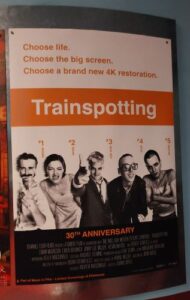
Anyway, what was the film I went to see?  It was a 30th-anniversary showing of Danny Boyle’s Trainspotting (1996), freshly spruced up for cinematic re-release.  As the movie poster’s tagline announced: “Choose life.  Choose the big screen.  Choose a brand new 4K restoration.”


At the time of its release, Trainspotting caught the zeitgeist of mid-1990s Britain, obsessed with Britpop and all things Cool Britannia.  Yes, how long ago that all seems now.  To be honest, it annoyed me in some ways that the movie got lumped in with the Britpop / Cool Britannia thing, even if the filmmakers opportunistically loaded its soundtrack with music of the time, by bands such as Pulp, Blur, Sleeper, Elastica, Leftfield and Underworld.  That said, the two songs that defined the film, Iggy Pop’s Lust for Life from 1977 and Lou Reed’s Perfect Day from 1972, had nothing to do with 1990s Britain.


To me Trainspotting sprang from an earlier, darker and less glamorous era than the one of Damien Hirst’s formaldehyde shark, Geri Halliwell’s Union Jack mini-skirt and Blur-versus-Oasis – namely, the mid-to-late 1980s, when Edinburgh’s boom in heroin use and the subsequent, resultant HIV / AIDS epidemic led to the city being dubbed ‘the AIDS capital of Europe’.


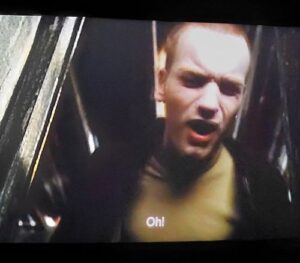
This became material for the book that inspired the film, Irvine Welsh’s novel Trainspotting (1993), which is an altogether bleaker and rougher-edged piece of work than Boyle’s cinematic version.  Though of course the film isn’t without its bleak or rough-edged moments either.  The worst toilet in Scotland, anyone?
 

© Channel Four Films / PolyGram Filmed Entertainment


Still, I’m not complaining too much.  I think both Trainspotting the book and Trainspotting the movie are great and are classics in their respective fields, 1990s Scottish literature and 1990s British cinema.  But after 30 years, how would the latter work hold up?


Pretty well, I thought, though the animatronic zombie-baby that Renton (Ewan McGregor) imagines crawling across the ceiling during a traumatic ‘cold turkey’ episode looks terrible now.  Mind you, it looked ropey enough in 1996.


I wondered how, in these days of extreme anxiety about sex predators preying on children, the gag about Renton meeting Diane (Kelly Macdonald) in a nightclub, going home with her and discovering the next day that she’s still at school would come across.  Not as ickily as I feared.  Diane is clearly the one doing the manipulating and Renton is properly horrified when he learns how old she is really.  Plus, McDonald’s true age at the time, 20, means the sequence’s punchline, when Diane appears in her school uniform, is cringily funny but – thankfully – a bit unbelievable.


Meanwhile, I winced at the scene following the death of Tommy (Kevin McKidd), where a grieving Spud (Ewan Bremner) pays tribute to his late friend by singing Two Little Boys – a song popularised by, and forever associated with, the Australian entertainer, TV personality and artist Rolf Harris, who had a smash-hit with it in 1969.  In 2014, Harris hit the headlines when he was found guilty of sexually assaulting four underage girls.  But to be fair to Two Little Boys, it was around long before Harris got his hands on it.  It was written in 1903 by composer Theodore F. Morse and lyricist Edward Madden.


The Singaporean audience I saw Trainspotting with certainly enjoyed it, even though I wondered how a film about heroin addicts would go down in a country with some of the strictest anti-drugs laws in the world.  If Trainspotting had taken place in Singapore, the drug dealing characters in it like ‘Mother Superior’ (Peter Mullan) and Mikey Forrester (Welsh in a cameo) would have been executed long ago.  Much of it they found funny, which is appropriate because the film is essentially a (very black) comedy.  The Worst Toilet in Scotland sequence and the one where the hapless Spud spectacularly soils the bedsheets in the house of this girlfriend Gail’s (Shirley Henderson) parents, then manages to scatter the contents of those bedsheets across Gail, her parents and their kitchen, elicited guffaws.

 

© Channel Four Films / PolyGram Filmed Entertainment


Also getting laughs was Renton’s famous ‘It’s shite being Scottish’ rant.  He may have hit a chord with the audience when he raged, “Some hate the English.  I don’t.  They’re just wankers.  We, on the other hand, are colonised by wankers!”  The Singaporeans, of course, were once colonised by the English too – though, technically, as part of the British Empire, they were colonised by the Scots and Welsh as well.


On the other hand, I must have been the only person in the cinema-hall chuckling during the references to and jokes about Sean Connery.  (“Do you shee the beasht?  Have you got it in your shights?”  “Clear enough, Missh Moneypenny!  This should preshent no shignificant problemsh”)  Most folk there were about half my age and I guess ‘Big Sean’ is unknown to the younger generation.


One thing I felt about seeing Trainspotting 30 years on was that now the Britpop musical soundtrack sounds quaint rather than cutting edge, and now that I know the punchlines to all the jokes about jobbies, Sean Connery and so on, its depiction of heroin addiction is more on-the-nose.  Without the film’s cultural baggage distracting me, I better perceived the horribleness of the characters’ situations.  Like when baby Dawn – whose zombie-fied form Renton will hallucinate about later – dies from neglect and her parents, Sick-Boy and Allison (Susan Vidler), after a moment’s anguish, greedily reach for the syringes, needles and smack again.  Or when Tommy – who was originally the healthiest and most level-headed of the gang – becomes ruinously addicted and, while he lies ravaged on a mattress, a conscience-stricken Renton tries to apologise for getting him hooked on the stuff.  Tommy pays the apology no heed and is interested only in getting money for his next fix.


Another thing I noticed in 2026 about Trainspotting is that, for a film supposed to be the greatest one ever set in Edinburgh, you see very little of Edinburgh in it.  You have the famous opening scene where Renton, Spud and Sick-Boy try to shoplift in (the now long-gone) John Menzies bookstore on Princes Street and are chased along the thoroughfare by security, with Renton making a last, doomed break for freedom down Calton Road and under Waterloo Place.  But that’s all.  The streets, side-streets, bunker-like nightclubs, pub-interiors and blighted junkies’ dens could be anywhere.  Though that’s hardly surprising considering it was partly funded by the Glasgow Film Fund and most of it was shot in Glasgow.


Compare that with the sequel, T2: Trainspotting (2017), which was partly based on Irvine Welsh’s literary follow-up Porno (2003), also used some bits from the novel Trainspotting that didn’t get into the first film, and also featured stuff from scriptwriter John Hodge’s own imagination – like the psychotic Frank Begbie (Robert Carlyle) staging an escape from Saughton Prison.  In T2, you get to see the Royal Mile, the Grassmarket, Cockburn Street, Harvey Nichols, the Scottish Parliament, the tram system, the Forth Road Bridge and Salisbury Crags.  It’s practically a love-letter to the Scottish capital.


Still, a few months ago, I was in Edinburgh and found myself walking down Calton Road.  And my immediate reation was, “Hey, this is where Ewan McGregor ran and got caught in Trainspotting!”  So one little piece of the city, at least, was immortalised by the original film.

 

Happy World Goth Day 2026


From youtube.com© South Park Studios


I know time seems to speed up as you grow older, but it still feels weird to me that we’re not only into another year, 2026, but we’re already nearing its halfway point.  In fact, today, we’ve reached May 22nd.  And rolling around again – again? – is World Goth Day.


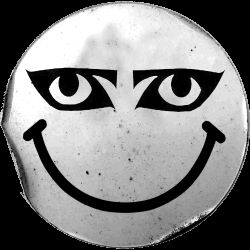
According to its Wikipedia entry, May 22nd became the annual day of celebration for the world’s darkest-clad, whitest-eyelinered, most sunlight-shunning musical sub-culture when “UK-based goth DJ Lee Meadows, aka DJ Cruel Britannia (currently known as BatBoy Slim), wrote a MySpace blog suggesting the idea of initiating a ‘Goth Day’ to a very positive reception.  In 2010, he and London-based DJ Martin Oldgoth decided to make the concept global, both ‘as a bit of fun’ and to create an environment of positivity and unity within the goth community.”


From worldgothday.com / © BatBoy Slim


As is customary on this blog, I’ll mark the occasion by providing links to a dozen of my favourite Goth songs on YouTube.  As ever, I apologise if you first have to endure some annoying corporate and insipid YouTube advertisements, packed with AI-generated visual crap, which are the antithesis of the mystical, elegiac and tenebrous aesthetic of Goth culture.


To get the ball rolling, here’s Wytches Chant ’98 by English Goth band Inkubus Sukkubus, whom noted punk / Goth journalist Mick Mercer described as ‘a zombie version of Fleetwood Mac.’  (Many would argue that the real Fleetwood Mac have been fairly zombified for the past few decades anyway.)  So, let’s raise our voices and sing along to that Wytches Chant ‘98: “Isis, Astarte, Diana, Hecate, Demeter, Kali, Inanna…”


A while ago I was looking at an online list of ‘underrated Goth bands’ and discovered Container 47 and their song Razor End Falling.  The band don’t have a Wikipedia page and all I know about them is that they’re from Italy and have been on the go since the early 2000s.  This song, to me at least, is agreeably heavy.


On the same ‘underrated Goth bands’ list, I noticed the name the Rose of Avalanche.  Wow, I thought – I hadn’t heard of them since they supported the Mission at a gig in Aberdeen in the mid-1980s.  They originally broke up in 1993 but, following a 26-year hiatus, reformed in 2019.  I found their 1985 single LA Rain enjoyably audacious – it takes the sound, ambience and languid pace of a typical Lou Reed / Velvet Underground song and drenches it in a shimmery, Gothy 1980s guitar-sound.


From roseofavalanche.com / © The Rose of Avalanche


Here’s some more rain, served up by the Swedish Goth band Miazma (which, from soon after its inception in the late 1990s, has apparently consisted of just one musician, Kristian Olofsson).  It’s called Black Rain.  Including this song on the list saves me having to include anything by the seminal Goth outfit the Sisters of Mercy because, frankly, Miazma sounds uncannily like the Sisters of Mercy, down to Olofsson’s vocals, which reproduce the nonchalant gruffness of the Sisters’ frontman, Andrew Eldritch.  On the other hand, a band whom this Miazma shouldn’t be confused with is another band called Miazma, which is actually a death metal one from Australia’s Alice Springs.


And yet more rain…  If Scottish alternative-rock brothers Jim and William Reid, aka the mighty Jesus and Mary Chain, knew I’d included one of their songs in a list of Goth tunes, I suspect they’d come round to my house and murder me – using hammers.  Well, tough luck, guys – I am including you.  I saw the Jesus and Mary Chain perform in Singapore last month and the gig, at the city-state’s Esplanade Theatre, attracted a fair number of Singaporean Goths.  And I think their song Nine Million Rainy Days, from the aptly titled 1987 album Darklands, is dripping with Gothic doom, gloom and darkness, as evidenced by the lyrics, “As far as I can tell / I’m being dragged from here to hell / All my time in hell was spent with you…”


Halfway through, however, Nine Million Rainy Days veers off in an unexpected direction when it borrows the famous ‘woo-woo’ backing vocals that grace the Rolling Stones’ Sympathy for the Devil (1969), though here they mutate into ‘woo-woo, woo-woo, woo!’


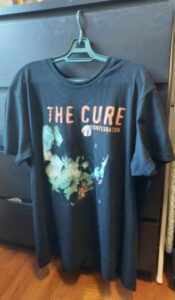
Talking of the Rolling Stones, eyebrows were recently raised when Mick, Keef and Ronnie announced that Robert Smith of the legendary Goth band the Cure would be contributing to their next album.  The Stones’ straight-up, unpretentious, bluesy, rock ‘n’ roll swagger seems light-years removed from the Cure’s meticulous, brooding atmospherics, so I don’t know how that’ll work out.  Meanwhile, the Cure and possibly their greatest album, 1989’s Disintegration, have been on my mind lately because my lovely mother-in-law gave me a Cure / Disintegration T-shirt as a present for my last birthday.  So, from that album, here’s the song Lullaby.  The link takes you to the song’s memorable video, where Smith, in pyjamas, sings worriedly about “Mr Spider-man” having him “for dinner tonight.”


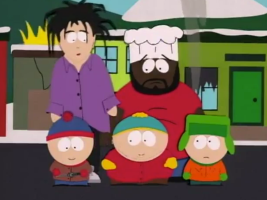
In fact, Disintegration is such a masterpiece I could have included any song off it: Fascination Street, Plainsong, Pictures of You, etc.  No wonder that in a 1998 episode of the scabrous TV cartoon show South Park, Kyle Broflovski shouts at Robert Smith, “Disintegration is the best album ever!”  (Admittedly, he was rather excitable by that point.  His town had been pulverised by Barbra Streisand, who’d transformed into a giant, robot-kaiju called Mecha-Streisand, and Robert Smith had saved the day by transforming into a giant moth and hurling her into outer space: “I have to try,” sighed the Cure’s front-man. “I can’t let Barbra Streisand do this to the entire world.”)


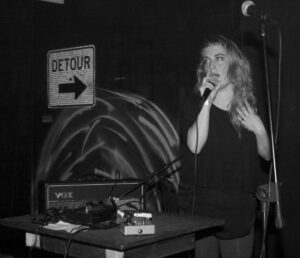
And now for a younger band.  Boy Harsher are a darkwave duo consisting of singer Jae Matthews and producer Augustus Muller, who hail from the American state of Georgia.  They cite among their influences the late, visionary filmmaker David Lynch, though with the next track on my list, a remastered version of Boy Harsher’s 2014 single Pain, I get more of a vibe of the synth tracks John Carpenter devised for the soundtracks of his 1970s and 1980s movies.  That’s initially at least, before Pain’s propulsive beat carries all before it.


Actually, Pain features in a movie itself.  It can be heard during a party scene in the 2022 horror film Terrifier 2.  I haven’t seen it, but I think that’s the one where the villain (Art the Clown) flays a victim and then rubs salt into the wound by, er, rubbing salt into the victim’s catastrophic wounds.  So, having a song called Pain in the film was appropriate.


From wikipedia.org / © GRIT PHOTOZINE


In fact, Pain got a remix in 2018 courtesy of the American musician and producer Luis Vasquez who from 2009 was also the single, official member of the band the Soft Moon.  Fittingly, an influence on the Soft Moon’s sound was the celebrated industrial / electronic rock band Nine Inch Nails, itself a one-man-band for the musician and producer Trent Reznor.  (More on Nine Inch Nails later.)  The next item on the list is one of my favourite Soft Moon songs, Become the Lies, from the band’s final album, Exister (2022).  I have to write about Luis Vasquez and the Soft Moon in the past tense because, tragically, Vasquez died in 2024 aged just 44.


Another musician specialising in dark electronica who left us much too soon was Frank Tovey, who as Fad Gadget at the very end of the 1970s and in the early 1980s helped pioneer both the synth-pop and darker, Goth sounds that became popular soon after.  Alas, a heart attack claimed Tovey / Gadget at the age of 45 in 2002.  Here’s his first and possibly most famous single, Back to Nature, from 1979.


Fad Gadget has been credited as a big influence on Depeche Mode, though beyond the use of newly affordable musical technology, like synthesisers, I personally can’t see much connection between the ruminative likes of Back to Nature and Depeche Mode’s early, chirpy (and for me, annoying) hits like New Life and Just Can’t Get Enough (both 1981).  Despite being irritated by the early ‘Mode’, I’ve gradually grown to love them as, in their later incarnations, they’ve shifted away from a poppy, kid-friendly synth sound and embraced a darker, harsher, more industrial and Gothic one.


Here’s the stomping Barrel of a Gun, the first single off Depeche Mode’s 1997 album Ultra.  The accompanying video shows how far they’d progressed by then from their early-1980s clean-cut-boys-with-synthesisers phase – this is grungy, decadent, Anton Corbijn-directed artiness.  At least, it is until Dave Gahan starts wandering around in a silly coat covered in Christmas-tree lights.


From wikipedia.org / © Mute Records


Here’s something else that’s silly, this time involving America’s awesomely dark and bleak industrial-rock juggernaut Nine Inch Nails (which is basically musician / vocalist / producer Trent Reznor and whoever happens to be in the studio with him at the time).  No, I’m not saying Nine Inch Nails are silly.  But some years ago, they were the subject of a celebrated musical / video ‘mashup’ whereby editor and content creator Garren Lazar grafted the band’s disturbing song Closer, from the 1994 album The Downward Spiral, onto clips taken from the beloved children’s TV programme The Muppet Show (1976-81).  Hence, the song’s opening drumbeat is performed in the video by Animal, the drummer in the Muppets’ house band, Dr Teeth and the Electric Mayhem.  (Thankfully, Animal doesn’t feature when Reznor sings Closer’s most notorious lyric, “I want to f**k you like an animal.”)


Watching Kermit, Gonzo, Miss Piggy and the rest cavort to this song is a reminder that, loveable though the Muppets are, if you first encountered them at a very young age you might have found them a bit sinister.  For example, the stuff in the video involving a frenetically speeded-up Dr Teeth is downright freaky.  Also featured are some of the human guests who appeared on The Muppet Show, such as Alice Cooper, Cloris Leachman, Rita Moreno, Harry Belafonte and Dudley Moore – Moore’s cameo is particularly worth waiting for.


However, should anyone be upset at me linking to a comical Nine Inch Nails / Muppets mashup, I’ll throw in a bonus link – to a more sombre and majestic mashup where Rory Gamble transposes Nine Inch Nails’ The Day the World Went Away (from 1999’s The Fragile) onto the trailer for Mad Max: Fury Road – Black & Chrome.  Both sonically and visually, it’s a work of genius.  You’ll punch the air when, one minute and ten seconds in, things get cranked up to 11.


Eat Your Makeup is the name of a short film made by American’s God-Emperor of Bad Taste, John Waters, back in 1968.  However, Eat Your Make Up – note the slight difference in the wording – is also the name of a French Goth band and here, to round things off, is their 2005 song I was the Murderer.  It’s a pleasant reminder that at least some of Goth’s musical roots lie in punk rock.


© Adipocere Records