Happy Mondays deliver a scrappy Tuesday


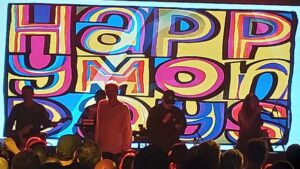
On Tuesday last week I went with a friend to Singapore’s Foo Chow Hall to attend a gig by the legendary Manchester band the Happy Mondays.  The Mondays helped popularise a cheerily trippy, dance-rock sound that was dubbed ‘Madchester’ – a reflection of the fact that many of its proponents originated in the same north-of-England city: see also the Inspiral Carpets, James, 808 State and, most notably, the Stone Roses.  In fact, the Happy Mondays and Stone Roses were to the Madchester sound what Nirvana and Pearl Jam were to grunge.


I love the Happy Mondays but I have to concede they only ever made three albums of note and those were recorded a long time ago: the memorably titled Squirrel and G-Man Twenty-Four Hour Party People Plastic Face Can’t Smile (White Out) (1987), Bummed (1988) and Pills ‘n’ Thrills and Bellyaches (1990).  I think that last album is superb, consisting of classic tracks from start to finish.  But the, shall we say, hedonistic nature of the band, and the chaos that seemingly surrounded them, meant the Happy Mondays would never reach those heights again.  In the 36 years since, they’ve put out two more albums, to mixed reviews, and ticket sales for their concerts have depended on the nostalgia and affection of their fans – fans who, these days, are getting long in the tooth.  I should know.  I’m one of them.


In fact, the last time I saw the Happy Mondays live was back in 1999 and even then they seemed a legacy act. That was at Scotland’s premier summer music festival, the now-defunct T in the Park, and the Mondays headlined Stage 2 on the festival’s second and final day.  By that point I was well-lubricated, but I do remember their set being brilliant even if it didn’t offer much musical innovation.  The next day, at work, a couple of my colleagues who’d also been at T in the Park, in a soberer condition, reacted to my report of seeing the Happy Mondays at Stage 2 with horror.  “What?” they exclaimed. “You ventured over there?” That year’s festival had taken place close to Edinburgh and the crowd at the Happy Mondays’ set had all resembled characters from Irvine Welsh’s Trainspotting (1992).  I guess I’d been too high-spirited to notice.


It was a contrast 27 years later to see the band in the saner surroundings of Singapore, performing before an audience of comfortably well-off Western expatriates – nearly all of whom were a bit on the wrinkly side. My friend, who’s in his early forties, must have been one of the youngest people on the premises.
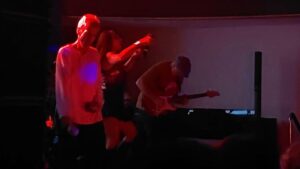


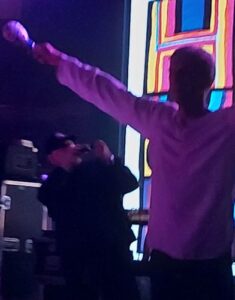
The line-up isn’t quite the Happy Mondays one of old, but it’s not far off it. There’s cussed singer-songwriter (and tambourine-tapper) Shaun Ryder, long-term guitarist Mark Day, long-term drummer Gaz Whelan and the talismanic dancer and maracas-shaker Bez, who is surely history’s greatest example of a band-member who doesn’t really play anything and is just there to help the vibe.  Keyboardist Dan Broad has been on board since 2008.  Sadly not around anymore is bassist and Ryder’s brother Paul, who died four years ago. Their bassist in 2026 is Mikey Shine, who was originally involved with the band for half-a-dozen years in the noughties.


Female vocalist Rowetta, who’d been a mainstay of the Happy Mondays since 1990, left the band in 2024. Her departure was followed by acrimony a year later when she alleged that Shaun Ryder had punched her during an altercation in 2000 – something that Ryder strongly denies.  Singing in her place on the current tour is Firouzeh Berry, whom I believe is also Bez’s wife.


This year the band is celebrating the 35th anniversary of Pills ‘n’ Thrills and Bellyaches and thus we were treated to all ten tracks from that album performed in chronological order.  The remainder of the set contained several songs from their earlier two albums, plus the haunting and mighty dance track Hallelujah from the 1989 EP of the same name.
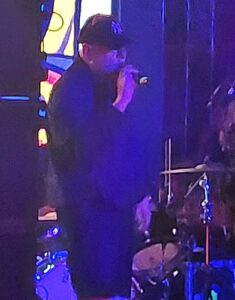


Okay, let’s address the elephant in the room.  Shaun Ryder’s voice was never a thing of beauty and nowadays it’s well past whatever prime it once had.  His singing was rough, even sepulchral at times.  I occasionally found myself imagining I wasn’t listening to the Happy Mondays at all but to another Manchester band, the Fall, who were famous for the growly stream-of-consciousness vocals of their late founder and singer-songwriter Mark E. Smith.  Well, it sounded like a version of the Fall with some cool dance grooves.


The issue was particularly noticeable during the first couple of songs when the front-of-house engineer hadn’t yet got the balance right at the mix desk and Ryder’s voice wasn’t just prominent but drowning out the rest of the band.  At least Ryder was open about his vocal shortcomings, for example, groaning before one of the more melodic numbers that he’d be forced to attempt to sing more.  Firouzeh Berry’s voice, meanwhile, had to do some heavy lifting to compensate.
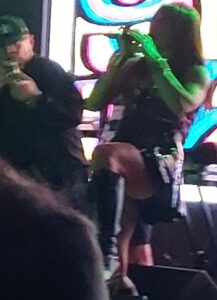


Still, some songs emerged relatively unscathed.  The band delivered a fine rendition of Hallelujah late on and, thankfully, my all-time favourite Mondays tune, Loose Fit from Pills ‘n’ Thrills and Bellyaches, was one of the evening’s highlights.


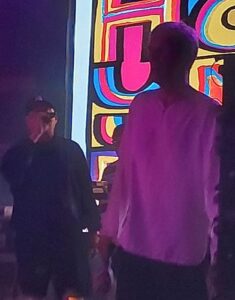
Bez was as spritely as ever.  Indeed, cavorting about the stage, he looked more mobile and agile than he had any right to be, considering his age (62) and his long history of reckless and excessive living.  During the Covid-19 pandemic, I chuckled when I heard he’d decided to become a fitness instructor and, to help folk stay healthy during lockdown, was putting exercise videos on YouTube under the title Buzzin’ with Bez.  But this fitness lark obviously hasn’t done the old bugger any harm.



So, due to one key component of the band sounding like an asthmatic frog, it was a scrappy evening – but istill a fun one.  The audience certainly enjoyed themselves.  The fact that many punters had turned up wearing identical Happy Mondays T-shirts, emblazoned with the 2026 tour logo, and that prior to the gig they’d been sinking pints in pubs along Tyrwhitt Road outside, gave the proceedings the rowdy air of a football match – albeit one where the whole crowd supported the same team.


Indeed, it seemed appropriate that the venue was Foo Chow Hall, a place that frequently hosts tournaments by Singapore Pro-Wrestling (SPW).  Just as the Happy Mondays are a bit lacking in musical finesse these days, so pro-wrestling is hardly dripping with proper, competitive sporting integrity.  But you can’t deny that both serve up plenty of entertainment.
 

We’ve lost the other Mr. Mountfield


From wikipedia.org / © Katherine Barton and Gaz Davidson


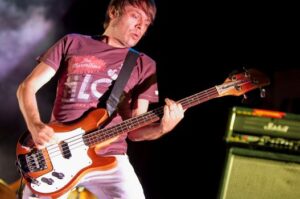
I was shocked and saddened to hear about the death on November 20th of Gary ‘Mani’ Mountfield, bass player with the Stone Roses from 1987 to 1996 and 2011 to 2017 and with Primal Scream for the 15 years between his spells in the Roses.


Shocked because Mani seemed such an exuberant figure (in keeping with his exuberant bass sound) that he was the very last rock-and-roll-related personage I’d expect to die at the relatively young age of 63.  I’ve seen plenty of other rock-and-roll figures on stage who did look ready to kick the bucket because of their frailty, ravaged-ness and general air of vulnerability.  But not Mani, who was always ebullient.   In fact, just days before his passing, he’d announced dates for a speaking tour of the United Kingdom planned for next year, which doesn’t sound like someone on their last legs.


Hailing – of course – from Manchester, Mani first played in two bands that were prototypes for the Stone Roses, the Fireside Chaps (with future Roses guitarist John Squire) and the Waterfront (with future Roses singer Ian Brown joining in 1983).  The Roses’ definite line-up finally coalesced in 1987 with him, Brown, Squire and drummer Alan ‘Reni’ Wren.  During the 1980s he also found time to play in a band called the Mill alongside Clint Boon, who’d later furnish humble but durable ‘Madchester’ band the Inspiral Carpets with their quirky keyboard sound.


Along with the Happy Mondays – and, okay, the Inspiral Carpets – the Stone Roses were the leading lights of the late 1980s / early 1990s Madchester movement, which irresistibly grafted the riffs of rock music onto the grooves of dance music and promoted a cheery, unpretentiously hedonistic vibe far removed from the posing and self-consciousness that’d plagued British popular music earlier in the 1980s.  It also paved away for the more internationally successful, but aesthetically less interesting, Britpop explosion of the mid-1990s.  Mani’s bass was an essential part of the formula.  For instance, it’s the first instrument you hear on I Want to be Adored, the opening track on the Stone Roses’ eponymous and massively acclaimed album of 1989.


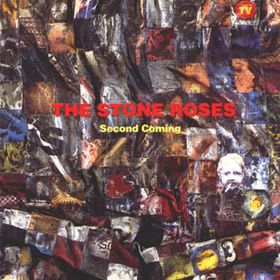
Sadly, legal wrangles and musical procrastination meant it was a long time before a second Stone Roses album appeared.  Second Coming finally saw the light of day in 1994, five-and-a-half years later.  Inevitably, after the wait and all the attendant anticipation, it was deemed a disappointment by the critics.  I have to say I think Second Coming is sorely underrated.  I fully understand why Simon Pegg, in Shaun of the Dead (2004), refuses to throw it along with the rest of his record collection at two advancing zombies.  “I like it,” he affirms.


I saw the Stone Roses for the first and last time during the tour they did on the back of Second Coming.  In 1995 they played a gig in the Japanese city of Sapporo, where I was living at the time.  It was not a happy experience.  Ian Brown was in a foul mood and gave the impression of wanting to be somewhere else – anywhere else.  To be fair, a trio of Australian bodybuilders had beaten Brown up in a club in Tokyo a few days earlier, which gave him a credible reason for his lack of enthusiasm.  Mani and the rest of the band played perfectly well.


© Geffen Records


Also slightly unhappy was the next occasion I saw Mani perform, which was after he’d joined Scottish band Primal Scream, another outfit intent on exploring the overlap between rock music and dance music.  The band were on the bill of a one-day event on Glasgow Green that I attended in 2000.  While they were limbering up to play the song Sick City from their new album XTRMNTR, Mani cheerfully barked into a microphone, “This is dedicated to Glasgow because it really is… a sick city!”  For a large portion of the Glaswegian crowd, this comment went down like a cup of – appropriately – cold sick.  (By the way, this was before ‘sick’ acquired its modern, slang meaning of ‘really good’.)   Later, Mani felt obliged to announce that he was only joking  and, really, “Glasgow isn’t a sick city at all!”  It’d been some banter that folk took the wrong way, but it impressed me that he was man enough to apologise for it.


I saw the Mani-era Primal Scream on two further occasions: at London’s Brixton Academy in 2003, when I thought they were pretty good; and at Norwich’s University of East Anglia in 2009, when they were on blistering form.  In fact, I’d include their 2009 Norwich show in my personal ‘Top Ten Gigs of All Time’.  With his jolly, everyman demeanour, Mani provided some balance to Primal Scream’s frontman Bobby Gillespie, whom I always found a bit too-cool-for-school when they played live.


Before joining the reformed Stone Roses in 2011, Mani found time to participate in another band, a ‘supergroup’ called Freebass whose gimmick was that it had three – three! – famous bass players, all from the Manchester area.  Its line-up also included Andy Rourke, former bassist with the Smiths, and Peter Hook, former bassist with Joy Division and New Order.  The project ended ignominiously, with Mani taking exception to what he saw as Hook unjustly exploiting the legacy of Joy Division and his late Joy Division bandmate Ian Curtis – Hook had also formed an outfit called Peter Hook and the Light that performed old Joy Division songs.  Hook’s wallet, Mani claimed on social media, was visible from space because it was ‘stuffed with Ian Curtis’s blood money.’  Needless to say, the two fell out, though later – again – Mani apologised and he and Hook made up.


Indeed, Hook has been one of the many musicians who’ve paid tribute to Mani since his death was announced a few days ago.  Other condolences have come from members of the Stone Roses, Primal Scream, the Happy Mondays, New Order, the Smiths, the Charlatans, the Verve, Echo and the Bunnymen, Elbow, the Courteneers, the Farm, Ocean Colour Scene, Kasabian, Shed Seven, Badly Drawn Boy…  I’m not a big fan of Oasis, but I thought it touching that, at their concert in Brazil the other night, Liam and Noel Gallagher projected Mani’s face onto the giant screen behind the stage whilst performing Live Forever (1994).  You get the impression you could go around everybody involved in the British music scene in the 1980s and 1990s and not find anyone with a bad word to say about the guy.


Finally, I owe Mani some gratitude.  Years ago – around 2010, I think – I was trying to think of a pseudonym to put on a horror short story I was about to submit to a magazine.  ‘Ian Smith’ seemed too dull a name to attach to a piece of short fiction that was meant to chill the blood.  At the time, I had a Primal Scream album playing in the background and I suddenly thought, “They’ve really had a second wind since Mani joined them.”  Then it occurred to me: Mani’s real name was Gary Mountfield.  ‘Mountfield’ sounded about right for a pseudonym – it wasn’t too exotic, but not too common either.  (Mountfield was also the name of a village in Country Tyrone, Northern Ireland, where I used to live, so it had a personal connection with me too.)  Thus, the penname Jim Mountfield was born.  It’s adorned nearly 70 published short stories since then.


So, thank you for the inspiration, Mani.


From wikipedia.org / © livepict.com