It’s Bat-Bond


From wikipedia.org / © Colleen Sturtevant


Unless you’ve spent the past week wearing a blindfold and earplugs, you’ll know from newspapers, new programmes, news websites, YouTube videos, TikTok videos, podcasts and general social media that English actor Robert Pattinson has been chosen as the next James Bond.  Making the choice were the powers that be at Amazon, which has lately gained financial and creative control over the Bond franchise.  Amazon chairman Jeff Bezos claimed he was ‘heavily involved’ in Pattinson’s selection.  Which is worrying.  James Bond, a man whose arch-nemesis is Ernst Stavro Blofeld, a bald billionaire with his own private space programme, is now having his fate decided by Jeff Bezos, a bald billionaire with his own private space programme.


Also in the running for the role were the actors Josh O’Connor, Callum Turner, Jack Lowden and Nicholas Hoult, who are all aged 36 and four years younger than Pattinson.  They’re also less famous than Pattinson, who’s already appeared in three super-popular cinematic franchises:  as the ill-fated Cedric Diggory in 2005’s Harry Potter and the Goblet of Fire, zapped to death on the orders of Lord Voldemort (played by Ralph Fiennes – M to Daniel Craig’s 007 in the three most recent Bond films); as a spangly vampire in the Twilight movies (2008-12); and as the title character of The Batman (2022), which has a sequel due in 2028.


Candidates to play Bond have to undergo a screentest that’s known as ‘the From Russia with Love (1963) test’.  According to former Bond producer Michael G. Wilson, they have to act out “the same scene… and that’s the one in From Russia With Love, where Bond comes back to his room after the assassination, and he starts taking off his shirt, goes into the room to bathe.  Then he hears something, takes his gun, goes in and the girl’s in the bed…  Anyone who can bring that scene off is right for Bond.  It’s tough to do.”  So, if you can perform the sequence as effortlessly as Sean Connery did in the real From Russia with Love, you’ve bagged the job of being the next 007.


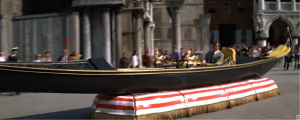
I have to say, though, that a sterner test would be a Moonraker (1979) test, wherein the aspiring Bond actors try to maintain their suaveness, dignity and cool while, Roger Moore-style, they emerge out of a Venetian canal in a gondala-that-turns-into-a-speedboat-that-turns-into-a-hovercraft, to the accompaniment of Johann Strauss’s Tritsch-Tratsch-Polka and with drunkards and pigeons doing double-takes.
 

From youtube.com / © Eon Productions / United Artists


I was rooting for Jack Lowden to get the role, mainly for geographical reasons.  I spent a good part of my youth in the Scottish Borders town of Peebles and Lowden grew up in the village of Oxton, just 30 miles from Peebles in the same region.  Also, Lowden would have been the first Scottish James Bond since Connery, the original and, for many folk, the best Bond actor.  But I’m not too upset by the fact that we’re getting a Bat-Bond rather than a Borders-Bond.  Countless other people are upset, though.  “I have never felt this much rage in my life.  This is the worst decision in all of cinema history…  This is an abomination,” a reader in the Guardian ranted about Pattinson’s appointment the other day.


I can understand arguments against Pattinson based on the fact of his current popularity – indeed, his current ubiquity.  Yes, it seems unfair that he gets to play Bond when he’s already playing Batman.  And yes, his recruitment to the role goes against the ethos governing the recruitment of the previous six Bond actors in the official film franchise.  When they were hired, none of them had the great big cinematic footprint behind them that Pattinson has already.  I suppose Roger Moore was the best-known of Pattinson’s predecessors when he became 007, but that was because of his TV work, in Ivanhoe (1958-59), The Saint (1962-69) and The Persuaders (1971-72).  However, I’m willing to overlook the objections because in my opinion Pattinson is a pretty decent actor.


For one thing, away from his Harry Potter / Twilight / Batman stuff, he was cast in two movies, Cosmopolis (2012) and Maps to the Stars (2014) by the great, innovative Canadian director David Cronenberg.  If Cronenberg puts you in his films, it shows you’re a special breed of actor – a breed that includes Oliver Reed, Patrick McGoohan, Christopher Walken, Jeremy Irons, Jennifer Jason Leigh and Viggo Mortensen.  He was also in Claire Denis’s scuzzy, downbeat sci-fi movie High Life (2018); in Robert Eggers’s Edgar Allan Poe-inspired The Lighthouse (2019) alongside a flatulent Willem Dafoe; and in Antonio Campos’s splendidly dark and overwrought southern-gothic movie The Devil All the Time (2020), in which he plays a scumbag, predatory preacher with the memorable name of the Reverend Preston Teagardin.


He’s also played a British secret agent before, in Christopher Nolan’s Tenet (2020).  Despite the bewildering presence of whirligig machines that change people moving forwards through time to moving backwards through it, and vice-versa, Tenet feels very much like a James Bond film.  Indeed, watching it, I found myself ticking off the Bond films it reminded me of – 1965’s Thunderball (the villain lounging on his luxury yacht); 1995’s Goldeneye (the bungee-jumping sequence); 1987’s The Living Daylights (the fight in the kitchen); and 1985’s A View to a Kill (the chase involving a fire engine).


As the raffish Neil, who pops up regularly to give confused hero John David Washington much-needed advice and support and who clearly knows much more than he’s letting on, Pattinson is one of the best things in Tenet.  It would be a mistake for him to play Bond in the way he plays Neil, but at least it shows he’s comfortable in an espionage movie with sci-fi overtones, which is what the Bond movies commonly are.


Also, the best Bond actors have conveyed the sense that there’s a certain darkness to the character, no matter how smoothly tuxedo-ed up he is, which I’m sure Pattinson is capable of doing too.
 

From wikipedia.org


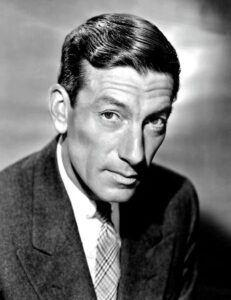
Actually, with his prominent cheekbones, Pattinson bears a faint resemblance to the American musician, composer and songwriter Hoagy Carmichael whom, in Ian Fleming’s original Bond novels Casino Royale (1953) and Moonraker (1955), Bond is said to resemble – one of the most tantalising clues Fleming gives readers about what his hero looks like.  I’m also encouraged by the fact that the publicity shot released with the announcement of Pattinson as Bond depicts him as a sniper, pointing a rifle – rather like Timothy Dalton, the actor who played Bond closest to the character in Fleming’s books, who had to do sniping duties at the start of his first Bond film, The Living Daylights.


Possibly more important than Pattinson’s casting, though, is the fact that the next Bond will be directed by Denis Villeneuve, whose CV includes Arrival (2016), Blade Runner 2049 (2017) and three Dune movies (2021, 24 & 26).  Villeneuve is the only modern filmmaker apart from Nolan who has the vision, self-confidence and know-how to get properly big and ambitious projects onto the screen and imbue them with intelligence as well as spectacle.  His talents, on top of Pattinson’s star power, should be exactly what’s needed to get the Bond franchise up and running, generating headlines and making profits again.


It’s rumoured that Villeneuve and Pattinson plan to make a trilogy of Bond movies.  If so, this would make the numerology of Bond-actors and (official) Bond-movies perfect.  George Lazenby made one movie, Dalton made two, Pierce Brosnan made four, Craig made five, Connery made six and Moore made seven.  Pattinson would fill in that missing three-movie slot.


Where would the stories for the trilogy come from, I wonder?  Would they be original ones?  Or would the filmmakers return to Fleming’s books, which include a loose trilogy, the novels involving Blofeld,  Thunderball (1961), On Her Majesty’s Secret Service (1963) and You Only Live Twice (1964)?  However, Thunderball has already been filmed twice, in 1965 and in Irvin Kershner’s ‘rogue’ Bond production with Connery, Never Say Never Again (1983), so audiences may be overly familiar with its plot.


Finally, I found it touching that in response to the announcement about Pattinson, the 87-year-old George Lazenby posted a video welcoming him to ‘the most exclusive club in the world’.  He also expressed hope that Pattinson would get to repeat his most famous line, “This never happened to the other fellow.”  I’d heard Lazenby hadn’t been in great health in recent years, so it was great to see him looking sprightly and cheerful.

 

From x.com/lazenbyofficial

Eggers’ banquet


© Focus Features / Universal Pictures


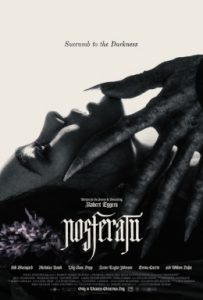
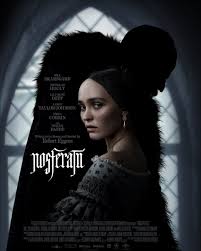
Robert Eggers’ Nosferatu (2024) has finally reached Singapore and a few days ago I watched it in the city-state’s excellent arthouse cinema The Projector.  This is Eggers’ reimagining of the 1922 silent horror-movie classic Nosferatu: A Symphony of Horror, which was directed by F.W. Murnau and based surreptitiously on Bram Stoker’s 1897 novel Dracula – though not so surreptitiously that Murnau and his producers escaped being sued by Stoker’s widow for breach of copyright.


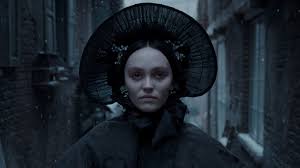
The new Nosferatu has provoked some extreme responses.  The reaction has been as polarised as the weird relationship at the film’s core, wherein the beautiful, fragrant Ellen (Lily-Rose Depp) gets intimate with the gaunt, rotting, pustuled Count Orlok (Bill Skarsgård), the dreaded nosferatu – vampire – of the title.  A while back, I read a very positive review of it by Wendy Ide in the Guardian but was taken aback by the negativity of the some of the comments below the line: “A turd…” “Just awful…” “Absolutely terrible…” “Beyond boring, absolute crap…”


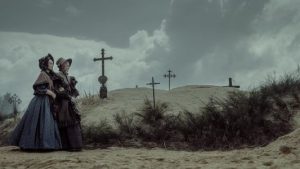
Well, I lean towards the Wendy Ide end of the Nosferatu debate because I thought the film was great.  At least, I thought so during the two hours and 12 minutes I sat before it in The Projector.  When my critical faculties started to function again – they’d been in a daze during the film itself – I became aware of a few flaws.  But generally, thanks to its atmosphere, its visuals, its sumptuous (if drained) palette and its overall craftsmanship, I found it the most impressive version of Stoker’s novel I’ve seen.  And yes, though it retains the original Nosferatu’s German setting and German character-names, this is essentially another retelling of Dracula.


Not that I’m saying it’s my favourite version of Dracula.  That accolade belongs to the 1958 Dracula made by Hammer Films, directed by Terence Fisher and starring Christopher Lee and Peter Cushing as Dracula and Van Helsing, which I saw when I was 13 years old.  13 is a formative age, when certain things tend to imprint themselves on your consciousness and become your favourites for life.  Also, I feel uncomfortable saying this Nosferatu is better than Murnau’s Nosferatu.  More than a century separates the two films, with huge differences in their historical contexts, themes, styles and filmmaking technology, and to me they’re like chalk and cheese.  That said, I noticed some of the flaws in Eggers’ Nosferatu when I did compare it with the old one.


© Focus Features / Universal Pictures


While we’re on the subject of comparisons, I should say I massively preferred this film to the 1992 Francis Ford Coppola one, Bram Stoker’s Dracula.  Despite having the peerless Gary Oldman in the title role, it was one of the few films I’ve come close to walking out of in a cinema.  I stayed the course in the hope it would improve in its later stages, but it didn’t.  Eggers’ Nosferatu is as operatic in its tone and as flamboyant in its visuals as Coppola’s Dracula.  However, while Coppola threw everything at the wall – restless camera movements, gimmicky special effects and make-up, over-the-top costumes, hammy performances – in the hope at least some of it would stick and hold the attentions of the raised-on-MTV teenagers he assumed would be the film’s audience, Eggers doesn’t merely show off In Nosferatu.  There are also moments of stillness and silence, of subtlety and holding back, of allowing atmosphere to ferment and ripen.  Actually, for my money, comparing it to Coppola’s Dracula is like comparing a moody and detail-laden work by a Dutch Master to a hyperactive kids’ cartoon.


Nosferatu’s storyline follows the Dracula template.  Young estate agent Thomas Hutter (the stand-in for Stoker’s Jonathan Harker, here played by Nicholas Hoult) is despatched from the fictional German port-city of Wisburg to a castle in Transylvania, where he has to supervise the paperwork for the purchase of a Wisburg mansion by the mysterious Transylvanian aristocrat Count Orlok.  Hutter’s sojourn in Orlok’s castle becomes a terrifying ordeal as he discovers the vampirical nature of his host.  He ends up plunging from one of its windows, into a river, while the Count sets off for Wisburg.


The Count’s chosen mode of travel is by ship – Romania, which Transylvania is part of now, borders on the Black Sea and Germany’s coast runs along the North and Baltic Seas, so this is evidently a long voyage – and he brings with him a horde of plague-carrying rats, which first destroy the ship’s crew and then start infecting the citizens of Wisburg when he reaches his destination.  These plague-rats are both a physical manifestation of Orlok’s evil and, presumably, a way of disguising his activities – with people dropping dead of plague left, right and centre, nobody’s going to notice a few blood-drained corpses.


But Orlok’s presence has been felt in Wisburg long before his arrival there.  Hutter’s wife Ellen – the Nosferatu equivalent of Stoker’s Mina Harker – has had an inexplicable psychic link to the ghoulish Count since her childhood and has already, in her dreams, pledged herself to him.  Also, Hutter’s boss Knock (Simon McBurney) has been communing with Orlok via some occult rituals.  Sending Hutter off to Transylvania was clearly part of a plan to relocate the vampire to the feeding-grounds of Wisburg.  Knock is the film’s version of Milo Renfield, the asylum-inmate who in Stoker’s novel becomes Dracula’s disciple.  Accordingly, Knock goes insane, gets incarcerated,  escapes and does Orlok’s bidding in the city.  Meanwhile, the thirsty Count makes a beeline for Ellen and those around her…


© Focus Features / Universal Pictures


Eggers’ cast-members acquit themselves well.  Lily-Rose Depp is extremely impressive in a role that requires her to be frightened, helpless, yearning, lascivious, possessed and defiant – often a couple of those things in one scene.  As a female foil to Dracula, she’s as good as Eva Green’s character Vanessa Ives in John Logan’s gothic-horror TV show Penny Dreadful (2014-16).  Likening someone to the mighty Eva Green is big praise from me.


Playing Jonathan Harker in a Dracula film is a thankless task.  You have to be bland and bloodless enough to add spice to the forthcoming dalliance between your missus and the Count, to suggest she’s a desperate 19th-century housewife who might actually welcome the vampire’s kiss.  But you also have to be interesting enough to make the audience root for you while you’re trapped in Castle Dracula.  And Nicholas Hoult does what’s required as the Harker-esque Hutter.  His restraint contrasts with the silent-movie acting of the original Hutter, Gustav von Wangenheim, who spent the early scenes of the 1922 Nosferatu grinning like a maniac.


On the other hand, Simon McBurney is unnervingly off-the-scale as Knock.  The 1922 Knock, Alexander Granach, was off-the-scale too, but McBurney’s one is allowed to slather himself in some full-on, 2024-stye blood and gore.  (He follows the hallowed Renfield tradition of chomping on small animals.)  If there’s a criticism, it’s that he doesn’t get enough to do.  More on that in a minute.


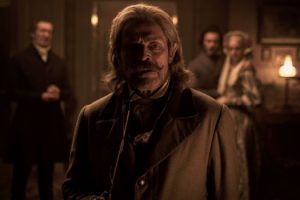
Ralph Ineson and Willem Dafoe respectively play a beleaguered Wisburg physician, Dr Sievers, and a Swiss expert on the occult, Professor Von Franz, who correspond to Stoker’s Dr Seward and Professor Van Helsing.  When Hutter gets back to Wisburg, they team up with him to put a stop to Count Orlok’s onslaught.  Willem Dafoe won’t replace Peter Cushing in my affections as the ultimate cinematic Van Helsing, but he’s delightful as the eccentric, cat-loving Von Franz.  Kind old gent though he is, Von Franz concocts a plan to destroy the vampire that may have tragic consequences for the people he’s supposed to be protecting.


© Focus Features / Universal Pictures


As for Bill Skarsgård and the film’s depiction of Count Orlok…  I can see why it’s been controversial.  Some have been disappointed that Eggers and Skarsgård didn’t replicate the iconic look of actor Max Schreck, who played the Count in 1922 as a bald, gaunt creature with rodentlike incisors, Spock ears and unseemly tufts of ear and eyebrow hair.  Indeed, in the first part of the film, we hardly see Orlok.  During the scenes set in his castle, he’s unsettlingly obscured by a haze of firelight, candlelight, shadows and darkness.  But when Eggers’ cameras finally reveal him, he’s an icky, mouldering thing, from the neck down at least, and he sports a monstrous and frankly distracting moustache.


I know Dracula had a moustache in the novel, and certain actors have played him with one, such as John Carradine in the Universal movies House of Frankenstein (1944) and House of Dracula (1945), and Christopher Lee in Jess Franco’s Count Dracula (1970).  But this must be the droopiest, shaggiest Drac-tache ever.


Maybe Eggers avoided the Max-Schreck look because he was sensitive to the accusations of antisemitism that dogged the old Nosferatu – that Schreck’s Orlok played on common German stereotypes and caricatures of Jewish people at the time.  Or maybe he just decided that look had become too much of a cliché.  As well as a slap-headed, pointy-eared vampire featuring in the previous remake of Nosferatu, Werner Herzog’s Nosferatu the Vampyre (1977), similar ones have appeared in the 1979 TV version of Stephen King’s Salem’s Lot, the original film version of What We Do In The Shadows (2014), and Guillermo del Toro’s Blade II (2002), where the leader of the baldy-vampires was played by Luke Goss.  (Yes… a Bros-feratu.)


© Focus Features / Universal Pictures


It’s also debatable if Eggers and Skarsgård made the right choice for Orlok’s loud, guttural voice, which booms out of the screen like the Voice of the Mysterons from Gerry Anderson’s TV show Captain Scarlet (1967-68) with a Slavic accent.  At least it’s different…  And Skarsgård put a lot of work into creating those vocals, training with an Icelandic opera singer and even studying Mongolian throat singing.  But I actually found Yorkshireman Ralph Ineson’s deep, gruff, north-of-England tones more menacing, even though his character, Dr Sievers, is one of the good guys.  (Sievers must have had a medical practice in Leeds before moving to Wisburg.)


Elsewhere, not a great deal happens during the second half of the film, though Dafoe’s charming performance keeps us engaged.  The latter part of the 1922 film is enlivened by a sub-plot involving Knock, who gets blamed for the mayhem in Wisburg after Orlok’s ship arrives.  Believing him to be the real vampire, the townspeople pursue him through the streets and the surrounding countryside, in scenes that are still impressive today – Knock perched like a gargoyle atop a vertiginous rooftop, for instance, or the mob mistaking a distant scarecrow for him, rushing at it and tearing it to pieces.  Eggers removes this sub-plot, however, and Knock (who in the original film didn’t even meet Orlok physically) serves as a conventional vampire’s acolyte.  If nothing else, this gives the Count someone to transport his coffin from the Wisburg docks to the mansion he’s bought.  In the 1922 Nosferatu, he suffered the indignity of having to carry the coffin himself.


So, the film drifts somewhat later on and I’m not fully convinced by its portrayal of Count Orlok.  But overall I really enjoyed Robert Eggers’ Nosferatu.  It’s a feast – an Eggers’ banquet – of gorgeousness, gloom, sensuality, repulsiveness, grue, humour, absurdity and tragedy.  It has fabulous visuals, entertaining performances and a smart balance between the aesthetically pleasing and the grotesquely yucky, meaning it should satisfy both cerebral arthouse types and horror-movie aficionados more interested in blood, gore and plague-rats.


And I can’t understand why some people disliked it so much.  This Nosferatu isn’t Dross-feratu, it’s the Absolute-boss-feratu.


© Focus Features / Universal Pictures