Happy World Goth Day 2026


From youtube.com© South Park Studios


I know time seems to speed up as you grow older, but it still feels weird to me that we’re not only into another year, 2026, but we’re already nearing its halfway point.  In fact, today, we’ve reached May 22nd.  And rolling around again – again? – is World Goth Day.


According to its Wikipedia entry, May 22nd became the annual day of celebration for the world’s darkest-clad, whitest-eyelinered, most sunlight-shunning musical sub-culture when “UK-based goth DJ Lee Meadows, aka DJ Cruel Britannia (currently known as BatBoy Slim), wrote a MySpace blog suggesting the idea of initiating a ‘Goth Day’ to a very positive reception.  In 2010, he and London-based DJ Martin Oldgoth decided to make the concept global, both ‘as a bit of fun’ and to create an environment of positivity and unity within the goth community.”
 

From worldgothday.com / © BatBoy Slim


As is customary on this blog, I’ll mark the occasion by providing links to a dozen of my favourite Goth songs on YouTube.  As ever, I apologise if you first have to endure some annoying corporate and insipid YouTube advertisements, packed with AI-generated visual crap, which are the antithesis of the mystical, elegiac and tenebrous aesthetic of Goth culture.


To get the ball rolling, here’s Wytches Chant ’98 by English Goth band Inkubus Sukkubus, whom noted punk / Goth journalist Mick Mercer described as ‘a zombie version of Fleetwood Mac.’  (Many would argue that the real Fleetwood Mac have been fairly zombified for the past few decades anyway.)  So, let’s raise our voices and sing along to that Wytches Chant ‘98: “Isis, Astarte, Diana, Hecate, Demeter, Kali, Inanna…”


A while ago I was looking at an online list of ‘underrated Goth bands’ and discovered Container 47 and their song Razor End Falling.  The band don’t have a Wikipedia page and all I know about them is that they’re from Italy and have been on the go since the early 2000s.  This song, to me at least, is agreeably heavy.


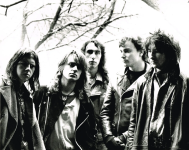
On the same ‘underrated Goth bands’ list, I noticed the name the Rose of Avalanche.  Wow, I thought – I hadn’t heard of them since they supported the Mission at a gig in Aberdeen in the mid-1980s.  They originally broke up in 1993 but, following a 26-year hiatus, reformed in 2019.  I found their 1985 single LA Rain enjoyably audacious – it takes the sound, ambience and languid pace of a typical Lou Reed / Velvet Underground song and drenches it in a shimmery, Gothy 1980s guitar-sound.  Though some people may not feel the same way about it.
 

From roseofavalanche.com / © The Rose of Avalanche


Here’s some more rain, served up by the Swedish Goth band Miazma (which, from soon after its inception in the late 1990s, has apparently consisted of just one musician, Kristian Olofsson).  It’s called Black Rain.  Including this song on the list saves me having to include anything by the seminal Goth outfit the Sisters of Mercy because, frankly, Miazma sounds uncannily like the Sisters of Mercy, down to Olofsson’s vocals, which reproduce the nonchalant gruffness of the Sisters’ frontman, Andrew Eldritch.  On the other hand, a band whom this Miazma shouldn’t be confused with is another band called Miazma, which is actually a death metal one from Australia’s Alice Springs.


And yet more rain…  If Scottish alternative-rock brothers Jim and William Reid, aka the mighty Jesus and Mary Chain, knew I’d included one of their songs in a list of Goth tunes, I suspect they’d come round to my house and murder me – using hammers.  Well, tough luck, guys – I am including you.  I saw the Jesus and Mary Chain perform in Singapore last month and the gig, at the city-state’s Esplanade Theatre, attracted a fair number of Singaporean Goths.  And I think their song Nine Million Rainy Days, from the aptly titled 1987 album Darklands, is dripping with Gothic doom, gloom and darkness, as evidenced by the lyrics, “As far as I can tell / I’m being dragged from here to hell / All my time in hell was spent with you…”


Halfway through, however, Nine Million Rainy Days veers off in an unexpected direction when it borrows the famous ‘woo-woo’ backing vocals that grace the Rolling Stones’ Sympathy for the Devil (1969), though here they mutate into ‘woo-woo, woo-woo, woo!’


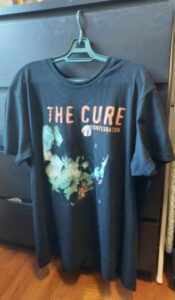
Talking of the Rolling Stones, eyebrows were recently raised when Mick, Keef and Ronnie announced that Robert Smith of the legendary Goth band the Cure would be contributing to their next album.  The Stones’ straight-up, unpretentious, bluesy, rock ‘n’ roll swagger seems light-years removed from the Cure’s meticulous, brooding atmospherics, so I don’t know how that’ll work out.  Meanwhile, the Cure and possibly their greatest album, 1989’s Disintegration, have been on my mind lately because my lovely mother-in-law gave me a Cure / Disintegration T-shirt as a present for my last birthday.  So, from that album, here’s the song Lullaby.  The link takes you to the song’s memorable video, where Smith, in pyjamas, sings worriedly about “Mr Spider-man” having him “for dinner tonight.”


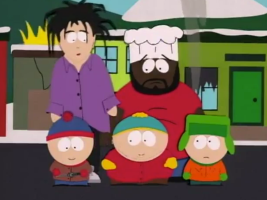
In fact, Disintegration is such a masterpiece I could have included any song off it: Fascination Street, Plainsong, Pictures of You, etc.  No wonder that in a 1998 episode of South Park, Kyle Broflovski shouts at Robert Smith, “Disintegration is the best album ever!”  (Admittedly, he was rather excitable by that point.  His town had been pulverised by Barbra Streisand, who’d transformed into a giant, robot-kaiju called Mecha-Streisand, and Robert Smith had saved the day by transforming into a giant moth and hurling her into outer space: “I have to try,” sighed the Cure’s front-man. “I can’t let Barbra Streisand do this to the entire world.”)


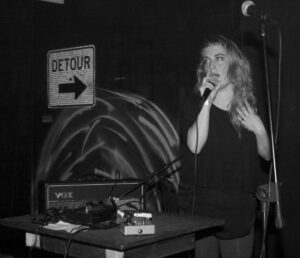
And now for a younger band.  Boy Harsher are a darkwave duo consisting of singer Jae Matthews and producer Augustus Muller, who hail from the American state of Georgia.  They cite among their influences the late, visionary filmmaker David Lynch, though with the next track on my list, a remastered version of Boy Harsher’s 2014 single Pain, I get more of a vibe of the synth tracks John Carpenter devised for the soundtracks of his 1970s and 1980s movies.  That’s initially at least, before Pain’s propulsive beat carries all before it.


Actually, Pain features in a movie itself.  It can be heard during a party scene in the 2022 horror film Terrifier 2.  I haven’t seen it, but I think that’s the one where the villain (Art the Clown) flays a victim and then rubs salt into the wound by, er, rubbing salt into the victim’s catastrophic wounds.  So, having a song called Pain in the film was appropriate.
 

From wikipedia.org / © GRIT PHOTOZINE


In fact, Pain got a remix in 2018 courtesy of the American musician and producer Luis Vasquez who from 2009 was also the single, official member of the band the Soft Moon.  Fittingly, an influence on the Soft Moon’s sound was the celebrated industrial / electronic rock band Nine Inch Nails, itself a one-man-band for the musician and producer Trent Reznor.  (More on Nine Inch Nails later.)  The next item on the list is one of my favourite Soft Moon songs, Become the Lies, from the band’s final album, Exister (2022).  I have to write about Luis Vasquez and the Soft Moon in the past tense because, tragically, Vasquez died in 2024 aged just 44.


Another musician specialising in dark electronica who left us much too soon was Frank Tovey, who as Fad Gadget at the very end of the 1970s and in the early 1980s helped pioneer both the synth-pop and darker Goth sounds that became popular soon after.  Alas, a heart attack claimed Tovey / Gadget at the age of 45 in 2002.  Here’s his first and possibly most famous single, Back to Nature, from 1979.


Fad Gadget has been credited as a big influence on Depeche Mode, though beyond the use of newly affordable musical technology, like synthesisers, I personally can’t see much connection between the ruminative likes of Back to Nature and Depeche Mode’s early, chirpy (and for me, annoying) hits like New Life and Just Can’t Get Enough (both 1981).  Despite being irritated by the early ‘Mode’, I’ve gradually grown to love them as, in their later incarnations, they’ve shifted away from a poppy, kid-friendly synth sound and embraced a darker, harsher, more industrial and Gothic one.


Here’s the stomping Barrel of a Gun, the first single off Depeche Mode’s 1997 album Ultra.  The accompanying video shows how far they’d progressed by then from their early-1980s clean-cut-boys-with-synthesisers phase – this is grungy, decadent, Anton Corbijn-directed artiness.  At least, it is until Dave Gahan starts wandering around in a silly coat covered in Christmas-tree lights.
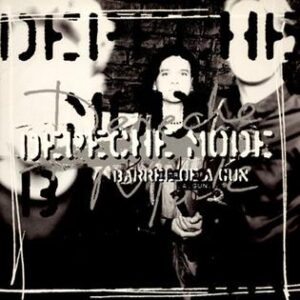
 

From wikipedia.org / © Mute Records


Here’s something else that’s silly, this time involving America’s awesomely dark and bleak industrial-rock juggernaut Nine Inch Nails (which is basically musician / vocalist / producer Trent Reznor and whoever happens to be in the studio with him at the time).  No, I’m not saying Nine Inch Nails are silly.  But some years ago, they were the subject of a celebrated musical / video ‘mashup’ whereby editor and content creator Garren Lazar married the band’s disturbing song Closer, from the 1994 album The Downward Spiral, onto clips taken from the beloved children’s TV programme The Muppet Show (1976-81).  Hence, the song’s opening drumbeat is performed in the video by Animal, the drummer in the Muppets’ house band, Dr Teeth and the Electric Mayhem.  (Thankfully, Animal doesn’t feature when Reznor sings Closer’s most notorious lyric, “I want to f**k you like an animal.”)


Watching Kermit, Gonzo, Miss Piggy and the rest cavort to this song is a reminder that, loveable though the Muppets are, if you first encountered them at a very young age you might have found them a bit sinister.  For example, the stuff in the video involving a frenetically speeded-up Dr Teeth is downright freaky.  Also featured are some of the human guests who appeared on The Muppet Show, such as Alice Cooper, Cloris Leachman, Rita Moreno, Harry Belafonte and Dudley Moore – Moore’s cameo is particularly worth waiting for.


However, should anyone be upset at me linking to a comical Nine Inch Nails / Muppets mashup, I’ll throw in a bonus link – to a more sombre and majestic mashup where Rory Gamble transposes Nine Inch Nails’ The Day the World Went Away (from 1999’s The Fragile) onto the trailer for Mad Max: Fury Road – Black & Chrome.  Both sonically and visually, it’s a work of genius.  You’ll punch the air when, one minute and ten seconds in, things get cranked up to 11.


Eat Your Makeup is the name of a short film made by American’s God-Emperor of Bad Taste, John Waters, back in 1968.  However, Eat Your Make Up – note the slight difference in the wording – is also the name of a French Goth band and here, to round things off, is their 2005 song I was the Murderer.  It’s a pleasant reminder that at least some of Goth’s musical roots lie in punk rock.
 

© Adipocere Records

The man from another place has gone to another place


From wikipedia.org / © Georges Biard


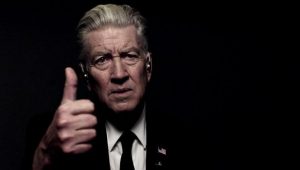
For the past few days, I’ve felt like wearing a black armband while I sip my cups of coffee.  That’s because David Lynch, visionary maker of movies, short films, TV shows, web series, music videos and commercials, and artist, musician and actor to boot, passed away on January 15th.


In his cinematic output, Lynch was surely one of the most American of film directors. His work was suffused with Americana, both the cosy variety populated by porches, picket fences, lawns, sprinklers, diners, coffee, pie and kindly, neighbourly folk; and the flashier variety whereby bequiffed, leather-jacketed Elvis wannabes and peroxide blondes cruised along endless highways in big, finned sports cars.  This being Lynch, though, submerged beneath the Americana and frequently bubbling to its surface were things altogether weirder, darker, more surreal and twisted.  There was as much Salvador Dali, Luis Bunuel and William S. Burroughs in his work as there was Edward Hopper, Frank Capra and Ray Bradbury.  Meanwhile, though Lynch’s themes, motifs, imagery and stylistic touches felt unique – no wonder ‘Lynchian’ became a word – he wasn’t afraid to dress his visions in the clothes of familiar genres: horror, thriller, crime noir, science fiction and – something Lynch didn’t get enough credit for – comedy.


Anyway, here’s a guide to my favourite parts of the David Lynch film-and-TV universe.


Favourite Lynch cast

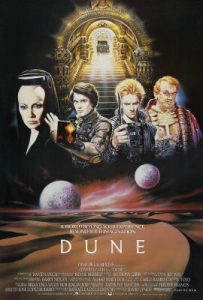
Lynch’s version of Dune (1984) was a box-office flop and received much abuse from critics.  (Dung, I remember the New Musical Express calling it.)  Unfortunately, Dune’s old-school producer Dino De Laurentiis wanted the doorstop-sized and labyrinthine Frank Herbert novel on which it was based crammed into a regulation two-hour movie.  The condensed result didn’t make much sense.


© Dino De Laurentiis Corporation / Universal Pictures


But Lynch never worked with a better troupe of actors.  It even outshone the cast that, four decades later, Denis Villeneuve assembled for his telling of the story in 2022 and 2024.  The Lynch Dune features Kyle MacLachlan, Jurgen Prochnow, Francesca Annis, Kenneth McMillan, Paul Smith, Patrick Stewart, Richard Jordan, Freddie Jones, Sian Phillips, Virginia Madsen, Jack Nance, José Ferrer, Everitt McGill, Brad Dourif, Max von Sydow and Dean Stockwell.  Oh, and Sting – more on him in a minute.


Favourite Lynch collaborator

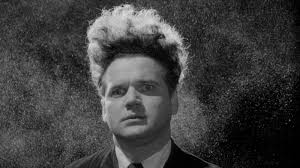
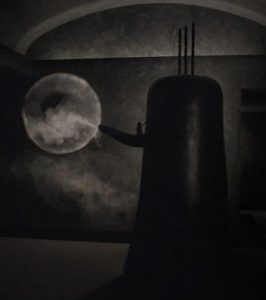
That would be Jack Nance, who played Henry Spencer, lead character in Eraserhead (1977), the film that put Lynch on the map.  With his impassive features, bouffant, tight suit and peculiar gait, Nance contributes as much to the film’s atmosphere as the elements that today we’d regard as typically Lynchian – the mutant baby, the lady in the radiator, the flickering lights, the industrial noise.  Thereafter, he was in all Lynch’s film projects (apart from 1980’s The Elephant Man) up to 1997’s Lost Highway.  He most famously played the amiable, fishing-and-chess-obsessed Pete Martell in Twin Peaks (1990-91), Lynch and Mark Frost’s oddball, sometimes barmy, occasionally confounding TV murder whodunnit, which coincidentally was a soap opera, comedy, horror story and science-fiction drama too.


© AFI Center for Advanced Studies / Libra Films


Nance’s life was hardly a bed of roses.  His film work was intermittent and in the mid-1980s he worked as a hotel clerk to make ends meet.  His second wife Kelly Jean Van Dyke (Dick Van Dyke’s niece) committed suicide.  And he had severe alcohol problems.  During the filming of Blue Velvet (1986), he was in such a state that Dennis Hopper – Dennis Hopper! – had to drive him to a rehabilitation centre.  In 1996, Nance died of a subdural hematoma, resulting from a ‘blunt force trauma’.  The previous day his face was bruised and he told friends that he’d been punched during a brawl he’d got into with some strangers in a doughnut shop.  Lynch said in tribute: “There’s not another actor I can think of who could fill his shoes.  I had roles in my head for future films that I was saving for Jack.  I cannot think of anyone else who could do it.”


Favourite Lynch funny bit

The other day at work I was discussing Lynch’s passing with a colleague.  I started enthusing about the sequence where Nicolas Cage and Willem Dafoe try to rob a feed store in Wild at Heart (1991) and how funny it was: “Willem Dafoe trips and falls on his shotgun and it goes off and you see the top of his head flying up in the air…  Meanwhile, there’s a wounded clerk who’s had his hand blown off at the wrist…  His colleague comforts him by saying modern surgery can reattach his hand… And then you see a dog running away outside with the hand in its mouth…”


At this point I realised my colleague wasn’t laughing with me, but was looking decidedly queasy.  He didn’t seem happy to be reminded of that sequence.  Which shows humour is subjective.  Still, I think the attempted robbery in Wild at Heart is Lynch’s funniest moment.


© PolyGram / Propaganda Films / Samuel Goldwyn Company


Favourite Lynch musical bit

Lynch was a musician, so music played a big role in his films – right from Eraserhead, when the lady in the radiator sings In Heaven.  In his final major work, Twin Peaks: The Return (2017), the long-awaited third season of his celebrated TV show, music wasn’t so much an element as a fixture.  Each episode ended with a scene in the Roadhouse, the bar / concert venue in the town of Twin Peaks, where a musical act would be performing.  Given Twin Peaks’ small size and remote location, the Roadhouse attracted some unfeasibly big names: Julee Cruise, the Cactus Blossoms, Rebekah Del Rio with Moby on guitar, and one Edward Louis Severson – Eddie Vedder to you and me.


But in my opinion, the act that rounds off Episode 8 of Twin Peaks: The Return is best of all.  It’s the fearsome electro-metal juggernaut Nine Inch Nails, whom the Roadhouse MC introduces as the Nine Inch Nails, no less.


© Dino De Laurentiis Corporation / Universal Pictures


Favourite Lynch musician in an acting role

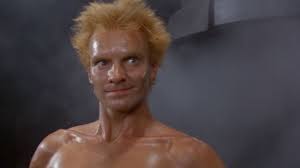
Lynch was also fond of putting singers and musicians in his casts.  Many remember Sting playing Feyd-Rautha Harknonnen, evil nephew of the equally-evil Baron Harkonnen, in Dune.  I’m not a fan of Sting’s acting but visually, with his spiky blonde hair, lean frame and daft codpiece, he was striking.  Indeed, when I saw Denis Villeneuve’s Dune Part 2 and Austen Butler strolled into view as Feyd-Rautha, my first thought was: “Oh look, there’s what’s-his-name in the Sting role!”


© Twin Peaks Productions / New Line Cinema / CiBy 2000


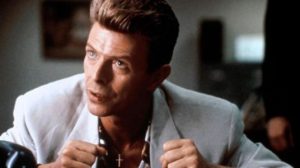
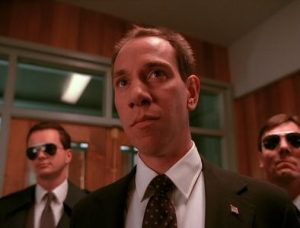
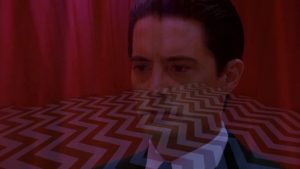
However, my favourite Lynchian musical-cameo comes in the middle of Twin Peaks’ cinematic prequel Twin Peaks: Fire Walk with Me (1992).  This is when David Bowie pops up as Phillip Jeffries, an FBI agent who’s been mysteriously missing for two years.  One morning, he suddenly steps out of a lift at FBI headquarters.  He proceeds to babble gibberish at FBI agents and Twin Peaks regulars Dale Cooper, Albert Rosenthal and Gordon Cole (Kyle MacLachlan, Miguel Ferrer and Lynch himself): “Who do you think this is, there…?  I found something.  And then there they were!”  Then he narrates a trippy dream montage involving dwarves, killers, masks, disembodied mouths and long-nosed spectres.  And then he vanishes into thin air.  “He’s gone!” squawks McLachlan.  “He was never here!” retorts Ferrer.


Bowie died early in 2016, before Twin Peaks: The Return began filming, which seemed to rule Philip Jeffries out of the third series’ storyline.  However, Lynch did include Jeffries.  Only now the disappearing agent is a giant teapot voiced by an actor called Nathan Frizell doing a Bowie impersonation.


David Bowie turned into a teapot.  Only David Lynch could do that.


© Lynch-Frost Productions / Showtime Networks


Favourite Lynch sad bit

Because of the nightmarish aspects of his works – it’s not the majority of their content, but it’s the stuff that lingers in viewers’ minds – Lynch isn’t readily associated with pathos.  Yet there are moments in his films that I find incredibly sad.  In The Elephant Man, for instance, it’s when the titular character John Merrick (John Hurt) escapes from the freak show owned by the evil Bytes (Freddie Jones), with the help of the show’s other inmates.  A dwarf, played by Star Wars’ Kenny Baker, remarks ruefully: “Luck, my friend, luck.  Who needs it more than we?”  Or in Twin Peaks: The Return when Deputy Hawk (Michael Horse) says a final goodbye to the ailing Margaret Lanterman, aka the Log Lady.  This is made more poignant by knowing that Log-Lady actress Catherine Coulson died early in the third season’s production.


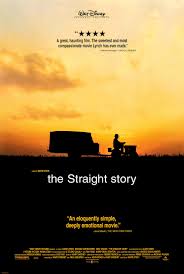
But my number-one Lynch sad moment is probably the ending of The Straight Story (1999), when Alvin (Richard Farnworth) finally makes it to the shack of his unwell brother, Lyle (Harry Dean Stanton).  They’re two old codgers, one using walking sticks and the other a Zimmer frame, and clearly aren’t used to expressing their feelings.  But Lynch, with some basic dialogue (“Did you ride that thing all the way out here to see me?” “I did, Lyle.”), some silence and some anxious, exhausted looks and expressions from his actors, conveys a huge amount of emotion.


© Asymmetrical Productions / Film4 / Buena Vista Productions


Favourite Lynch scary bit

Obviously, there are lots of scary bits in Lynch’s oeuvre.  I imagine he’d have been miffed if you described his works as ‘horror’ films, but he more than earned his entry in any ‘Encyclopaedia of Horror’.


Particularly freaky to me were several things in Twin Peaks and its 2017 sequel.  The image of Killer Bob (Frank Silva) crawling over a sofa in the original series was terrifying.  Twin Peaks: The Return featured in its first episode a strange experiment involving a big glass box and a mass of surveillance equipment that eventually conjures up a phantom entity.  Unfortunately for the guy monitoring the experiment – who’s inopportunely chosen this moment to have it off with his girlfriend – the entity is equipped with kitchen-blender fingers and It proceeds to reduce their heads to bloody confetti.  Also horrific is a sequence in a later episode wherein Deputy Bobby Briggs (Dana Ashbrook) tries to calm a hysterical woman at the wheel of a stalled car and a convulsing, vomiting zombie-like creature slowly rises out of the seat beside her.  This is never explained or referred to again – a perfect, scary Lynchian moment in other words.


And I remember sinking into my cinema seat, not wanting to look at the screen too much, during Lost Highway (1996), when Lynch’s camera starts prowling deep – deep – into the black recesses of the house belonging to Fred (Bill Pullman), the film’s initial hero.  That sequence had a real primordial chill to it.


But for my money, the scariest Lynch moment is the ‘Winkie’s Diner’ sequence in Mulholland Drive (2001).  A man sitting in the diner (Patrick Fischler) recounts two dreams he’s had, both of which take place there.  In each dream he’s been possessed by an inexplicable fear – and a man with a hideous face living behind the diner, whom he can see ‘through the wall’, seems to be responsible.  When a companion suggests he exorcises the memory of the dreams by checking behind the real diner, he reluctantly complies.  So they venture along the side alleyway, and…  What follows is one of the very few jump-scares in cinematic history that actually made me jump.


© Lynch-Frost Productions / Spelling Entertainment


Favourite Lynch speech

Miguel Ferrer’s Albert Rosenthal, the arrogant FBI pathologist who assists Kyle MacLachlan’s Dale Cooper in Twin Peaks, gets my vote here.  During the first season, Albert is very vocal about his low opinion of the town of Twin Peaks, which results in him getting punched out by Sheriff Harry S. Truman (Michael Ontkean).  During the second season, when Truman’s ready to punch him out again following a cutting jibe – “You might practise walking without dragging your knuckles on the floor” – Albert responds to the threat of violence with an impassioned speech explaining that he’s happy to be a knob-end if it helps him in the greater scheme of things, i.e. in the struggle against evil.  Oh, and he’s a committed pacifist too.


“While I will admit to a certain cynicism, the fact is that I’m a naysayer and hatchet-man in the fight against violence.  I pride myself in taking a punch and I’ll gladly take another because I choose to live my life in the company of Gandhi and King.  My concerns are global.  I reject absolutely revenge, aggression and retaliation.  The foundation of such a method is love.  I love you, Sheriff Truman.”


No wonder Cooper tells the dumfounded Truman afterwards, “Albert’s path is a strange and difficult one.”


© De Laurentiis Entertainment Group


Favourite Lynch villain

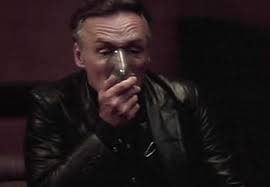
There are a good many contenders for this too: Killer Bob in Twin Peaks, Willem Dafoe’s Bobby Peru in Wild at Heart, and Kenneth McMillan’s Baron Harkonnen in Dune, who’s basically a levitating, leering sack of pus.  But at the end of the day, my ‘Favourite Lynch Villain’ award has to go to Dennis Hopper’s Frank Booth in Blue Velvet.


The scene where the black-clad, slick-haired Frank assaults Dorothy Vallens (Isabella Rossellini) whilst acting out a deranged sexual fantasy, screaming things like “Baby wants to f**k! Baby wants to f**k blue velvet!” and slurping gas out of a canister is astonishing.  It’s made even more harrowing by the fact that the hapless Jeffrey Beaumont (Kyle MacLachlan) is hiding nearby in a closet and has to witness it all.  This is the moment when the preppy, clean-cut Jeffrey discovers life is a lot more complicated, in a bad way, than he thought.  No wonder he laments: “Why are there people like Frank? Why is there so much trouble in this world?”


So, thank you David Lynch.  Your oeuvre was sometimes comfortingly genial, sometimes perplexingly weird, sometimes shockingly dark – but it was always fascinating.  I raise a damn fine cup of coffee in your honour.


© Lynch-Frost Productions / Showtime Networks

Thom is da bomb


I don’t know when I became a fan of the band Radiohead.  They seemed to creep up on me by stealth.  I’d been aware of them for years before suddenly, one day, I realised: “Hey! I really like them!”


Appropriately for a band who crept up on me, the first song by them I heard was Creep from their debut album Pablo Honey (1993).  Though a massive hit, I didn’t actually like Creep, finding it dull and plodding.  My disdain for it was shared by Radiohead themselves, with guitarist Ed O’Brien saying of their performances of the song during the early 1990s: “We seemed to be living out the same four and a half minutes of our lives over and over again.  It was incredibly stultifying.”


At this time I worked as a university lecturer in the northern Japanese city of Sapporo.  One day  in 1995 I received a gift from a cool indie-kid in one of my classes, Yoko Koyama, who’d discovered that despite my outward veneer of grumpiness and grouchiness I was, underneath, a sensitive soul who was heavily into music.  The gift was a cassette recording of Radiohead’s newly-released second album, The Bends.  I diplomatically accepted it, not expecting to like it much on the basis that I hadn’t been impressed by Creep.  But when I listened to it, I thought, “This is actually pretty good.”  Not brilliantly good, but definitely good.


Around then, Radiohead visited Sapporo and played a gig, but the night of their concert was one when I had to teach a couple of evening classes at the university.  So I missed the chance to see them.  The next day, I went into one of my regular Sapporo drinking hangouts, the Beifu-tei Bar, and got talking to a mate of mine, a Scotsman from St Andrews called Stevie Malcolm.  Stevie informed me, “Aye, thon English rock band were in here last night after their gig.  What dae ye call them?  Thingmie-heid.”


“You mean, Radiohead?”


“Aye, Radio-heid!”


I got the impression Stevie had chatted away to Radiohead barely knowing who they were.  Though from the band’s unconventional approach to the music industry and their discomfort with the trappings of superstardom, they probably liked chatting to strangers in bars with barely any idea of who they were.


In 1997 Radiohead released their third album OK Computer, which even my snobbiest, most purist music-loving friends, who’d dismissed Pablo Honey and The Bends with a contemptuous flick of the hand, had to admit was an awesome record.  It still figures prominently when music publications list the best rock albums of all time and retrospective reviews frequently award it a full five stars.  And though subsequent albums – Kid A (2000), Amnesiac (2001), Hail to the Thief (2003), In Rainbows (2007), The King of Limbs (2011) and A Moon Shaped Pool (2016) – never created quite the same stir, and often made demands on the listener by veering off into the avantgarde, experimental and left-field, I’ve found all of them laudable.


It helped that, unlike other bands who at various times were massively loved by audiences and hailed by critics as world-straddling musical colossi, Radiohead never seemed in your face that much.  So you didn’t grow sick of them.  Whereas for a few years U2 or Oasis, or even REM, seemed to be everywhere in the media, with the result that their ubiquity led to a backlash – the public losing interest, the critics getting disenchanted, familiarity generally breeding contempt – Radiohead were more subtle, less intrusive and lower profile.  Perhaps their credibility endured because of that.


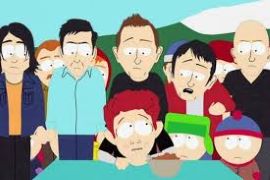
Even their appearances in popular culture tended to be wry and quirky and happened in unexpected, and cool, places.  For example, I remember the very last episode of Father Ted (1995-98) when the suicidal priest Father Kevin (Tommy Tiernan) gets cured of his depression by Ted playing to him Isaac Hayes’ joyous Theme from Shaft (1971) – only to lapse back into suicidal depression when he hears Radiohead’s Exit Music (For a Film) (1997) playing on the radio in a bus.  Or when they turned up in a 2001 episode of South Park called Scott Tenorman Must Die and added a final layer of torment to the unfortunate Scott Tenorman of the title.  Scott is a kid who’s been tricked by Eric Cartman into eating the minced bodies of his dead parents.  When he discovers what he’s done, he understandably bursts into tears.  Just then, his favourite band, Radiohead, happen to stroll past, see him and cruelly mock him for being a ‘cry-baby’.


From x.com / © Hat Trick Productions

© South Park Studios


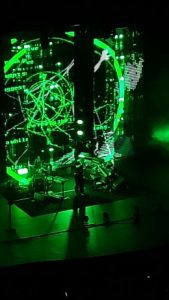
Anyway, last week on November 5th, Radiohead’s vocalist and main songwriter Thom Yorke rolled up here in Singapore to play a solo concert as part of his Everything tour.  Yorke has a long history of making music on his own, from his 2006 album The Eraser, through 2014’s Tomorrow’s Modern Boxes, to 2019’s ANIMA, and he’s also been involved in a couple of side-bands like Atoms for Peace and The Smile, so it’s not a surprise to find him performing without the rest of Radiohead.  I attended the gig accompanied by my better half, Mrs Blood and Porridge, who wouldn’t have missed this occasion for the world.  She’s such a dyed-in-the-wool Radiohead fan that the other day she even made our cat watch the video for 2016’s Burn the Witch on YouTube.


Yorke played at the Star Theatre, which I’ve visited a couple of times in the past.  At previous gigs there, I was not greatly impressed by the crowd, many of whom seemed more interested in filming the event on their phones than getting into the excitement and vibe of the music itself.  As I wrote a while ago about a Deep Purple concert: “Why remove yourself from the occasion and gaze zombie-like at tiny figures moving about a tiny stage on a tiny screen…?  It’s also, needless to say, disrespectful of the performers onstage…  Honestly, there were times when the auditorium was so densely flecked with glowing phone-screens you felt you were flying over Las Vegas at night.”  But tonight’s audience, Singaporeans and foreigners alike, seemed to be genuine Radiohead fans and Thom Yorke-lovers who knew the great man wasn’t going to appreciate having a thousand phones pointed at him by a thousand glaikit dimwits.  So, thankfully, phone-usage was at a minimum.


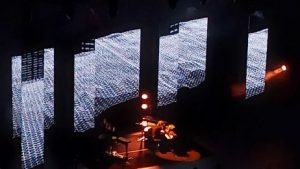
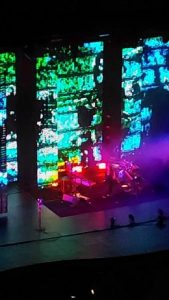
It wasn’t the most physical of performances.  Yorke spent most of his time on a patch of stage encircled by musical equipment, including several keyboards, and looked like a cross between Rick Wakeman of Yes and Captain Nemo tinkling out Sebastian Bach’s Toccata and Fugue in D Minor on his organ.  He did, occasionally, venture towards the audience to play guitar or indulge in some shuffling dancing.  The latter drew affectionate cheers.  I have to say seeing Thom make his funky moves brought a smile to my face, as it seemed to prove there was at least one person on the planet whose dancing is even worse than mine is.


But what of the music?  I’d read a worrying review of a gig from earlier in the tour, in Sydney, where the writer observed, “Each Radiohead song that’s played – they make up just under half the setlist – is met with a hushed reverence, while loud chatter is heard every time something else gets an airing.”  Maybe that means modern-day Sydney concertgoers are disrespectful bozos, for that certainly wasn’t my impression of the Singapore crowd.  Yes, the ten Radiohead numbers he played during the set – coming from a range of the band’s albums, though nothing featured from Pablo Honey, Hail to the Thief or The King of Limbs – were enthusiastically received.  But the audience showed their appreciation of the non-Radiohead stuff as well.  This included material from all three of Yorke’s solo albums, two new songs (Back in the Game and Hearing Damage), and two he’d composed for the 2018 soundtrack for Luca Guadagnino’s remake of the Dario Argento 1977 horror classic Suspiria.


It all meshed together nicely.  The solo material evoked at different times the sounds of the Aphex Twin, Depeche Mode and Nine Inch Nails and I even wondered if Yorke was getting a bit disco-y at one or two points.  Naturally, electronica-rooted Radiohead numbers like Idioteque, Everything in its Right Place or Packt Like Sardines in a Crushd Tin Box (off Kid A) slotted in seamlessly among that lot.  Surprisingly, though, the band’s more conventional – dare I say more tuneful – songs, like How to Disappear Completely (Kid A again) Fake Plastic Trees (off The Bends), and All I Need (off In Rainbows) fitted in smoothly too, making it an impressively cohesive set.  Maybe it was because Yorke’s falsetto – often mocked, but inimitable, haunting and gorgeous – provided the aural thread that stitched together all these disparate pieces of musical cloth.


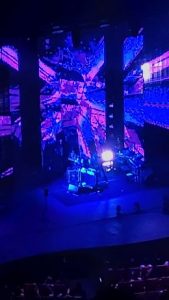
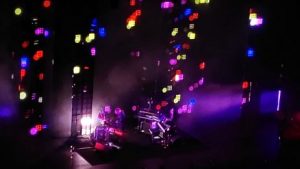
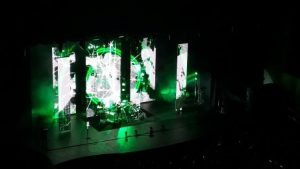
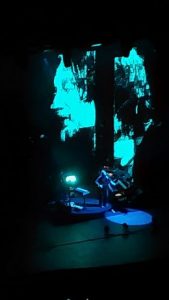
Praise is due too for the accompanying light show, with several tall screens treating the audience to dazzling and dizzying displays that, during the evening, seemed to range from daubs of luminous green graffiti to blizzards of multicoloured confetti, from drizzles of Matrix-style code to what looked like, frankly, masses of glowing spaghetti.  Occasionally, these gave way to stark white light, and darkness, where, at his consoles, Yorke looked like a torturer operating his torture-machines in a gothic dungeon.  Occasionally too, the chaotic patterns coalesced into the ghostly features of the man himself.  Thus, the show was an impressively visual as well as aural experience.  I have to say it was easier on the eyes than the screens at the previous gig I’d been to at the Star Theatre, which’d subjected me to regular, unflinching close-ups of the 78-year-old visage of Deep Purple’s Ian Gillan.


By the concert’s end it seemed the many diehard fans in the crowd had got their money’s worth.  Their frequent cries of “I love you, Thom!” had never lessened in enthusiasm while the 22-song set wound on.  And presumably the guy who shouted, before the gig and behind us on the escalator while we rode up to the theatre’s entrance, “Please, Thom, don’t play Creep tonight!”, went home happy too.


A good evening, then.  It certainly took our minds off the horror that was happening elsewhere on November 5th.