A splatter of life and death


© Plan B Entertainment / Mubi


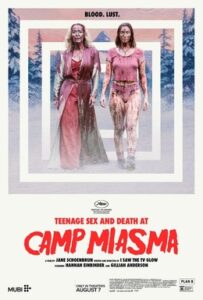
Two days ago, on October 26th, my wife and I received an early Halloween treat.  The 37th Singapore International Film Festival showed Teenage Sex and Death at Camp Miasma (2026), the new meta-horror movie from writer-director Jane Schoenbrun, at the Gallery Theatre in Singapore’s National Museum.  We got tickets for the event before it sold out.


This is Schoenbrun’s third movie, following We’re All Going to the World’s Fair (2021), which I haven’t seen, and I Saw the TV Glow (2024), which I did see recently while it had a tenure on Singaporean Netflix.  It took me two attempts to get into I Saw the TV Glow, but when I adjusted to its wavelength it really impressed me.  It’s a haunting and melancholic film about a pair of alienated high school kids (Justice Smith and Jack Haven) and their relationship with a kids’ horror TV show that, ultimately, causes reality to blur into fantasy.  When adulthood arrives and reality fails to blur anymore for one of them (Smith), the consequences are tragic.  The film has phantasmagorical qualities that sometimes make it feel like a David Lynch movie – if, crucially, David Lynch had grown up in the 1990s rather than the l1950s and 1960s.  And its ending is genuinely sad.


I certainly didn’t feel sad after watching Teenage Sex and Death at Camp Miasma, which I found a joyous and life-affirming, and very funny, experience.  Crudely, it could be summarised as 1950’s Sunset Boulevard transplanted into the universe of the Friday the 13th movies (1980-2009).  A very Friday the 13th-like horror franchise called Camp Miasma, wherein countless horny teenagers were bloodily slain by a killer called Little Death (I Saw the TV Glow’s Jack Haven with a box-shaped vent on their head and wielding a humungous spear), made pots of money in the 1980s.  Now a studio wants to reboot the franchise but, alas, the movies are today regarded as problematic.  The character of Little Death, dismissed at the time as a ‘freak’, is in modern parlance a transgender person.


To handle the project, and to cover their arses, the studio executives commission a young, queer director called Kris Wiliams (Hannah Einbinder), previously responsible for an arthouse film that was a remake of Alfred Hitchcock’s Psycho (1960) told ‘from the perspective of the shower curtain’.  They presume she’ll make it woke enough for modern sensibilities.


The earnest, nerdish but very likeable Kris has the idea of casting in her new version of Camp Miasma the actress Billy Presley (Gillian Anderson), who’d played the ‘final girl’ in the original movie of the series.  Billy has become a recluse and bizarrely lives in the huddle of old summer-camp buildings where that movie was filmed four decades earlier.  So, Kris goes to visit her and reality, as in I Saw the TV Glow, begins to blur…


Schoenbrun is obviously a big fan of the 1980s slasher movies that inspired the film.  In the opening-credits sequence, there’s a montage of Camp Miasma merchandising and artefacts, including video cassettes of the first movie and its (increasingly shite) sequels.  As with Friday the 13th, the sequels include a third instalment filmed in 3D, one called The Final Chapter and a subsequent one called A New Beginning, one where Little Death goes into outer space (Miasma 3000), and one where he tangles with a monster from a rival franchise (Little Death vs Sleepy Man).
 

© Crystal Lake Entertainment / New Line Cinema


Details elsewhere in the film also indicate how knowledgeable Schoenbrun is about the slasher school of cinema.  Billy mentions the unpleasantness of auditioning for the 1981’s The Burning (which was produced by a young Harvey Weinstein).  Kris refers to a gutter-press rumour that once circulated about Jamie Lee Curtis, star of the Halloween (1978-2022) franchise.  And Bruce Springsteen’s sister Pamela is alluded to – she appeared in the second and third entries in the Sleepaway Camp series in 1988 and 1989.


All this makes Teenage Sex and Death at Camp Miasma intriguing because Schoenbrun is transfeminine and non-binary and uses the pronouns ‘they’ and ‘their’.  And notoriously, those old slasher movies that Schoenbrun is a fan of frequently used gender non-conformity and transgender identity as cheap ways to explain their killers being murderously loopy.  See the first Sleepaway Camp movie in 1983, or Brian De Palma’s Dressed to Kill (1980) – which, despite its dodgy gender politics, is in my opinion the best slasher movie of the 1980s – or of course, the granddaddy of them all, Psycho.


I started watching the film wondering what it would do with those weary and mean-spirited old tropes.  As it turned out, Schoenbrun not only dismantles them but reassembles them and makes something wonderfully fresh out of them.  In the process, Teenage Sex and Death at Camp Miasma reclaims the slasher sub-genre for an audience that in the past was too often demonised by it.


One particular joy of the film is its performances.  Hannah Einbinder makes an engaging central character, clearly a stand-in for Schoenbrun, and sells the idea of somebody fascinated by the slasher sub-genre while simultaneously troubled by its misogyny, homophobia and transphobia.  But the film belongs to Gillian Anderson, whose portrayal of Billy Presley is majestic.  I’ve read that as a teenager Schoenbrun was a big fan of The X-files (1993-2002, 2016-18), where Anderson found fame playing FBI agent Dana Scully.  So, getting her to perform in their movie must feel like a dream come true.


Incidentally, another unwelcome trope in cinema is that of a sad, mad and possibly dangerous female movie star living as a recluse, past her prime and losing her looks.  It’s sexist – though if nothing else, it highlights the sexism of the industry around it.  Gloria Swanson, who played the washed-out actress Norma Desmond in Sunset Boulevard, was only 50 when the film was made; whereas nobody questioned the right of her co-star William Holden to still be a leading man in 1969’s The Wild Bunch when he was in his fifties.  But there’s none of that pathetic-ness about Anderson’s character.  Yes, she’s a bit odd at times;  but she’s also bold, funny, charismatic, sensual and empathetic.  Generally, she’s a joy every time she’s on screen.


Elsewhere in the cast, my wife was delighted to spot Kevin McDonald playing a clerk at a hotel near Billy’s summer-camp abode – McDonald is a member of the Canadian comedy team The Kids in the Hall, whose 1988-95 TV sketch show she’s a big fan of.  Another welcome face is that of Patrick Fischler, playing a scary gas-station attendant.  Fischler made a small but devastating appearance in David Lynch’s Mulholland Drive (2001) as the nightmare-haunted man who decides to check out what’s really behind the diner he keeps dreaming about and triggers the most frightening moment in the film – actually, for my money, it’s the most frightening moment in Lynch’s career.
 

© Sante Fe Productions / New World Pictures


I’ll admit, though, to having a few misgivings when I sat down to watch Teenage Sex and Death at Camp Miasma because I’m definitely not a fan of 1980s slasher movies.  I’d already become a horror fan by the end of the 1970s and, for me, the 1970s were the golden age of the genre.  During that decade, you got such classics as The Devils (1971), The Wicker Man (1973), Don’t Look Now (1973), The Exorcist (1973), Deliverance (1974), The Texas Chainsaw Massacre (1974), Carrie (1976), Jaws (1976), Suspiria (1977), Dawn of the Dead (1979) and Alien (1979).  So I was less than enthused when the 1980s arrived and all-of-a-sudden most horror filmmakers seemed interested only in making films wherein dummkopf teenagers get slaughtered by figures in Halloween masks and hockey masks.


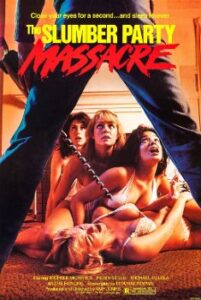
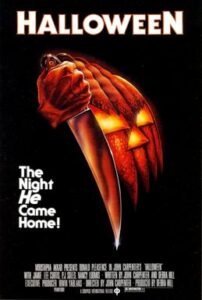
For me, the biggest crime of 1980s slashers like He Knows You’re Alone (1980) or Prom Night (1980) or Happy Birthday to Me (1981) or The Slumber Party Massacre (1982) was their stultifying lack of imagination.  Any display of imagination in the slasher sub-genre seemed to begin and end in the film that kickstarted it, John Carpenter’s original Halloween (1978) – itself a 1970s movie.


Teenage Sex and Death at Camp Miasma contains a number of scenes taken from the ‘original’ Camp Miasma movies of the 1980s.  Some are stylised re-imaginings of them that are operatic in their gusto and feature extraordinary geysers of blood.  But other scenes are meant to be ‘authentic’ ones, which Schoenbrun stages with a convincing, desperate, no-budget 1980s tackiness.  I did end up thinking that if I’d been a few years younger at the time, and less in thrall to 1970s horror movies, and the 1980s slashers had seemed like ‘forbidden fruit’ to me – films I was officially too young to watch and I only occasionally saw, furtively, through my fingers, on scratchy VCR recordings – I might have developed an affection for them too.  And today I’d enjoy them at least in a so-bad-they’re-good way.  (The reality is that I find them so bad they’re annoying.)


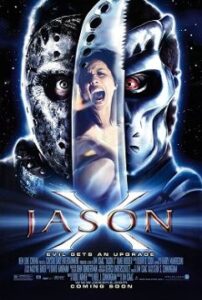
Incidentally, I was delighted that Schoenbrun included in their film a reference to 1983’s Videodrome, a horror movie far better than its slasher contemporaries, made by a genuinely visionary filmmaker, David Cronenberg.  As an actor, Cronenberg was game enough to appear in Jason X (2000), the entry in the Friday the 13th franchise where, yes, Jason Voorhees goes into outer space.


Lastly, it was a pleasure to see Teenage Sex and Death at Camp Miasma at the Singapore International Festival, surrounded by an enthusiastic and appreciative audience.  Everyone seemed to thoroughly enjoy the film and gave it a much-deserved round of applause at the end.
 

© Compass International Pictures / Aquarius Releasing

The man from another place has gone to another place


From wikipedia.org / © Georges Biard


For the past few days, I’ve felt like wearing a black armband while I sip my cups of coffee.  That’s because David Lynch, visionary maker of movies, short films, TV shows, web series, music videos and commercials, and artist, musician and actor to boot, passed away on January 15th.


In his cinematic output, Lynch was surely one of the most American of film directors. His work was suffused with Americana, both the cosy variety populated by porches, picket fences, lawns, sprinklers, diners, coffee, pie and kindly, neighbourly folk; and the flashier variety whereby bequiffed, leather-jacketed Elvis wannabes and peroxide blondes cruised along endless highways in big, finned sports cars.  This being Lynch, though, submerged beneath the Americana and frequently bubbling to its surface were things altogether weirder, darker, more surreal and twisted.  There was as much Salvador Dali, Luis Bunuel and William S. Burroughs in his work as there was Edward Hopper, Frank Capra and Ray Bradbury.  Meanwhile, though Lynch’s themes, motifs, imagery and stylistic touches felt unique – no wonder ‘Lynchian’ became a word – he wasn’t afraid to dress his visions in the clothes of familiar genres: horror, thriller, crime noir, science fiction and – something Lynch didn’t get enough credit for – comedy.


Anyway, here’s a guide to my favourite parts of the David Lynch film-and-TV universe.


Favourite Lynch cast

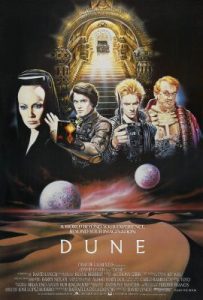
Lynch’s version of Dune (1984) was a box-office flop and received much abuse from critics.  (Dung, I remember the New Musical Express calling it.)  Unfortunately, Dune’s old-school producer Dino De Laurentiis wanted the doorstop-sized and labyrinthine Frank Herbert novel on which it was based crammed into a regulation two-hour movie.  The condensed result didn’t make much sense.


© Dino De Laurentiis Corporation / Universal Pictures


But Lynch never worked with a better troupe of actors.  It even outshone the cast that, four decades later, Denis Villeneuve assembled for his telling of the story in 2022 and 2024.  The Lynch Dune features Kyle MacLachlan, Jurgen Prochnow, Francesca Annis, Kenneth McMillan, Paul Smith, Patrick Stewart, Richard Jordan, Freddie Jones, Sian Phillips, Virginia Madsen, Jack Nance, José Ferrer, Everitt McGill, Brad Dourif, Max von Sydow and Dean Stockwell.  Oh, and Sting – more on him in a minute.


Favourite Lynch collaborator

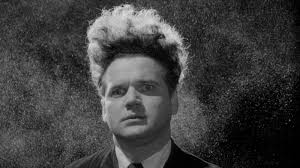
That would be Jack Nance, who played Henry Spencer, lead character in Eraserhead (1977), the film that put Lynch on the map.  With his impassive features, bouffant, tight suit and peculiar gait, Nance contributes as much to the film’s atmosphere as the elements that today we’d regard as typically Lynchian – the mutant baby, the lady in the radiator, the flickering lights, the industrial noise.  Thereafter, he was in all Lynch’s film projects (apart from 1980’s The Elephant Man) up to 1997’s Lost Highway.  He most famously played the amiable, fishing-and-chess-obsessed Pete Martell in Twin Peaks (1990-91), Lynch and Mark Frost’s oddball, sometimes barmy, occasionally confounding TV murder whodunnit, which coincidentally was a soap opera, comedy, horror story and science-fiction drama too.


© AFI Center for Advanced Studies / Libra Films


Nance’s life was hardly a bed of roses.  His film work was intermittent and in the mid-1980s he worked as a hotel clerk to make ends meet.  His second wife Kelly Jean Van Dyke (Dick Van Dyke’s niece) committed suicide.  And he had severe alcohol problems.  During the filming of Blue Velvet (1986), he was in such a state that Dennis Hopper – Dennis Hopper! – had to drive him to a rehabilitation centre.  In 1996, Nance died of a subdural hematoma, resulting from a ‘blunt force trauma’.  The previous day his face was bruised and he told friends that he’d been punched during a brawl he’d got into with some strangers in a doughnut shop.  Lynch said in tribute: “There’s not another actor I can think of who could fill his shoes.  I had roles in my head for future films that I was saving for Jack.  I cannot think of anyone else who could do it.”


Favourite Lynch funny bit

The other day at work I was discussing Lynch’s passing with a colleague.  I started enthusing about the sequence where Nicolas Cage and Willem Dafoe try to rob a feed store in Wild at Heart (1991) and how funny it was: “Willem Dafoe trips and falls on his shotgun and it goes off and you see the top of his head flying up in the air…  Meanwhile, there’s a wounded clerk who’s had his hand blown off at the wrist…  His colleague comforts him by saying modern surgery can reattach his hand… And then you see a dog running away outside with the hand in its mouth…”


At this point I realised my colleague wasn’t laughing with me, but was looking decidedly queasy.  He didn’t seem happy to be reminded of that sequence.  Which shows humour is subjective.  Still, I think the attempted robbery in Wild at Heart is Lynch’s funniest moment.


© PolyGram / Propaganda Films / Samuel Goldwyn Company


Favourite Lynch musical bit

Lynch was a musician, so music played a big role in his films – right from Eraserhead, when the lady in the radiator sings In Heaven.  In his final major work, Twin Peaks: The Return (2017), the long-awaited third season of his celebrated TV show, music wasn’t so much an element as a fixture.  Each episode ended with a scene in the Roadhouse, the bar / concert venue in the town of Twin Peaks, where a musical act would be performing.  Given Twin Peaks’ small size and remote location, the Roadhouse attracted some unfeasibly big names: Julee Cruise, the Cactus Blossoms, Rebekah Del Rio with Moby on guitar, and one Edward Louis Severson – Eddie Vedder to you and me.


But in my opinion, the act that rounds off Episode 8 of Twin Peaks: The Return is best of all.  It’s the fearsome electro-metal juggernaut Nine Inch Nails, whom the Roadhouse MC introduces as the Nine Inch Nails, no less.


© Dino De Laurentiis Corporation / Universal Pictures


Favourite Lynch musician in an acting role

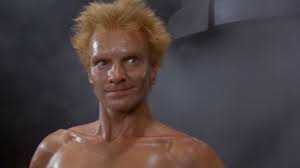
Lynch was also fond of putting singers and musicians in his casts.  Many remember Sting playing Feyd-Rautha Harknonnen, evil nephew of the equally-evil Baron Harkonnen, in Dune.  I’m not a fan of Sting’s acting but visually, with his spiky blonde hair, lean frame and daft codpiece, he was striking.  Indeed, when I saw Denis Villeneuve’s Dune Part 2 and Austen Butler strolled into view as Feyd-Rautha, my first thought was: “Oh look, there’s what’s-his-name in the Sting role!”


© Twin Peaks Productions / New Line Cinema / CiBy 2000


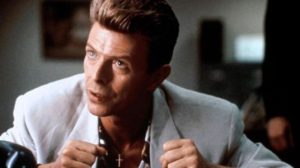
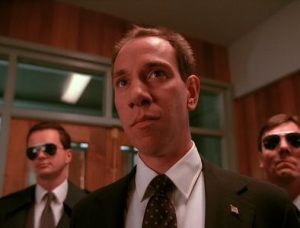
However, my favourite Lynchian musical-cameo comes in the middle of Twin Peaks’ cinematic prequel Twin Peaks: Fire Walk with Me (1992).  This is when David Bowie pops up as Phillip Jeffries, an FBI agent who’s been mysteriously missing for two years.  One morning, he suddenly steps out of a lift at FBI headquarters.  He proceeds to babble gibberish at FBI agents and Twin Peaks regulars Dale Cooper, Albert Rosenthal and Gordon Cole (Kyle MacLachlan, Miguel Ferrer and Lynch himself): “Who do you think this is, there…?  I found something.  And then there they were!”  Then he narrates a trippy dream montage involving dwarves, killers, masks, disembodied mouths and long-nosed spectres.  And then he vanishes into thin air.  “He’s gone!” squawks McLachlan.  “He was never here!” retorts Ferrer.


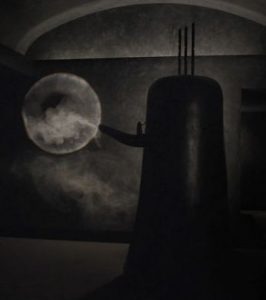
Bowie died early in 2016, before Twin Peaks: The Return began filming, which seemed to rule Philip Jeffries out of the third series’ storyline.  However, Lynch did include Jeffries.  Only now the disappearing agent is a giant teapot voiced by an actor called Nathan Frizell doing a Bowie impersonation.


David Bowie turned into a teapot.  Only David Lynch could do that.


© Lynch-Frost Productions / Showtime Networks


Favourite Lynch sad bit

Because of the nightmarish aspects of his works – it’s not the majority of their content, but it’s the stuff that lingers in viewers’ minds – Lynch isn’t readily associated with pathos.  Yet there are moments in his films that I find incredibly sad.  In The Elephant Man, for instance, it’s when the titular character John Merrick (John Hurt) escapes from the freak show owned by the evil Bytes (Freddie Jones), with the help of the show’s other inmates.  A dwarf, played by Star Wars’ Kenny Baker, remarks ruefully: “Luck, my friend, luck.  Who needs it more than we?”  Or in Twin Peaks: The Return when Deputy Hawk (Michael Horse) says a final goodbye to the ailing Margaret Lanterman, aka the Log Lady.  This is made more poignant by knowing that Log-Lady actress Catherine Coulson died early in the third season’s production.


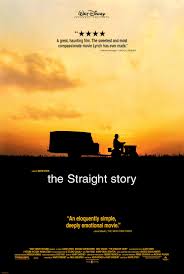
But my number-one Lynch sad moment is probably the ending of The Straight Story (1999), when Alvin (Richard Farnworth) finally makes it to the shack of his unwell brother, Lyle (Harry Dean Stanton).  They’re two old codgers, one using walking sticks and the other a Zimmer frame, and clearly aren’t used to expressing their feelings.  But Lynch, with some basic dialogue (“Did you ride that thing all the way out here to see me?” “I did, Lyle.”), some silence and some anxious, exhausted looks and expressions from his actors, conveys a huge amount of emotion.


© Asymmetrical Productions / Film4 / Buena Vista Productions


Favourite Lynch scary bit

Obviously, there are lots of scary bits in Lynch’s oeuvre.  I imagine he’d have been miffed if you described his works as ‘horror’ films, but he more than earned his entry in any ‘Encyclopaedia of Horror’.


Particularly freaky to me were several things in Twin Peaks and its 2017 sequel.  The image of Killer Bob (Frank Silva) crawling over a sofa in the original series was terrifying.  Twin Peaks: The Return featured in its first episode a strange experiment involving a big glass box and a mass of surveillance equipment that eventually conjures up a phantom entity.  Unfortunately for the guy monitoring the experiment – who’s inopportunely chosen this moment to have it off with his girlfriend – the entity is equipped with kitchen-blender fingers and It proceeds to reduce their heads to bloody confetti.  Also horrific is a sequence in a later episode wherein Deputy Bobby Briggs (Dana Ashbrook) tries to calm a hysterical woman at the wheel of a stalled car and a convulsing, vomiting zombie-like creature slowly rises out of the seat beside her.  This is never explained or referred to again – a perfect, scary Lynchian moment in other words.


And I remember sinking into my cinema seat, not wanting to look at the screen too much, during Lost Highway (1996), when Lynch’s camera starts prowling deep – deep – into the black recesses of the house belonging to Fred (Bill Pullman), the film’s initial hero.  That sequence had a real primordial chill to it.


But for my money, the scariest Lynch moment is the ‘Winkie’s Diner’ sequence in Mulholland Drive (2001).  A man sitting in the diner (Patrick Fischler) recounts two dreams he’s had, both of which take place there.  In each dream he’s been possessed by an inexplicable fear – and a man with a hideous face living behind the diner, whom he can see ‘through the wall’, seems to be responsible.  When a companion suggests he exorcises the memory of the dreams by checking behind the real diner, he reluctantly complies.  So they venture along the side alleyway, and…  What follows is one of the very few jump-scares in cinematic history that actually made me jump.


© Lynch-Frost Productions / Spelling Entertainment


Favourite Lynch speech

Miguel Ferrer’s Albert Rosenthal, the arrogant FBI pathologist who assists Kyle MacLachlan’s Dale Cooper in Twin Peaks, gets my vote here.  During the first season, Albert is very vocal about his low opinion of the town of Twin Peaks, which results in him getting punched out by Sheriff Harry S. Truman (Michael Ontkean).  During the second season, when Truman’s ready to punch him out again following a cutting jibe – “You might practise walking without dragging your knuckles on the floor” – Albert responds to the threat of violence with an impassioned speech explaining that he’s happy to be a knob-end if it helps him in the greater scheme of things, i.e. in the struggle against evil.  Oh, and he’s a committed pacifist too.


“While I will admit to a certain cynicism, the fact is that I’m a naysayer and hatchet-man in the fight against violence.  I pride myself in taking a punch and I’ll gladly take another because I choose to live my life in the company of Gandhi and King.  My concerns are global.  I reject absolutely revenge, aggression and retaliation.  The foundation of such a method is love.  I love you, Sheriff Truman.”


No wonder Cooper tells the dumfounded Truman afterwards, “Albert’s path is a strange and difficult one.”


© De Laurentiis Entertainment Group


Favourite Lynch villain

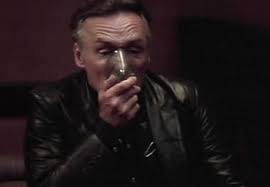
There are a good many contenders for this too: Killer Bob in Twin Peaks, Willem Dafoe’s Bobby Peru in Wild at Heart, and Kenneth McMillan’s Baron Harkonnen in Dune, who’s basically a levitating, leering sack of pus.  But at the end of the day, my ‘Favourite Lynch Villain’ award has to go to Dennis Hopper’s Frank Booth in Blue Velvet.


The scene where the black-clad, slick-haired Frank assaults Dorothy Vallens (Isabella Rossellini) whilst acting out a deranged sexual fantasy, screaming things like “Baby wants to f**k! Baby wants to f**k blue velvet!” and slurping gas out of a canister is astonishing.  It’s made even more harrowing by the fact that the hapless Jeffrey Beaumont (Kyle MacLachlan) is hiding nearby in a closet and has to witness it all.  This is the moment when the preppy, clean-cut Jeffrey discovers life is a lot more complicated, in a bad way, than he thought.  No wonder he laments: “Why are there people like Frank? Why is there so much trouble in this world?”


So, thank you David Lynch.  Your oeuvre was sometimes comfortingly genial, sometimes perplexingly weird, sometimes shockingly dark – but it was always fascinating.  I raise a damn fine cup of coffee in your honour.


© Lynch-Frost Productions / Showtime Networks