
© Greyladies
Until recently my single point of reference for the English writer E. (Edith) Nesbit, who lived from 1858 to 1924, was her children’s book The Railway Children (1906). I have memories of my primary school teacher, Mrs Atkinson, reading this book to us in instalments when I was eight or nine years old; and, later, I saw the 1970 film version of it, directed by Lionel Jeffries, on TV.
The bit of The Railway Children that’s always remained in my head comes from the film. The three kids, played by Jenny Agutter, Sally Thomsett and Gary Warren, witness a landslide that buries a section of railway track and they have to warn an approaching train to slow and stop before it crashes cataclysmically into the rubble. This necessitates Agutter and Thomsett stripping off their red bloomers and waving them like flags in the air.
I should say I was at an age where I was more interested in the landslide – I recall being spooked by Gary Warren exclaiming, “Look at that tree over there… Lord, it’s moving!” – than in the sight of Jenny Agutter, who’d later appear in Walkabout (1971), Equus (1977) and An American Werewolf in London (1981), and Sally Thomsett, who’d later appear in Straw Dogs (1971) and the popular TV sitcom Man about the House (1973-76), waving their brightly-coloured undergarments at a locomotive.
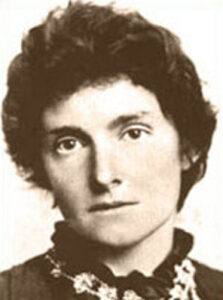
So, E. Nesbit was known to me as a children’s writer and as the author of one children’s book in particular. But she also wrote adult literature, poetry and non-fiction, as well as being a founding member of that venerable British democratic-socialist organisation the Fabian Society, whose other early members included George Bernard Shaw, H.G. Wells, Ramsay MacDonald and Emmeline Pankhurst. Despite writing items such as Women and Socialism: from the Middle-Class Point of View and Women and Socialism: A Working Woman’s Point of View (both 1885), she was not a fan of women’s suffrage – according to her Wikipedia entry, “mainly, she claimed, because women could swing Tory, thus harming the Socialist cause.”
Meanwhile, her personal life was unpleasantly complicated and sometimes tragic. Her first husband, Hubert Bland, was a philandering cad who sired three children with two other women while he was ostensibly married to Nesbit – Bernard Shaw observed that Bland had “simultaneously three wives, all of whom bore him children.” Nesbit lost her father at the age of three, her only sibling when she was around 12, and a son when she was in her early forties.
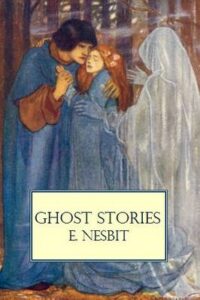
I wasn’t familiar with her backstory when, a short time ago, I picked up a paperback collection of seven of her ghost stories. If I’d known more about her, I might have been less surprised at what I read. Nesbit’s tales of the supernatural aren’t the comfy, cosy ones you associate with her time and place, i.e., Victorian and Edwardian England, where there’s a popular image of well-heeled gentlemen and ladies assembling around a log-fire at Christmas-time, with glasses of port and sherry, for the purpose of mildly spooking each other by telling a ghostly ‘yarn’. No, Nesbit’s stories have unexpected bite.
The opening one in the collection, From the Dead, begins with some painful marital complications not wholly dissimilar to those Nesbit faced with Hubert Bland. A maliciously forged letter causes the narrator to abandon his fiancé and marry someone else. When he learns the letter was forged, he casts out his wife in disgust. A change of heart sends him in search of her but, months later, when he finally locates her, he’s informed that she’s just died in childbirth. There ensues a scene that put me in mind of the apparition near the end of Edgar Allan Poe’s The Fall of the House of Usher (1839). The newborn child survives but the final line remarks sombrely: “It is four years old now, and it has never spoken and never smiled.”
John Charrington’s Wedding is more straightforward and traditional but it ends too on a downbeat note: “I saw her face. Shall I ever forget it. White, white, and drawn with agony and horror, bearing such a look of terror as I have never seen since, except in dreams.”
Then comes Man-Size in Marble, perhaps the most famous of Nesbit’s ghost stories. It has a young couple moving into a cottage in the English countryside where they discover, nearby, an ancient Norman church containing the funerary statues of two cruel-looking knights. The husband also hears a legend about how every Halloween – or Hallowe’en as it was back then – those statues come to life and stalk around the neighbourhood. He declines to tell his wife of the legend for the patronising reason that she “was always nervous, as highly strung natures are, and I felt that these tales… might have made our home less dear to my wife.” Incidentally, he has a habit of calling her ‘Pussy’ and ‘Puss cat’, which reminded me of Henrik Ibsen’s famous indictment of the patriarchy, his 1879 play A Doll’s House. In that, the beleaguered heroine Nora has to tolerate a husband who insists on calling her ‘skylark’ and ‘songbird’.
Partly due to the husband keeping his wife in the dark about the sinister legend of the statues, Man-Size in Marble has a grim denouement too.
© Adorable Media / BBC Film
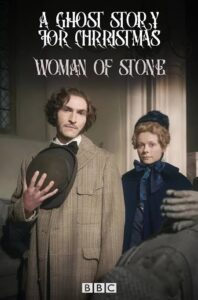
In 2024, Man-Size in Marble was adapted for television by Mark Gatiss, who retitled it Woman of Stone. This was broadcast by the BBC on Christmas Eve as an instalment in the channel’s revived A Ghost Story for Christmas franchise (1971-78 and 2005-present). Now I like Gatiss generally, and I like a lot of his work, but I’m not a fan of his adaptations of classic ghost stories penned by the likes of M.R. James. I think they’re too glossy and overcooked and, somehow, they miss the authenticity that made the originals effective. Anyway, I haven’t watched his version of Man-Size in Marble. E. Nesbit features in it as a character, supposedly… Played by Celia Imrie, no less.
Next is The Ebony Frame, whose narrator retrieves an aged painting from a storeroom not because of its canvas, which is blackened beyond recognition, but because he wants to reuse its frame, the ebony one of the title. He discovers that the blackened panel at the front never had a picture at all, because the frame actually contains two pictures, turned inwards, secured face-to-face. One of them, he’s shocked to learn, is of “Myself – in a cavalier dress, ‘love-locks and all’!” The other is of “a woman of the type of beauty beloved of Burne-Jones and Rossetti.” The sealed-together portraits point to a forbidden love affair in the distant past, while the narrator’s likeness to the cavalier suggests he’s the man’s descendent or even reincarnation. Predictably, he’s soon having frighteningly realistic dreams where the saucy Burne-Jones / Rossetti lady comes to him, keen to rekindle their romance.
Yes, The Ebony Frame is yet another haunted-painting story – it was first published in 1893, three years after Oscar Wilde’s The Portrait of Dorian Gray. But I found the idea of the two concealed pictures ingenious.
At ten pages, The Mystery of the Semi-Detached is the shortest thing in the collection. It differs from the other stories in that it’s a dark tale of premonition.
Also different is the penultimate entry, The Pavilion. From the conversations of the main characters, two young men and two young women, we learn how the title structure is connected to “some story about a wizard or an alchemist or something, and it was burned down, and then they rebuilt it in its present style.” It’s also engulfed by the stems and leaves of what’s said to be a Virginia creeper, though one person observes that it looks ‘more like a South American plant’. And because “there have always been so many rabbits and weasels and things found dead near it”, the pavilion is reputed to be haunted. A dare is made and the young men spend the night in the place. Needless to say, the creeper proves to be more mobile than anyone had thought. The Pavilion contains some unexpected character dynamics, which elevate it above the level of most killer-plants-at-large horror stories.
Lastly is The Shadow, perhaps the clammiest and most dread-inducing tale in the collection. This begins with the afore-mentioned scenario of Victorians making themselves comfortable at Christmas-time to tell ghost stories – but then takes the reader to places where there are ghosts but the vibe is definitely not comfortable. Following a festive dance, three young woman gather in a room and entertain themselves with spooky tales. Eventually, they invite the housekeeper to join them and coax her into telling one, and get more than they bargained for.
The Shadow features an entity that’s a harbinger – or a bringer – of death and, as the title suggests, its appearance is dark and incorporeal: “Between us and the coffin, first grey, then black, it crouched an instant, then sank and liquefied – and was gathered together and drawn till it ran into the nearest shadow. And the nearest shadow was the shadow of Mabel’s coffin.” Ultimately, the housekeeper’s young audience discover that the thing in her story has entered their world as well.
To sum up, these ghost stories contain many hapless and ill-fated characters, including some over-confident and foolish men who help to bring things upon themselves; and there’s many unhappy endings. And they’re excellently written. Like all good children’s writers, E. Nesbit perfected her craft writing for a readership who don’t have the patience to tolerate florid, overwrought and pretentious prose like many adults do. As a result, her style is admirably clear and direct.
From wikipedia.org