When Peter Medak showed his class


From wikipedia.org / © United Artists / AVCO Embassy Pictures


The British-Hungarian film and TV director Peter Medak died near the end of last month.  Here’s an update of something I wrote a decade ago about what I consider to be Medak’s greatest movie, 1972’s The Ruling Class…


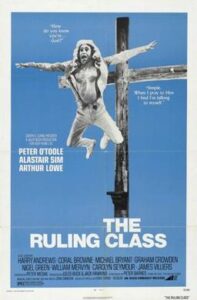
It’s fair to say that the British film industry hasn’t produced anything else quite like The Ruling Class, the satirical 1972 movie starring flamboyant Anglo-Irish actor Peter O’Toole, directed by émigré Hungarian filmmaker Peter Medak and scripted by English playwright Peter Barnes, who adapted for the screen his 1968 play of the same name.


Okay, The Ruling Class’s surreal but relentless lampooning of Britain’s social, religious and political establishments puts it in territory similar to that occupied by the famous film trilogy directed by Lindsay Anderson, If (1968), O Lucky Man! (1973) and Britannia Hospital (1982).  Indeed, the similarities feel more pronounced due to the presence in The Ruling Class of Arthur Lowe and Graham Crowden, two actors who appeared regularly in Anderson’s work.


Also, the casting of Lowe, Coral Browne and Harry Andrews in The Ruling Class calls to mind Douglas Hickox’s delicious comedy-horror movie Theatre of Blood (1973), in which all three actors fall victim to a psychopathic Shakespearean actor played by Vincent Price.  The Ruling Class contains a dose of the macabre too and shares with Theatre of Blood a mad but compelling antihero.


But for acting gusto, for directorial flair, for a story that blends a bewildering range of genres, and for mocking humour that veers between the delightfully subtle and the bruisingly un-subtle, The Ruling Class is in, well, a class of its own.
 

© United Artists / AVCO Embassy Pictures


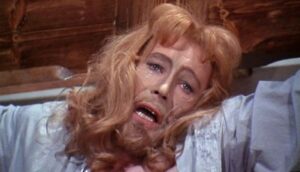
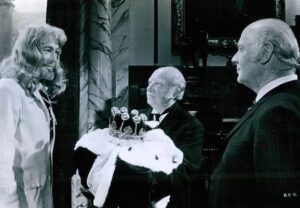
O’Toole plays Jack Gurney, the 14th Earl of Gurney, who inherits his title after the 13th Earl – a brief but barnstorming performance by Andrews – accidentally perishes during a disturbing sex-game involving a noose and a ballerina’s skirt.  To the relief of the late earl’s brother, a Church of England bishop played by the incomparable Alistair Sim, he didn’t commit suicide, which would of course have been sinful.


The Gurney family is dismayed to learn that young Jack is out-and-out, barkingly insane.  He believes he is Jesus Christ and sports an appropriately Christ-like beard and mane of hair.  He also wishes to bring peace and love to the earth and sleeps upright on a giant wooden cross.  Before long, the most unscrupulous of his relatives, his Uncle Charles (William Mervyn) and Aunt Claire (Browne), are plotting to get rid of him.


Charles decides to ensnare Jack using his young opera-singing mistress Grace (Carolyn Seymour).  He introduces them, calculating – correctly – that Jack will fall in love with her and marry her.  When the marriage is consummated and an heir produced, Charles can then have Jack committed.  Charles’s plans go astray, however.  Grace falls in love with the crazy but unsettlingly charming Jack and, later, Jack seems to be cured of his madness by his psychiatrist Dr Herder.  Herder is played by Michael Bryant, who for some reason does an uncannily accurate impersonation of the great Czech character actor Herbert Lom.  Indeed, so much is Bryant like Herbert Lom that during the film I assumed I was watching Lom.  I only realised it was Bryant in the role when I saw his name in the closing credits.


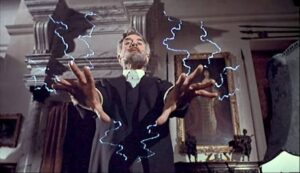
Herder bases his cure on the reasoning that there can only be one Jesus Christ, and if Jack can be convinced that somebody else is Christ then he’ll be cured of his own delusions.  There follows a sequence in which Herder introduces Jack to a psychiatric patient called McKyle, played by Nigel Green, who believes himself to be a very different sort of Messiah: a wrathful, blood-and-thunder, take-no-prisoners, Old Testament-style one with a booming Scottish accent.  Green’s performance here is electrifying – literally electrifying, because the panic-stricken Jack sees bolts of energy shooting out of his hands.  Actually, it’s disconcerting to watch Nigel Green in a role like this if, like me, you mainly remember him for playing Colour-Sergeant Bourne in Zulu (1964), who was surely the most unflappable and down-to-earth character in the history of British cinema.
 

© United Artists / AVCO Embassy Pictures


And Charles’s scheme to have his troublesome nephew banged away in the loony-bin ultimately fails when the court psychiatrist (Crowden) discovers to his joy that Jack is a fellow old Etonian – the film’s dig at the ‘old-boy network’ that’s promoted incompetence and mediocrity in the upper echelons of British society for centuries.  The pair of them then burst into a jolly rendition of The Eton Boating Song.  Incidentally, the film is peppered with musical interludes like this one.  None of them last long enough for it to quite qualify as a musical, but they add yet another colour to its palette.


Predictably, Jack isn’t really cured of his insanity.  “I’m Jack!” he affirms a little too keenly, “I’m Jack!”  He no longer believes that he’s Jesus Christ, but he soon develops a worrying interest in Victoriana and we realise that the Jack he thinks he is now isn’t Jack Gurney.  It’s a different Jack, one who gained notoriety in the back-streets of Whitechapel in the late 1880s.  In one phantasmagorical scene, splendidly orchestrated by director Medak, we see Jack step through the wall of his mansion’s living room and into a Victorian back-street, accompanied by one of the film’s female characters – who soon gets spitted on a long sharp blade.


However, in the film’s final spasm of irony, Jack Gurney’s confusion with Jack the Ripper does him no harm whatsoever.  His Ripper-style murder is blamed on someone else – the film’s sole working-class character, the Gurneys’ butler Tucker (Lowe).  Then, near the movie’s end, Jack takes his seat in the House of Lords and there delivers a debut speech that is a demented, psychotic hang-’em / flog-’em rant.  The speech, needless to say, is wildly popular among the House’s venerable members.  (Medak memorably shows the assembled lords through Jack’s eyes as a horde of rotting, cobwebbed but somehow animate corpses.)  His infant son, meanwhile, is also gurgling, “I’m Jack!  I’m Jack!” which suggests that the insanity of this particular branch of the ruling class will continue for another generation at least.


With all this going on, the success or failure of The Ruling Class depends on the ability of the actor in the lead role and Peter O’Toole is glorious.  He’s at the height of powers – still surfing the waves he made in 1962’s Lawrence of Arabia, 1964’s Beckett and 1968’s The Lion in Winter; and before booze and bad movie choices, like 1979’s Caligula and 1984’s Supergirl, took their toll on his reputation.  For the entire film his character is as mad as a hatter and yet you have no difficulty believing Carolyn Seymour’s Grace – and indeed, later, Coral Brown’s Aunt Claire – could fall for this wild-eyed, loquacious and charismatic lunatic.


But O’Toole is helped by his supporting cast.  Arthur Lowe is wonderful as the beleaguered and cantankerous butler, Tucker.  While Lowe’s career was full of delightful moments, I think the most delightful moment of all comes in The Ruling Class when he learns that the late 13th Earl of Gurney has left him 30,000 pounds in his will and he does a wee dance to celebrate.  Coral Browne, meanwhile, who was pushing 60 at the time she made the film, gives a memorable performance as a mature lady who remains sexually charged, slinky and alluring.  There’s nothing inelegant about the scene towards the movie’s end where she tries to seduce O’Toole, who’s some 20 years her junior.  Actually, I can understand why in real life Vincent Price married Browne shortly after he’d murdered her onscreen in Theatre of Blood.
 

© United Artists / AVCO Embassy Pictures


The film also showcases the talents of several actors whose careers were never quite as successful as they should have been.  Carolyn Seymour is excellent as Grace and it seems a shame that most of her subsequent work was on British and American television.  William Mervyn, who was typecast playing upper-class gentlemen in the likes of The Railway Children (1970) and various Carry On films, makes a splendid main villain, Uncle Charles, and it’s unfortunate he wasn’t given some similarly meaty roles before his death in 1976.  Also in the movie is James Villiers, playing Jack’s dim-witted but amiable cousin Dinsdale.  I was used to seeing Villiers in villainous or officious roles, like in Seth Holt’s Blood from the Mummy’s Tomb (1972) or the 12th Bond movie For Your Eyes Only (1982) and it’s a pleasure watching him play a very different character in this.


Another person connected with The Ruling Class whose talent didn’t get to blossom as much as it should have was Peter Medak.  This and his 1972 adaptation of the Peter Nichols play A Day In the Death of Joe Egg put plenty of wind in his sails, but that wind suddenly died in 1973 when he took on the near-career-ending task of directing the pirate-comedy movie Ghost in the Noonday Sun.  He later described it as “the biggest disaster of my life.”  The project was sabotaged by the almost pathological uncooperativeness of its star, Peter Sellers, then at his most unpredictable and volatile.  Having the famously bipolar Spike Milligan involved probably didn’t help.  Denied a cinematic release at the time, it finally saw the light of day on video in 1985.  I’ve watched half-an-hour of it on YouTube and it’s bloody awful.


In 1980, though, Medak directed The Changeling, a brave attempt at staging a subtle, old-fashioned ghost story during a period when most scary movies involved screaming teenagers, masked knife-wielding maniacs and buckets of gore.  And in the early 1990s he made a couple of decent British films like The Krays (1990) and Let Him Have It (1991) and also the ludicrous, overwrought but stylish thriller-noir Romeo is Bleeding (1993) with Gary Oldman and Lena Olin.  In 1998 he directed the old tosh that was Species II but thereafter, gratifyingly, was able to work on episodes of several top-quality American TV shows like The Wire (2002-8), Breaking Bad (2008-13) and Hannibal (2013-15).  Indeed, after Medak’s death on October 27th, Hannibal’s showrunner Bryan Fuller remembered him as a “gentle teddy bear of a Hungarian” and a “wonderfully talented, kind, and funny man who always had a great story to tell, both on and off the set.”


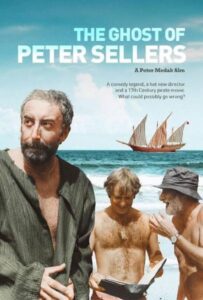
It was also gratifying that in Medak’s swansong, the 2018 documentary The Ghost of Peter Sellers, he managed to turn the darkest and most traumatic episode of his career, Ghost in the Noonday Sun, into a critically acclaimed account of the making of that luckless film.  The Ghost of Peter Sellers gives fascinating insight into how, in multitudinous ways, film projects can go wrong.  It’s also unexpectedly moving because, despite all the strife that Peter Sellers caused him, Medak vocalises with breathtaking magnanimity how much he loved and admired Sellers too.
 

© Vegas Media / 1091 Pictures


But the finest monument to Peter Medak, in my opinion, remains the exuberance and chutzpah of The Ruling Class.   At one point, Nigel Green’s deranged McKyle describes himself as “the high-voltage Messiah, the electric Christ, the AC/DC god”, and the film is something like a cinematic equivalent of that.
Whatever happened to kids’ Euro-telly?


© Franco London Films / ZDF Television


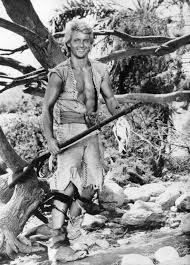
What a melancholy coincidence…  A few weeks ago, for the first time in years, something got me thinking about the 1960s children’s TV show The Adventures of Robinson Crusoe and I watched part of an episode of it on YouTube.  I wondered if its star, the Austrian actor Robert Hoffman, was still on the go, googled him and was pleased to find that he was.  Then, the other day, I read on social media that Hoffman had just passed away.


Anyway, here’s something I originally posted in 2012, which mentions Hoffman and The Adventures of Robinson Crusoe.  It’s now been updated for 2022.   


Politics, the economy and, indeed, cultural attitudes in Britain in the last half-dozen years have been dominated by Brexit.  This, depending on your point-of-view, has either been a joyous and much-needed liberation of Britain from the stifling bureaucracy and political interference it’d had to put up while it was a member of the European Union; or the most disastrous decision Britain has made since the 1956 Suez Crisis, one that’ll doom the country to being a parochial, xenophobic wee dump that backpedals towards the 1950s while the other European nations get on with living in the 21st century.  Anyone who regularly reads this blog will know which view I subscribe to.  Namely, that if you believe there’s anything positive about Brexit, you must have one of those heads that proverbially ‘zip up the back’.


The Brexit vote in 2016 came 43 years after Britain joined the European Union, or the European Economic Community (EEC) as it was then.  However, it’d be wrong to believe before 1973 Britons were wholly detached from the culture of continental Europe.  Indeed, though I was a mere mite before 1973, much of my headspace had already been colonised by the continent.  This was thanks to children’s television.


In the early 1970s, the BBC felt obliged not only to entertain kids after they’d arrived home from school and broadcast juvenile programmes from 4.00 to 5.45 PM, but also to broadcast such programmes during the mornings of school-holiday periods.  The morning schedules of the summer holidays in particular were a challenge for the BBC to fill with kiddie-related material.  As a result, the channel had to regularly raid its archives for old, dubbed children’s shows from France, Germany and elsewhere and broadcast those.


Let’s begin with my least favourite show.  Growing up on a Northern Irish farm where there weren’t many neighbours to mix with, I depended for company during the summer holidays on the elderly couple who lived a few hundred yards along the road from our farmhouse.  More precisely, I depended on their two granddaughters, who were around my age and usually came to spend much of the summer with them.  Luckily for me, the neighbours’ granddaughters were a pair of Tomboys who were dependable for games of cops and robbers, cowboys and Indians, and other activities normally more associated with young males.  However, they had one weakness, a fondness for a show called White Horses.


This was a co-production between German and Yugoslavian TV that’d been made back in 1965 but that rarely seemed to be off the BBC’s children’s holiday schedules in the early-to-mid-1970s.   It followed the adventures of a girl from Belgrade, Julia, who was staying on her uncle’s horse ranch.  Populating the ranch were handsome white steeds that made my two female playmates swoon with adoration.


As a boy, and not a fan of horses (white or otherwise), I thought this was the dumbest programme ever.  And it constantly annoyed me that on those summer mornings the games of cops and robbers and cowboys and Indians would abruptly stop and my two playmates would run indoors to sit goggle-eyed in front of their television the moment White Horses came on.  I have to say, though, that while I generally remember other kids’ TV programmes from then but not the details of individual episodes, two episodes of White Horses remain etched on my mind.


In one episode Julia found a metallic, saucer-shaped object on the grounds of the ranch and carried it to her uncle, who immediately screamed, “It’s a mine!” and flung it away as far as he could.  At which point it exploded.  In the other episode, the ranch’s dog was seen frothing at the mouth and in the ensuing pandemonium all the ranch-hands tore around on horseback, trying to hunt the rabid beast down.  Come to think of it, for a silly girls’ show, White Horses was actually quite dark.  It left me with the conviction that the European continent was a real danger zone, riddled with unexploded World War II landmines and overrun with rabid mammals.  That’s a message I’m sure Brexiters like Nigel Farage and Jacob Rees-Mogg would approve of.


© Philips


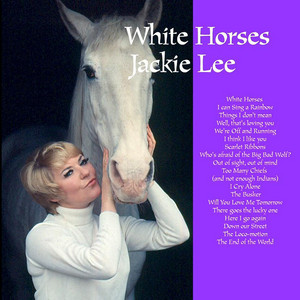
One thing that really annoyed me about White Horses was the sickly theme song.  This wasn’t a feature of the original German-Yugoslavian show but had been recorded by the Dublin singer Jackie Lee and stuck onto the dubbed BBC version.  The lyrics went: “On my horses let me ride away, to my world of dreams so far away, let me run, to the sun, to a world my heart can understand, it’s a gentle warm and wonderland, faraway, stars away, where the clouds are made of candyfloss, as the day is born, when the stars are gone, we’ll race to meet the dawn…”  Despite my intense dislike for it, however, the song is now regarded as a kitsch classic and has been covered many times, usually by ‘knowing’ indie-pop bands like Kitchens of Distinction and the Trashcan Sinatras.  Even Catatonia’s Cerys Matthews has had a go at singing it.  Here, if you can stomach it, is the original version.


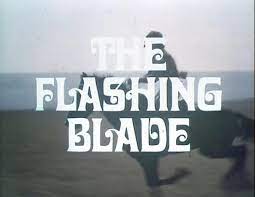
Now if you wanted a Euro-kids’ TV show with a seriously bad-ass theme song, you didn’t have to look any further than The Flashing Blade, a historical swashbuckler made by France’s Office de Radiodiffusion Television Francaise (ORTF) in 1967.  Set in the early 17th century, during the War of Mantuan Succession between France and Spain, the show’s theme song was accompanied by footage at the start of each episode showing the principals racing manically across countryside on horseback.  Their manic-ness, of course, was increased by the fact that the film was wildly speeded up.  The singer implored: “You’ve got to fight for what you want, and all that you believe, it’s right to fight for what we want, to live the way we please, as long as we have done our best, then no one can do more, and life and love and happiness, are well worth fighting for.”  Here’s the show’s blood-stirring opening on YouTube.


Unlike White Horses, I don’t remember much about the story of The Flashing Blade, except that to my impressionable young mind it was very like The Three Musketeers.  For some reason, however, I’ve never forgotten a scene where two characters – one presumably villainous because he sported a pointed beard – were playing chess and the villain made a comment about the uselessness of pawns with regard to the outcome of the game.  The other player immediately came back with an observation along the lines of: “Even the smallest pebble can shatter the most beautiful of mirrors.”  As a seven-year-old, this seemed the profoundest thing I’d ever heard.


© Office de Radiodiffusion-Télévision Française 


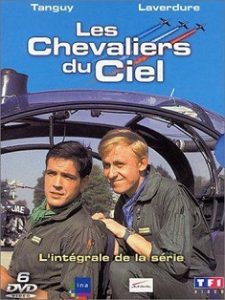
Also originating with France’s ORTF in 1967 was Les Chevaliers du Ciel, which ran on Gallic television for the next three years.  By the time it turned up in anglicised form on British TV it’d been retitled The Aeronauts and given a new, hard-rockin’, by BBC standards, English-language theme song by the Canadian musician and TV presenter Rick Jones.  His Aeronauts song went: “Better than best, boys, we pass every test, you’re ahead of the rest, when those crime-fighting Aeronauts are cutting those bounds, in a fury of sound, you’re a loser all round, against the crook-catching Aeronauts, so play in the wind, boys, you better give in, because your troubles begin when those two daring aeronauts fly!“  I can’t find the opening sequence for this one, only the song itself.


Incidentally, the memorably bearded, balding and intense-looking Rick Jones was no stranger to children’s TV programmes, as in 1972 he hosted Fingerbobs, which must’ve featured the cheapest and most low-fi puppets in the history of television.  Over seven years he also worked on the BBC’s long-running show for pre-school kids, Play School (1964-88), a stint that ended when, to quote his Wikipedia entry, he was ‘fired by the BBC, after a fan sent him two cannabis spliffs at the corporation’s address’.  Jones, alas, died in San Francisco last year.


Once again, though I remember the theme music well, I can’t recall much of what went on in The Aeronauts.  Maybe that was just as well, since the show was about two hunky young guys called Ernest and Michel who were pilots in the French Air Force.  As such, they might’ve spent the episodes bombing la merde out of insurgents in North Africa or Greenpeace activists in the South Pacific.


© Office de Radiodiffusion-Télévision Française 


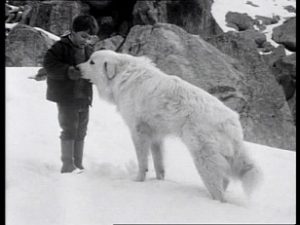
I’ve spoken ironically about the music on The Flashing Blade and The Aeronauts, but there’s no disputing the fact that the theme tune of Belle and Sebastian had a genuine haunting quality.  This was the Anglicised version of Belle et Sebastien, which ran on French television from 1965 to 1970 and was based on the novel by Cecile Aubrey about a boy and his big Pyrenean mountain dog.  It’s fitting that wistful Glaswegian indie-pop band Belle & Sebastian took their name from this show.  And apparently its theme song was covered by New Zealand singer-songwriter Bic Runga a few years ago.  Here’s the original version.


There are a number of things I remember about Belle and Sebastian, apart from its music and its obvious star, the hefty canine Belle.  I remember being awed by the sheer, bleak mountain landscapes that formed its backdrop – it’d been filmed around the village of Belvedere in the Alpes-Maritimes.  Indeed, years later, when I finally saw the Alps for real, the first association I made in my head was with that old French kids’ TV show.


I also remember how the voices in Belle and Sebastian puzzled me.  Not being aware of dubbing procedures or the fact that the BBC employed a small group of actors to do the English dialogue for these imported shows, I couldn’t figure out at the time why the adults in Belle and Sebastian sounded exactly like the adults in White Horses.  By the way, Sebastian in the show was played by Mehdi el Glaoui, who was Cecile Audrey’s son.  Little Mehdi’s father was Moroccan and indeed his grandfather had been the Pasha of Marrakech.


© Office de Radiodiffusion-Télévision Française 


However, musically, the best Euro-kids’ programme of all was surely The Adventures of Robinson Crusoe.  Robinson Crusoe was of course a British cultural property, but this children’s drama version of the story had been made in 1964 by France’s Franco London Films (FLF) and starred Austrian actor Robert Hoffman in the title role.  The BBC got its hands on it, dubbed it and broadcast it regularly during its children’s TV schedules from the mid-1960s to the late 1970s.


The BBC added a lovely, mock-classical score composed by Robert Mellin and P. Reverberi, which managed to be both stirring and slightly desolate.  I’ve read somewhere that the spiralling opening chords were meant to represent the breakers striking the beach of Crusoe’s desert island.  It doesn’t surprise me that when electronica band The Orbital put together 19 of their favourite tracks in 2002 for the Back to Mine compilation series, they decided to close their compilation with this tune.


To be fair to The Adventures of Robinson Crusoe, a lot more of the show has remained with me over the years than just its theme music.  For a long time, Hoffman’s youthful features formed my image of how the character should look – so that when I saw other versions of the story later on, such as a 1974 BBC adaptation with Stanley Baker and a more politically correct movie adaptation called Man Friday (1975) with Peter O’Toole and Richard Roundtree, I couldn’t accept them.  The series took liberties with Daniel Dafoe’s novel, though.  For example, it climaxed with a shipload of pirates invading Crusoe’s island.  At which point, Man Friday took off and hid in the island’s jungle, and started killing the pirates off one by one.


Finally, for pure weirdness, you couldn’t beat The Singing Ringing Tree, which had started life as a film made by an East German studio, Das Singende Klingende Baumchen.  The BBC duly chopped it into TV-serial form.  Even by the standards of the other Euro-kids’ shows I saw at the time, The Singing Ringing Tree was particularly venerable, dating back to 1957.  It lingers in my mind because, although it was ostensibly a fairy tale, it spooked the hell out of me.


© Deutsche Film-Aktiengesellschaft


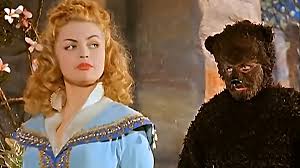
With characters including an evil dwarf, a humanoid bear creature (who was actually a prince transformed by a magic spell) and a gigantic goldfish, the series resembled a Brothers Grimm story directed by David Lynch.  Reviewers, at least those who took the show seriously, noted an influence of German expressionism on how it looked and an influence of The Cabinet of Dr Caligari (1920) in particular.  To my seven-year-old sensibilities, the fate suffered by the dwarf at the end was especially traumatising.  He was last seen swooping around in the air and then plunging through the thin-crusted ground and vanishing in a belch of volcanic, sulphurous smoke.


If this makes me sound wimpish, I should point out that I wasn’t alone in being scared by the show.  The comedian and impersonator Paul Whitehouse said of The Singing Ringing Tree that it used to make him ‘pee his pants’ when he was a kid.  Perhaps as a way of exorcism, Whitehouse staged a spoof of it on his popular comedy programme The Fast Show (1994-97) called The Singing Ringing Binging Plinging Tinging Plinking Plonking Boinging Tree with, somewhat inevitably, the ubiquitous Warwick Davies in the role of the dwarf.  And in 2006, the show lent its name to a ‘wind powered sound sculpture’ in the Pennines in Lancashire.


And there ends my round-up of kids’ Euro-telly.  They might have been a set of old, cheap and badly-dubbed TV shows, but nonetheless they converted me into a good little European – even if at the time I still thought Brussels was something you were force-fed at Christmas, not the hub of one of the most important political and trading alliances in the world.


© Franco London Films / ZDF Television