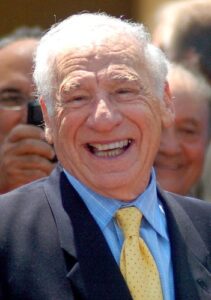
The 100-year-old Mel


From wikipedia.org / © Angela George


Last week saw much hype and noise about the United States of America celebrating its 250th birthday.  Under the leadership of Donald Trump, the USA marked the 250th anniversary of its independence from the British by holding a Great American State Fair on Washington DC’s National Mall.  This featured empty booths, cancelled musical performances, racist flags, power outages, collapsing roofs and a plywood model of the victory arch Trump wants to build on the Potomac that cracked, crumbled and oozed yellow gunk.  How odd that hardly anyone wanted to go to it.


In other moves to celebrate America’s 250th Independence Day, Trump refurbished the Lincoln Memorial’s Reflecting Pool, also in Washington DC, so that its water would shine a patriotic blue, though it immediately shone a less patriotic green thanks to a sudden and unforeseen algae bloom.  He also tried to extend the USA team’s run in the 2026 Football World Cup by arm-twisting Gianni Infantino and FIFA into breaking the sport’s red-card rules so that a key American player could play in the team’s next game – which they lost, courtesy of a 4-1 drubbing by Belgium, causing their exit from the competition.


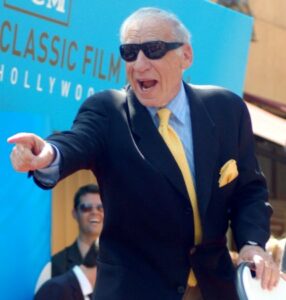
The sound and fury about the 250th anniversary of American independence, and the Trump-esque shenanigans accompanying it, have obscured the fact that, one week earlier, the USA witnessed another important three-digit birthday.  June 28th saw the 100th birthday of the legendary American filmmaker, comedian and general funnyman Mel Brooks.  By the time he turned his hand to making movies in the late 1960s, Brooks already had impressive comic credentials – devising the famed 2000-Year-Old Man comedy sketch with Carl Reiner, for instance, or creating the classic spy-comedy TV show Get Smart (1965-70) with Buck Henry.  But it’s fair to say his films are the body of work for which he’s most beloved.


Like much of the comedy I experienced from an early age – the CarryOn movies, or those starring Abbott and Costello, or the telly career of Ronnie Corbett – I’ve had a complicated and changing relationship with the oeuvre of Mel Brooks.  As a youngster, I thought it was brilliant.  As a young adult, who took himself much too seriously, I dismissed it – certainly, the later films Brooks made – as crass, cringeworthy guff.  Now, in my old age, I can find pleasure in the entirety of Brooks’s canon and appreciate the artistry displayed in even what are, by general consensus, his lesser efforts.  A bad joke might provoke a groan rather than a laugh, but to engineer that groan you still need a certain, warped skill.


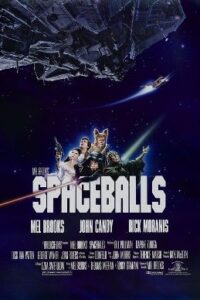
I think I passed from my youthful period of Brooks-disdain to my more mature period of Brooks-admiration in the 1990s.  This was when I was attempting to woo (with a total lack of success) a lady from New York whom I considered, for a while, the coolest thing on earth.  We were chatting one evening about our favourite films and the object of my affections suddenly astounded me by saying she was a huge fan of…  No, not Jean-Pierre Melville’s Le Samourai (1967), or Terence Mallick’s Badlands (1973), or Jim Jarmusch’s Mystery Train (1989), but…  Mel Brooks’s Spaceballs (1987).
 

From wikipedia.org / © Metro-Goldwyn-Mayer / Brooksfilms


“Seriously?” I spluttered.  I’d seen this science-fiction / Star Wars piss-take shortly after its release and thought it was dreadful.  But, patiently, the lady explained to me the sociological depth and cleverness of some of Spaceballs’ jokes that I’d missed – for example, when Bill Pullman and John Candy rescue the princess (Daphne Zuniga) and Pullman remarks, “That’s all we needed…  A Jewish princess!”  I had to concede there was more to Brooks’s humour than I’d thought.


So, I had my moment of epiphany.  I decided, to misquote a line in The Producers, “Don’t be stupid, be a smarty / Come and join the Mel Brooks party.”


Anyway, it’s a fortnight late for the great man’s 100th, but here is a belated guide to the funniest bits, in my opinion, of his movies.  There’s no mention of The Twelve Chairs (1970) and Life Stinks (1991) because I haven’t seen those two.


L.S.D. gets auditioned in The Producers (1967)

The movie that put Brooks on the cinematic map, The Producers has had quite an afterlife, becoming a successful Broadway musical that, in 2005, was turned into a film itself.  For me, its highlight isn’t the famous song-and-dance number Springtime for Hitler that’s the centrepiece of the show that impresario Zero Mostel and accountant Gene Wilder stage in the hope it’ll be a massive flop (allowing them to make a fortune from the shares they’ve sold in it).  No, the highlight comes earlier.


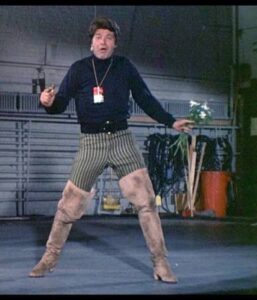
That’s when hippy Lorenzo St. DuBois – L.S.D. to his friends – stumbles into the show’s auditions by mistake and performs, with his female guitar / keyboards / sax backing band, a funny-terrible number called Love Power.   (“And I give a flower to the big fat cop / He takes his glove and he beats me up!”)  Played by Dick Shawn with thigh-high furry boots and a Campbell’s soup-can hanging on a chain around his neck, the hapless L.S.D. is hilarious – and the sequence reaches a perfect conclusion when Mostel bellows ecstatically, “THAT’S OUR HITLER!”
 

From instagram.com / (c) Embassy Pictures


The campfire scene in Blazing Saddles (1974)

If I was more sophisticated, I’d nominate as the funniest moments in Brook’s smash-hit comedy-western the scenes where he skewers the residents of frontier town Rock Ridge for their bone-headed racism.  (“You’ve got to remember that these are just simple farmers.  These are people of the land.  The common clay of the new West. You know…  morons.”)  However…  I’m nominating instead the sequence in Blazing Saddles where Slim Pickens’s men sit around a campfire and stuff themselves with traditional cowboy fare – beans – with flatulent results.


I first saw Blazing Saddles when it played on a big screen in the assembly hall of my school as one of the movies chosen for the school’s Film Club.  When the farting began, the teenaged audience, including myself, laughed like drains.  We were still roaring our heads off minutes after the sequence finished.  No other film shown during the several years I was a member of that Film Club – not Alfred Hitchcock’s Psycho (1960), not Nicolas Roeg’s Don’t Look Now (1973), not Ridley Scott’s Alien (1979) – provoked so tumultuous a reaction.  I’m not proud.


The monster meets the blind hermit in Young Frankenstein (1974)

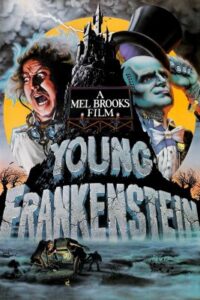
The most genuinely affectionate of Brooks’s genre parodies, Young Frankenstein pokes fun at the black-and-white Frankenstein movies made by Universal Pictures in the 1930s.  My favourite part of it is when Brooks sends up the sequence in Bride of Frankenstein (1936) where the Frankenstein monster (Boris Karloff) is touchingly but briefly befriended by a lonely blind hermit (O.P. Heggie) who’s unaware of his monstrousness.  Here, the well-meaning but, well, blind hermit (Gene Hackman) accidentally and repeatedly scalds and burns the unfortunate monster (Peter Boyle) whilst trying to offer him broth, cigars, etc., until the latter flees from his cottage in terror.  Despite the gleeful bad taste of the gags, the Young Frankenstein sequence retains some of the sweetness and sadness of the Bride of Frankenstein one.  It also makes you wish Gene Hackman had played more comedy roles.
 

From wikipedia.org / © Gruskoff / Venture Films / 20th Century Fox


The boardroom table in Silent Movie (1976)

This was another movie shown at my school’s Film Club and another sequence that sent us – uncivilised little oiks that we were at the time – into paroxysms of laughter.  Evil corporation Engulf & Devour intends to take over the studio of filmmaker Mel Funn (Brooks) but that won’t happen if the new movie Funn is making becomes a hit.  Engulf & Devour’s board of executives hatch a fiendish plan to sabotage Funn and his movie – they’ll send sultry nightclub singer Vilma Kaplan (Bernadette Peters) to seduce, then dump Funn and re-kindle the massive alcohol problem he had previously.  When a picture of Vilma is unveiled to the executives, sitting around the boardroom table, they’re so impressed that the table rises by several inches.


The line Funn / Brooks inspires when Vilma does dump him, and he goes on a massive bender to drown his sorrows – “He is truly the lord of the winos!” – is pretty funny too.


The orchestra in High Anxiety (1977)

Brooks’s next film takes fond aim at the thriller movies of Alfred Hitchcock.  Its hero, Dr Richard Harpo Thorndyke, again played by Brooks himself, suffers from the titular disorder, the vertigo-like ‘high anxiety’.  While travelling in the back of a car, Thorndyke / Brooks suffers a moment of ominous foreboding, which is accompanied by an equally ominous swell of Bernard Herrmann-like orchestral music – the sort that Hitchcock liked to insert into his films to augment the mood.  This being a Brooks film, though, Thorndyke’s car then passes a bus that contains, as passengers, the orchestra playing the music.


Yes, this is the second time Brooks has used that gag.  It originally appeared in Blazing Saddles and involved the Count Basie Orchestra performing in the desert,  But the orchestra-on-a-bus joke in High Anxiety works better, I think.


The Spanish Inquisition in History of the World, Part I (1981)

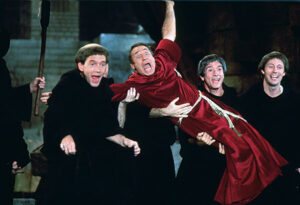
A truly hit-and-miss collection of gags and sketches, History of the World, Part 1 depicts five chapters in world history from the Stone Age to the French Revolution.  Its undisputed highlight is a segment about the Spanish Inquisition.  This features Brooks as Torquemada – his victims are warned not to try to talk him out of torturing them because, “You can’t Torquemada anything!” – and an elaborate Busby Berkeley-like song-and-dance number in a torture chamber which, with its exuberant bad taste, is as impressive as Springtime for Hitler in The Producers.
 

© Brooksfilms / 20th Century Fox


Snotty’s line in Spaceballs (1987)

Spaceballs spoofs Star Wars (1977) but also contains some elaborate send-ups of Planet of the Apes (1968) and Alien (1979) – the latter even drafts in John Hurt to reprise his role as the unfortunate Kane.  But the funniest, or groan-iest, bit in it for me is a simple pun.  A Scottish character called Snotty (Jeff MacGregor), obviously based on Scotty from Star Trek (1966-69), is in a control room flicking a series of switches.  “Lock One!” he shouts.  “Lock Two!  Lock Three!  Loch Lomond!”


The abbot in Robin Hood: Men in Tights (1993)

You have to be a connoisseur of long-ago comedy double-acts to appreciate my favourite joke in Robin Hood: Men in Tights, Brooks’ irreverent take on the then-recent and hugely-successful Robin Hood: Prince of Thieves (1991).  An abbot (Dick Van Patten) is walking in his finery outside his monastery and enjoying the adulation of the local population.  Then a guy who looks and sounds suspiciously like Lou Costello yells at him, “Hey, Abbott!”  Van Patten grumbles, “I hate that guy.”


Dracula tries to control Mina’s mind in Dracula: Dead and Loving It (1995)

I don’t hold it against Brooks’s Dracula: Dead and Loving It, which stars Leslie Neilson as the legendary vampire count, that it isn’t great.  After all, there have been many attempts over the years to spoof vampire films and hardly any of them have been funny – see Roman Polanski’s Dance of the Vampires (1967) or Stan Dragoti’s Love at First Bite (1977).  In fact, it wasn’t until Jermaine Clement and Taika Waititi’s What We Do in the Shadows (2014) that I encountered a vampire-movie parody that made me laugh.


However, Dracula: Dead and Loving It has one funny part where, from a distance, Dracula / Neilson exerts his willpower over the bitten and partly vampirised Mina (Amy Yasbeck) and tries to summon her: “Mina…  Open your eyes…  Arise…  Come to the door…”  The operation goes less smoothly when the mind-controlling vampire discovers there’s a confusing closet door in the way, and a hazardous footstool, and an inconvenient maidservant who’s also picking up his telepathic instructions: “Mina…  You are in the closet.  Open the door and come out…  Watch out for the footstool…  Stand up…  Not you, sit…  No, you sit…  You stand…”


And just before I finish, some praise is due for Brooks as a producer too.  He’s the man who oversaw both David Lynch’s The Elephant Man (1980) and David Cronenberg’s The Fly (1986).
 

From wikipedia.org / © Angela George
The controls are set for the heart of the sun


© Val Guest Productions / Pax Films / British Lion Films


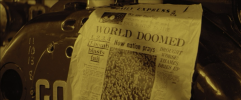
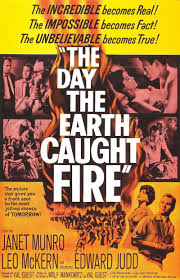
In my previous blog-post, I cited the ending of the apocalyptic 1961 sci-fi film The Day the Earth Caught Fire, where we’re inside a newspaper office and see that two versions of the next day’s front page have been prepared.  One page’s headline announces WORLD SAVED.  The other announces WORLD DOOMED.  Which headline, I wondered, would be appropriate after the US presidential election on November 5th?


Well, the results are in.  And it’s…


© Val Guest Productions / Pax Films / British Lion Films


I think I’ll stay away from the news for the next week or so, as it’s going to be full of the sights and sounds of the very worst people on the planet popping open the champagne and jeering and crowing about Trump’s win – from despots and corrupt authoritarians like Vladimir Putin, Benjamin Netanyahu, Kim Jong Un, Victor Orban and Aleksandr Lukashenko to billionaires who believe (probably rightly, given the evidence now) that democracy is something that can be bought and sold in the quest for profits, like Elon Musk, Jeff Bezos, Charles Koch, Rupert Murdoch, Paul Marshall and all the other media tycoons, hedge-fund moguls, oligarchs, oil barons and would-be tech overlords.


Despite a majority of British people hating Trump’s guts, Britain’s press and social media will be particularly infested with sycophants drooling and slobbering over the orange turd’s victory.  These range from online grifters who make their money whipping gullible people into frenzies of paranoia and hatred, such as Andrew Tate, Russell Brand, Neil Oliver, Tommy Robinson and failed nepo-baby thespian Laurence Fox; to the preening hacks who pen vitriol for the country’s right and far-right-wing publications, like Brendan O’Neill, Alison Pearson, Douglas Murray, Piers Morgan and Isabel Oakeshott; and to its most discredited, unsavoury and opportunistic politicians, such as Boris Johnson, Liz Truss, Nigel Farage, Lee Anderson and Jacob Rees-Mogg.  So, I’ll avoid that lot too for a while.  I don’t want to be put off my food.


Many hideous people are no doubt licking their lips at the prospect of the dystopian years ahead, thinking about what they can do as part of the Trump bandwagon and how they can line their pockets from it.  I’m sure that includes all those I’ve mentioned above.


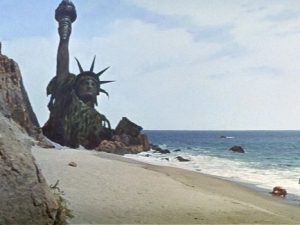
Finally, I now find myself thinking of the ending of another 1960s sci-fi film, that of Franklin J. Schaffner’s Planet of the Apes (1968).


© APJAC Productions / 20th Century Fox


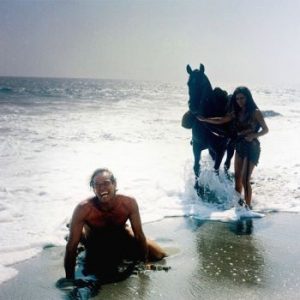
Not only does this conclude with Charlton Heston discovering the Statue of Liberty buried up to her chest in sand – indicating that the USA, plus the rest of human civilisation, are now extinct and lie hidden under millions of tons of sediment – but it shows Heston having a meltdown in front of this haunting and pitiful spectacle.  “You maniacs!” he rages.  “You blew it up!  Damn you!  Goddamn you all to hell!”


He could have been referring to those millions of Americans who thought it was a good idea to vote Donald Trump back into office the other day.


© APJAC Productions / 20th Century Fox

Cinematic heroes 3: David Warner


© Warner Bros.


I’ve just discovered that a few days ago was the 80th birthday of the film and TV character actor David Warner.  In honour of the great man becoming an octogenarian, here’s an updated version of a post I wrote about him eight years ago.


For most actors, becoming typecast is a pain in the neck.  The day that the lugubrious-faced, distinctive-voiced David Warner became typecast, as an actor specialising in offbeat roles in offbeat films, often horror, science fiction and fantasy ones, it was actually a pane in the neck.


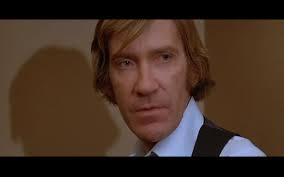
As Keith Jennings, the photographer who befriends Gregory Peck’s ambassador Richard Thorne in 1976’s The Omen, he is memorably decapitated when a sheet of glass comes crashing off the back of a truck and shears his head from his shoulders.  Indeed, though The Omen was choc-a-block with people dying in gruesome freak accidents, and later there were Omen sequels with more freak accidents, and later still there were a half-dozen Final Destination movies following a similar template and serving up many more freak accidents, the cinema has seen very few freak accidents as spectacularly shocking as Warner’s in that 45-year-old movie.


© 20th Century Fox


The main actors in the big-budget Omen – Peck, Lee Remick, Billie Whitelaw – were names not normally associated with horror movies.  Until then, Warner’s name hadn’t been associated with them either.  Mancunian by birth, he started acting professionally in 1962 and the following year joined the Royal Shakespeare Company, which led to stage roles in Henry IV Part 1, Henry VI Parts I-III, Julius Caesar, Richard II, The Tempest, Twelfth Night and, in 1965, playing the title role, Hamlet.  The earliest films he appeared in were sometimes theatrical in origin too, such as A Midsummer Night’s Dream and The Sea Gull, which both appeared in 1968.  However, it was in 1966’s Morgan: A Suitable Case for Treatment that he made his biggest impression on 1960s movie audiences.  In it he plays a working-class artist who’s abandoned by his posh wife, played by Vanessa Redgrave, and goes to unhinged extremes to win her back.


When Warner’s career is discussed, it’s often overlooked that he was once a regular performer with the legendary action-movie director Sam Peckinpah.  His association with the hard-drinking, coke-snorting, near-deranged filmmaker started with 1970’s The Ballad of Cable Hogue, in which he played an eccentric preacher who befriends Jason Robards’ titular hero.  Peckinpah often boasted, “I can’t direct when I’m sober,” and for the young Warner Hogue must have been quite an initiation into the director’s weird and wonderful ways.  When bad weather held up filming, Peckinpah and his crew went on a massive drinking binge and ran up a bar-bill worth thousands and thousands of dollars.


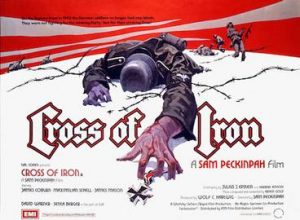
In the next year’s Straw Dogs, Peckinpah’s taboo-busting film set in the English West Country, Warner plays a simpleton who unwittingly kills a girl and then takes refuge in Dustin Hoffman and Susan George’s house with a squad of vigilantes on his trail.  In Cross of Iron, Peckinpah’s 1977 war movie about a doomed German platoon on the Russian front, he plays a humane German officer who just wants to get through the war in one piece.  In fact, in Cross of Iron, nearly all the Germans, including James Coburn’s gallant corporal and James Mason’s world-weary colonel, are humane types who view war with extreme distaste.  What upsets the apple-cart, and eventually gets most of them killed, is the arrival of Maximillian Schell’s glory-hunting Prussian officer.  Schell is obsessed with winning an iron cross for himself and isn’t worried about other soldiers dying in the process.


© Anglo-EMI Productions


In 1973 Warner made his first appearance in a horror film, the British anthology movie From Beyond the Grave, whose stories were based on the writings of Ronald Chetwyn-Hayes.  In the film’s first story, The Gate Crasher, he plays an arrogant prick called Edward Charlton who acquires an old mirror from an antique shop and gets it on the cheap by lying to the shop-owner about the mirror’s likely age.  Charlton obviously hasn’t seen many horror films before.  Otherwise, he might have thought twice about cheating a proprietor played by Peter Cushing in a shop called Temptations Inc.  He gets his just deserts.  The mirror turns out to be inhabited by a malevolent spirit, which possesses him and drives him to commit murder.


It was in the late 1970s and early 1980s that Warner got his fondest-remembered roles, starting with the kindly but ill-fated Jennings in The Omen.  Then, in 1979’s Time After Time, he switches from being a nice guy to being a bad one, playing John Leslie Stevenson, a Victorian gentleman and friend of the pioneering science-fiction writer H.G. Wells, who’s played by Malcolm McDowell.  Unbeknownst to Wells, Stevenson has been making a name for himself by butchering prostitutes in Whitechapel – for he is none other than Jack the Ripper.  When Wells unveils his latest invention, a working time machine like the one he would later write about in his famous 1895 novella, Stevenson uses it to escape the closing police net and scoots one century forward into the future.  But the machine has a recall function, so a horrified Wells summons it back to the 19th century and uses it to follow Leslie to 1979.  Wells assumes that he’s let Jack the Ripper loose on Utopia and, predictably, is more than a little disappointed to find that the 20th century is less utopian than he’d anticipated.  Meanwhile, the Ripper has taken to the era’s violence, sleaze and heavy-decibel rock music like a duck to water.


A quirky and very entertaining movie, Time After Time was written and directed by Nicholas Meyer who, regrettably, devoted most of his energies to the less adventurous and eccentric, and more mainstream and family-friendly Star Trek franchise during the 1980s.  Actually, it’s probably because of Meyer’s involvement that both Warner and Malcolm McDowell have made appearances in Star Trek films – Warner was in both Star Trek V and VI (1989 and 1991).  I’m not much of a fan of Star Trek or its movie spin-offs, but I like the sixth one, largely because Warner is in it.  He plays Chancellor Gorkon, charismatic leader of the Klingons and obviously modelled on the then Soviet leader Mikael Gorbachev, who’s decided it’s time for the Klingon Empire to pursue peace-talks with the Federation.


In 1981 Warner delivered another memorable performance in Terry Gilliam’s cinematic fairy tale The Time Bandits.  He plays Evil, who’s been created by Ralph Richardson’s Supreme Being and then imprisoned in a hellish place called the Fortress of Ultimate Darkness.  Obviously, Warner and Richardson’s characters are the Devil and God under different monikers.  Some fine actors have played Old Nick in movies over the years, including Robert De Niro, Al Pacino and Jack Nicholson, but for my money Warner’s portrayal is the most entertaining.  His Devil is a petulant and embittered type who spends his time ranting at his idiotic minions (“Shut up!  I’m speaking rhetorically!”) about how rubbish God is.  The Almighty, he argues, has wasted His time creating useless things such as slugs, and nipples for men, and 43 species of parrots, when He could have concentrated on making laser beams, car phones and VCRs.  Warner steals the show in The Time Bandits, which is no minor achievement considering that in addition to Richardson the film stars Ian Holm, John Cleese, Sean Connery, Michael Palin, Shelley Duvall and a delightful gang of time-traveling dwarves led by David Rappaport.


Thereafter, Warner’s CV filled with all manner of odd movies, hardly Shakespearean in the acting opportunities they offered, but relished by obsessives like myself.  These include 1979’s Nightwing, 1980’s The Island, 1987’s Waxwork, 1991’s Cast a Deadly Spell, 1995’s In the Mouth of Madness, 1997’s Scream 2 and 2010’s Black Death.


© Walt Disney Productions


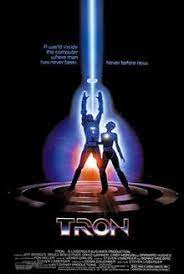
As an actor he’s adept at playing out-and-out villains, for example, his Dillinger / Sark character in the 1981 Disney computer-game fantasy Tron, a movie that was unappreciated at the time but that, in the decades since, has been accorded considerable retro-cool.  He’s also good at doing mad scientists, like the splendidly named Doctor Alfred Necessiter in the whacky 1982 comedy The Man with Two Brains, which is poignant today as a reminder of the time when Steve Martin used to be funny.


But he also has harassed and melancholic qualities, which come nicely to the fore when he’s playing fathers.  He was, for instance, the heroine’s father in 1984’s The Company of Wolves, Neil Jordan’s atmospheric and sensual adaptation of Angela Carter’s gothic short stories.  Meanwhile, in Tim Burton’s 2001 remake of Planet of the Apes, he plays Senator Sandar, father of dishy chimpanzee Helena Bonham-Carter.  In heavy simian make-up and in Warner’s unmistakable tones, Sandar sighs at one point: “Youth is wasted on the young…”


In 1997 Warner found time to appear in James Cameron’s Titanic, then the biggest-grossest movie of all time.  Say what you like about Titanic, about the mawkish love story between Kate Winslet and Leonardo Di Caprio, about Billy Zane’s cartoonish performance as the villain, about the unspeakable theme song sung by Celine Dion, but you can’t deny that it has a great supporting cast: Warner, Kathy Bates, Bernard Hill, Victor Garber, Bill Paxton.  Warner, playing Spicer Lovejoy, Zane’s valet, doesn’t have much to do apart from connive with his master, stalk around, spy on Kate Winslet and generally behave sinisterly.  He does, though, get to punch Di Caprio in the guts after he’s been handcuffed to a railing on board the sinking liner, which is actually my favourite bit in the film.  (Warner also turned up in a 1979 movie called SOS Titanic and the Titanic features in The Time Bandits too.  Thus, he’s a titanic actor in all senses of the term.)


Warner has long been a fixture on television as well.  He’s appeared in one-off TV movies and dramas like 1984’s Frankenstein, where he plays the creature to Robert Powell’s Victor Frankenstein and Carrie Fisher’s Elizabeth, 1993’s Body Bags and 2003’s Dr Jekyll and Mr Hyde; appeared in series and mini-series like 1981’s Masada, 1982’s Marco Polo, 1984’s Charlie, 2011’s Secret of Crickley Hall and, from 2008 to 2016, Wallander, in which he plays another father, this time to Kenneth Branagh; and lent his voice to animated shows, including the Superman, Batman and Spiderman ones during the 1990s.


© Greengrass Productions / ABC Distribution Company


Some of his TV work is as cult-y as his film work.  In 1991, he guest-starred in three episodes of David Lynch’s glorious, off-the-wall crime / horror / sci-fi / soap opera Twin Peaks, playing Thomas Eckhardt, a Hong Kong-based crime-lord who has a long and dark history with Joan Chen’s Jocelyn Packard.  Two years after that, he appeared in the underrated, Oliver Stone-produced mini-series Wild Palms, a hybrid of conspiracy thriller, Alice in Wonderland and the then-recent literary genre of cyberpunk.  Set in a near-future USA, under the heel of an organisation that’s part multinational corporation and part Scientology-style religious sect, the show features Warner as Eli, the leader of an underground resistance movement.  (This clip neatly encapsulates Wild Palms’ weird energy.)  And in 2014 he popped up in John Logan and Sam Mendes’ gothic horror mash-up Penny Dreadful, in the role of Bram Stoker’s vampire hunter Abraham Van Helsing.  Because Warner played Frankenstein’s creature in 1984, it’s ironic that in Penny Dreadful – in a cheeky tangling of Stoker and Mary Shelley’s original narratives – Van Helsing gets killed by the same creature, played this time by Rory Kinnear.


In 2005 Warner was involved with the macabre TV comedy show The League of Gentlemen, written by and starring Mark Gatiss, Reece Shearsmith, Steve Pemberton and Jeremy Dyson.  In fact, he didn’t appear in the show itself, but in its cinematic spinoff The League of Gentlemen’s Apocalypse.  Like many a film-based-on-a-TV-show, it doesn’t really work on the big screen, though its most effective scenes are definitely those featuring Warner as a 17th century magician called Dr Erasmus Pea.  His character is rottenly evil but he’s very amusing too.  For example, while Dr Pea uses a pan to fry a hellish concoction including two recently gouged-out eyeballs, from which he plans to grow a monstrous homunculus, the camera cuts to a close-up and he pulls a pretentiously absorbed, TV-chef expression worthy of Jamie Oliver.


Warner clearly gets along with The League of Gentlemen’s creators, because since then he has appeared alongside Mark Gatiss in the radio comedy show Nebulous (2005-8); in The Cold War, a 2013 Gatiss-scripted episode of Doctor Who; and in The Trial of Elizabeth Gadge, a 2015 episode of Reece Shearsmith and Steve Pemberton’s acclaimed anthology show Inside No. 9.


The 21st century has seen Warner return to the stage, giving well-received turns as the venerable and vulnerable monarch in King Lear in 2005 and as Falstaff in Henry IV Parts I and II in 2007.  His IMDb entry lists his most recent movie appearance as 2018’s Mary Poppins Returns and says he was still doing voice-work last year.  Warner is now at an age where you wouldn’t begrudge for him retiring and choosing an easier life of armchairs, cardigan, slippers and pipe, but I for one hope that some young filmmakers – perhaps ones who grew up enjoying his performances in The Omen, Time After Time, The Time Bandits and Tron when they were shown on TV – coax him into making a few more movies.  He’s the sort of actor whose mere presence in a film, no matter how good or bad, gives you a glow.


© Handmade Films / Janus Films