Jim Mountfield: less angelic, more demonic


© Cloaked Press


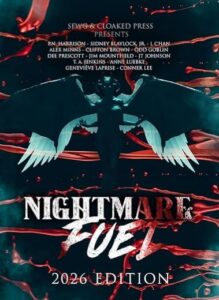
The independent publisher Cloaked Press has just brought out the latest instalment in its series of annual horror-story anthologies, Nightmare Fuel.  The 2026 anthology is called Angels & Demons and, as its title indicates, its contents are about supernatural entities either of the angelic or demonic varieties.  I’m pleased to say I have a story included in Nightmare Fuel 2026: Angels & Demons.  It’s entitled Asmodeus 86 and it’s attributed to Jim Mountfield, the pseudonym under which I write macabre fiction.


My story is about a demon, not an angel – the ‘Asmodeus’ of the title is, according to his Wikipedia entry, ‘a king of demons in the legends of Solomon and the constructing of Solomon’s temple’ and ‘associated with lust’.  He’s mentioned in various holy texts in Judaism, Christianity and Islam, as well as being referenced in the notorious 1486 treatise on witchcraft the Malleus Maleficarum (the Hammer of Witches in English) and supposedly involved in the famous possession of a convent of Ursuline nuns in Loudon in France in 1634.


Oddly, though, I first became aware of the name Asmodeus through something entirely different.  In Geoffrey Household’s 1939 thriller Rogue Male, the novel’s anonymous narrator and hero gives the name to a feral cat who befriends him while he’s literally holed up in the English countryside, hiding from the bad guys.  ‘Asmodeus’ is an appropriate moniker for the cat since he’s rather supernatural in appearance, being wholly black.  Also, the kinship the narrator feels with the cat whilst under extreme pressure – he spends ages concealed in a dark, filthy cubbyhole under a huge hedgerow in Dorset – becomes intense and spooky: “…there is, I believe, some slight thought transference between us…  back and forth between us go thoughts of fear and disconnected dreams of action.  I should call these dreams madness, did I not know they came from him and that his mind is, by our human standards, mad.”


So Asmodeus-the-demon is the exotic subject of my story in Nightmare Fuel 2026: Angels & Demons.  But Asmodeus 86’s setting is a mundane one.  It takes place in a state secondary school in the south of Scotland in the 1980s, just like the one I attended back then, Peebles High School.  The story concerns a group of school-pupils who resort to using black magic to achieve their ends and one hapless kid who unwittingly gets caught up in their shenanigans.  If you map the ages of the characters onto my high-school experiences, the events in the story would have happened in 1982, my final year, when I did my final exams there.


However, at that time in 1982, the news in Scotland, and the United Kingdom generally, was dominated by the war between Britain and Argentina over possession of the Falkland Islands.  So I shifted the setting forward to 1986, when the story’s characters would have less ‘background noise’ coming from the TV, newspapers and conversations around them.  (Not that big events weren’t happening in 1986.  The story namechecks a certain Mr. Gorbachev, a certain disaster at Chernobyl and… psychobilly music.)


Lastly, I titled the story Asmodeus 86 as a tribute to Artemis 81, the baffling, barmy and fascinating three-hour occult / mystery / fantasy / sci-fi TV play broadcast by the BBC in December 1981, written by David Rudkin, directed by Alastair Reid, and starring such thespians as Hywel Bennet, Dan O’Herlihy, Anthony Steel, Roland Curran, Ingrid Pitt, a very young Daniel Day-Lewis and, er, Sting as a gay angel.  Yes, I can safely say the days when the BBC would be so bold as to spend money on an audacious and willfully headache-inducing project like Artemis 81 are long past.


Containing 13 stories dedicated to the ‘divine and the damned, the celestial and the unholy’, the 285-page Nightmare Fuel 2026: Angels & Demons can be purchased on kindle here and as a paperback here.
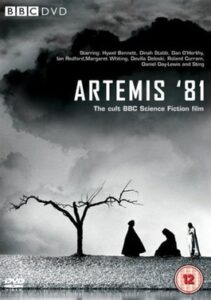
 

From wikipedia.org / © BBC
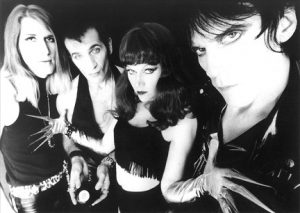
Why I love the Cramps


From slugmag.com


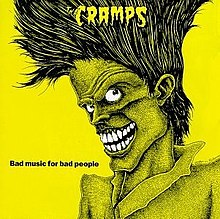
The American rock band the Cramps, who blazed a sonic trail for three memorable decades from the mid-1970s to the mid-noughties, wore an awful lot of influences on their black-leather sleeves.  Yet somehow they managed to meld those influences into a sound and style quite unlike anyone or anything else.


They took as inspiration classic 1950s rock ‘n’ roll, rockabilly, surf music, garage rock, the velocity and bad attitude of punk and the darkness and glamour (but not the pomposity) of goth.  The band’s heart and soul were guitarist Poison Ivy (Kirsty Wallace), who was responsible for their sometimes juddering, sometimes twangy, always captivating guitar sound and who wasn’t adverse to posing for album-cover photos in high heels, fishnets, suspenders, shades, devil’s horns and body-hugging PVC; and her romantic and musical partner, the towering vocalist Lux Interior (Erik Purkhiser), whose sepulchral voice and ghoulish lyrics channelled a 1950s American childhood spent immersed in trashy horror, sci-fi and exploitation movies and gruesome sensationalist comics like Vault of Horror and Tales from the Crypt.


Outside the creative nucleus of Ivy and Lux, the Cramps underwent a lot of line-up changes.  Among some 20 band-members over the years, only guitarists Bryan Gregory and Kid Congo Powers, bassists Candy Del Mar and Slim Chance and drummers Nick Knox and Harry Drumdini were around long enough to make much impression.


Under Ivy and Lux’s control, the Cramps became a Frankenstein’s Monster fashioned out of pieces of Elvis, Ricky Nelson, Link Wray, Dick Dale, Screamin’ Jay Hawkins, the New York Dolls, the Ramones, Roger Corman, Ed Wood, Herschell Gordon Lewis, the Marquis de Sade and the Addams Family; but this was no lumbering misshapen monster.  This was something cadaverously elegant and it rocked.


As usual, I was late to the party.  I didn’t get into the Cramps until the late 1980s, a dozen years after they’d started, thanks to my brother giving me a crackly cassette-tape recording of their 1983 compilation album Off the Bone.  Incidentally, on the other side of the cassette was the 1988 Sugarcubes album Life’s Too Good.  Wow, those were the days.


© Creation


But at least by then I’d heard of the Cramps.  Indeed, the band had been credited with inventing their own musical genre, psychobilly.  Their supposed progeny, such raucous, upright-bass-slapping combos as the Meteors, Guano Batz and King Kurt, with their thickly greased quiffs, brothel creepers and copious tattoos, had been rampaging through the sweatier, dingier music venues of 1980s Britain.  The music journalist Dick Porter notes in his 2015 biography of the band Journey to the Centre of the Cramps that the Cramps were certainly responsible for the term ‘psychobilly’.  They’d made the word up and stuck it on a promotional flyer when they were trying to get themselves noticed in New York a decade earlier.  But they maintained a polite and slightly bemused distance from the actual musical scene they were meant to have spawned.


Porter quotes Poison Ivy as saying, “I think our songs have a more sensuous tempo.  I’m not sure what exactly defines psychobilly but it seems to have taken on a life of its own.  But it’s not quite what we do.”  Porter himself observes that “whereas the Cramps drew on a smorgasbord of influences that included R&B and doo-wop, the psychobilly groups tended to eschew blues-based influences and splice rockabilly to a punk template that hadn’t existed back when the Cramps got started.”


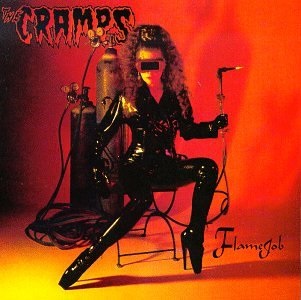
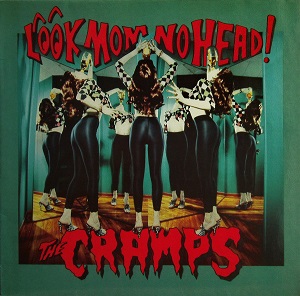
Anyway, as soon as I heard Off the Bone, I was hooked.  And I snapped up their releases in subsequent years, albums like Stay Sick (1990), Look Mom No Head (1991) and Flamejob (1994), which were choc-a-bloc with irresistible songs like Bikini Girls with Machine Guns, Creature from the Black Leather Lagoon, Journey to the Centre of a Girl, All Women are Bad, I Wanna Get in your Pants, Eyeball in my Martini, Bend Over I’ll Drive, Let’s Get F***ed Up and Naked Girl Falling Down the Stairs.  Even now, when I’m feeling a little down or stressed about something, I only have to listen to one of those songs, with the stutter or buzz of Poison Ivy’s guitar, and with Lux Interior’s macabre, funny and innuendo-laden lyrics, and after a minute I’ll feel right as rain again.


© Restless / Enigma


Take Naked Girl Falling Down the Stairs, for instance: “I fell in love at a terrible pace…  When someone gave her a shove down a staircase…”  I mean, how can anyone not love a song called Naked Girl Falling Down the Stairs?


I never saw them live, though, which is something I really regret now.


One thing the band never received enough praise for was their musicianship.  There’s a perception of the Cramps, popular for example among certain snooty British music critics, as a kitschy, campy and not-to-be-taken-seriously novelty act.  This overlooks the skill, attention to detail and sheer hard graft that went into composing and recording their songs.  Ivy and Lux were extremely knowledgeable about their influences and committed about what they did and they put the work in.  Their finished songs might’ve made it look and sound easy, but this illusion of effortlessness is testimony to high standards of talent and professionalism behind the scenes.


The story of the Cramps ended on a melancholic note, for in 2009 Lux Interior died suddenly and unexpectedly from a tear in his aortic wall.  Not only did his death deprive rock ‘n’ roll music of one of its most striking and amusing figures; but it also brought the curtain down both on his lifelong romantic and creative partnership with Poison Ivy and on the Cramps themselves.


That partnership and the band were of course one and the same thing.  As Poison Ivy remarked to Dick Porter in 2006, “That’s all the Cramps is – a folie à deux.”


© I.R.S