Attack ‘n’ Byrne


In the past few weeks I’ve been fortunate enough to attend two of the best musical concerts I’ve ever experienced.  Both took place at Singapore’s Star Theatre.


On July 29th, the Star hosted the English trip-hop collective Massive Attack.  Formed in Bristol in 1988 by Robert ‘3D’ Del Naja, Grant ‘Daddy G’ Marshall, Adrian ‘Tricky’ Thaws and Andre ‘Mushroom’ Vowles, Massive Attack is less massive in terms of members nowadays.  Only 3D and Daddy G remain, Tricky and Mushroom having left in 1995 and 1999 respectively.  What we got on July 29th still sounded massive, though.


In the 1990s, I loved the band.  Their three albums from that decade, Blue Lines (1991), Protection (1994) and Mezzanine (1999), are all-time favourites of mine.  I found their sound irresistible: its hypnotic melodies, its measured pace, its building crescendos, its atmospherics, its lurking orchestral grandeur – composer John Barry never seemed far away – and, unpinning everything, its relentless drums and basslines.  After hearing them, I had a hard time getting songs like the soaring Unfinished Symphony or the sublimely restless Safe from Harm from Blue Lines, or the haunting Teardrop from Mezzanine, out of my head.


My ultimate Massive Attack song, though, was Mezzanine’s Angel, which after a slow but remorseless build-up lets fly two minutes and 19 seconds in.  That’s the best crescendo in music ever.  It would make a terrific accompaniment to a movie sequence where there’s a brooding sense of unease, then an explosion of action.  It has been used in films, actually, but the only one I’ve heard it in was the forgettable 2004 remake of Robert Aldrich’s The Flight of the Phoenix (1965).  I know it turned up in Guy Ritchie’s Snatch (2000) too, but I’ve never watched that one.


The one time I saw them live during the 1990s was in insalubrious circumstances.  They played at the now-defunct Scottish music festival T in the Park in 1999.  The crowd was boozed-up and raucous and I’d been at the front of it all afternoon, before they performed, watching earlier bands on the bill.  These included the then-popular rock band Reef.  While Reef were playing, someone bodysurfed past me and accidentally struck me in the head with a boot.  A week previously, I’d been the victim of an assault, which resulted in me getting multiple stitches in the back of my head in an A and E department.  The body-surfer’s boot opened those stitches and blood leaked out everywhere, including down my face.  Consequently, when Massive Attack came on, I looked like I’d just strolled off the set of a horror movie.


It didn’t help that a crowd-member then flung a bottle at the stage, which smashed down close to their frequent collaborator, the reggae roots singer Horace Andy.  They continued playing, but looked extremely pissed off.  (They should have followed the example of Jim Kerr, the frontman of Simple Minds.  Supposedly, once, when somebody chucked a bottle at Simple Minds during a Parisian gig, he told the crowd, “I hope whoever threw that dies of cancer.”)


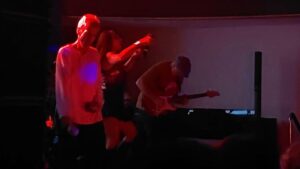
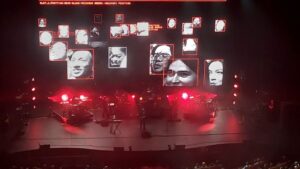
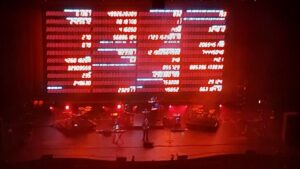
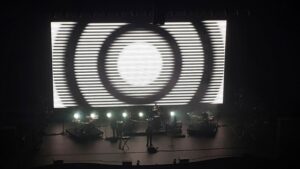
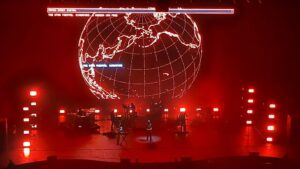
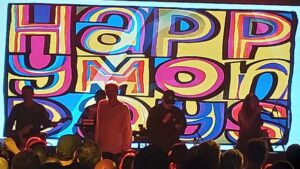
So, what a contrast to see them again, 27 years later, from a vantage point high in the circle of the grand and comfortable Star Theatre.  On the stage, 3D, Daddy G and their team of travelling musicians were ensconced, in near-darkness for much of the time, among their instruments and consoles while the theatrics were provided by dazzling visuals that materialised on giant screens above them to accompany each song.  In fact, ‘visuals’ is too lame a word to describe what the audience saw.  A reviewer in Australian Musician wrote that the band used “monolithic LED screens, archival footage, political imagery and dreamlike sequences to create a constantly shifting portrait of a world where personal freedom, privacy and even human emotion are increasingly commodified.”


As the visuals shifted wrenchingly from the picturesque Swiss lakeside city of Zug (where much equity money ends up, apparently) to Africa and impoverished locals having to dig up precious minerals in wretched  conditions, from worrying graphics illustrating the global reach of mass surveillance to gibbering headlines about celebrities, from Peter Thiel quotations about why democracy is a bad idea to bald statements that could have come from 1984’s Ministry of Truth (‘WHAT IS PURPOSE?’), I was reminded of the work of radical documentary filmmaker Adam Curtis.  Later, I learnt that Curtis and the band have enjoyed a long association and he worked with them to put these digital displays and film clips together.


Not that the visual show was entirely serious.  I was delighted to see the great horror actor Bruce Campbell get chased through a cabin by the forces of darkness in The Evil Dead (1982) while a message flashed up telling us we can’t escape ‘the algorithm’.  Later, another great horror actor, Boris Karloff, appeared as the title character in The Mask of Fu Manchu (1932) in an ironic commentary on the West’s tendency to blame China for everything.  (See Covid-19.)


Musically, it was superb.  The crowd gave roars of appreciation for Horace Andy, singing on three tracks, including – yes! – Angel; and for other longtime collaborators Deborah Miller,  singing on Unfinished Symphony and Safe From Harm, and Elizabeth Fraser, who did vocal duties on Mezzanine’s Black Milk and Group Four and a cover of Tim Buckley’s Song to the Siren (1970).  Fraser also brought the evening to a perfect close with the final song, Teardrop.


The gig was overshadowed by an incident at the end when, briefly, 3D and Daddy G brandished a Palestinian flag onstage.  Singapore’s Straits Times newspaper reported that this broke a local law forbidding “the public display of foreign national emblems without a permit or exemption.”  Afterwards, according to the Times, the authorities released a statement saying, “…the police… administered stern warnings to both men for the offences of Section 3 of the Foreign National Emblems (Control of Display) Act and Section 16 of the Public Order Act,” and “both men will be banned from re-entering Singapore.”  The BBC, meanwhile, quoted an official spokesman as saying Singapore’s police “take a serious view of acts which could potentially harm the racial and religious harmony in Singapore”.


This leaves me with mixed feelings.  I believe people should be free to express their opinions, so long as that expression doesn’t cause innocent parties any harm, and I don’t see how two 60-something men holding a flag for a few seconds in a theatre full of Massive Attack fans could cause much harm.  However, I also believe in the old adage, ‘When in Rome, do as the Romans do’.  Singaporeans are proud of the stable, prosperous, multicultural society they’ve created, in a region that, elsewhere, has often been troubled by ethnic and religious conflicts.  For many people, having strict laws outlawing the display of foreign flags (and eliminating any possibility they could be used to stir up trouble) is a price worth paying.  I didn’t see much sympathy for the band on local Internet discussion-forums, where the sentiment was largely, “Bloody foreigners, coming over here, breaking our laws.”  “Good riddance to bad rubbish,” said one commentator, evidently not a fan.


It’s worth noting that the UK authorities have given Massive Attack a hard time too for their pro-Palestinian sympathies.  3D was arrested in Trafalgar Square in April this year for carrying a sign expressing support for the proscribed, allegedly terrorist group Palestine Action.


Anyway, this furore obscures the fact that the concert itself was exceptional.


Then on August 7th, singer-songwriter David Byrne – one-time vocalist and guitarist with legendary American new-wave band Talking Heads – performed at the Star to promote his 2025 solo album Who is the Sky?  This gig didn’t begin well for me.  When I bought my ticket via Ticketmaster, I got an email warning me not to try to enter the venue using a screenshot of it.  I should have the ticket open in my Ticketmaster account, on my phone, ready for security staff to scan its QR code.  Just before I set off for the Star, I discovered the link in the email was taking me not to the David Byrne ticket in my account, but to the Massive Attack one from 10 days earlier.  This kept happening on my phone only.  When I clicked the link on my computer, I was taken to the correct ticket.  Finally, exasperated, I took a screenshot of the Byrne one on my computer and sent it to my phone, as proof I’d at least bought the ticket.


When I explained the problem to the ladies at the Ticketmaster table outside the Theatre entrance, they told me to use the screenshot on my phone.


“But your instructions said…”


“Just use it!”


The security lady looked at me tetchily when I presented the screenshot, but she scanned its QR code and it was accepted.  I was in.


I wasn’t only me suffering technical difficulties.  The gig was scheduled to start at eight o’clock but nothing happened onstage for another half-hour – except for a few minutes when David Byrne himself walked into view.  He explained that some glitches were delaying proceedings and, by way of apology, entertained us with some sightseeing photos he’d taken that day in Singapore.  He did this with much enthusiasm.  His photos appeared on big screens above him and included one taken at Singapore’s marvellous Haw Par Villa, where you can stroll through a giant diorama depicting the 10 Courts of Hell from Chinese and Buddhist mythology.  That photo depicted sinners impaled bloodily on a ‘hill of knives’, which Byrne cheerfully informed us was the afterlife punishment awaiting people who charge too much interest on loans.  You know, bankers.


Byrne came across as someone with genuine interest in the places he travelled to and his good humour was greatly engaging.  I’d always thought he was decent, but after this episode I decided he was an absolutely top bloke.


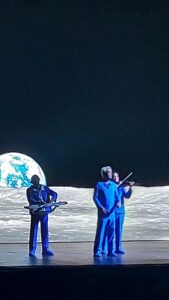
During the delay I’d observed how the stage was empty.  It contained no instruments or equipment.  When the gig finally started, I understood why.  After the opening number, a static rendition of the 1979 Talking Heads song Heaven, which Byrne sang accompanied by two musicians playing a violin and portable keyboard (while the earth rose majestically through space on the screens behind), the show really became a show – a dance one as well as a musical one.


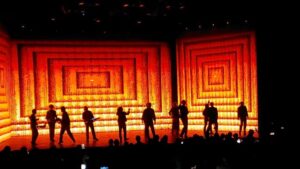
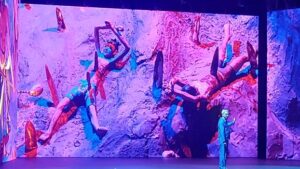
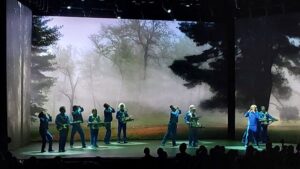
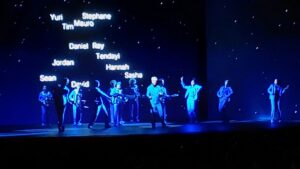
For each song, Byrne and eleven blue-clad co-performers went through a set of choreographed moves.  Six of the eleven were dancers and background singers.  The other five were musicians, carrying their instruments with them – guitars and keyboards, drums such as a tom-tom, timbale, snare drum and marching bass drum, and, when the song required, a violin or saxophone.  The musicians especially impressed me, keeping focused on where they were going as well as on what they were playing.  Meanwhile, the screens conjured up various backdrops: American suburbia, a forest, a skyscape, psychedelic patterns, a disorientating video where the same performers followed the same moves they were currently doing onstage but wearing animal-heads.


It felt part Broadway musical, part cheerleader routine, part circus (with Byrne as the ringmaster), part parade by a marching band.  Byrne even reminded me at times of Willy Wonka, orchestrating his co-performers like Oompa Loompas.  (I have to say, though, that with his blonde hair and cheery demeanour, Byrne looked more like Peter Isherwell, the sinister, ultimately incompetent billionaire played by Mark Rylance in the 2021 end-of-the-world movie Don’t Look Up.)  It’s also pretty astonishing how Byrne can do all this, seemingly effortlessly, at the age of 74.


With a plethora of drums, the music was percussion-heavy, which suited the catchy rhythms of Byrne’s solo songs perfectly.  I wondered if his Talking Heads songs would come across as well, but they did.  Several (including 1985’s And She Was) were performed during the first half of the set, before the focus switched to his solo stuff.  Then, near the end, out came the biggest Talking Heads numbers: Psycho Killer (1977), Life During Wartime (1979), Once in a Lifetime (1981) and Burning Down the House (1983).  Psycho Killer got the biggest reaction from the crowd, who inevitably chanted “Fa-fa-faa-fa-fa, fa-fa-faa-fa-fa!” in unison.  But I think it’s Once in a Lifetime that’s my favourite in Byrne’s oeuvre.  I remember first hearing it on Top of the Pops (1964-2006) when I was 16 and thinking it was bloody weird.  A week later, when I heard it again, I was hooked.


Anyway, this was a wonderful concert too.  Maybe not quite a once-in-a-lifetime experience, but not far off one.


Rock star insults


From youtube.com


This blog entry starts with Kate Bush… but isn’t about Kate Bush.


The other day I read a news report about how Kate Bush’s 1985 song Running Up That Hill had just gone to number one in the United Kingdom, Australia, Belgium and Sweden and reached number five in the United States.  The renewed popularity of the song was due to it being featured in season four of the American sci-fi / horror TV series Stranger Things.  My curiosity was sufficiently piqued for me to go to YouTube and type ‘running up that hill’ into its search-bar, wondering if it would provide the clip from the TV show where the song was used.  That didn’t happen, however.  Instead, YouTube – presumably its algorithms had taken note of my past musical preferences at the site – sent me to a cover version of Running Up That Hill performed by the late 1990s / early 2000s band Placebo.  I have to say the cover version didn’t sound bad at all.  And incidentally, the comments below were full of Americans saying things like, “I’d always assumed this was an original Placebo song.  I hadn’t known some English chick had sung it first, back in the 1980s!”


Meanwhile, my reaction at that time was: Placebo?  Wow, I haven’t heard of them for years…


And then I thought: Hold on! They were responsible for the greatest rock ‘n’ roll insult I’ve ever heard live!


Let me explain.  In 1999, I attended T in the Park, then the biggest annual music festival held in Scotland.  Placebo was one of the bands performing on the main stage and I was near the front of the crowd at the start of their set.  Also appearing that day was the rock band Gay Dad, who’d recently scored hit singles with the songs To Earth with Love and Joy, although sceptics grumbled that the hype surrounding the band was nothing to do with quality and everything to do with the fact that its singer Cliff Jones had previously been a music journalist – his former colleagues in the media were promoting his outfit as a favour.  Placebo’s singer Brian Molko was obviously one of the sceptics.  Before they began playing, Molko apologised for the band being slightly late in coming onstage.


This, he said, was because: “I was getting a blowjob backstage from the singer of Gay Dad.”  He paused, then added with timing worthy of a master comedian: “Believe me, it’s not just their music that sucks!”


Anyway, that memory got me thinking about the following question.  What are the best rock star insults of all time?


There are a few famous ones that come immediately to mind.  I recall Robert Smith of the Cure saying of the self-consciously fey and militantly vegetarian frontman of the Smiths, “If Morrissey says not to eat meat, then I eat meat. That’s how much I hate Morrissey.”  Also memorable was Nick Cave’s comment on a well-known Californian funk-rock band: “I’m forever near a stereo saying, ‘What the f*ck is this garbage?’ And the answer is always the Red Hot Chili Peppers.”  Van Halen singer Dave Lee Roth was pretty brutal about a certain post-punk troubadour of the late 1970s and early 1980s: “Music journalists like Elvis Costello because music journalists look like Elvis Costello.”  Though for brutality, you can’t beat the Manic Street Preachers’ Richey Edwards talking about Slowdive, one of the key bands of the shoegaze movement of the late 1980s: “We hate Slowdive more than we hate Hitler.”


George Melly, though strictly speaking not a rock star – he was a jazz / blues singer – deserves inclusion here for his response to Mick Jagger.  Melly had drawn attention to the deep grooves on the Rolling Stone’s face and Jagger had tried to dismiss them as ‘laughter-lines’.  “Nothing,” pronounced Melly, “is that funny.”  Meanwhile, I was never a fan of Boy George but I’ve always chuckled at his verdict on Elton John: “All that money and he’s still got hair like a f*cking dinner lady.”  And just to prove that the art of the rock-star insult remains alive and well in 2022, there was recently a spat between Joan Jett and gun-humping, Trump-worshipping rock-neanderthal Ted Nugent, which produced this Jett-gem: “Ted Nugent has to live with being Ted Nugent.  He has to be in that body, so that’s punishment enough.”


From wikipedia.org / © Will Fresch


The world of rock contains certain individuals who can be relied upon to denigrate their contemporaries practically every time they open their mouths.  Two who spring to mind are siblings Liam and Noel Gallagher, late of Britpop mega-band Oasis.  Among those suffering the wrath of Liam Gallagher have been Keith Richards and George Harrison (“jealous and senile and not getting enough f*cking meat pies”), Bob Dylan (“a bit of a miserable c*nt”), Billie Joe Armstrong of Green Day (“I don’t like his head”), Bono (“he looks like a fanny”) and Florence Welch from Florence and the Machine (“sounds like someone’s stood on her f*cking foot”).  For my money, though, his best insult was heard at a Q Magazine Awards ceremony, where he yelled at Coldplay’s Chris Martin, “You’re a plant pot!”


As the older and supposedly more cerebral Gallagher, Noel’s insults have been more elaborate, if a tad less savage.  Of the musical output of Justin Bieber, he once opined, “My cat sounds more rock ‘n’ roll than that.”   He likened the appearance of the White Stripes’ Jack White to “Zorro on doughnuts” and mused about skatey Canadian punk rockers Sum 41: “After I heard Sum 41, I thought, I’m actually alive to hear the shittiest band of all time.”  Needless to say, Oasis’s Britpop arch-enemies Blur came in for some stick too: “I wish Blur were dead, John Lennon was alive and the Beatles would reform.”  And inevitably he’s had some choice words for his wayward younger brother since they acrimoniously parted company in 2009.  That same year he famously described Liam to “a man with a fork in a world of soup.”  (For his part, the younger Gallagher has repeatedly referred to Noel as a ‘potato’ and called his post-Oasis band the High Flying Birds ‘the High Flying Smurfs’.)


© Weidenfeld & Nicolson


The Rolling Stones’ Keith Richards has also had a famously barbed tongue, powered by his apparent disdain for any form of music that isn’t structured around a 12-bar blues progression.  He’s dissed Prince as “an overrated midget”, REM as “a whiny college rock band” and P Diddy as “bereft of imagination.  What a piece of crap.”  He dumped on the Grateful Dead for “Just poodling about for hours and hours.  Jerry Garcia, boring shit, man. ”  Of Metallica he speculated, “I don’t know where Metallica’s inspiration comes from, but if it’s from me, I f*cked up.”  Hilariously, he said of Elton John after the death of Princess Diana in 1997 and after John had reworked his 1973 ode to Marilyn Monroe, Candle in the Wind, as a tribute to the deceased princess: “His writing is limited to songs about dead blondes.”  (To which Elton John retorted that the venerable Stones guitarist resembled “a monkey with arthritis.”)


But surely the man who’s suffered the most ignominious put-down from Keith Richards is his long-term singer, writing partner and fellow Rolling Stone Mick Jagger.  Jagger’s image as a tireless lothario took a dent when Richards wrote about his manhood in his 2010 autobiography Life: “Marianne Faithful had no fun with his tiny todger.  I know he’s got an enormous pair of balls but it doesn’t quite fill the gap.”


From vassifer.blogs.com


However, when it comes to rock-star insults, one man is – or alas, was – the undisputed champion.  Mark E. Smith, for four decades until his death in 2018 the driving force behind the fascinatingly off-the-wall post-punk / alternative rock group the Fall, was never more entertaining in interviews than when he directed his guns at his peers and rivals in the music world.  Among those getting it in the neck from Smith over the years were Badly Drawn Boy (“fat git”), Echo and the Bunnymen (“old crocks”), Garbage (“like watching paint dry”), Bob Geldof (“a dickhead”), Sonic Youth’s Thurston Moore (“should have his rock licence revoked”), Mumford and Sons (“We were playing a festival in Dublin…  There was this other group, like, warming up… and they were terrible.  I said, ‘Shut them c*nts up!’  And they were still warming up, so I threw a bottle at them…  I just thought they were a load of retarded Irish folk singers”), Pavement (“They haven’t got an original thought in their heads”), Ed Sheeran (like “a duff singer songwriter from the 70s you find in charity shops”) and Suede (“Never heard of them,” said Smith cruelly, just after off coming off a tour where Suede were the support band).


And in fact, not even a songstress as lauded as Kate Bush escaped Smith’s vitriol.  In 2014, when Bush’s Before the Dawn concerts – her first live performances since 1979 – triggered massive interest in her and her music again, Smith told the Manchester Evening News: “Who decided it was time to start liking her again?  I never even liked her the first time round.  It’s like all these radio DJs have been raiding their mam and dad’s record collections and decided that Kate Bush is cool again.  But I’m not having it!”


It’s a shame the wonderfully curmudgeonly Smith isn’t around today to witness Kate Bush’s latest return to prominence with Running Up That Hill.  I’m sure he’d have some entertaining pronouncements to make on the matter.


© EMI