More things that terrified the young me


From wikipedia.org / © Group Three Productions


Here’s the second half of my account of things that scared me, to the point of scarring me, when I was wee.


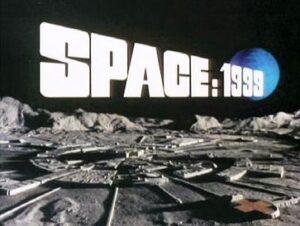
Space: 1999 – Dragon’s Domain (1975)

Even as a kid, I knew the TV show Space: 1999 was silly.  I already had enough awareness of science to realise the ridiculousness of its premise – a titanic explosion on the moon in the then-future year of 1999 sends it, and 300 human beings crewing a base there called Moonbase Alpha, careering out of earth’s orbit and into deep space.  Particularly ridiculous was how every second episode the moon hurtled into a new solar system and came close enough to an earth-type planet for the Moonbase Alpha folk to explore it.  Space: 1999 depicted the universe as a giant pinball machine with the moon bouncing between earth-type planets like the silver ball bouncing between the machine’s flippers and bumpers.


And yet…  A Space: 1999 episode called Dragon’s Domain petrified me.  It has the runaway moon approaching a sinister graveyard of abandoned spaceships in which a horrifying, one-eyed, tentacled monstrosity lurks.  Okay, seen today, the monster in Dragon’s Domain doesn’t impress, being a mass of wavy tentacles obviously animated by wires.  But the barrage of things that accompany it still inspire fear – it initially materialises as a swirling pattern of lights, it makes hideous shrieking noises and its victims are battered by gusts of wind.  Most horribly, moments after those victims are dragged into its maw, they’re spat out again as desiccated corpses, apparently drained of all their moisture.


There’s something about the episode’s ineluctability that got me too.  It focuses on a Moonbase Alpha member (Gianni Garko) who’s encountered the monster before.  While he was captaining a mission into deep space, it ate his crew and only he managed to escape.  Now stuck on the moon after its unexpected departure from earth’s orbit, fate has cruelly decreed that he’ll meet the thing again.


The pictures in The Horrific World of Monsters (1974)

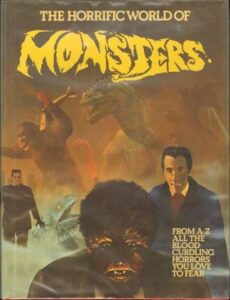
I might have been terrified by monsters like that Space: 1999 one, but I was also fascinated by them and in the mid-1970s I bought a hardcover, kids-orientated book called The Horrific World of Monsters by Dulan Barber.  This provided an A-Z of monsters from myth, folklore, cryptozoology, movies, TV and comics.
 

© Marshall Cavendish


Lavishly illustrated, a couple of the book’s page-sized movie-stills troubled me, lodged themselves in my psyche and occasionally caused me nightmares.  These depicted the mummy, played by Lon Chaney Jr in 1944’s The Mummy’s Ghost, throttling a victim; a fanged, hairy Michael Landon pouncing on a victim in I was a Teenage Werewolf (1957); and, in unflinching close-up, the title character of The Return of the Fly (1959), the second film in the series about a scientist experimenting with a teleportation device who gets his molecules mixed up with those of a fly and acquires a massive, insectile head.  Just as well it wasn’t a close-up of Jeff Goldblum from late in David Cronenberg’s 1986 remake of The Fly.  That sight would have left me gibbering.


Eventually, I sold the book to a schoolmate called Geoff Simmons, who was a gifted artist and who used some of its illustrations as inspiration for pictures – I remember him showing me one he’d drawn based on the mummy.  Geoff is now a graphic designer (and also a community historian) in London.  I’d like to think The Horrific World of Monsters played a small part in shaping his future career.


Bodega Bay gets attacked in The Birds (1963)

By the mid-1970s, someone had informed me that the Americans and Russians both had ‘bombs that could blow up the world’, so I had a new thing to worry about – the end of humanity.  Accordingly, apocalyptic movies frightened the bejesus out of me.  For example, Steve Sekely’s Day of the Triffids (1963), a cheap adaptation of John Wyndham’s 1951 novel, scared me with its depiction of a world where nearly everyone has gone blind.  Even at 10 years old, unfortunately, I could tell how shoddy its special effects were, especially the ones involving the triffids.


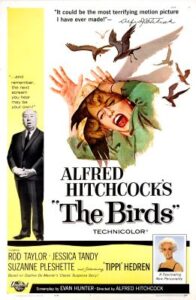
But the apocalyptic movie that traumatised me was 1963’s The Birds, directed by the impeccable Alfred Hitchcock and based on a 1952 short story by the equally impeccable Daphne du Maurier.  Most traumatic for me was the part where Tippi Hedren and Rod Taylor find themselves in a diner in the middle of the little coastal town of Bodega Bay, trying to convince the locals – who react with varying degrees of scepticism – that the area’s feathered population is behaving very strangely.  After seven minutes of conversation that mingles humour with growing unease, and is brilliantly performed by character actors like Doreen Lang (as an increasingly frightened mother), Charles McGraw (as a gruff fisherman), Ethel Griffies (as an elderly, know-all ornithologist) and Karl Swenson (as a Bible-quoting Irish drunkard), all hell breaks loose.


Multitudinous seagulls swoop down and cars and petrol pumps explode (thanks to fuel spewing from a dropped hose), more cars crash, horses run wild and many townspeople get clawed and pecked.  Hedren spends a nightmarish minute trapped inside a telephone booth with birds, plus one unlucky human victim, smashing into its sides.  Taylor rescues her and gets her into the diner again, but…  The atmosphere there is suddenly less welcoming.
 

From wikipedia.com / © Universal Pictures


Hitchcock’s orchestration of this blew me away.  The telephone-booth bit was possibly the first time I’d been exposed to what film-fans would describe as ‘pure cinema’.  But Taylor and Hedren’s return to the diner provides the chilling coup de grâce.  The people inside are cowering in terror, including Griffies’s no-longer-cocky ornithologist, and already a superstitious irrationality is taking hold of them.  This crystalises when a now-crazed Lang accuses Hedren of, basically, being a witch: “Who are you?”  What are you?  Where did you come from?  I think you’re the cause of all this.  I think you’re evil.  Evil!”  No doubt a young Stephen King was taking notes at this point.  Similar things happen in his 1980 novella The Mist, with many of its characters reacting to another apocalyptic event by succumbing to medieval-style hysteria.


Doctor Who – The Seeds of Doom, episode 4 (1976)

I could write a whole article based only on moments from the BBC’s long running science-fiction / fantasy / horror series Doctor Who (1963-89, 2005-25) that scared me: the shop dummies coming to life in the serial Spearhead from Space (1970); the killer plastic chair in Terror of the Autons (1971); the murderous Morris dancers in The Daemons (1971); a scaly hand appearing over a boat’s gunwale in The Sea Devils (1972); an infected crewman removing his hand from his pocket and revealing it transformed into a slab of glistening green slime (okay, it’s really green-painted bubble-wrap, but hardly anyone at the time knew what bubble-wrap was) in The Ark in Space (1975)…  But scariest of all was the 1976 serial The Seeds of Doom, about alien seed-pods that infect humans and transform them into malevolent, carnivorous plant-monsters.  Episode 4 of The Seeds of Doom, to be precise.


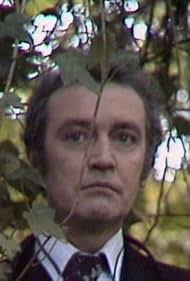
One alien pod becomes the possession of an insane millionaire plant-lover called Harrison Chase – played by character actor Tony Beckley, who’d been in The Italian Job (1969) and Get Carter (1971) – and at the start of episode 4 it germinates, infecting one of Chase’s minions, a hapless botanist called Arnold Keeler (Mark Jones).  Ignoring Keeler’s pleas to be taken to a hospital, Chase has him chained to a bed, purring in delight, “The rate of increase is astonishing…  Protein absorption from the animal, of course…  We shall have to give you some food soon…  You’re changing into a plant, Keeler…  a marvellous new species of plant!”
 

© BBC


With Keeler turning green, then fibrous, then tentacular, and Chase trying to speed up the metamorphosis by feeding him pieces of raw meat, what I was witnessing here was the icky sub-genre of horror known as ‘body horror’.  But it was the performances of Beckley and Jones, one disturbingly malevolent, the other distressingly pathetic, that truly conveyed the horribleness of the situation.


Legend Horror Classics, issue 4 (1976)

The same impulse that made me buy The Horrific World of Monsters inspired me to purchase issue 4 of a British film magazine called Legend Horror Classics, edited by Gent Shaw, who’d also edited the scary-movie magazine World of Horror in 1974-75.  Issue 4 of Legend Horror Classics was devoted to zombies, which until then I’d understood to be dead people brought back to life by voodoo and put to work on Caribbean sugar plantations.  By the 1970s, however, thanks to the influence of George A. Romero’s Night of the Living Dead (1968), zombie stories and films had become less voodoo-reliant and a lot grislier and more visceral.  This issue contained several gruesome photos that, like those in the Monsters book, gave me nightmares.


However…  Since then, I’ve discovered, indignantly, that the yuckiest pictures in the issue weren’t actually from zombie movies!  There was one of the mouldering, prehistoric ape-creature inhabited by an evil alien intelligence in the Christopher Lee / Peter Cushing horror film Horror Express (1972); and one of a rotting corpse (not reanimated as a zombie) from another 1972 movie featuring Christopher Lee, Deathline.  If you’re reading this, Gent Shaw, I’m accusing you of breaking the Trade Descriptions Act.
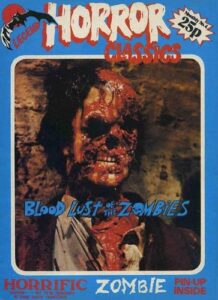
 

© Legend Publishing


The Nationwide report about the Hexham Heads (1976)

The Hexham heads were two little stone heads, possibly Celtic in origin, discovered in the northeast English town of Hexham in 1971.  Reputedly, the heads triggered paranormal activity in the homes of whoever had custody of them.  And that paranormal activity manifested itself spectacularly in the form of a werewolf that was glimpsed stalking through their homes after dark.


Infamously, Nationwide (1969-83) – normally a family-friendly TV current-affairs programme, which aired on the BBC every weekday evening after six o’clock – featured a report on the story in 1976.  The makers of the report had the not-so-family-friendly idea of spicing it up with ghastly screams, images of severed human heads and an unexpected jump-cut of Oliver Reed lurching towards the camera in 1961’s Curse of the Werewolf.  This approach traumatised every kid who happened to be watching, me included.


One eyewitness reported seeing the Hexham Heads werewolf after arriving home late at night – allegedly she spotted it prowling about her dark house before she switched on the lights.  Soon afterwards, my family moved from Northern Ireland to Scotland.  My parents frequently received invitations to Sunday lunch and dinner at the homes of Northern Irish folk they knew directly, or knew as friends of friends, who were now living in Scotland.  After much food, whisky and blethering, we wouldn’t get home until late on Sunday evening.  While my parents unlocked the front door and we entered a black, silent house, I’d think of the Nationwide report and wonder, “What if there’s a werewolf waiting in there?”


From wikipedia.org / © Archaeology Data Service / Dr Anne Ross


Footage of that legendary 1976 TV report on the Hexham Heads was long believed lost but it’s now been discovered and restored – see here and here.


Jon Voight’s dream at the end of Deliverance (1972)

By the time I was 12, I believed I was a mature, hardened type who’d seen everything and couldn’t be frightened anymore.  But then on TV one evening I watched John Boorman’s Deliverance (1972), about four Atlanta business men whose canoeing holiday in remote north Georgia turns into an ordeal, and was freaked out by it.


Oddly, it wasn’t the notorious sequence where some hillbillies rape Ned Beatty’s character and insist that he squeals ‘like a pig’ that upset me most.  Maybe I wasn’t old enough to fully understand what was happening.  No, it was the bit near the end where Jon Voigt’s character has a nightmare about the river they canoed on – which has since been dammed and turned into a lake – and sees a pale, bloated hand rising out of its water.  The image of that emerging hand haunted me for weeks afterwards.  I obviously wasn’t as tough as I thought I was.


© Elmer Enterprises / Warner Bros.


Thinking about it, I suppose I must have been a complete scaredy-cat whose childhood was one long procession of moments of terror.  So now, half-a-century later, why do I write short horror stories under the penname of Jim Mountfield?  I’ve had nearly 70 such stories published.


Perhaps it’s a case of ‘if you can’t beat ’em, join ‘em.”

10 scary pictures for Halloween 2023


From pixabay.com / © socialneuron


It’s Halloween today.  In keeping with tradition on this blog, I’ll celebrate the occasion by displaying ten pieces of macabre, spooky or unsettling artwork that I’ve come across and liked during the past year.


To start on a musical note…  Here’s a flutist painted by the late Polish artist Zdzislaw Beksinski, whose work suggested Hieronymus Bosch combined with H.R. Giger and frequently depicted apocalyptic hellscapes populated by wraith-like figures.  By Beksinski’s standards, this is a fairly sedate and playful piece.  Its ochre-bathed figure is characteristically skeletal, but what impresses is how its multiple fingers, knuckles, joints, bones and tendons fuse chaotically to the flute and become a grotesque mechanism that’s an extension of it.


Beksinski met a tragic end in 2005 – after a traumatic few years during which he’d seen the death of his wife and the suicide of his son, he was murdered in a dispute over a small sum of money.  Still, interest in his art has burgeoned since his death and there’s now a host of stuff about him on YouTube.


© Zdzislaw Beksinski


Moving eastwards from Poland to Ukraine – yes, a place that’s suffered plenty of real-life horror in the past two years.  Yuri Hill is a Kiev-based artist who specialises in digital painting and whose work often depicts things worryingly pagan and primordial lurking in the forest.  This piece is particularly good.  As you study its crepuscular grey-blue murk, more and more details filter into view – not just the drooping, feathery branches of towering conifers, but the strange, bestial furriness of the figures and the Herne-the-Hunter-like antlers sprouting from their heads.  The fact that they’re moving about on stilts just adds to the strangeness.  For those of you wanting to see more of his work, Hill’s Instagram account is accessible here and his page on artstation.com here.


© Yuri Hill


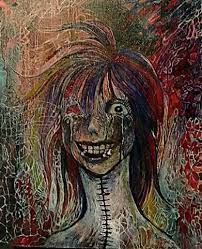
From folk-horror to J-horror, i.e., Japanese horror, whose psychological, supernatural and urban-myth-derived traditions clearly inform this painting.  Entitled Red Laugh, it’s the work of Yuko Tatsushima, who’s been described as both a ‘rockstar’ and an ‘outsider’ in Japanese painting.  Even before we get to the grotesque subject matter, with the face missing an eyeball and some prominent, autopsy-like stitches running up its throat, the scratchy paint-strokes almost make you wonder if the artist did it with broken, bloody fingernails.


Indeed, the composition has a howl of rage about it that’s common in Tatsushima’s work.  It frequently addresses sexual oppression, harassment and assault, things Japanese society – all societies, for that matter – often tries to look away from and things the artist has been a victim of herself.  Such is the Francis Bacon-style intensity of Tatsushima’s creations that this YouTube film about her comes with a warning that its images might be ‘too disturbing for more sensitive viewers’.


© Yuko Tatsushima / From sugoii-Japan.com


That seems far, far removed from my next picture, which celebrates the cosy tradition of classical British horror fiction, set in wooden-panelled Victorian and Edwardian drawing rooms and populated by crusty, tweedy gentlemen.  It’s by Charles W. Stewart, one of the few people who can claim to have been born in the Philippines but brought up in Galloway in Scotland, and whose enthusiasm for illustrating was apparently matched for his enthusiasm for ballet and costume design.  Stewart, clearly a man of many interests, selected the stories and did the illustrations for a 1997 collection entitled Ghost Stories, and Other Horrid Tales, which was published four years before his death.  The volume includes fiction by Sheridan Le Fanu, Robert Louis Stevenson, Lafcadio Hearn, Vernon Lee, M.R. James and Walter de la Mare.


Stewart’s illustration here, which shows an antiquarian discovering he has unexpected company whilst engaged in some nocturnal research, is presumably for M.R. James’s Canon Alberic’s Scrap-Book.  The story ends with the fictional equivalent of a cinematic jump-scare: “…his attention was caught by an object lying on the red cloth just by his left elbow…  Pale, dusky skin, covering nothing but bones and tendons of appalling strength; coarse black hairs, longer than ever grew on a human hand; nails rising from the ends of the fingers and curving sharply down, grey, horny and wrinkled…”


© Folio Society


One of the greatest early scares in film history occurred in the 1925 silent version of Gaston Leroux’s The Phantom of the Opera, which starred the remarkable Lon Chaney Sr in the title role.  The mysterious masked phantom gets unmasked whilst playing at his beloved organ.  Unable to stop herself, the singer Christine (Mary Philbin) whips the mask off from behind. The audience is confronted by the phantom’s horribly gaunt, stretched and skull-like face in the screen’s foreground – at this point, supposedly, some 1925 audience-members fainted.  Then he turns around and the audience is traumatised a second time as they see Christine reacting in horror to his deformed visage too.  Anyway, here’s a regal portrait of Chaney Sr’s Phantom of the Opera, sans mask, courtesy of Pittsburgh artist Daniel R. Horne, who’s painted a number of classic movie monsters.


© Daniel R. Horne


There were scares a-plenty in the films of director Alfred Hitchcock.  Indeed, he was perhaps cinema’s greatest practitioner in the genres of suspense and horror.  So popular was Hitchcock among the public in his heyday that he licensed his name to dozens of collections of crime, mystery, thriller, espionage and horror short stories, whose titles ranged from Alfred Hitchcock’s Coffin Break (1974) to Alfred Hitchcock’s Hard Day at the Scaffold (1967), from Alfred Hitchcock’s Monster Museum (1965) to Alfred Hitchcock’s Sinister Spies (1966).  These had introductions purporting to be written by the great man himself, but they were actually penned by publishing-house editors.


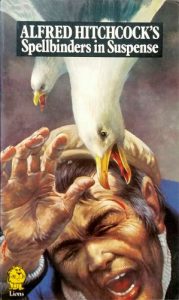
I’m partial to this cover illustration from the collection Alfred Hitchcock’s Spellbinders in Suspense (1967), which includes Daphne du Maurier’s short story The Birds (alongside the likes of Richard Connell’s The Most Dangerous Game, Roald Dahl’s Man from the South and Robert Bloch’s Yours Truly, Jack the Ripper).  Hitchcock, of course, filmed The Birds in 1963.  The cover’s artist isn’t identified, but with those brutally-pecky gulls, and the victim’s screaming face, he or she does a good job of capturing the directness of du Maurier’s grim, claustrophobic original.  Hitchcock’s treatment of it is more mannered and expansive, though still brilliant.


© Lions, London


While many modern artists have taken their inspiration from the cinema, the American painter and illustrator Burt Shonberg could boast that his work turned up in movies. Most notably, Shonberg provided the disturbingly dark-eyed and corpse-faced portraits of former members of the Usher family, which Roderick Usher (Vincent Price) shows to Philip Winthrop (Mark Damon) in Roger Corman’s Edgar Allan Poe adaptation House of Usher (1960).


Acclaimed as ‘the premier psychedelic artist of Los Angeles’ from the 1950s until his death in 1977, Shonberg’s work extended beyond hippy-era psychedelia and he flirted with cubism and did some fine pen-and-ink drawings.  Here, however, I’m showing a languid, sultry composition entitled Magical Landscape or Lucifer in the Garden, which depicts an unsettlingly youthful version of Auld Nick.  Obviously, representations of the Devil abound throughout the history of art, but what makes this one memorable are those particularly long pasterns and the strange little sphinx resting on his lap.


From cvltnation.com


In these art-themed Halloween posts, I also like to honour the festival that comes straight after Halloween – Mexico’s Dia de Muertos, the Day of the Dead, at the start of November, which features skulls and skeletons as a major theme.  This next picture gets straight to the point.  It’s by David Lozeau, a San Diego artist who’s dedicated much of his career to creating Day of the Dead-inspired artwork, and it shows two skeletons raucously celebrating…  Day of the Dead.  I assume that yellow stuff in the señorita skeleton’s bottle is reposado tequila, which acquires its colour from the oak barrels it matures in.


© David Lozeau


There’s also an admirable directness about this picture, of a vampire lady, by Argentinian artist Hector Garrido, who passed away in 2020 when he was in his nineties.  Put Garrido’s name into Google Images and you’ll be assailed by countless pictures of G.I. Joe toy-packaging, which he designed back in the 1980s.  However, his main work was creating book covers, most popularly for gothic and romantic novels and for the series about the wholesome juvenile sleuths Nancy Drew and the Hardy Boys.  But Garrido’s CV includes covers for the likes of John Brunner, Ramsey Campbell, Agatha Christie, John Christopher, Robert A. Heinlein, Richard Matheson and Robert Silverberg too.


This one comes from a book called A Walk with the Beast, actually a collection of ‘vintage tales of human monsters and were-beasts’ edited by Charles M. Walker.  The stories include one by Vernon Lee, who also appeared in Charles W. Stewart’s Ghost Stories, and Other Horrid Tales.  ‘All fun’ says the book’s single reviewer on amazon.com, so evidently it ‘does what it says on the tin’.


© Avon Books


And finally, for my final picture, it’s back to Japan for something similarly fun and schlocky – not the cover of a book but one of a Japanese comic-book.  This effort by the late manga-artist Marina Shirakawa is wonderfully sinewy and eye-catching.  It’s full of typical manga-style details – see those simultaneously hideous and gleeful ghouls in the background – and peculiarly Japanese ones, such as the heroine’s sailor-suit school uniform.  Its colour scheme of dark, blue-grey hues, with smudges of blood-red at the back, is memorable too.


© From monsterbrains.blogspot.com


And that’s it for another year.  Happy Halloween…

Du Maurier, du merrier (Part 1)


© Penguin Books


As Halloween is approaching, here’s a reposting of something I once wrote about the novella that inspired one of the greatest horror movies of all time – Daphne du Maurier’s 1971 tale Don’t Look Now, turned into the Nicolas Roeg movie of the same name two years later.  And there’s mention of some other disquieting stories by her too.


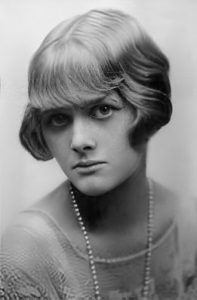
I have a tiny sliver of a connection with Daphne du Maurier, the popular 20th century English writer responsible for novels like Jamaica Inn (1936) and Rebecca (1938) and short stories like The Birds (1952) and Don’t Look Now (1971).  When I was at college in the 1980s, I knew her great-nephew very slightly.  Actually, I was better acquainted with her great-nephew’s flatmate and a few times, because of him, I visited their apartment.  Its walls were slathered with pictures of George Michael and Andrew Ridgely from the then-massive pop duo Wham, cut out of popular teen magazines of the time like Smash Hits and No 1.  I assume the young du Maurier and his flatmate had stuck up these pictures in an attempt to appear ironic.  Unfortunately, it meant that thereafter when I saw his great-aunt’s name on the cover of a book, I couldn’t help but hear, by way of association, the irritatingly bouncy strains of such Wham pop-dance numbers as Club Tropicana (1983) or Wake Me Up Before You Go-Go (1984).


For a long time the only thing by Daphne du Maurier I’d read was The Birds (1952), a story that because of its remote Cornish setting feels even more claustrophobic and desperate than the North America-set film version directed by Alfred Hitchcock in 1963.  However, a while back, I got a chance to familiarise myself with more of her fiction when my partner gave me a copy of du Maurier’s 1971 collection Don’t Look Now and Other Stories as a present.


A novella about a grieving English couple who’re taking a break in Venice when they’re approached by two strange women – one of whom claims to be a medium – and told that their dead daughter’s spirit is trying to warn them against danger, Don’t Look Now has been filmed too.  Nicolas Roeg directed a movie version in 1973 and it’s now regarded as a classic, both as a horror film and as an example of Roeg’s work in the 1970s and 1980s, which combined fragmented and elliptical narratives, haunting and recurrent images and scenes of violent and sexual intensity to unforgettable effect.  Having seen the film several times over the years, I was keen to read the piece of fiction that’d inspired it.


My first impression when I started reading Don’t Look Now was that film and story felt like they belonged to different eras.  The couple, John and Laura, seem more modern, liberated and chic in the film, though that may be because they were played by 1970s icons Donald Sutherland and Julie Christie.  On the page, John and Laura have an old-fashioned English starchiness and they try to get over their loss with stiff upper lips and a strained Keep Calm and Carry On cheerfulness.  Also, the literary John and Laura are in Venice as tourists, so they seem less confident and more vulnerable.  Their cinematic equivalents are there for work reasons – John is helping to restore a Venetian church – and thus know their way around better.


Then there’s the presentation of the story.  Du Maurier’s novella is a briefer and more economical account of the events I was familiar with from the film.  As it stands, it could easily have been made into a 45-minute TV play.  (The film clocks in at 110 minutes.)  It begins in Venice with John and Laura encountering the medium.  The death of their daughter, by meningitis, is mentioned retrospectively.  And the suggestion that the dead girl’s spirit is urging them to leave the city before something terrible happens feels like a simple device to kick-start the main story – wherein John doesn’t leave Venice, through a series of mishaps, misunderstandings and further supernatural shenanigans; and then, when he tries to intervene in what he thinks is the mistreatment of a child, something terrible does happen.


© Casey Productions / Eldorado Films / British Lion Films


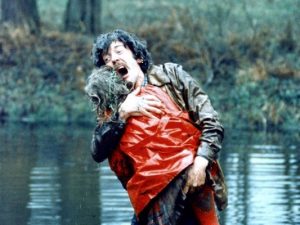
The movie opens with a harrowing sequence showing the death of John and Laura’s daughter – not by meningitis but by drowning in a pond in the English countryside.  Roeg and his scriptwriters Allan Scott and Chris Bryant create a sense of a cosmic, all-encompassing evil at work.  Even as the girl dies, everything that’s still to happen in Venice seems to be prefigured.  We see John studying pictures of the Venetian church where he’ll be working and discovering a mysterious figure wearing a red coat in one of the slides.  When he spills water onto the figure, its redness spreads across the slide like a bloodstain.  John’s daughter is also wearing a red coat when she drowns and, later, so too is the child-figure John sees scarpering alongside the night-time Venetian waterways.


Indeed, in the film, John clearly makes a connection between the two characters thanks to the coat.  Is the red-clad figure by the canals the ghost of his daughter?  But this association doesn’t appear in the original novella.


Daphne du Maurier’s Don’t Look Now is efficiently gripping.  But I think Nicolas Roeg’s brooding cinematic version, spinning a web of portents, visions and uncanny coincidences in which John’s doom seems pre-ordained from the start, is better – a work of art.  That’s despite the fact that, by changing the girl’s death from meningitis to drowning, the film can be accused of illogicality.  As the website British Horror Films observes pithily: “If tragedy has struck and drowned your daughter, why go to a place with an excess of water?”


Actually, with Don’t Look Now and Other Stories, I preferred a couple of those ‘other stories’ to the title one.  And interestingly, nearly all of them share a similar theme, in that they deal with English people going abroad and coming unstuck as they leave their cultural comfort zones.


Not After Midnight is about an amateur artist taking a holiday in Crete to do some landscape painting.  In a manner reminiscent of the hero of John Fowles’s novel The Magus (1965), he encounters a strange man and becomes embroiled in some equally-strange activities touching upon ancient Greek myths.  However, while Fowles’s novel is an airy and exuberant affair where a Prospero-like figure orchestrates spectacular and elaborate ‘masques’, Not After Midnight is altogether grungier.  The man putting the events in motion is a drunken, debauched brute and, accordingly, the myths invoked concern “Silenos, earth-born satyr, half-horse, half-man, who, unable to distinguish truth from falsehood, reared Dionysus, god of intoxication, as a girl in a Cretan cave, then became his drunken tutor and companion.”  Du Maurier doesn’t say explicitly what bacchanalian depravities her hero finally succumbs to; but as he’s a teacher at a posh English boys’ school, we can guess.


From wikipedia.org / © The Chichester Partnership


In A Border Line Case, a young woman who works as a theatre actress tries to honour the dying wish of her father.  She goes in search of her father’s long-lost best friend, to tell him that her father had wanted to “shake the old boy by the hand once more and wish him luck.”  She finds the missing friend in the Republic of Ireland, living as a recluse on an island, mysteriously lording it over a cohort of local men, and engaged in activities that are probably illegal and possibly weird.  Unlike the hapless protagonists in the other stories, the heroine here is a resourceful type.  She uses her skills as an actress to improvise, hide her identity and talk her way out of tight spots.  However, when at one point she suspects she’s stumbled across a secret society of homosexuals (“They were all homos…  It was the end.  She couldn’t bear it…”), you feel surprised that a theatre actress should be so wary and intolerant of gay men.  Still, A Border Line Case is well-paced and balanced nicely between an adventure story and a mystery one.  It builds up impressively to a nasty, if slightly predictable ending.


The book’s most humorous story is The Way of the Cross, about a group of disparate English tourists making their way to and then around Jerusalem.  The characters and plot seem slightly contrived at times.  It’s unlikely that a progressive left-wing lady who’s worried about the plight of the Palestinians should be married to a hard-nosed right-wing businessman.  Also, a climax where two characters are stricken by unconnected illnesses and a third one suffers a serious accident stretches credibility.  Nonetheless it’s an enjoyably satirical account of English folk abroad.


The final story, The Breakthrough, is the exception to the rule.  Its engineer hero doesn’t leave England for another country, although he is posted to the desolate flatlands and beaches of East Anglia.  There, an ambitious experiment is underway in a scientific / military laboratory, ostensibly involving computers, but really about capturing a psychic energy that surrounds people when they’re alive and escapes when they die.  The Breakthrough’s blending of the scientific and the supernatural calls to mind the famously frightening TV play The Stone Tape (1973), written by Nigel Kneale.  Bravely, du Maurier opts for a non-sensational ending that prioritises character over action or horror.  Admittedly, some readers might find that ending a bit of a let-down.


Overall, I greatly enjoyed reading Don’t Look Now and Other Stories, because of the author’s precise and no-nonsense prose, her ability to pack a lot of incident into her narratives without letting them get too convoluted, and her determination at all times to tell a rattling good yarn.


Indeed, on the strength of this, I’m now starting to think of Daphne du Maurier as being in the mould of Stephen King – and not so much in connection with George Michael and Andrew Ridgely.  Yes, better the author of The Running Man (1982) than the authors of I’m your Man (1986).


© Casey Productions / Eldorado Films / British Lion Films


Expect more on Daphne du Maurier very soon…