The 100-year-old Mel


From wikipedia.org / © Angela George


Last week saw much hype and noise about the United States of America celebrating its 250th birthday.  Under the leadership of Donald Trump, the USA marked the 250th anniversary of its independence from the British by holding a Great American State Fair on Washington DC’s National Mall.  This featured empty booths, cancelled musical performances, racist flags, power outages, collapsing roofs and a plywood model of the victory arch Trump wants to build on the Potomac that cracked, crumbled and oozed yellow gunk.  How odd that hardly anyone wanted to go to it.


In other moves to celebrate America’s 250th Independence Day, Trump refurbished the Lincoln Memorial’s Reflecting Pool, also in Washington DC, so that its water would shine a patriotic blue, though it immediately shone a less patriotic green thanks to a sudden and unforeseen algae bloom.  He also tried to extend the USA team’s run in the 2026 Football World Cup by arm-twisting Gianni Infantino and FIFA into breaking the sport’s red-card rules so that a key American player could play in the team’s next game – which they lost, courtesy of a 4-1 drubbing by Belgium, causing their exit from the competition.


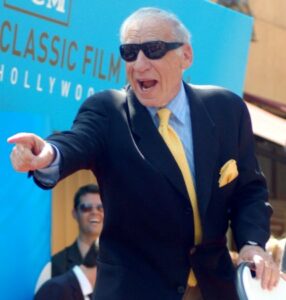
The sound and fury about the 250th anniversary of American independence, and the Trump-esque shenanigans accompanying it, have obscured the fact that, one week earlier, the USA witnessed another important three-digit birthday.  June 28th saw the 100th birthday of the legendary American filmmaker, comedian and general funnyman Mel Brooks.  By the time he turned his hand to making movies in the late 1960s, Brooks already had impressive comic credentials – devising the famed 2000-Year-Old Man comedy sketch with Carl Reiner, for instance, or creating the classic spy-comedy TV show Get Smart (1965-70) with Buck Henry.  But it’s fair to say his films are the body of work for which he’s most beloved.


Like much of the comedy I experienced from an early age – the CarryOn movies, or those starring Abbott and Costello, or the telly career of Ronnie Corbett – I’ve had a complicated and changing relationship with the oeuvre of Mel Brooks.  As a youngster, I thought it was brilliant.  As a young adult, who took himself much too seriously, I dismissed it – certainly, the later films Brooks made – as crass, cringeworthy guff.  Now, in my old age, I can find pleasure in the entirety of Brooks’s canon and appreciate the artistry displayed in even what are, by general consensus, his lesser efforts.  A bad joke might provoke a groan rather than a laugh, but to engineer that groan you still need a certain, warped skill.


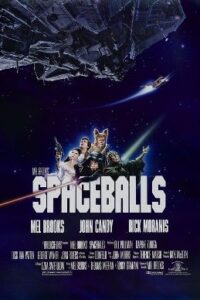
I think I passed from my youthful period of Brooks-disdain to my more mature period of Brooks-admiration in the 1990s.  This was when I was attempting to woo (with a total lack of success) a lady from New York whom I considered, for a while, the coolest thing on earth.  We were chatting one evening about our favourite films and the object of my affections suddenly astounded me by saying she was a huge fan of…  No, not Jean-Pierre Melville’s Le Samourai (1967), or Terence Mallick’s Badlands (1973), or Jim Jarmusch’s Mystery Train (1989), but…  Mel Brooks’s Spaceballs (1987).


From wikipedia.org / © Metro-Goldwyn-Mayer / Brooksfilms


“Seriously?” I spluttered.  I’d seen this science-fiction / Star Wars piss-take shortly after its release and thought it was dreadful.  But, patiently, the lady explained to me the sociological depth and cleverness of some of Spaceballs’ jokes that I’d missed – for example, when Bill Pullman and John Candy rescue the princess (Daphne Zuniga) and Pullman remarks, “That’s all we needed…  A Jewish princess!”  I had to concede there was more to Brooks’s humour than I’d thought.


So, I had my moment of epiphany.  I decided, to misquote a line in The Producers, “Don’t be stupid, be a smarty / Come and join the Mel Brooks party.”


Anyway, it’s a fortnight late for the great man’s 100th, but here is a belated guide to the funniest bits, in my opinion, of his movies.  There’s no mention of The Twelve Chairs (1970) and Life Stinks (1991) because I haven’t seen those two.


L.S.D. gets auditioned in The Producers (1967)

The movie that put Brooks on the cinematic map, The Producers has had quite an afterlife, becoming a successful Broadway musical that, in 2005, was turned into a film itself.  For me, its highlight isn’t the famous song-and-dance number Springtime for Hitler that’s the centrepiece of the show that impresario Zero Mostel and accountant Gene Wilder stage in the hope it’ll be a massive flop (allowing them to make a fortune from the shares they’ve sold in it).  No, the highlight comes earlier.


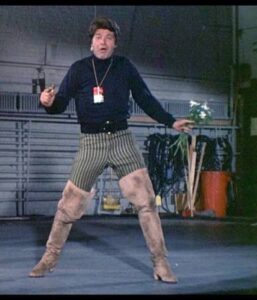
That’s when hippy Lorenzo St. DuBois – L.S.D. to his friends – stumbles into the show’s auditions by mistake and performs, with his female guitar / keyboards / sax backing band, a funny-terrible number called Love Power.   (“And I give a flower to the big fat cop / He takes his glove and he beats me up!”)  Played by Dick Shawn with thigh-high furry boots and a Campbell’s soup-can hanging on a chain around his neck, the hapless L.S.D. is hilarious – and the sequence reaches a perfect conclusion when Mostel bellows ecstatically, “THAT’S OUR HITLER!”


From instagram.com / (c) Embassy Pictures


The campfire scene in Blazing Saddles (1974)

If I was more sophisticated, I’d nominate as the funniest moments in Brook’s smash-hit comedy-western the scenes where he skewers the residents of frontier town Rock Ridge for their bone-headed racism.  (“You’ve got to remember that these are just simple farmers.  These are people of the land.  The common clay of the new West. You know…  morons.”)  However…  I’m nominating instead the sequence in Blazing Saddles where Slim Pickens’s men sit around a campfire and stuff themselves with traditional cowboy fare – beans – with flatulent results.


I first saw Blazing Saddles when it played on a big screen in the assembly hall of my school as one of the movies chosen for the school’s Film Club.  When the farting began, the teenaged audience, including myself, laughed like drains.  We were still roaring our heads off minutes after the sequence finished.  No other film shown during the several years I was a member of that Film Club – not Alfred Hitchcock’s Psycho (1960), not Nicolas Roeg’s Don’t Look Now (1973), not Ridley Scott’s Alien (1979) – provoked so tumultuous a reaction.  I’m not proud.


The monster meets the blind hermit in Young Frankenstein (1974)

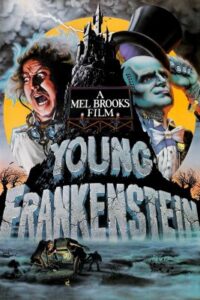
The most genuinely affectionate of Brooks’s genre parodies, Young Frankenstein pokes fun at the black-and-white Frankenstein movies made by Universal Pictures in the 1930s.  My favourite part of it is when Brooks sends up the sequence in Bride of Frankenstein (1936) where the Frankenstein monster (Boris Karloff) is touchingly but briefly befriended by a lonely blind hermit (O.P. Heggie) who’s unaware of his monstrousness.  Here, the well-meaning but, well, blind hermit (Gene Hackman) accidentally and repeatedly scalds and burns the unfortunate monster (Peter Boyle) whilst trying to offer him broth, cigars, etc., until the latter flees from his cottage in terror.  Despite the gleeful bad taste of the gags, the Young Frankenstein sequence retains some of the sweetness and sadness of the Bride of Frankenstein one.  It also makes you wish Gene Hackman had played more comedy roles.


From wikipedia.org / © Gruskoff / Venture Films / 20th Century Fox


The boardroom table in Silent Movie (1976)

This was another movie shown at my school’s Film Club and another sequence that sent us – uncivilised little oiks that we were at the time – into paroxysms of laughter.  Evil corporation Engulf & Devour intends to take over the studio of filmmaker Mel Funn (Brooks) but that won’t happen if the new movie Funn is making becomes a hit.  Engulf & Devour’s board of executives hatch a fiendish plan to sabotage Funn and his movie – they’ll send sultry nightclub singer Vilma Kaplan (Bernadette Peters) to seduce, then dump Funn and re-kindle the massive alcohol problem he had previously.  When a picture of Vilma is unveiled to the executives, sitting around the boardroom table, they’re so impressed that the table rises by several inches.


The line Funn / Brooks inspires when Vilma does dump him, and he goes on a massive bender to drown his sorrows – “He is truly the lord of the winos!” – is pretty funny too.


The orchestra in High Anxiety (1977)

Brooks’s next film takes fond aim at the thriller movies of Alfred Hitchcock.  Its hero, Dr Richard Harpo Thorndyke, again played by Brooks himself, suffers from the titular disorder, the vertigo-like ‘high anxiety’.  While travelling in the back of a car, Thorndyke / Brooks suffers a moment of ominous foreboding, which is accompanied by an equally ominous swell of Bernard Herrmann-like orchestral music – the sort that Hitchcock liked to insert into his films to augment the mood.  This being a Brooks film, though, Thorndyke’s car then passes a bus that contains, as passengers, the orchestra playing the music.


Yes, this is the second time Brooks has used that gag.  It originally appeared in Blazing Saddles and involved the Count Basie Orchestra performing in the desert,  But the orchestra-on-a-bus joke in High Anxiety works better, I think.


The Spanish Inquisition in History of the World, Part I (1981)

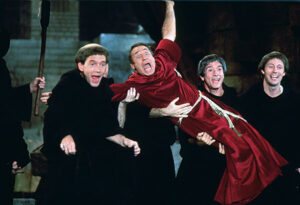
A truly hit-and-miss collection of gags and sketches, History of the World, Part 1 depicts five chapters in world history from the Stone Age to the French Revolution.  Its undisputed highlight is a segment about the Spanish Inquisition.  This features Brooks as Torquemada – his victims are warned not to try to talk him out of torturing them because, “You can’t Torquemada anything!” – and an elaborate Busby Berkeley-like song-and-dance number in a torture chamber which, with its exuberant bad taste, is as impressive as Springtime for Hitler in The Producers.


© Brooksfilms / 20th Century Fox


Snotty’s line in Spaceballs (1987)

Spaceballs spoofs Star Wars (1977) but also contains some elaborate send-ups of Planet of the Apes (1968) and Alien (1979) – the latter even drafts in John Hurt to reprise his role as the unfortunate Kane.  But the funniest, or groan-iest, bit in it for me is a simple pun.  A Scottish character called Snotty (Jeff MacGregor), obviously based on Scotty from Star Trek (1966-69), is in a control room flicking a series of switches.  “Lock One!” he shouts.  “Lock Two!  Lock Three!  Loch Lomond!”


The abbot in Robin Hood: Men in Tights (1993)

You have to be a connoisseur of long-ago comedy double-acts to appreciate my favourite joke in Robin Hood: Men in Tights, Brooks’ irreverent take on the then-recent and hugely-successful Robin Hood: Prince of Thieves (1991).  An abbot (Dick Van Patten) is walking in his finery outside his monastery and enjoying the adulation of the local population.  Then a guy who looks and sounds suspiciously like Lou Costello yells at him, “Hey, Abbott!”  Van Patten grumbles, “I hate that guy.”


Dracula tries to control Mina’s mind in Dracula: Dead and Loving It (1995)

I don’t hold it against Brooks’s Dracula: Dead and Loving It, which stars Leslie Neilson as the legendary vampire count, that it isn’t great.  After all, there have been many attempts over the years to spoof vampire films and hardly any of them have been funny – see Roman Polanski’s Dance of the Vampires (1967) or Stan Dragoti’s Love at First Bite (1977).  In fact, it wasn’t until Jermaine Clement and Taika Waititi’s What We Do in the Shadows (2014) that I encountered a vampire-movie parody that made me laugh.


However, Dracula: Dead and Loving It has one funny part where, from a distance, Dracula / Neilson exerts his willpower over the bitten and partly vampirised Mina (Amy Yasbeck) and tries to summon her: “Mina…  Open your eyes…  Arise…  Come to the door…”  The operation goes less smoothly when the mind-controlling vampire discovers there’s a confusing closet door in the way, and a hazardous footstool, and an inconvenient maidservant who’s also picking up his telepathic instructions: “Mina…  You are in the closet.  Open the door and come out…  Watch out for the footstool…  Stand up…  Not you, sit…  No, you sit…  You stand…”


And just before I finish, some praise is due for Brooks as a producer too.  He’s the man who oversaw both David Lynch’s The Elephant Man (1980) and David Cronenberg’s The Fly (1986).


From wikipedia.org / © Angela George

10 scary pictures for Halloween 2025


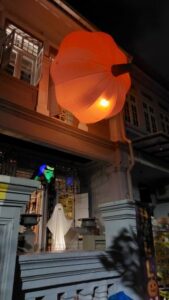
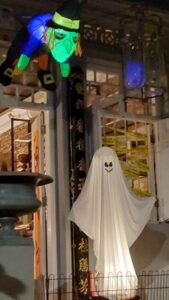
It’s October 31st, the day of the spooky festival known in Ireland as Samhain and elsewhere as Halloween.  As is my custom each Halloween, I’ll celebrate the spirit of the occasion by posting on this blog ten of the creepiest or most unsettling pieces of artwork I’ve come across during the year.  By the way, the above photos are of a house in my immediate neighbourhood in Singapore.  Its inhabitants must really love Halloween.


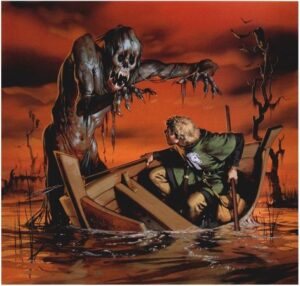
Let’s begin with a great, old-school horror illustration where an unwary boatman has an encounter with a marsh-monster.  This was painted by the late Angus McBride, an artist who was born in London to Scottish parents but spent much of his professional career based in South Africa.  McBride’s resume included work for the educational magazines Look and Learn (1962-82) and Worlds of Wonder (1970-75), the Men-at-Arms series from Osprey Publishing and the tabletop game Middle-earth Role Playing inspired by the works of J.R.R. Tolkien.  In fact, it’s from a collection of those last illustrations – Angus McBride’s Characters of Middle-earth (1990) – that this ghoulish picture comes.  The hideous beastie is actually a Mewlip, which The One Wiki to Rule Them All describes as ‘a fictional race, made up by Hobbits of the Shire, mentioned only in one poem.’


© Iron Crown Enterprises


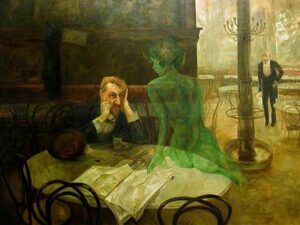
Onto something more elegant.  I love old posters and illustrations advertising that most decadent of alcoholic drinks, absinthe.  These were often the work of Art Nouveau artists, most famously, Alphonse Mucha.  But away from the gentle curves and nymph-like belles dames of Art Nouveau, there’s a darker school of absinthe artwork, which suggests the drink’s more sinisterly seductive and ruinous side.  These feature green devils, black cats and, depicted in this painting from la Belle Epoque, a splendidly vaporous green lady-ghost.  It’s entitled Absinthe Drinker and is the work of the Czech artist Viktor Oliva, who reputedly quaffed much of the stuff in Paris in the late 19th century.  Absinthe Drinker now hangs in the Zlata Husa Gallery in Prague.


From wikipedia.org


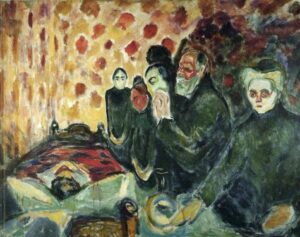
You get the impression la Belle Epoque passed by the great Norwegian painter Edvard Munch, whose paintings – most famously The Scream (1893) – often suggest he lived in a state of perpetual, nerve-jangling anxiety.  During his childhood, he suffered the trauma of losing his mother and sister to tuberculosis and getting a bout of it himself when he was 13: “One Christmas Eve, when 13 years old, I lie in my bed,” he recalled. “The blood trickles from my mouth – the fever rages in my veins – fear cries out deep within me. Now, now, in just a moment, you will meet your Maker and be sentenced for eternity.”  In 1893, drawing on those experiences, he painted By the Death Bed (Fever) with pastels.  He would do further versions of it, with oils in 1895 and 1915 and as a lithograph in 1896.  It’s the 1915 By the Death Bed (Fever) that I find most disturbing. The white-skinned, almost skull-faced woman on the right could pass for the Angel of Death, while the appropriately diseased-looking wallpaper resembles a close-up of a yellow handkerchief, into which a TB victim has just coughed globs of blood.  Actually, the décor puts me in mind of one of the best horror short stories of all time, Charlotte Perkins Gilman’s The Yellow Wallpaper (1892).


From archive.com/artwork


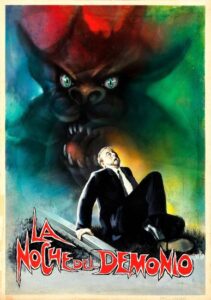
Another all-time classic horror short story is M.R. James’ Casting the Runes (1911), which taps into the fear there’s something monstrous and nasty following you, and following you, and all the time getting closer…  The story was filmed as Night of the Demon in 1957, 21 years after James’ death.  I think James would have approved of the creepy atmosphere and build-up created by director Jacques Tourneur, but not of big, shonky-looking demon that’s doing the following and appears at the movie’s climax.  Apparently, it was shoehorned into the film by its producers, against Tourneur’s wishes.  Still, I really like this colourful poster for the movie, painted by Spanish artist Enrique Mataix.  Mataix produced movie posters for almost a half-century, from 1939 to 1988, including ones for Bringing Up Baby (1938), Waterloo Bridge (1940), The Glenn Miller Story (1954), Lust for Life (1956), North by Northwest (1959) and Anatomy of a Murder (1959).  Yes, his Night of the Demon poster gives prominence to that silly demon, but it’s slightly blurred, which hides its shonkiness.  And the surrounding, infernally psychedelic colours are striking.


From monsterbrains.blogspot.com / © Columbia Pictures


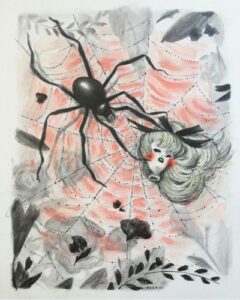
This next work, Can You Show Me the Way Home by Californian artist Brandi Milne, feels like it could be an illustration from a movie poster.  Maybe one for a warped 1960s psychological thriller where children are imperiled, like Bunny Lake is Missing (1965), The Nanny (1965) or The Mad Room (1969).  Of course, it also echoes that hoary old 1958 sci-fi / horror movie The Fly, whose finale has a human / fly hybrid – David Hedison’s tiny head grafted onto a fly’s body – trapped in a spider’s web, while the humungous spider crawls hungrily towards it.  Rather than an attached-to-a-bug David-Hedison-head, Can You Show Me the Way Home artfully features a detached doll-head.  Also, it’s disarmingly presented in a child-like palette of black, white, grey, pink and straw-yellow.  Though going by the size of the doll-head, its spider must be pretty humungous too.


From dorothycircusgallery.com / © Brandi Milne


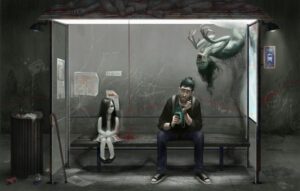
And there’s an obvious cinematic vibe – J-Horror this time – from this picture by Ohio-based concept artist David Sladek, aptly titled Waiting at the Wrong Bus Stop.  It strikes a particular chord with me.  During my misspent youth, I occasionally spent too long in a pub on a Friday or Saturday night and then found myself waiting for a late-night bus, in a decrepit and remote bus shelter, in the company of various unsavoury-looking characters.  Though none of them ever looked as unsavoury as the characters here.


From artstation.com / © David Sladek


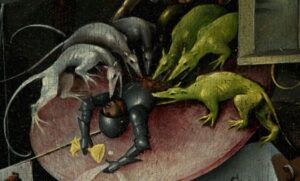
And now for something completely different.  For depictions of the surreally ghoulish, you can’t beat Hieronymus Bosch.  Here’s a detail from The Garden of Earthly Delights, the legendary triptych the Dutchman painted between 1490 and 1510.  Its panels depict the paradise that’d been the Garden of Eden, the titular garden with its cavorting, amorous nudes and… hell.  Obviously, the hell-panel contains the images that everyone remembers.  This part of it shows a knight being devoured by what Wikipedia describes as ‘a pack of wolves’, though to me they look more that horror-story staple, rats – giant ones.  No doubt the thoughts flashing through the unfortunate knight’s brain are similar to the thoughts of the first victim in James Herbert’s 1974 paperback epic, The Rats: “Rats! His mind screamed the words.  Rats eating me alive!  God, God help me…”


From smarthistory.org


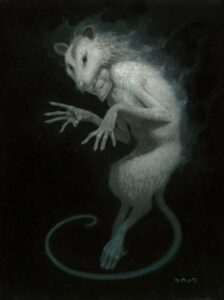
And keeping with rats, this gleeful-looking half-human, half-rat creature never fails to give me the creeps.  It’s the work of the American artist Brom, originally from Albany, Georgia.  His career has included illustrating the roleplaying worlds of Dungeons & Dragons and, more recently, providing pictures for as well as writing his own horror novels.  This illustration comes from his 2021 novel Slewfoot: A Tale of Bewitchery.


From bromart.com / © Gerald Brom


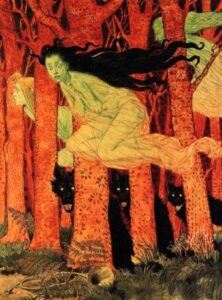
Meanwhile, proper wolves – though perhaps they’re werewolves – feature in this beautifully evocative watercolour, ink and pencil work done by the Swiss artist Eugene Grasset in 1892, Three Women and Three Wolves.  I love everything about it: the trio of eerily floating women, who must be witches, or nymphs, or spirits, and the half-shocked, half-indignant way the nearest woman looks out of the picture at us; the three black wolves also looking, and laughing, out of the picture; the subtly-patterned russet trunks of the forest trees; the carpet of ferns.  And what’s that lying in the bottom left-hand corner?  A horn?  A hunting horn?  Have the wolves just been chomping on a huntsman?  No wonder they look so jolly.


From wikipedia.org


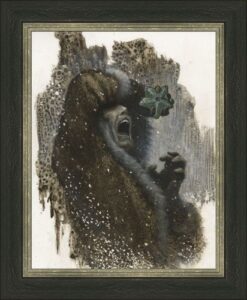
There aren’t any wolves, giant rats, giant spiders, J-Horror apparitions or any other monstrosities in this illustration by another Californian, Michael Whelan, described as ‘one of the world’s premier artists of imaginative realism’ and the most lauded artist in the history of science fiction.  (He has 15 Hugo Awards under his belt for a start.)  Done in acrylic, it’s an interior illustration for a Centipede Press edition of the famous H.P. Lovecraft novella At the Mountains of Madness (1931) which, as far as I can ascertain, hasn’t been published yet.  It’s the pictorial equivalent of a cinematic reaction shot.  But what a reaction.  The screaming explorer conveys all the cosmic horror that makes this particular story, set in the wastes of Antarctica, so claustrophobic.  Particularly clever are the margins of grey fur along the edges of the explorer’s garments.  They’re arranged so that they resemble that most Lovecraftian of motifs – a coiling tentacle.


From dmrbooks.com / © Michael Whelan / Centipede Press


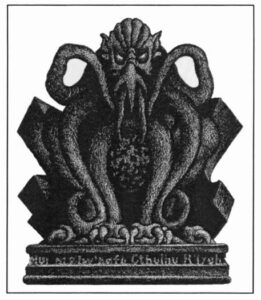
And on the subject of H.P. Lovecraft…  I traditionally feature ten scary pictures in these annual Halloween posts.  But this year, here’s an extra one, an eleventh, in honour of the legendary New Jersey artist Stephen Fabian, who sadly died in May this year (admittedly at a grand old age of 95).  I admire the black-and-white interior designs he did for a 1998 volume entitled In Lovecraft’s Shadow, which is a collection of short stories not by Lovecraft but by his pen-friend and posthumous publisher August Derleth.  Unfortunately, reproducing an entire illustration on this page would mean reducing it and shedding some of its intricate detail.  So here’s part of an illustration for the 1948 Derleth short story Something in Wood.  It shows a statue of Lovecraft’s ghastliest and most famous deity, Cthulhu, looking tentacle-y and baleful, as ever.


© Mycroft & Moran / Stephen E. Fabian Sr


Happy Halloween!

10 scary pictures for Halloween 2021


From unsplash.com / © Nicola Gambetti


It’s Halloween today and as usual I thought I’d celebrate the occasion by displaying ten of the most interesting pieces of macabre art I’ve come across in the past year.


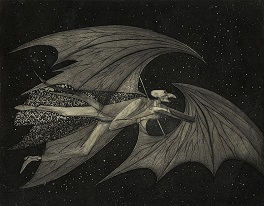
And what better way to start than with this illustration by the Italian-born, American-reared artist Joseph Mugnaini for Ray Bradbury’s 1972 fantasy novel The Halloween Tree?  Never having read that novel, I don’t know what the winged, cadaverous, hooked-nosed figure represents, but he makes an elegant and cosmically weird image.


© Yearling Books / From monsterbrains.blogspot.com 


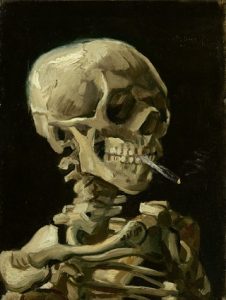
In these art-themed Halloween posts I usually include something featuring skeletons, as a nod to the festival that comes immediately after Halloween – Mexico’s skeleton-obsessed Dia de Muertos, the Day of the Dead, at the start of November.  This year’s skeletal number is by Vincent Van Gogh, no less.  Known as Skeleton with a Lit Cigarette in its Mouth, it now resides in Amsterdam’s Van Gogh Museum.  The museum’s website describes it as “a juvenile joke”, painted by Van Gogh “in early 1886, while studying at the art academy in Antwerp…  Drawing skeletons was a standard exercise at the academy, but painting them was not part of the curriculum.  He must have made this painting at some other time, between or after his lessons.”  I find the painting discombobulating, not just because of the cigarette or, indeed, the revelation that Van Gogh, associated with intensity and misery in most people’s minds, actually had a sense of humour.  No, it’s more that the skeleton is such a complex assemblage, of corners, ridges, crenels, shelves and slats.  It’s almost machine-like – slightly reminiscent of the lethal, metal endoskeleton that pops up at the climax of The Terminator (1982).


From vangoghmuseum.nl/en


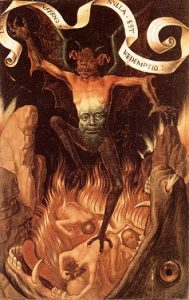
Going further back in time, I have to say I love this depiction of a devil, which occupies the front side of the right-hand panel in the triptych Earthly Vanity and Divine Salvation.  It was painted in the 1480s by the German-born, Bruges-based artist Hans Memling and is now on display in the Musée des Beaux-Arts in Strasbourg.  It’s the merriment with which the little fellow is dancing, on top of those sinners suffering in eternal hellfire, that gets me.  Why, he’s practically riverdancing.


From musees.strasbourg.eu


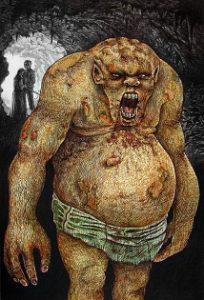
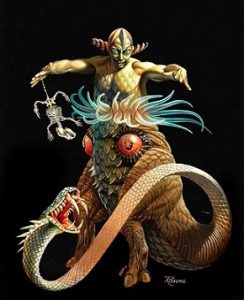
Now for a devil from a different culture and different part of the world.  This bloated, pustular apparition is what’s known as a ta-awi, a Philippine ogre / demon.  I happened across it on Cryptid Wiki, which describes the beast as “a large hideous humanoid from Philippine mythology.”  It “raids villages and devours people alive, but doesn’t eat their eyeballs because it can’t digest them for some reason.”  All I can determine about the artist is that his name is Isaiah Paul and he has a page on deviantart.com here.


© Isaiah Paul


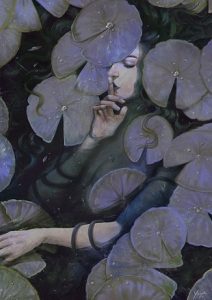
Less in-your-face and more ambiguous – the figure depicted may not even be supernatural, but just an odd person who likes to immerse herself among water lilies – is this painting, which I believe is called Hidden Things and is by modern-day Welsh artist Kim Myatt.  In fact, I’d say it evokes the subtle strangeness of the fiction of Robert Aickman.


© Kim Myatt


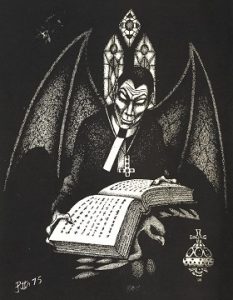
In 1980, when I was both a spotty adolescent and an aspiring writer, the first stories I ever submitted were to a handsome little magazine called Fantasy Tales. (The stories weren’t accepted, but the editors were kind enough to write back and offer me advice like “When you’re typing, try leaving a space after commas and full stops,” or “It’s probably not a good idea to have six single-sentence paragraphs in a row.”)  What made Fantasy Tales so visually appealing was that it featured the artwork of Lancastrian Jim Pitts, whose exquisitely detailed and atmospheric illustrations, often in black-and-white, recalled the great artists of the 1930s and 1940s pulp-fiction magazines such as Virgil Finlay and Hannes Bok. Here’s a gothic and vampirical item that Pitts did for issue four of the magazine Dark Horizons.


© Jim Pitts


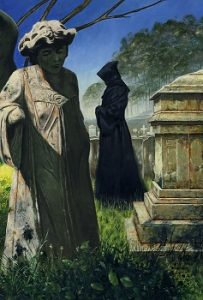
Another English illustrator I remember fondly from my youth is Les Edwards, whose work adorned the covers of paperbacks like Karl Edward Wagner’s Bloodstone (1975) and Robert Holdstock’s novelisation of the movie Legend of the Werewolf (1975).  I like Edwards’ work for being unpretentious and upfront – you certainly knew what sort of book you were getting when you saw his art on the cover – but also for its precision and colour.  This piece is called The Shade and achieves a chill despite its graveyard scene being pictured in daylight.  There’s a suggestion of mist creeping ominously in from the distant trees and the stone angel in the foreground adds to the discomfort.


© Les Edwards


A third illustrator whose work was familiar to me in my teenage years was the American science fiction and fantasy artist Rowena Morrill, who sadly died in February this year.  Morrill blazed a trail as a rare thing in 1970s paperback illustration – a woman.  Her work graced the covers of the first collections of stories by H.P. Lovecraft that I managed to lay my hands on, The Dunwich Horror (1978) and The Colour Out of Space (1978).  Her depictions of Lovecraft’s ‘Elder Gods’ as amalgamations of bits of wildly-different creatures may not be how most people imagine Cthulhu and company nowadays, i.e., with lots of tentacles, but they’re grotesquely and baroquely weird.  Here’s the picture that adorned The Dunwich Horror.


© Jove / HBJ Books


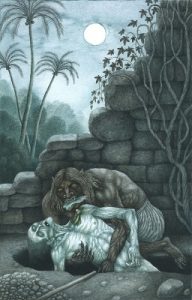
I’ve seen the Czech artist Jindra Capek described online as a ‘children’s book illustrator’.  Hmm.  I don’t know if the following picture, showing a hungry ghoul-type creature (though one civilised enough to be wearing what looks like a pair of boxer shorts) taking a bite out of a newly-dug-up corpse, is what you’d expect to see in the pages of a children’s book.  Come to think of it, though, my ten-year-old self would have been delighted by it.


© Jindra Capek


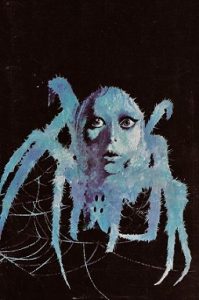
One sort of image I’ve always found unsettling is that of an insect, or general creepy-crawly, sporting the facial features of a human being.  I’m thinking of David Hedison in The Fly (1958), playing a hapless scientist whose experiments with teleportation go astray and end up grafting his head onto the bug of the title; or the scuttling, insectoid, human-faced aliens in The Zanti Misfits, the famous 1963 episode of the TV anthology show The Outer Limits.  Needless to say, I find this item disturbing.  It’s by the Belgian artist Henri Lievens, who in his lifetime created the covers for more than 200 books.  Entitled L’Araignee, its lady-faced spider is icky-looking but also, with those large doe eyes, worryingly fetching.  The lurid blue and black palette heightens its effect.


From unquietthings.com


And that’s it for another year.  Happy Halloween!