A splatter of life and death


© Plan B Entertainment / Mubi


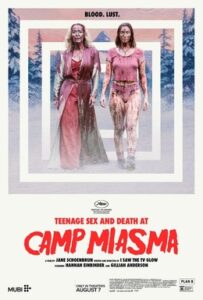
Two days ago, on October 26th, my wife and I received an early Halloween treat.  The 37th Singapore International Film Festival showed Teenage Sex and Death at Camp Miasma (2026), the new meta-horror movie from writer-director Jane Schoenbrun, at the Gallery Theatre in Singapore’s National Museum.  We got tickets for the event before it sold out.


This is Schoenbrun’s third movie, following We’re All Going to the World’s Fair (2021), which I haven’t seen, and I Saw the TV Glow (2024), which I did see recently while it had a tenure on Singaporean Netflix.  It took me two attempts to get into I Saw the TV Glow, but when I adjusted to its wavelength it really impressed me.  It’s a haunting and melancholic film about a pair of alienated high school kids (Justice Smith and Jack Haven) and their relationship with a kids’ horror TV show that, ultimately, causes reality to blur into fantasy.  When adulthood arrives and reality fails to blur anymore for one of them (Smith), the consequences are tragic.  The film has phantasmagorical qualities that sometimes make it feel like a David Lynch movie – if, crucially, David Lynch had grown up in the 1990s rather than the l1950s and 1960s.  And its ending is genuinely sad.


I certainly didn’t feel sad after watching Teenage Sex and Death at Camp Miasma, which I found a joyous and life-affirming, and very funny, experience.  Crudely, it could be summarised as 1950’s Sunset Boulevard transplanted into the universe of the Friday the 13th movies (1980-2009).  A very Friday the 13th-like horror franchise called Camp Miasma, wherein countless horny teenagers were bloodily slain by a killer called Little Death (I Saw the TV Glow’s Jack Haven with a box-shaped vent on their head and wielding a humungous spear), made pots of money in the 1980s.  Now a studio wants to reboot the franchise but, alas, the movies are today regarded as problematic.  The character of Little Death, dismissed at the time as a ‘freak’, is in modern parlance a transgender person.


To handle the project, and to cover their arses, the studio executives commission a young, queer director called Kris Wiliams (Hannah Einbinder), previously responsible for an arthouse film that was a remake of Alfred Hitchcock’s Psycho (1960) told ‘from the perspective of the shower curtain’.  They presume she’ll make it woke enough for modern sensibilities.


The earnest, nerdish but very likeable Kris has the idea of casting in her new version of Camp Miasma the actress Billy Presley (Gillian Anderson), who’d played the ‘final girl’ in the original movie of the series.  Billy has become a recluse and bizarrely lives in the huddle of old summer-camp buildings where that movie was filmed four decades earlier.  So, Kris goes to visit her and reality, as in I Saw the TV Glow, begins to blur…


Schoenbrun is obviously a big fan of the 1980s slasher movies that inspired the film.  In the opening-credits sequence, there’s a montage of Camp Miasma merchandising and artefacts, including video cassettes of the first movie and its (increasingly shite) sequels.  As with Friday the 13th, the sequels include a third instalment filmed in 3D, one called The Final Chapter and a subsequent one called A New Beginning, one where Little Death goes into outer space (Miasma 3000), and one where he tangles with a monster from a rival franchise (Little Death vs Sleepy Man).
 

© Crystal Lake Entertainment / New Line Cinema


Details elsewhere in the film also indicate how knowledgeable Schoenbrun is about the slasher school of cinema.  Billy mentions the unpleasantness of auditioning for the 1981’s The Burning (which was produced by a young Harvey Weinstein).  Kris refers to a gutter-press rumour that once circulated about Jamie Lee Curtis, star of the Halloween (1978-2022) franchise.  And Bruce Springsteen’s sister Pamela is alluded to – she appeared in the second and third entries in the Sleepaway Camp series in 1988 and 1989.


All this makes Teenage Sex and Death at Camp Miasma intriguing because Schoenbrun is transfeminine and non-binary and uses the pronouns ‘they’ and ‘their’.  And notoriously, those old slasher movies that Schoenbrun is a fan of frequently used gender non-conformity and transgender identity as cheap ways to explain their killers being murderously loopy.  See the first Sleepaway Camp movie in 1983, or Brian De Palma’s Dressed to Kill (1980) – which, despite its dodgy gender politics, is in my opinion the best slasher movie of the 1980s – or of course, the granddaddy of them all, Psycho.


I started watching the film wondering what it would do with those weary and mean-spirited old tropes.  As it turned out, Schoenbrun not only dismantles them but reassembles them and makes something wonderfully fresh out of them.  In the process, Teenage Sex and Death at Camp Miasma reclaims the slasher sub-genre for an audience that in the past was too often demonised by it.


One particular joy of the film is its performances.  Hannah Einbinder makes an engaging central character, clearly a stand-in for Schoenbrun, and sells the idea of somebody fascinated by the slasher sub-genre while simultaneously troubled by its misogyny, homophobia and transphobia.  But the film belongs to Gillian Anderson, whose portrayal of Billy Presley is majestic.  I’ve read that as a teenager Schoenbrun was a big fan of The X-files (1993-2002, 2016-18), where Anderson found fame playing FBI agent Dana Scully.  So, getting her to perform in their movie must feel like a dream come true.


Incidentally, another unwelcome trope in cinema is that of a sad, mad and possibly dangerous female movie star living as a recluse, past her prime and losing her looks.  It’s sexist – though if nothing else, it highlights the sexism of the industry around it.  Gloria Swanson, who played the washed-out actress Norma Desmond in Sunset Boulevard, was only 50 when the film was made; whereas nobody questioned the right of her co-star William Holden to still be a leading man in 1969’s The Wild Bunch when he was in his fifties.  But there’s none of that pathetic-ness about Anderson’s character.  Yes, she’s a bit odd at times;  but she’s also bold, funny, charismatic, sensual and empathetic.  Generally, she’s a joy every time she’s on screen.


Elsewhere in the cast, my wife was delighted to spot Kevin McDonald playing a clerk at a hotel near Billy’s summer-camp abode – McDonald is a member of the Canadian comedy team The Kids in the Hall, whose 1988-95 TV sketch show she’s a big fan of.  Another welcome face is that of Patrick Fischler, playing a scary gas-station attendant.  Fischler made a small but devastating appearance in David Lynch’s Mulholland Drive (2001) as the nightmare-haunted man who decides to check out what’s really behind the diner he keeps dreaming about and triggers the most frightening moment in the film – actually, for my money, it’s the most frightening moment in Lynch’s career.
 

© Sante Fe Productions / New World Pictures


I’ll admit, though, to having a few misgivings when I sat down to watch Teenage Sex and Death at Camp Miasma because I’m definitely not a fan of 1980s slasher movies.  I’d already become a horror fan by the end of the 1970s and, for me, the 1970s were the golden age of the genre.  During that decade, you got such classics as The Devils (1971), The Wicker Man (1973), Don’t Look Now (1973), The Exorcist (1973), Deliverance (1974), The Texas Chainsaw Massacre (1974), Carrie (1976), Jaws (1976), Suspiria (1977), Dawn of the Dead (1979) and Alien (1979).  So I was less than enthused when the 1980s arrived and all-of-a-sudden most horror filmmakers seemed interested only in making films wherein dummkopf teenagers get slaughtered by figures in Halloween masks and hockey masks.


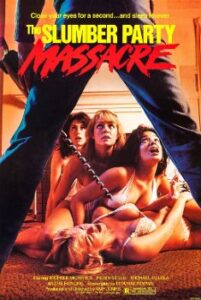
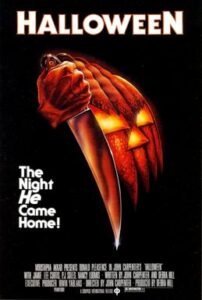
For me, the biggest crime of 1980s slashers like He Knows You’re Alone (1980) or Prom Night (1980) or Happy Birthday to Me (1981) or The Slumber Party Massacre (1982) was their stultifying lack of imagination.  Any display of imagination in the slasher sub-genre seemed to begin and end in the film that kickstarted it, John Carpenter’s original Halloween (1978) – itself a 1970s movie.


Teenage Sex and Death at Camp Miasma contains a number of scenes taken from the ‘original’ Camp Miasma movies of the 1980s.  Some are stylised re-imaginings of them that are operatic in their gusto and feature extraordinary geysers of blood.  But other scenes are meant to be ‘authentic’ ones, which Schoenbrun stages with a convincing, desperate, no-budget 1980s tackiness.  I did end up thinking that if I’d been a few years younger at the time, and less in thrall to 1970s horror movies, and the 1980s slashers had seemed like ‘forbidden fruit’ to me – films I was officially too young to watch and I only occasionally saw, furtively, through my fingers, on scratchy VCR recordings – I might have developed an affection for them too.  And today I’d enjoy them at least in a so-bad-they’re-good way.  (The reality is that I find them so bad they’re annoying.)


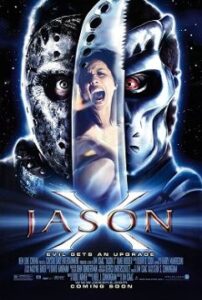
Incidentally, I was delighted that Schoenbrun included in their film a reference to 1983’s Videodrome, a horror movie far better than its slasher contemporaries, made by a genuinely visionary filmmaker, David Cronenberg.  As an actor, Cronenberg was game enough to appear in Jason X (2000), the entry in the Friday the 13th franchise where, yes, Jason Voorhees goes into outer space.


Lastly, it was a pleasure to see Teenage Sex and Death at Camp Miasma at the Singapore International Festival, surrounded by an enthusiastic and appreciative audience.  Everyone seemed to thoroughly enjoy the film and gave it a much-deserved round of applause at the end.
 

© Compass International Pictures / Aquarius Releasing

Richard Matheson – he was legend


© Orion Publishing Co


Something has got me thinking about Richard Matheson, the science-fiction and horror author and screenwriter who passed away in 2013 at the age of 87.


What thing?  Well, the news that the anti-Covid-19-vaxxers in America, determined to plumb the depths of stupidity to find new reasons for not getting vaccinated, have found the stupidest reason yet.  Speculation is rife that the vaccine could turn you in a zombie.  You know, like one did in the 2007 sci-fi / horror movie I am Legend, with Will Smith, which was based on Matheson’s 1954 novel of the same name.  This has prompted one of the movie’s scriptwriters, Akiva Goldsman, to step up and announce on social media: “Oh.  My.  God.  It’s a movie.  I made that up.  It’s not real.” In fact, the source of the contagion in the movie wasn’t a vaccine but a virus, genetically reprogrammed by Dr Emma Thompson to combat cancer, going spectacularly rogue.


In Matheson’s novel I am Legend the monsters are vampires, not zombies.  Also, what turns people into those vampires isn’t the movie’s lab-reprogrammed virus, but a mysterious pandemic.  However, the book’s premise of the world being suddenly and nightmarishly turned upside down and a small number of uninfected humans finding themselves menaced by those who’ve been infected and turned into monsters, including their own loved ones, was one that a young George Romero appropriated for his seminal 1968 movie Night of the Living Dead.  In doing so, Romero made it the blueprint for at least 80% of the zombie movies that have lurched across cinema and TV screens ever since.


In the novel, the number of uninfected humans is small indeed: just one, Richard Neville, who is alone in the world during the daytime and then under siege in his fortified house at night, by the vampires that everyone else has turned into.  Gradually, Neville, researching the plague, stumbles on scientific explanations for the vampire-like symptoms of its victims, why they drink blood, why they can only be killed by stakes through the heart, and why they have an aversion to sunlight, garlic and crucifixes.  I am Legend also ends with an unnerving psychological twist.  Neville, who’s spent his days roaming the surrounding city and staking the slumbering vampires, realises that the vampires are now the normal ones and he’s become the monster of everyone’s nightmares, the deadly legend of the title.


It’s a pity that though I am Legend was filmed on several occasions, and though Matheson lived to a venerable age, he never got to see a satisfactory celluloid version of it.  The novel received its first film treatment in Italy, where Rome unconvincingly stood in for Los Angeles, with the cheaply and incompetently made L’Ultimo Uomo della Terra (The Last Man on Earth).  Neville was played by Vincent Price, whom Matheson admired as an actor but thought was miscast in the role.  L’Ultimo Uomo della Terra was at least fairly faithful to the book, unlike the subsequent film versions, 1970’s The Omega Man, with Charlton Heston, and the 2007 one.  In The Omega Man the vampires have become a group of demented albino mutants called, with an unsubtle reference to Charles Manson, the Family.  In the Will Smith version of I am Legend they’re even less impressive, a bunch of bald, hyperactive zombies animated by some shoddy CGI.


Both the later movie versions lack the courage to portray Neville as being totally alone and eventually have him encounter other, as yet uninfected survivors.  They also lack the courage to include Matheson’s game-changing ending.  Instead, they close with Heston and Smith depicted as Christ-like figures who nobly sacrifice themselves for the good of what’s left of humanity.  Neville was a more interesting character when he discovered he’d become a bogeyman.  Still, disappointing though all three film versions are, there’s at least a good graphic-novel adaptation of I am Legend available.


© Gold Medal Books


The more I reminisce about Matheson, the more I realise what a wonderful and influential writer he was.  His other big – though ‘big’ perhaps isn’t the most appropriate adjective – novel of the 1950s was The Shrinking Man (1956).  Its hero, an archetypal middle-class American male called Scott Carey, is exposed to a radioactive cloud that causes his body to shrink at the rate of a seventh of an inch every day.  Thereafter, Carey’s world turns nightmarishly upside down too, though at a more gradual rate than Richard Neville’s.  First, he experiences psychological and sexual humiliation as he finds himself increasingly dwarfed by his normal-sized wife.  Following an assault by the family cat, no longer a loveable moggie but a carnivorous monster, the now-tiny Carey loses all contact with humanity and finds himself trapped in his house’s basement where the dangers facing him become formidable indeed.  A common spider, for instance, takes on elephantine proportions.  And Carey’s shrinking doesn’t stop, let alone get reversed.  At the book’s close, he muses, “If nature existed on endless planes, so also might intelligence.”  Thereafter, he dwindles away into infinity.


A year after its publication, the novel was filmed as The Incredible Shrinking Man, directed by Jack Arnold and with Matheson providing the script.  Matheson was unhappy with how Arnold structured the film.  He told the story in linear fashion, whereas Matheson wanted it to begin with the shrunken Carey in the basement, reliving what had happened to him via a series of flashbacks.  However, it’s still one of the best science fiction movies of the 1950s.  It crucially retains the novel’s bleakly philosophical ending.  I can remember seeing the film on TV as a kid and being genuinely upset when the ending defied my expectations that things would finish on an upbeat note.  The Incredible Shrinking Man was, incidentally, one of the great J.G. Ballard’s top ten favourite sci-fi movies.


© Sphere Books


As well as novels, Matheson was a prolific writer of short stories, many of which were collected in four books called the Shock series.  Shock 1-4 were published in Britain in the 1970s by Sphere Books, who decorated the covers with lurid and gory images – the antithesis of the unsensational, non-violent and thoughtful works inside.  The stories I remember best include Long Distance Call, about a woman plagued by mysterious phone calls that, she discovers, emanate from a local cemetery into which the telephone wire has blown down; The Children of Noah, about a motorist who finds himself in Kafkaesque predicament when he breaks the 15-miles-per-hour speed limit of a tiny American town called Zachary; and the brilliant The Splendid Source, in which a man embarks on a quest to find out where dirty jokes really come from.


Long Distance Call was one of several Matheson stories that were turned into episodes of the celebrated TV anthology series The Twilight Zone (1959-64).  The best of these, adapted by Matheson himself, was of course Nightmare at 20,000 Feet.  In this, William Shatner essayed his second-most-famous role, that of a just-released psychiatric patient who’s on board a plane and, looking out of the window, sees a gremlin dismantling one of the engines on the wing.  Whenever he tries to alert the crew and fellow passengers, the beastie inconveniently disappears from view.  Particularly memorable is the moment when the traumatised Shatner dares to peek through the window again and discovers the gremlin pressing its face, which resembles that of a hare-lipped teddy bear, against the outside of the glass and staring in at him.  The episode was remade as a segment of the movie version of The Twilight Zone in 1983, with John Lithgow in the Shatner role, and ten years later it received the ultimate accolade – it was spoofed in a Treehouse of Horror edition of The Simpsons, with Bart Simpson the only passenger on the school bus able to see a gremlin sabotaging its engine.  This version was called Nightmare at 5½ Feet.


© Universal Pictures


Other episodes that Matheson penned for The Twilight Zone were also influential.  A World of Difference is about a businessman who makes the mind-blowing discovery that he’s a fictional character and his life is actually a movie.  Furthermore, the movie has just had its production halted, meaning he’ll have to live in the ‘real’ world as the declining, drunken movie star who’s been playing him.  This clearly informs Peter Weir’s 1998 film The Truman Show.  Meanwhile, Little Girl Lost tells the tale of a child who, one night, falls from her bed and into another dimension, a mysterious, misty void from which she can hear her parents’ concerned voices but can’t escape.  A young Steven Spielberg no doubt saw and remembered this one, because the same idea features in 1982’s Spielberg-produced Poltergeist, though this time the little girl is sucked into the other dimension through the household TV set.  And yes, The Simpsons spoofed it too in Treehouse of Horror.


Steven Spielberg has much to thank Matheson for.  Matheson’s short story Duel, based on an experience he had on November 22nd, 1963 – of driving home depressed at the news of Kennedy’s assassination and being harassed by a large, tailgating truck – was filmed as a TV movie in 1971 by Spielberg and gave the young director his first big critical success.  Again, Matheson wrote the script.  Duel-the-movie has motorist Dennis Weaver and the psychopathic driver of a 1955 Peterbilt 281 truck get into a deadly game of cat and mouse around the roads and highways of rural California.   We never see the truck driver himself, just his immense, bellowing, dinosaur-like vehicle.  Duel is the archetypal man-versus-machine story and, again, has been influential.  Stephen King basically rewrote it (but upped the ante by adding lots of malevolent vehicles) with his short story Trucks, which he later filmed as Maximum Overdrive (1986).


The made-for-television movies that filled American TV schedules in the 1970s kept Matheson busy.  As well as Duel he scripted The Night Stalker (1972) about a reporter called Carl Kolchak (Darren McGavin) who investigates a series of killings in modern-day Los Angeles and discovers that the perpetrator is a vampire.  The Night Stalker was successful enough to eventually spawn a TV show called Kolchak: The Night Stalker (1974-75), also starring McGavin, in which Kolchak investigated other strange cases involving monsters and supernatural phenomena.  Though short-lived, the show was a major inspiration for Chris Carter, whose massively popular The X-Files (1993-2018) had a similar theme.  Carter acknowledged his debt to Kolchak by having Darren McGavin guest-star in two X-Files episodes.


Meanwhile, the TV anthology movie Trilogy of Terror, from 1975, was based on three of Matheson’s short stories.  The first two segments are unmemorable, but the third one, which Matheson scripted from his story Prey, is great.  It stars Karen Black as an insecure woman who tries to shore up her relationship with her boyfriend, a lecturer in social anthropology, by buying him an antique ‘Zuma fetish doll’ as a birthday present.  The doll is a hideous-looking thing and sports a many-fanged grin resembling a Venus flytrap.  Before she can give the doll to its intended recipient, it comes to violent, gibbering life and she spends the evening fighting it off in the confines of her apartment.  Black’s plight is the inverse of the shrinking man’s.  She’s normal-sized and the threat she faces is tiny, but terrifying.  This also creates the template for Joe Dante’s movie Gremlins in 1984.  In particular, the scene in Gremlins where Frances Lee McCain fights off a horde of the sneering, reptilian mini-monsters in her kitchen, employing a blender and a microwave oven as weapons, is very reminiscent of Trilogy of Terror.


When he wasn’t writing novels, short stories and television scripts, the ever-industrious Matheson was writing for the cinema.  In the early 1960s, he scripted several of the movies based on works by Edgar Allen Poe that were made by American International Pictures and directed by Roger Corman: The House of Usher (1960), The Pit and the Pendulum (1961), Tales of Terror (1962) and The Raven (1963).  All told, Matheson did a good job of preserving the original stories’ gloomy, clammy spirit, whilst meeting the commercial demands of a studio and a director who were already famous for their exploitation movies, and keeping engaged a star – Vincent Price – whose performances tended to slip into the knowingly hammy when his material bored him.  The movies aren’t the most faithful adaptations of Poe, but they’re surely the most fondly remembered ones.


© Academy Pictures Productions / 20th Century Fox


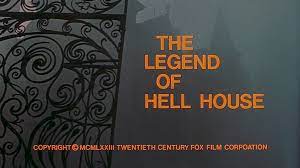
Matheson also worked on British movies.  For AIP’s trans-Atlantic rival, Hammer Films, he scripted The Devil Rides Out in 1968 and managed to turn Dennis Wheatley’s bloated, reactionary novel about upstanding Anglo-Saxon aristocrats fighting a bunch of ghastly Satan-worshipping foreigners into something rather good.  And in 1973, he adapted his haunted-house novel Hell House for the screen.  The result was The Legend of Hell House, directed by John Hough and starring Roddy McDowall, Clive Revill, Pamela Franklin and Gayle Hunicutt as psychic investigators trying to get to the bottom of terrifying supernatural manifestations in the titular mansion.  The movie’s ending, which has the surviving investigators finding a hidden sanctum where the psychic forces are emanating from an embalmed body, played by a very un-embalmed-looking Michael Gough, is pretty stupid, which Matheson himself admitted.  Still, John Hough directs the film’s scary set-pieces with vigour and there’s an unsettling electronic score by Delia Derbyshire and Brian Hodgson.


Matheson was a modest soul and in interviews he usually seemed puzzled that so many people could be so inspired by his work.  He might have ended up a very rich man if, like his famously litigious contemporary Harlan Ellison, he’d bothered to sue every filmmaker and writer who’d ripped off his ideas.  Mind you, he’d probably have spent all his time in court, so I’m glad he just turned the other cheek and devoted that time instead to writing his marvellous stories.


© Cayuga Productions / CBS Productions