In the past few weeks I’ve been fortunate enough to attend two of the best musical concerts I’ve ever experienced. Both took place at Singapore’s Star Theatre.
On July 29th, the Star hosted the English trip-hop collective Massive Attack. Formed in Bristol in 1988 by Robert ‘3D’ Del Naja, Grant ‘Daddy G’ Marshall, Adrian ‘Tricky’ Thaws and Andre ‘Mushroom’ Vowles, Massive Attack is less massive in terms of members nowadays. Only 3D and Daddy G remain, Tricky and Mushroom having left in 1995 and 1999 respectively. What we got on July 29th still sounded massive, though.
In the 1990s, I loved the band. Their three albums from that decade, Blue Lines (1991), Protection (1994) and Mezzanine (1999), are all-time favourites of mine. I found their sound irresistible: its hypnotic melodies, its measured pace, its building crescendos, its atmospherics, its lurking orchestral grandeur – composer John Barry never seemed far away – and, unpinning everything, its relentless drums and basslines. After hearing them, I had a hard time getting songs like the soaring Unfinished Symphony or the sublimely restless Safe from Harm from Blue Lines, or the haunting Teardrop from Mezzanine, out of my head.
My ultimate Massive Attack song, though, was Mezzanine’s Angel, which after a slow but remorseless build-up lets fly two minutes and 19 seconds in. That’s the best crescendo in music ever. It would make a terrific accompaniment to a movie sequence where there’s a brooding sense of unease, then an explosion of action. It has been used in films, actually, but the only one I’ve heard it in was the forgettable 2004 remake of Robert Aldrich’s The Flight of the Phoenix (1965). I know it turned up in Guy Ritchie’s Snatch (2000) too, but I’ve never watched that one.
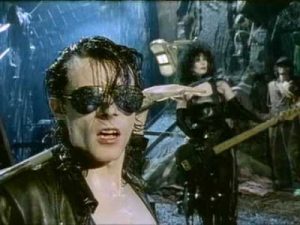
The one time I saw them live during the 1990s was in insalubrious circumstances. They played at the now-defunct Scottish music festival T in the Park in 1999. The crowd was boozed-up and raucous and I’d been at the front of it all afternoon, before they performed, watching earlier bands on the bill. These included the then-popular rock band Reef. While Reef were playing, someone bodysurfed past me and accidentally struck me in the head with a boot. A week previously, I’d been the victim of an assault, which resulted in me getting multiple stitches in the back of my head in an A and E department. The body-surfer’s boot opened those stitches and blood leaked out everywhere, including down my face. Consequently, when Massive Attack came on, I looked like I’d just strolled off the set of a horror movie.
It didn’t help that a crowd-member then flung a bottle at the stage, which smashed down close to their frequent collaborator, the reggae roots singer Horace Andy. They continued playing, but looked extremely pissed off. (They should have followed the example of Jim Kerr, the frontman of Simple Minds. Supposedly, once, when somebody chucked a bottle at Simple Minds during a Parisian gig, he told the crowd, “I hope whoever threw that dies of cancer.”)
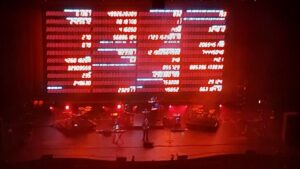
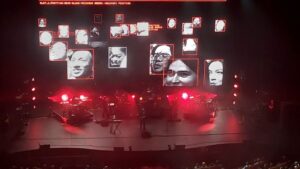
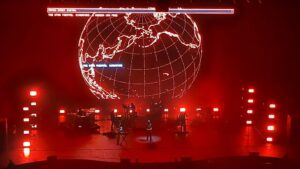
So, what a contrast to see them again, 27 years later, from a vantage point high in the circle of the grand and comfortable Star Theatre. On the stage, 3D, Daddy G and their team of travelling musicians were ensconced, in near-darkness for much of the time, among their instruments and consoles while the theatrics were provided by dazzling visuals that materialised on giant screens above them to accompany each song. In fact, ‘visuals’ is too lame a word to describe what the audience saw. A reviewer in Australian Musician wrote that the band used “monolithic LED screens, archival footage, political imagery and dreamlike sequences to create a constantly shifting portrait of a world where personal freedom, privacy and even human emotion are increasingly commodified.”
As the visuals shifted wrenchingly from the picturesque Swiss lakeside city of Zug (where much equity money ends up, apparently) to Africa and impoverished locals having to dig up precious minerals in wretched conditions, from worrying graphics illustrating the global reach of mass surveillance to gibbering headlines about celebrities, from Peter Thiel quotations about why democracy is a bad idea to bald statements that could have come from 1984’s Ministry of Truth (‘WHAT IS PURPOSE?’), I was reminded of the work of radical documentary filmmaker Adam Curtis. Later, I learnt that Curtis and the band have enjoyed a long association and he worked with them to put these digital displays and film clips together.
Not that the visual show was entirely serious. I was delighted to see the great horror actor Bruce Campbell get chased through a cabin by the forces of darkness in The Evil Dead (1982) while a message flashed up telling us we can’t escape ‘the algorithm’. Later, another great horror actor, Boris Karloff, appeared as the title character in The Mask of Fu Manchu (1932) in an ironic commentary on the West’s tendency to blame China for everything. (See Covid-19.)
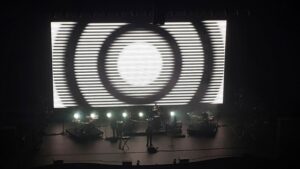
Musically, it was superb. The crowd gave roars of appreciation for Horace Andy, singing on three tracks, including – yes! – Angel; and for other longtime collaborators Deborah Miller, singing on Unfinished Symphony and Safe From Harm, and Elizabeth Fraser, who did vocal duties on Mezzanine’s Black Milk and Group Four and a cover of Tim Buckley’s Song to the Siren (1970). Fraser also brought the evening to a perfect close with the final song, Teardrop.
The gig was overshadowed by an incident at the end when, briefly, 3D and Daddy G brandished a Palestinian flag onstage. Singapore’s Straits Times newspaper reported that this broke a local law forbidding “the public display of foreign national emblems without a permit or exemption.” Afterwards, according to the Times, the authorities released a statement saying, “…the police… administered stern warnings to both men for the offences of Section 3 of the Foreign National Emblems (Control of Display) Act and Section 16 of the Public Order Act,” and “both men will be banned from re-entering Singapore.” The BBC, meanwhile, quoted an official spokesman as saying Singapore’s police “take a serious view of acts which could potentially harm the racial and religious harmony in Singapore”.
This leaves me with mixed feelings. I believe people should be free to express their opinions, so long as that expression doesn’t cause innocent parties any harm, and I don’t see how two 60-something men holding a flag for a few seconds in a theatre full of Massive Attack fans could cause much harm. However, I also believe in the old adage, ‘When in Rome, do as the Romans do’. Singaporeans are proud of the stable, prosperous, multicultural society they’ve created, in a region that, elsewhere, has often been troubled by ethnic and religious conflicts. For many people, having strict laws outlawing the display of foreign flags (and eliminating any possibility they could be used to stir up trouble) is a price worth paying. I didn’t see much sympathy for the band on local Internet discussion-forums, where the sentiment was largely, “Bloody foreigners, coming over here, breaking our laws.” “Good riddance to bad rubbish,” said one commentator, evidently not a fan.
It’s worth noting that the UK authorities have given Massive Attack a hard time too for their pro-Palestinian sympathies. 3D was arrested in Trafalgar Square in April this year for carrying a sign expressing support for the proscribed, allegedly terrorist group Palestine Action.
Anyway, this furore obscures the fact that the concert itself was exceptional.
Then on August 7th, singer-songwriter David Byrne – one-time vocalist and guitarist with legendary American new-wave band Talking Heads – performed at the Star to promote his 2025 solo album Who is the Sky? This gig didn’t begin well for me. When I bought my ticket via Ticketmaster, I got an email warning me not to try to enter the venue using a screenshot of it. I should have the ticket open in my Ticketmaster account, on my phone, ready for security staff to scan its QR code. Just before I set off for the Star, I discovered the link in the email was taking me not to the David Byrne ticket in my account, but to the Massive Attack one from 10 days earlier. This kept happening on my phone only. When I clicked the link on my computer, I was taken to the correct ticket. Finally, exasperated, I took a screenshot of the Byrne one on my computer and sent it to my phone, as proof I’d at least bought the ticket.
When I explained the problem to the ladies at the Ticketmaster table outside the Theatre entrance, they told me to use the screenshot on my phone.
“But your instructions said…”
“Just use it!”
The security lady looked at me tetchily when I presented the screenshot, but she scanned its QR code and it was accepted. I was in.
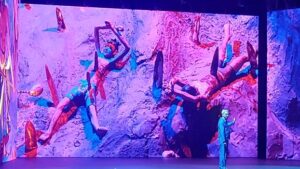
I wasn’t only me suffering technical difficulties. The gig was scheduled to start at eight o’clock but nothing happened onstage for another half-hour – except for a few minutes when David Byrne himself walked into view. He explained that some glitches were delaying proceedings and, by way of apology, entertained us with some sightseeing photos he’d taken that day in Singapore. He did this with much enthusiasm. His photos appeared on big screens above him and included one taken at Singapore’s marvellous Haw Par Villa, where you can stroll through a giant diorama depicting the 10 Courts of Hell from Chinese and Buddhist mythology. That photo depicted sinners impaled bloodily on a ‘hill of knives’, which Byrne cheerfully informed us was the afterlife punishment awaiting people who charge too much interest on loans. You know, bankers.
Byrne came across as someone with genuine interest in the places he travelled to and his good humour was greatly engaging. I’d always thought he was decent, but after this episode I decided he was an absolutely top bloke.
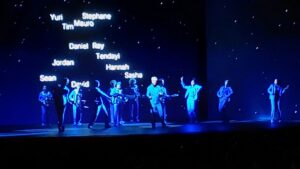
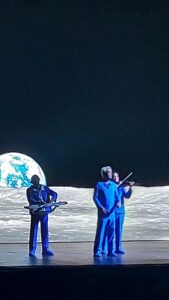
During the delay I’d observed how the stage was empty. It contained no instruments or equipment. When the gig finally started, I understood why. After the opening number, a static rendition of the 1979 Talking Heads song Heaven, which Byrne sang accompanied by two musicians playing a violin and portable keyboard (while the earth rose majestically through space on the screens behind), the show really became a show – a dance one as well as a musical one.
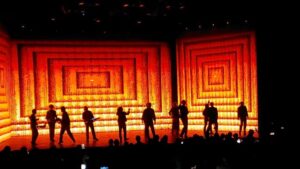
For each song, Byrne and eleven blue-clad co-performers went through a set of choreographed moves. Six of the eleven were dancers and background singers. The other five were musicians, carrying their instruments with them – guitars and keyboards, drums such as a tom-tom, timbale, snare drum and marching bass drum, and, when the song required, a violin or saxophone. The musicians especially impressed me, keeping focused on where they were going as well as on what they were playing. Meanwhile, the screens conjured up various backdrops: American suburbia, a forest, a skyscape, psychedelic patterns, a disorientating video where the same performers followed the same moves they were currently doing onstage but wearing animal-heads.
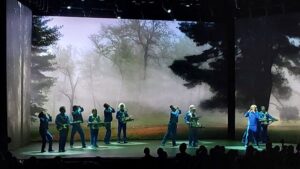
It felt part Broadway musical, part cheerleader routine, part circus (with Byrne as the ringmaster), part parade by a marching band. Byrne even reminded me at times of Willy Wonka, orchestrating his co-performers like Oompa Loompas. (I have to say, though, that with his blonde hair and cheery demeanour, Byrne looked more like Peter Isherwell, the sinister, ultimately incompetent billionaire played by Mark Rylance in the 2021 end-of-the-world movie Don’t Look Up.) It’s also pretty astonishing how Byrne can do all this, seemingly effortlessly, at the age of 74.
With a plethora of drums, the music was percussion-heavy, which suited the catchy rhythms of Byrne’s solo songs perfectly. I wondered if his Talking Heads songs would come across as well, but they did. Several (including 1985’s And She Was) were performed during the first half of the set, before the focus switched to his solo stuff. Then, near the end, out came the biggest Talking Heads numbers: Psycho Killer (1977), Life During Wartime (1979), Once in a Lifetime (1981) and Burning Down the House (1983). Psycho Killer got the biggest reaction from the crowd, who inevitably chanted “Fa-fa-faa-fa-fa, fa-fa-faa-fa-fa!” in unison. But I think it’s Once in a Lifetime that’s my favourite in Byrne’s oeuvre. I remember first hearing it on Top of the Pops (1964-2006) when I was 16 and thinking it was bloody weird. A week later, when I heard it again, I was hooked.
Anyway, this was a wonderful concert too. Maybe not quite a once-in-a-lifetime experience, but not far off one.