Uncle Sam (Part 1)


From wikipedia.org / © Sean Koo


Having just paid tribute to the centenarian Mel Brooks, I hadn’t intended to post another film-related entry so soon on this blog.  Sadly, however, Sam Neill, whom I admired both as an actor and as a person, passed away three days ago and I thought I should pen some words in honour of him too.


Neill’s passing was made even sadder by the fact he’d recently been declared cancer-free after a five-year battle against the disease.  Seemingly, his immune system was so weakened by the treatment he’d received that he fell prey to pneumonia.  Rima Te Wiata, Neill’s co-star in Hunt for the Wilderpeople (2016) told the New Zealand Herald: “It really sucks, actually… I think he would be like: ‘For goodness sake, I got over my cancer. And now look, now I get pneumonia. What next?'”


Though officially a New Zealander, Neill could also be called a Northern Irishman because in 1947 he was born in Omagh, county-town of County Tyrone (17 miles away from where I spent my childhood), to New Zealand and English parents.  He moved from there to Christchurch in 1954 and presumably, if he’d ever acquired a Northern Irish accent, he soon lost it.  Decades later, when he played the psychotic Belfast policeman Chester Campbell in the first two seasons of the TV show Peaky Blinders (2013-14), he asked two mates – Northern Irish actors Liam Neeson and James Nesbitt – for coaching so that he could produce a convincing ‘Norn Irn’ accent.


He also began life as ‘Nigel’, but by the age of 11 had taken to calling himself ‘Sam’.  When he started acting, he was glad he’d chosen the blokey ‘Sam’ over the slightly effete ‘Nigel’.  In an interview published recently in the Guardian, he commented, “If I’d stayed with Nigel Neill, I don’t think I would have had a film career.”  He’d obviously never encountered the great screenwriter Nigel Kneale, whose creations included the Quatermass films and TV dramas.


Though he’d done film and TV work throughout the 1970s, including Roger Donaldson’s thriller Sleeping Dogs (1977), described on its Wikipedia page as “the first feature-length 35 mm film produced entirely in New Zealand”, Neill first came to my attention in 1981, when I was a horror-film-obsessed teenager and when he appeared in two fairly high-profile horror films, Graham Baker’s Omen III: The Final Conflict and Andrzej Żuławski’s Possession.  I read about them in film magazines like Starburst and Fangoria, though I was too young to see them in a cinema because in the UK they were given ‘X’ certificates, meaning only people aged 18 and over could see them.  In the case of Possession, I didn’t even have a chance to see it later on video for it ended up on the Britain’s infamous (and idiotic) ‘video nasties’ list, deemed likely to ‘deprave or corrupt’ its viewers and thus banned from home viewing.
 

© Mace Neufeld Productions / 20th Century Fox


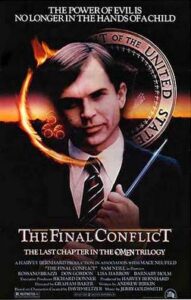
Omen III: The Final Conflict was the third in the trilogy that’d started with Richard Donner’s The Omen (1976) and continued with Don Taylor’s DamienOmen II (1978) and that told the tale of Damien Thorn, the son of Satan and the Antichrist who, according to Biblical prophecies, will rise to power in end times.  Unlike the earlier two movies, where Damien is depicted as a kid (first played by Harvey Spender Stephens, then Jonathan Scott-Taylor), he’s now an adult.  Portrayed by Neill, he’s the powerful CEO of Thorn Industries and soon into the film also becomes US ambassador to Britain, a position from which he hopes to launch his biggest project yet – the thwarting of the Second Coming of Christ.


As Damien, Neill is suave enough to be convincing as a powerful operator in purely human affairs, one who can rub shoulders with top people in top places and get what he wants; whilst also having a sinisterness and darkness that makes you accept him as the same, infernal creature he was in the earlier films (especially the disturbingly baleful Spender Stephens in the first Omen).  Alas, Neill is the only thing of value in the film.  Coming after the original, which was very enjoyable hokum, and the second film, which at least had its moments, The Final Countdown is a damp squib.  Unlike his predecessors Donner and Taylor, Graham Baker doesn’t have the directing chops to properly mount the Omen films’ main attractions – the set-piece ‘accidents’, elaborate, supernaturally-engineered and inevitably fatal, that bump off anyone who gets in Damien’s way.  That said, the scene early on where the previous American ambassador commits ‘suicide’ and conveniently creates a job opening for him, is agreeably splattery.


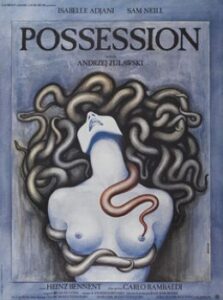
A far less conventional horror film, and a far better one, is the same year’s Possession.  Though it defies all description, you could say it was a particularly traumatic and traumatising break-up movie…  Or a brooding parable about the Cold War (it was filmed in West Berlin)…  Or a psychological thriller involving doppelgangers…  Or a body-horror film wherein a woman makes repeated love to a vilely tentacled, half-human, half-squid creature…  Or an espionage thriller leading to an apocalyptic World War III finale.


Director Andrzej Żuławski – himself suffering from depression after recently being expelled from his native Poland – put Neill and his co-star Isabelle Adjani through the wringer during the film’s making.  Neill remarked in 2021 that he ‘escaped’ from the movie with his ‘sanity barely intact’.  Adjani suffered even more, though, and supposedly needed a couple of years to get over the experience.  That’s understandable when, for instance, you see the berserk intensity of the now-legendary sequence where she suffers a miscarriage in a subway corridor.  Actually, a young Gaspar Noé must have been highly impressed by that sequence because he basically got Sofia Boutella to recreate it in his 2018 movie Climax.
 

© Gaumont Distribution


Things were looking up for Neill’s career in 1983, when he played the title role in Reilly, Ace of Spies, a 12-part TV series dramatizing the life of real-life superspy Sidney Reilly during the first quarter of the 20th century.  Reilly was scripted by Troy Kennedy Martin and directed by Jim Goddard and Martin Campbell and Campbell, a fellow Kiwi, would later direct two James Bond movies, Goldeneye (1995) and Casino Royale (2006).  In fact, for a time in the mid-1980s it looked like Neill was in with a shout of becoming the next James Bond.  (It makes sense – there have been Scottish, Australian, Welsh and Irish Bonds, so why not a New Zealand one?)


In the Guardian interview I mentioned earlier, he was asked about the Bond role.  He said he would have accepted it if it’d been offered to him, but added: “I’m also aware that I wouldn’t have enjoyed my life so much if I was an ex-Bond. That’s what people would say when I went for my morning coffee. ‘Look – it’s what’s-his-name, who used to be James Bond?’ ‘Yeah, he was the one I never really liked.’”


In 1989 he had a good role in Philip Noyce’s Dead Calm, a maritime thriller / horror movie that conveys both the claustrophobia of being at sea – you’re stuck in the confined space of a boat – and the agoraphobia of it – you’re out on a vast, empty mass of water, far from civilisation and help.  Neil and Nicole Kidman (in her seventh, and breakout, film role) play a couple who, while yachting, discover a sinking schooner.  They pick up one survivor (Billy Zane) who – surprise! – turns out to be a crazed killer.


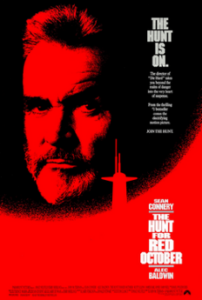
Still, I had the impression that during the late 1980s Neil’s moment had passed and he was destined to spend his remaining career in movies’ supporting casts as a reliable character actor.  This was suggested, for example, by his role in 1990’s The Hunt for Red October, where he gets fourth-place billing after Sean Connery, Alec Baldwin and Scott Glenn.  He plays the second-in-command to Connery’s Captain Marko Ramius, and a participant in a plot whereby the only submarine-commander in the Soviet fleet with a Scottish accent, and his officers, commandeer a super-submarine called Red October and attempt to defect with it to the West.  When Neill’s character starts waxing lyrically to Connery about the rabbit farm he plans to start up after they reach America, you know he’s going to get killed before the end.
 

© Mace Neufeld Productions / Paramount Productions


However, then, Neill’s fortunes took an upswing – because Steven Spielberg and blockbuster-dom came knocking.


To be continued…
It could have happened here


© Triad Granada


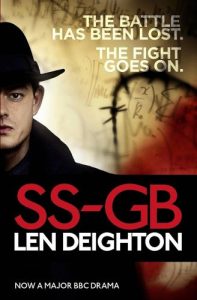
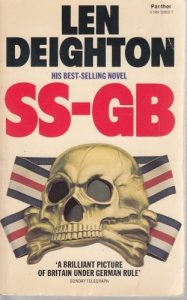
Recently, I’ve read a couple of ‘alternative history’ novels that imagine different realities in the 1930s and 1940s: wherein Britain and the USA were taken over by fascism just as Germany and Italy were.  What could have induced me, in 2025, to read novels about Britain and the USA succumbing to fascism?  I really can’t imagine.  Here are my thoughts on one of those books, Len Deighton’s SS-GB (1978).


Deighton is best known as the author of The IPCRESS File (1962), the book that introduced the world to Harry Palmer, a down-at-heels spy whose humdrum experiences are a corrective to the glamorous espionage fantasy-world inhabited by Ian Fleming’s James Bond.


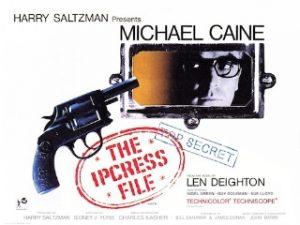
Actually, that description does both Deighton and Fleming a disservice.  Harry Palmer isn’t even the name of the protagonist in The IPCRESS File.  Deighton keeps its first-person narrator anonymous.  The name was only devised for the character in 1965 when the book was made into a film with the non-capitalised title The Ipcress File, directed by Sidney J. Furie and starring Michael Caine.  Also, while the film version is determinedly unexotic and, possibly for budgetary reasons, restricts its action to a non-swinging 1960s London, Deighton’s novel is more expansive.  It allows its hero to do some properly exciting, Bondian things, such as participate in a rescue mission in Beirut and visit an American neutron-bomb test site in the Pacific Ocean.


Meanwhile, Fleming’s novels certainly featured exotic locations (the Caribbean, the Swiss Alps, the French coast), exotic activities (scuba diving, skiing, gambling in casinos) and exotic food and drink (caviar, stone crabs, Dom Pérignon champagne), which no doubt tantalised his readers, many of whom were living in drab, austere, post-war Britain and eating such rationing-era fare as pig’s trotters, spam and lardy cake.  But he invested at least some of those novels with a little grit and realism too.  However, just as the medium of film made Harry Palmer more lowkey than the literary original, so a series of over-the-top movies unanchored the character of Bond and floated him off into the realms of total fantasy.  Ironically, the Harry Palmer movies and the first nine Bond movies shared the same producer, Harry Saltzman.


© Lowndes Productions / Rank Film Distributors


I was reminded of this dichotomy when reading SS-GB because, while its hero inhabits a grey, downbeat world, where dealing with even the simplest details of everyday life can be exhausting, some big, almost Bondian things hove into view and require his attention.  These, though, hardly make his existence any more glamorous.  Rather, they make it a lot harder for him than it was already.


In Deighton’s imagined alternative universe, SS-GB begins in November 1941.  Nine months earlier, in February, Britain surrendered to Germany.  February 1941 was four months before, in real history, Hitler turned against Stalin and ordered the invasion of the Soviet Union, an event that in in SS-GB evidently didn’t happen because the novel depicts Germany and the Soviet Union as, still, firm allies.  Japan’s attack on Pearl Harbour, which drew the USA into the war against the Axis powers, occurred at the end of 1941 and hasn’t happened yet.  One wonders if, here, it will happen, given the alterations elsewhere on the timeline.  The USA remains neutral in SS-GB, whilst peering across the Atlantic at a fully Nazi-controlled Europe with wariness and trepidation.  Incidentally, Deighton provides almost no exposition about what has gone on and it’s left to the reader to infer.


SS-GB’s hero, Detective Superintendent Douglas Archer, is a policeman at Scotland Yard who finds himself having to do his police-work under the supervision of the German occupiers.  His immediate superior is General – ‘or, more accurately in SS parlance, Gruppenführer’ – Fritz Kellerman: “a genial-looking man in his late fifties… of medium height but his enthusiasm for food and drink provided a rubicund complexion and a slight plumpness…”  Obviously, it was never put to the test, but Kellerman represents a good guess on Deighton’s part about how many German officials would have behaved if they had been posted to a defeated Britain and put in power there.   They’d have behaved like amiable Anglophiles, dressing in tweed suits, going hunting and fishing on country estates, playing golf, guzzling Scotch whisky and stocking their rooms with British antiques.  (Deighton has fun developing that last idea.  He depicts a bunch of 1940s British spivs running an illicit trade in British heirlooms, aimed at the German occupiers.)


Archer fits neatly into those Germans’ image of Britain because he represents another cosy and much-loved British cliché: the famous sleuthing detective.  Recognising him, one occupier exclaims, “You’re Archer of the Yard… You’re the detective who solved the Bethnal Green Poisonings and caught ‘the Rottingdean Ripper’ back before the war.”  Later in the book, Archer plays up his fame among the Germans – at least, the ones who enjoy true-life crime stories – to his advantage.


Behind the bonhomie of the likes of Kellerman, however, lurks the despotic ruthlessness of Nazi Germany.  Early on, Kellerman warns Archer about what may be coming.  Of Scotland Yard, he says, “Neither of us want political advisors in this building, Superintendent.  Inevitably, the outcome would be that your police force is used against British Resistance groups, uncaptured soldiers, political fugitives, Jews, gypsies and other undesirable elements.”


The story begins with Archer assigned to what looks like a straightforward murder case, a shooting in a rundown neighbourhood called Shepherd Market.  The murder scene is a flat “crammed with whisky, coffee, tea and so on, and Luftwaffe petrol coupons lying around on the table.  The victim is a well-dressed man, probably a black-marketeer.”  Of course, Archer gradually realises there’s more to the case than initially meets the eye.  And, as he grapples with the increasingly serious implications of what he’s investigating, he encounters a variety of characters who may be on his side or may be out to get him.


These include an officer in the SS’s intelligence service, an intense and driven man called Oskar Huth, who’s flown in from Berlin and put in charge of Archer and his investigation, and who’s the antithesis of the jocular Kellerman.  When Archer meets him off his Lufthansa plane and inquires where his bags are, he snaps, “Shotguns, golf-clubs and fishing tackle, you mean?  I’ve no time for that sort of nonsense.”  Constituting the one glamorous element that enters Archer’s life during the book is Barbara Barqa, a foxy American journalist who’s been allowed into London by the press attaché of the German Embassy in Washington.  She unexpectedly turns up at the murder scene and, predictably, isn’t all that she seems.  Meanwhile, additional tension comes from Archer’s elderly sergeant, and mentor, Harry Woods.  He’s a man ‘who fought and won in the filth of Flanders’ and ‘would never come to terms with defeat.’  It’s whispered that he has connections with the British Resistance movement, which makes Archer’s position very precarious.


As Archer’s investigation continues, I was, initially, a little disappointed by two of the main plot devices that Deighton uses.  These devices seemed to me slightly obvious ones for an alternative-history / World War II novel set in early-1940s London.  One is the race by various countries to develop a game-changing weapon – guess which weapon that is.  Indeed, when Archer learns that the murder-victim was suffering from radiation poisoning, I was reminded of Troy Kennedy Martin’s masterly TV miniseries Edge of Darkness (1985), which had a policeman investigating a killing and finding himself embroiled in a huge conspiracy involving the nuclear industry.  The other plot device is an operation to rescue an important personage whom the Germans have imprisoned in the Tower of London.  If the rescue is successful, it’ll be a boost for Britain’s battered morale and a propaganda win for the British Resistance.  Again, guess who that personage is.


To be fair, Deighton keeps both plot devices grounded. They’re wrapped in believably authentic realpolitik involving the neutral Americans, different elements in the British Resistance, and competing factions among the occupying Germans.  And the way one of them is resolved, near the end, caused me genuine surprise.  Also, there’s a subplot involving Karl Marx – whose remains are buried at London’s Highgate Cemetery – that I thought Deighton handled ingeniously.


But what really makes SS-GB a pleasure are Deighton’s descriptions of everyday life in occupied London – and what the ordinary population, war-weary, demoralised and living near the breadline, have to put up with.  There’s ‘the green, sooty fog’ with its ‘ugly smell’, which doesn’t quite hide ‘advertisement hoardings, upon which appeals for volunteers to work in German factories, announcements about rationings and a freshly pasted German-Soviet Friendship Week poster shone rain-wet.’  There’s Archer’s landlady, whose soldier-husband is in ‘a POW camp near Bremen, with no promised date of release.’  She serves her policeman lodger eggs she got from a neighbour as payment for an ‘old grey sweater to unravel for the wool’, and a cube of margarine, ‘the printed wrapper of which declared it to be a token of friendship from German workers.’


And there’s a rather desperate-sounding gala evening at the Metropolitan Music Hall.  This ends with the cast trying to cheer up the dejected London audience by ‘throwing paper streamers, wearing funny hats and popping balloons that descended from a great wire basket suspended from the ceiling’ – leaving the theatre ‘in a chaos of litter that had to be salvaged for re-use.’  The line-up for the evening includes Gracie Fields and Flanagan and Allen.  No George Formby, though.  Probably he’s in a prison camp, as a punishment for punching Hitler in his 1940 movie Let George Do It! 


And there are the ruins and wreckage left both by the Blitz and by Deighton’s imagined German invasion.  It’s a grey, wet, cold, blasted place, full of dejected and frustrated people, and it isn’t difficult to envision the London of George Orwell’s 1984 (1949) being a little further along the road.  Deighton, who’s still with us at the venerable age of 96, was ten years old when World War II broke out, and he came from the Marylebone area of London.  Presumably, he had images of the city in wartime seared into his memory and didn’t have to stretch his imagination too much to describe SS-GB’s version of it.


Thus, SS-GB’s crowning achievement is a depiction of Nazi-controlled London, and Britain, that you can practically see, hear, feel, smell and taste.  Though of course, you really wouldn’t have wanted to.


© Harper Collins Publishers


Apparently, in 2017, the BBC turned SS-GB into a five-episode TV miniseries, starring Sam Riley, Rainer Bock, Lars Eidinger, Kate Bosworth and James Cosmo.  I haven’t seen it, but let’s hope the BBC made a good job of it.