From wikipedia.org / © Michael Spencer
It’s time to put poison pen to paper, or poison fingers to keyboard, and release more bile about more types of music I can’t stand. Having poured scorn on jazz, country and Irish, prog rock and disco music in my previous post, I’ll now address another four musical genres that I’d sooner poke a sharpened stick into my ear than listen to. And first up is…
New romantic
Just into my teens, in the late 1970s and early 1980s, I naively thought it was a great time to like music. Punk had recently happened and on its heels had arrived the new wave bands. Even on mainstream outlets, such as the BBC’s Radio 1 and its flagship TV music-show Top of the Pops (1964-2006), you regularly heard the likes of Blondie, the Jam, Elvis Costello and the Attractions, Ian Dury and the Blockheads, the Boomtown Rats, Talking Heads, the Undertones and Martha and the Muffins. Some of these artists ranked highly in the singles and albums charts and a few even made it to number one. Thus, frequently, the period had a nice correlation between what was popular and what sounded good.
It couldn’t last. Indeed, I remember the moment things changed. Early in 1981, I was watching an episode of Tiswas, the anarchic Saturday-morning kids’ TV show, when presenter Chris Tarrant said words to the effect of, “Here’s a video of a song by a great new band called Duran Duran!” Then I found myself staring at my TV screen in bafflement, trying to make sense of the figures of Simon Le Bon, Nick Rhodes and Andy, John and Roger Taylor, wearing puffy and frilly shirts, sporting floppy fringes and slathered in make-up, while they cavorted to the strains of Planet Earth. The new romantic craze had begun. The horror!
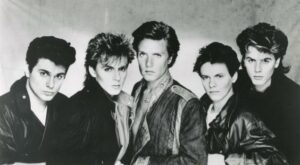
From wikipedia.org / © Ben Aris / Capitol Records
Thereafter came a flood: Spandau Ballet, Culture Club, Wham, Visage, A Flock of Seagulls, Classix Nouveaux, Kajagoogoo, the Thompson Twins, Tears for Fears, all of whom drove me up the walls. Vacuous songs. Production qualities that might have sounded hi-tech in the 1980s but just sound dated now, all dinky drums and plinky keyboards. A smug dedication to style over substance, with the performers lavishly dressed and expensively coiffured. Maybe I’m giving them more social significance than they deserved, but they seemed to personify the flash-your-cash, greed-is-good ethos of the Thatcherite 1980s.
Now you can reply to my moaning by saying, “Well, if you didn’t like them, you didn’t have to listen to them!” But actually, back then, you did. For a couple of years, the new romantic bands were everywhere, On the radio. On TV. On the covers of glossy new teenybop magazines like Smash Hits and Number One. In the newspapers – never more so than when the Sun famously ran the headline, ‘BOY GEORGE’S BIG SECRET: I PREFER A CUP OF TEA TO SEX’.
Things got particularly bad in 1984-85, during my second year as a student at Aberdeen University, when to make ends meet I worked in a nightclub called Ritzy’s three or four evenings a week. I was a member of its floor-staff and the club’s DJ liked his new romantic records. It was truly gruelling to have to collect glasses and empty ashtrays whilst being blasted by Spandau Ballet crooning their way through True (1983), and then Wham chirping Wake Me Up Before You Go-Go (1984), and then Simon Le Bon conspicuously failing to hit the high notes in Duran Duran’s Wild Boys (1984), and then, oh joy, Boy George ruminating, “War, war is stupid, and people are stupid…” in Culture Club’s The War Song (1984). Happy memories… Not.
Honourable exceptions: David Sylvian’s outfit Japan were sometimes called a new romantic band and I thought they were pretty good. And I liked Adam and the Ants, at least, up until Adam Ant turned into a dandy highwayman. And though I’ve just given Duran Duran a kicking, I’ll admit that their late-career hit Ordinary World (1992) is a lovely song. In fact, Ordinary World has featured in not one, but two textbook examples of how to use pop music effectively in movies – Matthew Vaughan’s stylish gangster film The Layer Cake (2004) and Nia DaCosta’s superb zombie flick 28 Years Later: The Bone Temple (2026).
From wikipedia.org / © Capitol Records
Hair metal
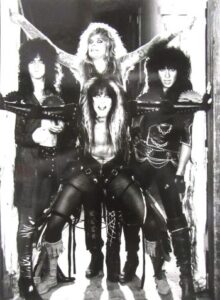
During the first half of the 1980s, it wasn’t easy being a heavy metal fan, as I was. Heavy metal had a serious image problem then. Both conservatives and left-wingers regarded it as music made for disreputable, juvenile, sexist, dumbly hedonistic louts. It didn’t help that metal’s most visible sub-genre at the time was all of those things. There’s nothing wrong with being disreputable, but hair metal was also juvenile, sexist, dumbly hedonistic and loutish. (And at the same time, kind of lame – I’ll get to that in a minute.)
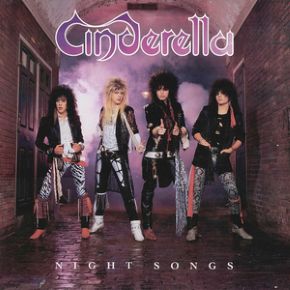
Actually, its practitioners referred to the music as ‘glam metal’ but, given the extravagant, backcombed locks they sported, and the amount of hairspray they used, I prefer the more dismissive moniker ‘hair metal’. The movement received other disdainful nicknames too, which is a testimony to how disliked it was. The bands – Mötley Crüe (who added umlauts to their name not because they liked listening to Motörhead, but because they liked drinking Löwenbräu), Quiet Riot, W.A.S.P., Ratt, Poison, Warrant, Dokken, Cinderella – were sneeringly called ‘poodle-heads’. Their sound was also described as ‘butt rock’.
Clad in spandex, caked in make-up, jangling with accessories and balancing on their bonces the aforementioned ‘big’ hair, whilst singing songs whose lyrics sounded like they’d been written by Frank Kelly’s Father Jack Hackett character in Father Ted (1995-98) – see Mötley Crüe’s Girls, Girls, Girls (1987) – they were bloody awful. To my ears, they weren’t even that metal. They used poppy guitar riffs and harmonies and churned out an ungodly number of power ballads.
A decade earlier, God had put an end to the foolishness of prog rock by creating punk music. Thankfully, around 1988 or so, He again decided enough was enough and created grunge. Once kids started listening to Kurt Cobain and co, the poodle-heads became history. Incidentally, there’s a 2005 song by the surreal English indie band Half Man Half Biscuit called Upon Westminster Bridge whose lyrics sum up my feelings about hair metal. It goes “Oh help me Mrs Medlicott / I don’t know what to do / I’ve only got three bullets / And there’s four of Mötley Crüe.”
Honourable exceptions: Guns n’ Roses. That’s it.
From wikipedia.org / © Mercury Records
Thankfully, after hair metal’s demise, heavy metal couldn’t possibly produce another sub-genre that was so horrible. Could it? Well…
Nu metal
“I’d rather have my eyelids pulled out than listen to nu metal,” David Mustaine, the frontman of Megadeth, once remarked. Which is ironic, considering that the one time I saw Megadeth play live, in Chicago in 1995, the support bands included Korn, an outfit credited with helping to kickstart nu metal in the first place.
Mustaine’s disdain for nu metal is typical of many in the traditional heavy metal community, who thought the music of Korn, Limp Bizkit, Linkin Park, the Deftones, Disturbed, Alien Ant Farm, Papa Roach, etc., sucked because it incorporated influences from hip-hop while neglecting the established staples of heavy metal, such as guitar solos. Mustaine was particularly sore about nu metal’s absence of guitar solos: “I’m talking about the bands that wouldn’t do guitar solos. Guys who get out there and they’d do rhythms and stuff but they’d never do a guitar solo…”
Well, I don’t mind heavy metal music not having guitar solos and certainly don’t mind it being influenced by hip-hop. Indeed, I love some of the bands who tried to fuse the two genres before the existence of nu metal (and inadvertently became the inspiration for it): Faith No More, the early Beastie Boys and the mighty Rage Against the Machine. In fact, RATM’s Tom Morello has stated: “For better or worse, Rage Against the Machine seemed to have planted the seeds for the genre that sprung up known as nu metal. My apologies.”
But I found most nu metal music to be a pain in the arse, a crime against the ears and an affront to the intelligence. The first – and by far the worst – negative about it was the toxic, misogynistic, bro-y energy it seemed to generate in its heyday. As Tom Morello observed, “the ethos of it tended to be… anti-woman and fratty.” This reached its nadir at the Woodstock 1999 festival when, during a Saturday evening performance by Limp Bizkit, the crowd erupted into an orgy of vandalism, violence and sexual assault.

From wikipedia.org / © Ruzov Dimitry
Add to that its fashion sense, or lack of one. Every nu metal band looks a nightmarish collision of chin beards, frosted tips, dreadlocks, shaven scalps, piercings, tattoos, baseball caps, beanies, cargo pants, baggy shorts, hoodies, sports tops and white socks. Plus the lyrics which, when they aren’t being misogynistic, are being whiny. The New Musical Express once summarised them as: “I hate my daddy wah wah I’m drowning do you know how it feels to be face down in a rotting corpse drownin’ in blood so ashamed of who I am… wah wah wah wah.”
Honourable exceptions: I like some stuff by Korn, Slipknot and System of a Down.
Emo
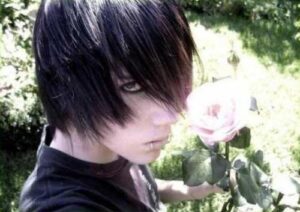
The journalist Gavin Baddeley described emo in his 2015 book Street Culture as ‘punk for kids not ashamed of being smart or showing their feelings… The look was a blend of preppy punk and geek chic… the attitude one of angst, unabashed awkwardness and frustration, making it a powerful draw for smart teenaged misfits.” He also detailed emo fashions: “…tight black jeans and skinny-fit band t-shirts, sneakers… piercings and tattoos… plenty of black hair-dye and eyeliner…”
Well, I have difficulty telling the difference between emo and another, equally black-clad sub-culture, goth. Yes, I know emo is supposed to have its roots in the American hardcore punk scene in the 1980s, whereas goth was a melancholy offshoot of an older punk scene, the UK one in the late 1970s. But all the same… I can’t help but think of a 2013 episode of the TV cartoon-show South Park in which the Goth Kids try to explain the distinction to a child-protection officer: “A goth believes that, deep down, the world is totally f*cked up, but an emo believes that, deep down, they are totally f*cked up… Emos are more prone to suicide but goths are more prone to be depressed that so many people commit suicide… Goths’ darkness is nihilistic whereas emos’ is cynical… Wait, I thought we were cynical…”
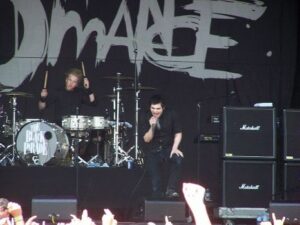
Anyway, I’ve nothing against the sub-culture of emo and its adherents. My beef is that emo bands – like My Chemical Romance, Funeral for a Friend, Fall Out Boy, Jimmy Eat World, Paramore – simply do nothing for me. Sorry.
Honourable exceptions: I’ve seen Death Cab for Cutie described, in their early years, as an emo band, and I like them.
From wikipedia.org / © Jezebel Parker
And now I have all that worked out of my system, I’ll hopefully return to writing about nicer subjects shortly.