Cormac’s tales from the riverbank


© Vintage


I’d assumed I was long past the age where I could get really, really excited about books.  If I had to compile a list of my favourite 20 books of all time, I would expect everything on it to be stuff I’d read in my teens, twenties or, at a stretch, my thirties: James Joyce’s Ulysses (1922), Walter Scott’s The Bride of Lammermoor (1819), Malcolm Lowry’s Under the Volcano (1947), Mervyn Peake’s Gormenghast trilogy (1946-59}, etc.  I still read a fair bit, but nothing I peruse these days seems to generate the same frisson that certain books did in me during my youth.


I wouldn’t completely agree with the legendary blues singer and musician B.B. King when, in 1969, he sang The Thrill is Gone.  But I would say the thrill survives in a reduced capacity.  You get older, you become less impressionable, and nothing surprises you anymore.  Or so I thought.


I was surprised when, a couple of years back, I read the books in Bernard Cornwell’s Warlord trilogy (1995-97), about King Arthur, and found myself entranced by them – so much so that when I got to the final volume, 1997’s Excalibur, I wrote on this blog that I was “almost reluctant to read it because I’d come to know so well, even love, the characters from the earlier two books – and this being the King Arthur legend, I was aware things wouldn’t end happily for them.”  It’d been a long time indeed since a series of book had had such an effect on me.


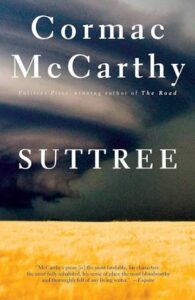
Now the same thing has happened with Cormac McCarthy’s semi-autobiographical novel Suttree (1979).  A few pages in, I realised I was reading a very special book – for me, anyway – and I consumed the rest of it with a passion.  And I imagine that in my top-20 books list, one of the entries that I read during the first half of my life has just been demoted from it and Suttree has taken its place.  Yes, I reckoned McCarthy’s novel was that good.


Before I continue talking about Suttree, a warning – there will be spoilers.


The novel recounts the adventures, and misadventures, of a young man called Cornelius Suttree while he lives on a houseboat on the Tennessee River by the rundown edge of Knoxville in the early 1950s.  He ekes out a living fishing and selling his catches at the local market.  He also fraternises with the neighbourhood’s underclass, a rogue’s gallery of misfits, eccentrics, down-and-outs and mad people.  McCarthy, who died in 2023, was not one for giving interviews, so I assume it’s never been determined how much of Suttree is autobiographical.  I’d imagine, though, that the novel – written over 20 years – is at least partly inspired by the period of his marriage to Lee Holleman in the 1960s when, according to his Wikipedia entry, “McCarthy moved to what Holleman’s obituary calls ‘a shack with no heat and running water in the foothills of the Smoky Mountains outside of Knoxviille.’”


As the narrative unfolds, we learn about Suttree’s past.  He’s from a well-to-do family and his lifestyle choices haven’t pleased his father.  In a letter to him, that father states his belief that “the world is run by those willing to take the responsibility for the running of it.  If it is life that you feel you are missing I can tell you where to find it.  In the law courts, in business, in government.  There is nothing occurring in the streets.  Nothing but a dumbshow composed of the helpless and the impotent.”  We also learn that he’d been in a marriage that, ultimately, he’d run away from.  More on that in a minute.


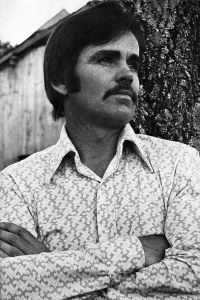
Incidentally, we get clues that Suttree is quite a handsome devil – as McCarthy himself was in his young days.  At one point he and some mates get into a catastrophic brawl in a dodgy Knoxville dance-place: “Before they reached the door someone hit him in the head with a bottle…  He must have fallen foul of yet other hands afterwards because when he woke in the hospital he had a broken finger, three broken ribs, a mouthful of loose teeth and one missing.”  Though he’s now gap-toothed, Suttree has the following conversation with a nurse: “You created quite a sensation.”  “What, among the inmates?”  “No, silly.  Among the nurses.”
 

From wikipedia.org / © Evening Star Books


I’ve used the word ‘narrative’ but Suttree doesn’t have the structure of a typical novel.  It’s rambling and episodic, really a patchwork of vignettes and short stories featuring the same characters in the same setting.  The reader takes pleasure in the randomness of it, not knowing what grotesqueness, hilarity, idiocy, beauty, horror, weirdness or, indeed, moment of sheer poetry is going to appear next.


A couple of the longer ‘short stories’ see Suttree leave Knoxville, temporarily, with painful results.  In one episode, he discovers that the son he left behind has died and sets off to attend his funeral, even though he has barely any money.  When he gets to his destination, his former wife and in-laws, and indeed the whole community, react to him with contempt and hatred.  He only leaves the town alive thanks to the begrudging intervention of its sheriff, who opines: “You, my good buddy, are a 14-carat plated son of a bitch.  That’s what your problem is…  Now I’m goin to do you a favour.  Against my better judgement.  And it’s not goin to make me no friends.  I’m goin to drive your stinkin ass to the bus station and give you an opportunity to get out of here.”


Another time, a chancer called Reese and his family arrive on the scene.  This symbolically occurs during a flood, when all sorts of flotsam and jetsam are being washed past Suttree’s houseboat: “Next came looming out of the yellow mist a patchwork shack composed of old slats and tarpaper and tin snuff signs all mounted in wild haphazard upon a derelict barge and turning with the keelless rotations of a drunken bear…”  Reese inadvertently befriends Reese, his wife and his children, who inhabit that barge-shack and, for all his worldly wisdom, gets suckered into helping Reese with a get-rich scheme we know is doomed from the start.  They travel upriver and begin fishing for mussels, believing there’s money to be made from selling their shells and pearls.  Though there’s a little light, with Suttree romancing Reese’s daughter, what follows is mostly a gruelling litany of hardship, futility and, finally, tragedy.


However, much of the book simply records Suttree’s interactions with the characters who live, fish and scavenge around him.  They’re an intriguing bunch even if you don’t envy them their existences.  They include the Ragpicker – his title says it all – who claims not to believe in God because “I got no reason to think he believes in me”; Daddy Watson, a former railwayman happy to tell Suttree about the gory train crashes he witnessed during his working life; Ab Jones, a black man who with his wife Dolly runs an illicit bar on another houseboat and whose defiant nature invariably gets him into trouble; Mother She, an ancient and decrepit witch who provides the novel with its most hallucinatory episode; Michael, a native American fisherman whom Suttree briefly befriends; and Red Callahan, who ‘s perhaps the closest thing in Suttree to the psychotic Francis Begbie in Irvine Welsh’s Trainspotting (1993), another episodic book about a bunch of misfits living in punishing circumstances.


One part of Suttree that’s particularly Welsh-like – i.e., simultaneously horrible and funny – concerns a male prostitute called Leonard.  He enlists Suttree’s reluctant help to dispose of the corpse of his father, which his family has kept hidden at home for months, pretending the old man is still alive so they can keep collecting his social security money.  At one point during the operation, Suttree protests, “That’s the awfullest stink I ever smelted.”  Leonard retorts, “That‘s the biggest reason we had to get him out of the house.”


Apart from Suttree, though, the most prominent character is the chaotic Gene Harrogate, a youth whom Suttree first encounters while they’re both in prison – Harrogate for the unusual crime of sneaking into a watermelon field near his home, cutting holes in the crop and then having intercourse with them.  (As the stunned farmer says, “You ain’t goin to believe this…  Somebody has been f*ckin my watermelons.”)  Following his release, Harrogate takes up residence in Suttree’s neighbourhood, living “under the final concrete arches of the viaduct where they ran to earth…  The earth was cool and naked and dry.  Here some bones.  Broken glass.  A few stray dog-turds…  there was never a retreat so secluded.”

 

From pixabay.com / © Riedlinger


Suttree becomes his surrogate big brother, trying to rein in his wildest and daftest impulses and having to mop up after him when his antics end in disaster.  He’s remarkably patient, considering how madcap Harrogate’s schemes are.  At one point, the lad learns he can earn a dollar for every dead bat he finds and hands into Knoxville’s medical authorities, who are keen to monitor rabies in the local chiropteran population.  Soon Harrogate is firing poisoned pellets into the air from his skiff, at dusk, hoping the swooping bats will mistake them for insects.  “Bats had begun to drop everywhere from the heavens.  Little leatherwinged creatures struggling in the river…”  More spectacular, and no more successful, is a project he devises after finding a cave / tunnel system that takes him under Knoxville – where, he believes, he can dynamite his way into the vault of the city treasury.


Incidents like these make Suttree the funniest of McCarthy’s books.  Although folk who’ve read Child of God (1973), or Blood Meridian (1985), or The Road (2006) would probably argue that having more laughs than the norm in McCarthy’s oeuvre is not a particularly high bar.  Anyway, I found myself guffawing loudly in places.


The prose oscillates between Joycean flamboyance and Hemingway-esque precision.  The opening paragraph reads: “Dear friend now in the dusty clockless hours of the town when the streets lie black and steaming of the wake of the watertrucks and now when the drunks and the homeless have washed up in the lee of walls in alleys or abandoned lots and cats go forth highshouldered and lean in the grim perimeters about, now in these sootblacked brink or cobbled corridors where lightwire shadows make a gothic harp of cellar doors no soul shall walk save you.”


In contrast, after Suttree’s friend J-Bone informs him of his son’s death, McCarthy describes the moment thus: “Suttree set his cup down and looked out of the window.  There was a small pool of spilled cream on the marble countertop at his elbow and flies were crouched about it lapping like cats.  He got up and went out.”  Some may find this disparity in writing styles off-putting.  I have to say, for me, the combination is like catnip.


Unflinchingly, the book explores a harsh, brutal but somehow fascinating world, one whose inhabitants certainly suffer, yet you also understand the hold that world exerts over them – through the moments of peace and calm, the occasional pleasures, the camaraderie, the satisfaction of knowing you’re not bound by the rules and regulations of conventional society.   But it’s also a transitory world where nothing lasts for long, including the people living in it.  As the book progresses, characters get killed, get permanently incarcerated (in the prison or asylum) or simply vanish.  As you near the book’s end, you wonder what Suttree’s choice will be.  Will he decide to stay here and become a casualty too, or will he try to escape?


But if he does escape, you suspect his experiences on the river will haunt him for his remaining days.  Just as Cormac McCarthy’s experiences of poverty and desperate living in Tennessee haunted him for 20 years and informed this marvellous novel.

 

From pixabay.com / © Leoleobobeo
Climbing Mount Ulysses


© Penguin


Today is June 16th, a day that connoisseurs of Irish literature will recognise as Bloomsday, the date on which the events described in James Joyce’s epic novel Ulysses took place in Dublin in 1904.  Literary legend has it that on the real June 16th, 1904, Joyce and his muse and future wife Nora Barnacle – “She stuck to him like a limpet!” one of my university lecturers liked to quip – acquired carnal knowledge of each other for the first time.  And since 2022 is the centenary of Ulysses‘ original publication in 1922, today is a special Bloomsday indeed.


Ah, Ulysses.  I first encountered it in 1982, when I spied a hefty copy of it reposing on a rack in Whitie’s, the main bookshop in my hometown of Peebles.  As someone who was into books and writing, I decided that this was something I ought to experience.  So I purchased it, lugged it home and started reading: “Stately, plump Buck Mulligan came from a stairhead, bearing a bowl of lather on which a mirror and a razor lay crossed…”


The task took me several months.  This amused my school English teacher Iain Jenkins, who cheerfully admitted that he’d never read Ulysses and never intended to, believing it to be a pile of pretentious twaddle.  Whenever he bumped into me, he’d mischievously inquire how I was getting on with Joyce’s masterwork, assuming sooner or later I’d throw in the towel and never get to the end of Bloomsday.


But I persevered.  The months passed.  April, May, June, July…  In fact, the countries I was in changed too, for I finished school in May and left Scotland for some pre-university wandering: France, Northern Ireland, Switzerland, Austria, Germany, Belgium…  And I took Ulysses with me.


As far as I can remember, it was in a chilly youth hostel in Brussels in November, as far away from Dublin on June 16th as seemed possible, that I navigated the book’s final section.  This is the lengthy stream of consciousness going on inside Molly Bloom’s head that ends: “…yes I said yes I will Yes.


I should point out that during those half-dozen months I didn’t just read Ulysses. Over the same period I remember reading stuff by Ernest Hemmingway, Ray Bradbury, Jerome K. Jerome, Sean O’Faolain and Anthony Burgess.  Incidentally, Burgess, who was still alive at the time, was probably the world’s most famous Joyce authority and had written a book about him called Here Comes Everybody in 1965.  It actually helped that I would read a section of Ulysess, leave the book for a couple of weeks, read something by someone else, and return to it.  I’d discovered how episodic it was, each episode having its own theme, style and literary gimmicks, and reading it this way gave me time to process one episode before I started on the next.


Famously, the episodes of Ulysses parallel the adventures of the mythological Ulysses in Homer’s Odyssey, although this didn’t dawn on my 16 / 17-year-old self until the scene set in Barney Kiernan’s Pub.  This climaxes with the Citizen hurling a biscuit tin at Leopold Bloom’s head, which I realised was a representation of Polyphemus the Cyclops lobbing a rock after the escaping Ulysses in the Odyssey.


How did I find it? Well, there were times early on when it was bloody hard work.  At one point in June, while I was in France, I nearly did give up.  I was possibly mired in the book’s third section, which is notoriously abstruse.  But later it all seemed to click for me.  Joyce’s prose, however complicated it got, settled into a comforting, familiar rhythm.  The external and internal voices of its two main characters, Leopold Bloom and Stephen Dedalus, became like the banter of old friends.  And when I finished, I felt I’d read a truly great book.  I suspect, though, my admiration for it then was like the admiration a climber feels for the grandeur of Mount Everest while standing on its summit.  The admiration is mingled with his or her own sense of achievement at having climbed the beast.


One thing that impressed me was that Joyce had obviously gone out and done some living.  He knew and was able to convincingly portray Dublin and its inhabitants – all its inhabitants, not just the posh or arty ones.  Perhaps that’s why I was never enthused by the works of Virginia Woolf, which I tackled soon afterwards.  Surely Woolf and her affected Bloomsbury (as opposed to Bloomsday) set wouldn’t have lasted long in Barney Kiernan’s Pub.


Talking of pubs, while I was wandering around Switzerland in October that year, I happened across an establishment in Zurich called the James Joyce Pub.  It cashed in on the fact that much of Joyce’s post-Ireland life had been spent in Zurich.  Eagerly, I popped inside for a Guinness. What a disappointment the place was.  It was full of people who regarded themselves as intellectuals and took themselves way too seriously – the opposite of what I believed Ulysses, in which all human life seemed present, was about.


And now?  Well, I wouldn’t like to read the book again.  One thing I’ve noticed about growing older is that, as the years and experiences accumulate, it becomes harder to feel impressed.  New people I meet, whom I would have found fascinating in my youth, make less of an impression because I’ve met their type before and their personality traits no longer seem special.  The same goes with books.  Literary razzle-dazzle that might have blown me away when I was younger just annoys me in my middle-age.  Sorry, I’ve seen all that already.  When I read Milan Kundera’s The Unbearable Lightness of Being (1984) in my twenties, I thought, “Wow!  This the profoundest book ever!”  Whereas I read Kundera’s Slowness (1995) last month and thought, “Oh, stop showing off, you poser.”  I’d hate it if I read Joyce’s opus again and reacted with the same weariness.


Some things are best left in the past. And though I still think it’s a great book, Ulysses is probably one of them.


From wikipedia.org

Travellers at the bar


As I mentioned in my previous blog-entry, the latest Covid-19 lockdown in Sri Lanka, which was imposed for a good part of May and June, has recently been relaxed.  This relaxation has allowed some eating and drinking places to re-open.


However, one place that my partner and I have often retreated to in the past, when we’ve felt the need for calm and a touch of soothing, old-school luxury (to convey the illusion for a few hours that we’ve actually got money), remains off-limits to us.  This is the Traveller’s Bar and its lovely outdoor verandah, which overlooks the Indian Ocean, at Colombo’s Galle Face Hotel.  For now, the bar and verandah are open only for hotel guests, not outside customers.  This is a shame because few things are as good for the soul as sitting there between six and six-thirty on a clear evening and watching the sky segue from one gorgeous colour to another while the sun sinks behind the distant waves.


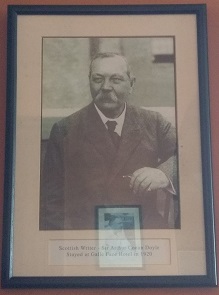
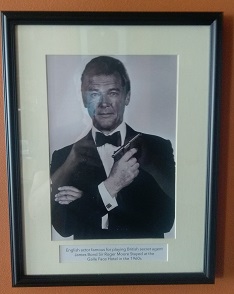
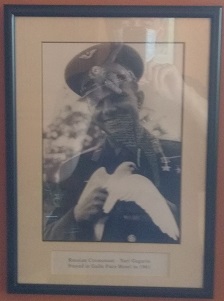
The Galle Face Hotel will soon be a venerable 120 years old and it’s prestigious enough to have featured in Patricia Schultz’s 2003 travel book 1000 Places to See Before You Die.  Predictably, during its long history, it has accommodated some very famous guests.  Many of these are commemorated by a gallery of framed photographs adorning the interior of the Traveller’s Bar, with information about the years, occasionally just the decades, when they stayed there.


Among the earliest people featured in the gallery are writers.  You see Anton Chekov (credited with being at the Galle Face in 1890), George Bernard Shaw (in the 1930s), W. Somerset Maugham (the 1920s), Noel Coward (1944) and Evelyn Waugh (the 1950s).  D.H. Lawrence showed up there in 1922, presumably either on his way to or from the 99-day sojourn he had in Australia that gave rise to his novel Kangaroo, published the following year.


One literary hero of mine, Sir Arthur Conan Doyle, stayed at the Galle Face Hotel in 1920 and, unimpressed by its prices, described it as ‘a place where the preposterous charges are partly compensated for by the glorious rollers that break upon the beach outside.”  He was also unimpressed by the equally famous Mount Lavinia Hotel, which in those days stood beyond the southern edge of Colombo.  “There are two robbers’ castles, as the unhappy visitor calls them, facing the glorious sea, the one Galle Face, the other the Mount Lavinia Hotel.” At least he appreciated the journey between the castles: “They are connected by an eight-mile road, which has all the colour and life and variety of the East for every inch of the way.”


At this point Doyle was heavily into spiritualism and had been gullible enough to believe that the notoriously faked Cottingley fairies were real.  However, he retained enough of his wits not to be taken in by a display of the famous ‘mango-tree’ trick, which a Sri Lankan magician did for him just outside the hotel.  Doyle praised the magician’s skill, though: “He did it so admirably that I can well understand those who think that it is an occult process.”


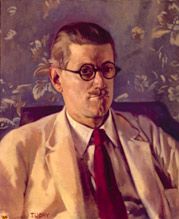
I’m perplexed by the presence of a portrait of James Joyce, supposedly a guest of the Galle Face in 1904.  (Coincidentally, June 16th, 1904, was the date of ‘Bloomsday’, the day during which all the events of Joyce’s 1922 masterpiece Ulysses take place).  To the best of my knowledge, he never travelled outside Europe, let alone visited southern Asia.  In fact, the only connections I can dig up between Joyce and Sri Lanka are that: (1) he makes mention of the ‘Cinghalese’ in Ulysses; and (2) he was known to own a copy of Henry Olcott’s Buddhist Catechism According to the Sinhalese Canon – Olcott was the American army officer who became the first president of the Theosophical Society and was an important figure in the revival of Buddhism in Sri Lanka, so much so that he’s honoured with a statue in front of Fort Railway Station today.


Perhaps somebody else with the name ‘James Joyce’ stayed at the hotel in 1904?


One writer not displayed in the Traveller’s Bar is legendary science-fiction scribe Sir Arthur C. Clarke, even though it was in the Galle Face that he supposedly wrote the last chapters of the last volume of his Space Odyssey series, 3001: The Final Odyssey (1997).  However, Clarke had lived in Sri Lanka since 1956, so he wasn’t really what you’d call a ‘visitor’ or a ‘guest’.


The Traveller’s Bar gallery is mostly a collection of the great and good, but it has at least one rogue in it, namely Richard Nixon.  He stayed at the hotel in the 1950s, sometime before he became the second-most crooked US president in modern history.  Other political dignitaries who were guests there include father and daughter Indian Prime Ministers Pandit Jawaharlal Nehru (1950) and Indira Gandhi (1976); and iconic revolutionary Che Guevara, whose portrait says he stayed in 1958, although according to a feature in Sri Lanka’s FT his visit was actually in August 1959.  He’d come to Sri Lanka because it was one of the first countries to recognize Castro’s Cuba.


From the mid-20th century onwards, Sri Lanka began to appeal as an exotic location to Western filmmakers and so the Galle Face Hotel had Hollywood movie stars stay while on their way to or from film shoots.  These include Sir Alec Guinness (1957), in town for the making of Bridge on the River Kwai and, I have to say, looking a bit shifty in his photograph; Harrison Ford (1983), there to make Indiana Jones and the Temple of Doom (whose production had switched from India to Sri Lanka after the Indian government objected to the ‘thuggee’ elements in its script); and Ursula Andress, whom I trust enjoyed her stay in Sri Lanka in 1976 even though she probably prefers to forget the film she made there, the Italian horror movie The Mountain of the Cannibal God, directed by Sergio Martini and considered so offensive in Britain that it was classified as a ‘video nasty’ and banned until 2001.


Andress, of course, found international fame as the very first Bond girl.  Meanwhile, the man responsible for the third cinematic incarnation of James Bond, Roger Moore, appears in the Traveller’s Bar too.  He’s said to have stayed at the hotel in the 1960s, but he’s depicted in his famous 1970s Bondian bowtie and dinner-suit, so the photo obviously wasn’t taken at the time.


One star in the Traveller’s Bar who’s rather forgotten nowadays is Lex Barker, who took over the role of Tarzan from Johnny Weissmuller in 1949.  Barker’s picture says he was there in the 1950s, although the only thing I can find in his filmography that was made in Sri Lanka was a 1963 movie called Storm Over Ceylon.  While Barker’s Hollywood Tarzan movies were too low-budget to be filmed on location in a tropical country like Sri Lanka, money was not a problem for Bo Derek and her director-husband John Derek, who used Sri Lanka for the jungle scenes of their notorious, mammary-obsessed Tarzan the Ape Man (1981), while using the Maldives for its beach scenes.  For their salacious take on Edgar Rice Burroughs’ Lord of the Jungle, Bo, John and their crew imported some decidedly non-native wildlife into the country.  According to an article in the New York Times, they brought with them a lion (called Dandi), an orangutan (called C.J.), three chimpanzees, two Irish wolfhounds and an 18-foot, 120-pound python.  Thus, Ms Derek is now commemorated by a portrait in the Traveller’s Bar as well.


A nice story is attached to Gregory Peck, who stayed in 1954 whilst making a film called The Purple Plain.  Apparently, he came down with a nasty bout of flu, but recovered with the help of a traditional local remedy of plain tea incorporating inguru and kothamalli (ginger and coriander).  In the 1950s Peck was a global heartthrob and his use of this remedy didn’t go unnoticed by his lady admirers in Sri Lanka.  As another article in the Daily FT observes: “It used to be said in lighter vein those days that many upper-class ladies of Colombo 7 began drinking ginger / coriander tea only after Gregory Peck told them about it.”


Finally, the gallery sports a picture of the first man in space, Yuri Gagarin, symbolically holding a white dove.  The great Russian cosmonaut came to Sri Lanka in 1961 and among the things done to mark the visit was the planting of a tree in his honour at the botanical gardens in Peradeniya, close to Kandy.  According to a piece published by the Russian Centre for Science and Culture in Colombo, the tree was said to have stopped growing at the time of Gagarin’s death in a jet crash in 1968.  However, mysteriously, it continued to live, so that it’s resembled a young tree for the past half-century.  This is contradicted by an article in Ceylon Today, which claims it merely fell ill at the time of Gagarin’s death, but recovered and kept on growing.  I was at the botanical gardens a few years ago and really wish I’d examined the Yuri Gagarin tree to find out which of these accounts was true.