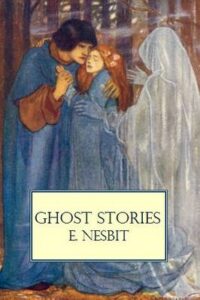
Edith gets eerie: E. Nesbit’s ghost stories


© Greyladies


Until recently my single point of reference for the English writer E. (Edith) Nesbit, who lived from 1858 to 1924, was her children’s book The Railway Children (1906).  I have memories of my primary school teacher, Mrs Atkinson, reading this book to us in instalments when I was eight or nine years old; and, later, I saw the 1970 film version of it, directed by Lionel Jeffries, on TV.


The bit of The Railway Children that’s always remained in my head comes from the film.  The three kids, played by Jenny Agutter, Sally Thomsett and Gary Warren, witness a landslide that buries a section of railway track and they have to warn an approaching train to slow and stop before it crashes cataclysmically into the rubble.  This necessitates Agutter and Thomsett stripping off their red bloomers and waving them like flags in the air.


I should say I was at an age where I was more interested in the landslide – I recall being spooked by Gary Warren exclaiming, “Look at that tree over there… Lord, it’s moving!” – than in the sight of Jenny Agutter, who’d later appear in Walkabout (1971), Equus (1977) and An American Werewolf in London (1981), and Sally Thomsett, who’d later appear in Straw Dogs (1971) and the popular TV sitcom Man about the House (1973-76), waving their brightly-coloured undergarments at a locomotive.


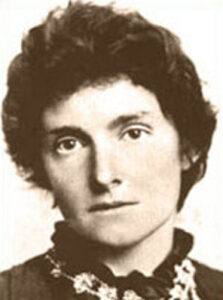
So, E. Nesbit was known to me as a children’s writer and as the author of one children’s book in particular.  But she also wrote adult literature, poetry and non-fiction, as well as being a founding member of that venerable British democratic-socialist organisation the Fabian Society, whose other early members included George Bernard Shaw, H.G. Wells, Ramsay MacDonald and Emmeline Pankhurst.  Despite writing items such as Women and Socialism: from the Middle-Class Point of View and Women and Socialism: A Working Woman’s Point of View (both 1885), she was not a fan of women’s suffrage – according to her Wikipedia entry, “mainly, she claimed, because women could swing Tory, thus harming the Socialist cause.”


Meanwhile, her personal life was unpleasantly complicated and sometimes tragic.  Her first husband, Hubert Bland, was a philandering cad who sired three children with two other women while he was ostensibly married to Nesbit – Bernard Shaw observed that Bland had “simultaneously three wives, all of whom bore him children.”  Nesbit lost her father at the age of three, her only sibling when she was around 12, and a son when she was in her early forties.


I wasn’t familiar with her backstory when, a short time ago, I picked up a paperback collection of seven of her ghost stories.  If I’d known more about her, I might have been less surprised at what I read.  Nesbit’s tales of the supernatural aren’t the comfy, cosy ones you associate with her time and place, i.e., Victorian and Edwardian England, where there’s a popular image of well-heeled gentlemen and ladies assembling around a log-fire at Christmas-time, with glasses of port and sherry, for the purpose of mildly spooking each other by telling a ghostly ‘yarn’.  No, Nesbit’s stories have unexpected bite.


The opening  one in the collection, From the Dead, begins with some painful marital complications not wholly dissimilar to those Nesbit faced with Hubert Bland.  A maliciously forged letter causes the narrator to abandon his fiancé and marry someone else.  When he learns the letter was forged, he casts out his wife in disgust.  A change of heart sends him in search of her but, months later, when he finally locates her, he’s informed that she’s just died in childbirth.  There ensues a scene that put me in mind of the apparition near the end of Edgar Allan Poe’s The Fall of the House of Usher (1839).  The newborn child survives but the final line remarks sombrely: “It is four years old now, and it has never spoken and never smiled.”


John Charrington’s Wedding is more straightforward and traditional but it ends too on a downbeat note: “I saw her face.  Shall I ever forget it.  White, white, and drawn with agony and horror, bearing such a look of terror as I have never seen since, except in dreams.”


Then comes Man-Size in Marble, perhaps the most famous of Nesbit’s ghost stories.  It has a young couple moving into a cottage in the English countryside where they discover, nearby, an ancient Norman church containing the funerary statues of two cruel-looking knights.  The husband also hears a legend about how every Halloween – or Hallowe’en as it was back then – those statues come to life and stalk around the neighbourhood.  He declines to tell his wife of the legend for the patronising reason that she “was always nervous, as highly strung natures are, and I felt that these tales… might have made our home less dear to my wife.”  Incidentally, he has a habit of calling her ‘Pussy’ and ‘Puss cat’, which reminded me of Henrik Ibsen’s famous indictment of the patriarchy, his 1879 play A Doll’s House.  In that, the beleaguered heroine Nora has to tolerate a husband who insists on calling her ‘skylark’ and ‘songbird’.


Partly due to the husband keeping his wife in the dark about the sinister legend of the statues,  Man-Size in Marble has a grim denouement too.
 

© Adorable Media / BBC Film


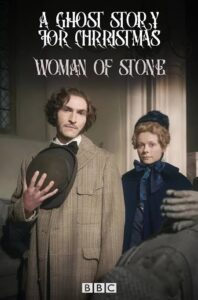
In 2024, Man-Size in Marble was adapted for television by Mark Gatiss, who retitled it Woman of Stone.  This was broadcast by the BBC on Christmas Eve as an instalment in the channel’s revived A Ghost Story for Christmas franchise (1971-78 and 2005-present).  Now I like Gatiss generally, and I like a lot of his work, but I’m not a fan of his adaptations of classic ghost stories penned by the likes of M.R. James.  I think they’re too glossy and overcooked and, somehow, they miss the authenticity that made the originals effective.  Anyway, I haven’t watched his version of Man-Size in Marble.  E. Nesbit features in it as a character, supposedly…  Played by Celia Imrie, no less.


Next is The Ebony Frame, whose narrator retrieves an aged painting from a storeroom not because of its canvas, which is blackened beyond recognition, but because he wants to reuse its frame, the ebony one of the title.  He discovers that the blackened panel at the front never had a picture at all, because the frame actually contains two pictures, turned inwards, secured face-to-face.  One of them, he’s shocked to learn, is of “Myself – in a cavalier dress, ‘love-locks and all’!”  The other is of “a woman of the type of beauty beloved of Burne-Jones and Rossetti.”  The sealed-together portraits point to a forbidden love affair in the distant past, while the narrator’s likeness to the cavalier suggests he’s the man’s descendent or even reincarnation.  Predictably, he’s soon having frighteningly realistic dreams where the saucy Burne-Jones / Rossetti lady comes to him, keen to rekindle their romance.


Yes, The Ebony Frame is yet another haunted-painting story – it was first published in 1893, three years after Oscar Wilde’s The Portrait of Dorian Gray.  But I found the idea of the two concealed pictures ingenious.


At ten pages, The Mystery of the Semi-Detached is the shortest thing in the collection.  It differs from the other stories in that it’s a dark tale of premonition.


Also different is the penultimate entry, The Pavilion.  From the conversations of the main characters, two young men and two young women, we learn how the title structure is connected to “some story about a wizard or an alchemist or something, and it was burned down, and then they rebuilt it in its present style.”  It’s also engulfed by the stems and leaves of what’s said to be a Virginia creeper, though one person observes that it looks ‘more like a South American plant’.  And because “there have always been so many rabbits and weasels and things found dead near it”, the pavilion is reputed to be haunted.  A dare is made and the young men spend the night in the place.  Needless to say, the creeper proves to be more mobile than anyone had thought.  The Pavilion contains some unexpected character dynamics, which elevate it above the level of most killer-plants-at-large horror stories.


Lastly is The Shadow, perhaps the clammiest and most dread-inducing tale in the collection.  This begins with the afore-mentioned scenario of Victorians making themselves comfortable at Christmas-time to tell ghost stories – but then takes the reader to places where there are ghosts but the vibe is definitely not comfortable.  Following a festive dance, three young woman gather in a room and entertain themselves with spooky tales.  Eventually, they invite the housekeeper to join them and coax her into telling one, and get more than they bargained for.


The Shadow features an entity that’s a harbinger – or a bringer – of death and, as the title suggests, its appearance is dark and incorporeal: “Between us and the coffin, first grey, then black, it crouched an instant, then sank and liquefied – and was gathered together and drawn till it ran into the nearest shadow.  And the nearest shadow was the shadow of Mabel’s coffin.”  Ultimately, the housekeeper’s young audience discover that the thing in her story has entered their world as well.


To sum up, these tales present a bleak view of the supernatural.  They depict it as a hostile realm, with the humans who blunder into it having mostly unhappy or tragic fates.  Also, in a couple of cases, the foolish actions of men help bring about fatal consequences for the female characters.  The stories are excellently written.  Like all good children’s writers, E. Nesbit perfected her craft writing for a readership who don’t have the patience to tolerate florid, overwrought and pretentious prose like many adults do.  As a result, her style is admirably clear and direct.
 

 From wikipedia.org

Many moons ago


© Universal Pictures / Polygram Pictures


When I think about the films that I saw and loved during the formative years of my mid-to-late-teens, films like Ridley Scott’s Alien (1979) and Blade Runner (1982), George A. Romero’s Dawn of the Dead (1979), Stanley Kubrick’s The Shining (1980), George Miller’s Mad Max II (1981), Terry Gilliam’s The Time Bandits (1981), Jean-Jacques Beineix’s Diva (1981), John Carpenter’s The Thing (1982) and Walter Hill’s 48 Hrs (1982), I instinctively assume they were released, oh, maybe a quarter of century ago.  It scares me when I actually do the maths and realise that no, 40 years have now passed, or will have passed soon, since their original release.  Yes, I know the platitudes – ‘Time waits for no man’, ‘None of us are getting younger’ and so on.  Still, it comes as a mighty shock to realise these films are now as far back in time from 2021 as Stagecoach (1939) with John Wayne, or The Wizard of Oz (1939) with Judy Garland, were back in time from when they first hit the cinemas in the late 1970s and early 1980s.


Anyway, August 2021 has served up yet another cinematic reminder of what a dribbling old fart I now am.  I’ve discovered that exactly 40 years have elapsed since the release of John Landis’s much-loved horror comedy, An American Werewolf in London (1981).


The film won the first-ever Oscar awarded for Best Make-Up, courtesy of legendary make-up artist Rick Baker.  Though what Baker pulls off when he transforms star David Naughton into the titular werewolf, elongating his face into a muzzle and his hands into paws, making fangs sprout from his jaws and claws from his fingertips, having long black fur ooze through his skin, is more a triumph of practical special effects.  Ironically, while American Werewolf deserves to be seen on a cinema-sized screen for those effects to be appreciated in their full glory, I’ve only ever seen it on a small screen.  My first viewing came in 1982, at a private hostel called Balmer’s in the Swiss town of Interlaken, where the management would entertain its guests in the evening by showing them recent movies using a TV set and video-cassette recorder.  The evening I stayed there, they showed American Werewolf on video and I watched it amid a bunch of American backpackers not dissimilar to the pair of American backpackers, David (Naughton) and Jack (Griffin Dunne), whom we’re introduced to and then see savaged by a werewolf during the film’s opening minutes.


Since then, I’ve seen it umpteen times, through late-night TV showings, or on video (invariably at a mate’s house and accompanied by a carryout of beer), or more lately on my laptop, and it’s never failed to work its magic on me.


When I first watched it, I thought it a rather strange film.  Movies that combined horror and comedy weren’t anything new, and the previous decade had seen both Mel Brooks’ Young Frankenstein (1974) and Stan Dragoti’s Dracula spoof Love at First Bite (1979).  However, those and pretty much all ‘horror-comedies’ until then had emphasized the comedy and used the horror merely as a seam from which un-bloody, family-friendly jokes were mined.  Little or nothing was shown that was actually horrifying.


American Werewolf, on the other hand, quite happily treats its audience to images of flesh being ripped, throats being slashed, heads being bitten off and so on.  Indeed, much of the humour is generated by the visceral horror, especially in the scenes where Jack, killed in the opening minutes, returns as an affable, chatty zombie to warn David that, having been bitten by a werewolf, he’s going to turn into one himself come the next full moon.  With each appearance, Jack is considerably more decayed.  At one point his alarming appearance prompts David to exclaim, “I will not be threatened by a walking meat loaf!”


© Universal Pictures / Polygram Pictures


Also strange is the film’s unconventionally leisurely pacing up until its main event, David turning into a werewolf and going on a rampage, which takes place at the hour-mark.  Not that anything before that key moment is boring.  The film is an endearing hodgepodge of sub-plots, themes and observations that happen to take director / writer John Landis’s fancy.  These include David’s romance with Alex Price (the radiant Jenny Agutter), a nurse working in the London hospital where he ends up following the initial werewolf attack.  This has been hushed up and passed off as an attack by an ‘escaped lunatic’, a term that shows the film’s age a wee bit.  I don’t think you can talk about ‘lunatics’, even in a horror film, in the politically correct 2020s.  Come to think of it, when David and Alex finally get it on, it’s to the strains of Van Morrison’s Moondance, which shows the film’s age too.  It’s been a long time indeed since the curmudgeonly Van Morrison could be associated with anything horny.


Landis also shows us David suffering from bizarre dreams, presumably the result of the lycanthropic gene that’s now in his body.  These include one memorable sequence where he dreams of his family being slaughtered by decayed-faced werewolves in Nazi uniforms while they watch The Muppet Show.  And Landis makes some bemused observations too about British life in the early 1980s – the less-than-rosy reception that David and Jack get when they blunder into a Yorkshire pub (the Slaughtered Lamb) at the beginning; the London Underground being full of surly punk rockers; British TV consisting of three terrestrial channels that show only darts, News of the World adverts and the BBC Test Card; British kids being weird little brats who shout “No!” all the time or laugh manically when their dogs bark at you; grumblings about inflation; grumblings about British food; and the rain.  The rain depicted in American Werewolf isn’t typical horror-movie, thunder-and-lightning rain.  It’s just grey, depressing British rain that always seems to fall at the wrong moment.


This social commentary continues after David transforms from man to werewolf on the next full moon and paints London red.  His victims represent both ends of the spectrum of the nascent Margaret Thatcher’s Britain.  They include homeless down-and-outs huddling around a fire down by the edge of the Thames and an annoyingly cheerful proto-yuppie couple, who continue to be annoyingly cheerful even after they’ve been torn apart and, like Jack, come back to haunt David as the living dead.  Landis also has a dig at the then-sleaziness of central London by having the film’s climax (ouch!) begin in a porno cinema in Piccadilly Circus, where the punters are watching a spectacularly gormless British sex movie called See You Next Wednesday.  A fictitious ‘film within a film’, See You Next Wednesday is foreshadowed earlier on. When David claims a victim in the Tottenham Court Road tube station, we see a poster advertising it on one of the walls.


© Universal Pictures / Polygram Pictures


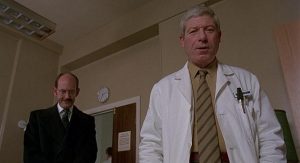
One thing about American Werewolf that doesn’t get enough praise is its supporting cast. David Naughton, Jenny Agutter and Griffin Dunne have all won plaudits and yes, they’re great, but there’s plenty of solid acting talent backing them up.  John Woodvine gives a commanding and unflappable performance as Dr Hirsch, the medical man who resolves to find out what’s really going on after the injured, seemingly-raving David arrives in his care in London.  Up north, meanwhile, the role of main villager at the Slaughtered Lamb pub required a bald-headed, rough-looking Yorkshireman and only one man could handle the job, the splendid Brian Glover.  Although Glover is fondly remembered for his comic turn as the pompous PE teacher Mr Sugden in Ken Loach’s Kes (1969), the scene in American Werewolf where he entertains the Lamb’s patrons with his ‘Remember the Alamo!’ joke is surely as funny.  Those patrons include a young and shifty-looking Rik Mayall.  I assume Mayall and Glover hit it off because, years later, I recall Glover making a guest appearance in Mayall’s TV show Bottom (1991-95).


Frank Oz appears briefly as a snotty American Embassy official – Oz recently noted, “Whenever John (Landis) needed a prick in a film, he called me” – and Cockney actor Alan Ford pops up as a talkative London cabbie who enlightens David about the carnage he caused (but didn’t remember causing) the night before: “Six of ’em… all in different parts of the city, all mutilated… He must be a real, right maniac, this fellah!”  In micro-cameos, you might just spot Landis himself as the poor schmuck who, during the final werewolf-induced carnage in Piccadilly Circus, gets struck by an out-of-control car and is knocked through a shop window, and legendary James Bond stuntman Vic Armstrong as the driver of the double-decker bus that also comes to grief.


© Universal Pictures / Polygram Pictures


If the film has a fault, it’s that it ends so abruptly.  I guess Landis was trying to be shockingly and modishly nihilistic in depicting David’s final fate, but it feels like a cheat that there’s so little build-up, tension and drama in those last minutes.  That said, Jenny Agutter as the now-distraught Alex still gives the truncated finale an emotional punch.


Even the last couple of minutes of American Werewolf, disappointing though they are, are a hundred times better than the entirety of the belated sequel An American Werewolf in Paris (1997), made by a different team from the one that made the original.  It’s a dire, slipshod, intentionally dumb-assed film that shits werewolf-dung all over the memory of its predecessor, not least because it dispenses with Rick Baker’s practical effects and renders its werewolves in lousy-looking, cartoonish CGI.


More recently, there’s been talk of a remake.  But a new American Werewolf in London couldn’t hope to capture the essence of the time – as opposed to the place – that made the original so special.  The 1981 film is unique because it showed the personality of London, and Britain, that existed 40 years ago, albeit through the eyes of a bemused main character and bemused writer / director who were both outsiders.


I doubt very much if a tale of an American werewolf prowling around 2021 London would win the affection of audiences.  We’re talking a charmless modern London of oligarchs, dirty money, hollowed-out neighbourhoods, rapacious developers, Mayor Johnson’s ego-trip skyscraper developments, embarrassing white elephants like the Millennium Dome, Emirates Air Line and Marble Arch Mound, and exorbitant housing and living costs – there’s no way Nurse Alex could afford a flat of her own, for David to shelter in, as she did in 1981.  Mind you, I might warm to a remake if it had the werewolf chomping on Nigel Farage’s head.


Here’s a lovely re-invention of the movie poster for An American Werewolf in London by the artist and illustrator Graham Humphreys.  I hope he doesn’t mind me using it here.


© Graham Humphreys