The 100-year-old Mel


From wikipedia.org / © Angela George


Last week saw much hype and noise about the United States of America celebrating its 250th birthday.  Under the leadership of Donald Trump, the USA marked the 250th anniversary of its independence from the British by holding a Great American State Fair on Washington DC’s National Mall.  This featured empty booths, cancelled musical performances, racist flags, power outages, collapsing roofs and a plywood model of the victory arch Trump wants to build on the Potomac that cracked, crumbled and oozed yellow gunk.  How odd that hardly anyone wanted to go to it.


In other moves to celebrate America’s 250th Independence Day, Trump refurbished the Lincoln Memorial’s Reflecting Pool, also in Washington DC, so that its water would shine a patriotic blue, though it immediately shone a less patriotic green thanks to a sudden and unforeseen algae bloom.  He also tried to extend the USA team’s run in the 2026 Football World Cup by arm-twisting Gianni Infantino and FIFA into breaking the sport’s red-card rules so that a key American player could play in the team’s next game – which they lost, courtesy of a 4-1 drubbing by Belgium, causing their exit from the competition.


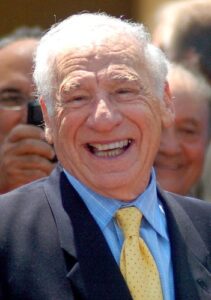
The sound and fury about the 250th anniversary of American independence, and the Trump-esque shenanigans accompanying it, have obscured the fact that, one week earlier, the USA witnessed another important three-digit birthday.  June 28th saw the 100th birthday of the legendary American filmmaker, comedian and general funnyman Mel Brooks.  By the time he turned his hand to making movies in the late 1960s, Brooks already had impressive comic credentials – devising the famed 2000-Year-Old Man comedy sketch with Carl Reiner, for instance, or creating the classic spy-comedy TV show Get Smart (1965-70) with Buck Henry.  But it’s fair to say his films are the body of work for which he’s most beloved.


Like much of the comedy I experienced from an early age – the CarryOn movies, or those starring Abbott and Costello, or the telly career of Ronnie Corbett – I’ve had a complicated and changing relationship with the oeuvre of Mel Brooks.  As a youngster, I thought it was brilliant.  As a young adult, who took himself much too seriously, I dismissed it – certainly, the later films Brooks made – as crass, cringeworthy guff.  Now, in my old age, I can find pleasure in the entirety of Brooks’s canon and appreciate the artistry displayed in even what are, by general consensus, his lesser efforts.  A bad joke might provoke a groan rather than a laugh, but to engineer that groan you still need a certain, warped skill.


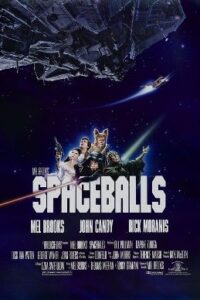
I think I passed from my youthful period of Brooks-disdain to my more mature period of Brooks-admiration in the 1990s.  This was when I was attempting to woo (with a total lack of success) a lady from New York whom I considered, for a while, the coolest thing on earth.  We were chatting one evening about our favourite films and the object of my affections suddenly astounded me by saying she was a huge fan of…  No, not Jean-Pierre Melville’s Le Samourai (1967), or Terence Mallick’s Badlands (1973), or Jim Jarmusch’s Mystery Train (1989), but…  Mel Brooks’s Spaceballs (1987).
 

From wikipedia.org / © Metro-Goldwyn-Mayer / Brooksfilms


“Seriously?” I spluttered.  I’d seen this science-fiction / Star Wars piss-take shortly after its release and thought it was dreadful.  But, patiently, the lady explained to me the sociological depth and cleverness of some of Spaceballs’ jokes that I’d missed – for example, when Bill Pullman and John Candy rescue the princess (Daphne Zuniga) and Pullman remarks, “That’s all we needed…  A Jewish princess!”  I had to concede there was more to Brooks’s humour than I’d thought.


So, I had my moment of epiphany.  I decided, to misquote a line in The Producers, “Don’t be stupid, be a smarty / Come and join the Mel Brooks party.”


Anyway, it’s a fortnight late for the great man’s 100th, but here is a belated guide to the funniest bits, in my opinion, of his movies.  There’s no mention of The Twelve Chairs (1970) and Life Stinks (1991) because I haven’t seen those two.


L.S.D. gets auditioned in The Producers (1967)

The movie that put Brooks on the cinematic map, The Producers has had quite an afterlife, becoming a successful Broadway musical that, in 2005, was turned into a film itself.  For me, its highlight isn’t the famous song-and-dance number Springtime for Hitler that’s the centrepiece of the show that impresario Zero Mostel and accountant Gene Wilder stage in the hope it’ll be a massive flop (allowing them to make a fortune from the shares they’ve sold in it).  No, the highlight comes earlier.


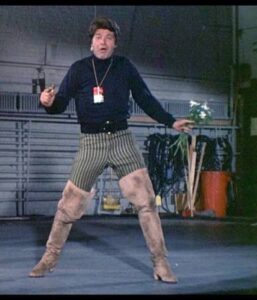
That’s when hippy Lorenzo St. DuBois – L.S.D. to his friends – stumbles into the show’s auditions by mistake and performs, with his female guitar / keyboards / sax backing band, a funny-terrible number called Love Power.   (“And I give a flower to the big fat cop / He takes his glove and he beats me up!”)  Played by Dick Shawn with thigh-high furry boots and a Campbell’s soup-can hanging on a chain around his neck, the hapless L.S.D. is hilarious – and the sequence reaches a perfect conclusion when Mostel bellows ecstatically, “THAT’S OUR HITLER!”
 

From instagram.com / (c) Embassy Pictures


The campfire scene in Blazing Saddles (1974)

If I was more sophisticated, I’d nominate as the funniest moments in Brook’s smash-hit comedy-western the scenes where he skewers the residents of frontier town Rock Ridge for their bone-headed racism.  (“You’ve got to remember that these are just simple farmers.  These are people of the land.  The common clay of the new West. You know…  morons.”)  However…  I’m nominating instead the sequence in Blazing Saddles where Slim Pickens’s men sit around a campfire and stuff themselves with traditional cowboy fare – beans – with flatulent results.


I first saw Blazing Saddles when it played on a big screen in the assembly hall of my school as one of the movies chosen for the school’s Film Club.  When the farting began, the teenaged audience, including myself, laughed like drains.  We were still roaring our heads off minutes after the sequence finished.  No other film shown during the several years I was a member of that Film Club – not Alfred Hitchcock’s Psycho (1960), not Nicolas Roeg’s Don’t Look Now (1973), not Ridley Scott’s Alien (1979) – provoked so tumultuous a reaction.  I’m not proud.


The monster meets the blind hermit in Young Frankenstein (1974)

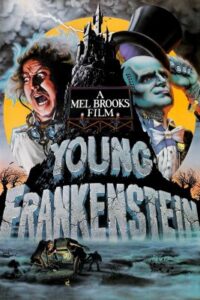
The most genuinely affectionate of Brooks’s genre parodies, Young Frankenstein pokes fun at the black-and-white Frankenstein movies made by Universal Pictures in the 1930s.  My favourite part of it is when Brooks sends up the sequence in Bride of Frankenstein (1936) where the Frankenstein monster (Boris Karloff) is touchingly but briefly befriended by a lonely blind hermit (O.P. Heggie) who’s unaware of his monstrousness.  Here, the well-meaning but, well, blind hermit (Gene Hackman) accidentally and repeatedly scalds and burns the unfortunate monster (Peter Boyle) whilst trying to offer him broth, cigars, etc., until the latter flees from his cottage in terror.  Despite the gleeful bad taste of the gags, the Young Frankenstein sequence retains some of the sweetness and sadness of the Bride of Frankenstein one.  It also makes you wish Gene Hackman had played more comedy roles.
 

From wikipedia.org / © Gruskoff / Venture Films / 20th Century Fox


The boardroom table in Silent Movie (1976)

This was another movie shown at my school’s Film Club and another sequence that sent us – uncivilised little oiks that we were at the time – into paroxysms of laughter.  Evil corporation Engulf & Devour intends to take over the studio of filmmaker Mel Funn (Brooks) but that won’t happen if the new movie Funn is making becomes a hit.  Engulf & Devour’s board of executives hatch a fiendish plan to sabotage Funn and his movie – they’ll send sultry nightclub singer Vilma Kaplan (Bernadette Peters) to seduce, then dump Funn and re-kindle the massive alcohol problem he had previously.  When a picture of Vilma is unveiled to the executives, sitting around the boardroom table, they’re so impressed that the table rises by several inches.


The line Funn / Brooks inspires when Vilma does dump him, and he goes on a massive bender to drown his sorrows – “He is truly the lord of the winos!” – is pretty funny too.


The orchestra in High Anxiety (1977)

Brooks’s next film takes fond aim at the thriller movies of Alfred Hitchcock.  Its hero, Dr Richard Harpo Thorndyke, again played by Brooks himself, suffers from the titular disorder, the vertigo-like ‘high anxiety’.  While travelling in the back of a car, Thorndyke / Brooks suffers a moment of ominous foreboding, which is accompanied by an equally ominous swell of Bernard Herrmann-like orchestral music – the sort that Hitchcock liked to insert into his films to augment the mood.  This being a Brooks film, though, Thorndyke’s car then passes a bus that contains, as passengers, the orchestra playing the music.


Yes, this is the second time Brooks has used that gag.  It originally appeared in Blazing Saddles and involved the Count Basie Orchestra performing in the desert,  But the orchestra-on-a-bus joke in High Anxiety works better, I think.


The Spanish Inquisition in History of the World, Part I (1981)

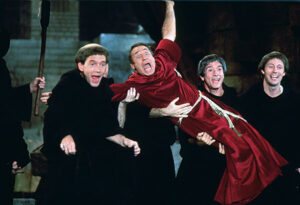
A truly hit-and-miss collection of gags and sketches, History of the World, Part 1 depicts five chapters in world history from the Stone Age to the French Revolution.  Its undisputed highlight is a segment about the Spanish Inquisition.  This features Brooks as Torquemada – his victims are warned not to try to talk him out of torturing them because, “You can’t Torquemada anything!” – and an elaborate Busby Berkeley-like song-and-dance number in a torture chamber which, with its exuberant bad taste, is as impressive as Springtime for Hitler in The Producers.
 

© Brooksfilms / 20th Century Fox


Snotty’s line in Spaceballs (1987)

Spaceballs spoofs Star Wars (1977) but also contains some elaborate send-ups of Planet of the Apes (1968) and Alien (1979) – the latter even drafts in John Hurt to reprise his role as the unfortunate Kane.  But the funniest, or groan-iest, bit in it for me is a simple pun.  A Scottish character called Snotty (Jeff MacGregor), obviously based on Scotty from Star Trek (1966-69), is in a control room flicking a series of switches.  “Lock One!” he shouts.  “Lock Two!  Lock Three!  Loch Lomond!”


The abbot in Robin Hood: Men in Tights (1993)

You have to be a connoisseur of long-ago comedy double-acts to appreciate my favourite joke in Robin Hood: Men in Tights, Brooks’ irreverent take on the then-recent and hugely-successful Robin Hood: Prince of Thieves (1991).  An abbot (Dick Van Patten) is walking in his finery outside his monastery and enjoying the adulation of the local population.  Then a guy who looks and sounds suspiciously like Lou Costello yells at him, “Hey, Abbott!”  Van Patten grumbles, “I hate that guy.”


Dracula tries to control Mina’s mind in Dracula: Dead and Loving It (1995)

I don’t hold it against Brooks’s Dracula: Dead and Loving It, which stars Leslie Neilson as the legendary vampire count, that it isn’t great.  After all, there have been many attempts over the years to spoof vampire films and hardly any of them have been funny – see Roman Polanski’s Dance of the Vampires (1967) or Stan Dragoti’s Love at First Bite (1977).  In fact, it wasn’t until Jermaine Clement and Taika Waititi’s What We Do in the Shadows (2014) that I encountered a vampire-movie parody that made me laugh.


However, Dracula: Dead and Loving It has one funny part where, from a distance, Dracula / Neilson exerts his willpower over the bitten and partly vampirised Mina (Amy Yasbeck) and tries to summon her: “Mina…  Open your eyes…  Arise…  Come to the door…”  The operation goes less smoothly when the mind-controlling vampire discovers there’s a confusing closet door in the way, and a hazardous footstool, and an inconvenient maidservant who’s also picking up his telepathic instructions: “Mina…  You are in the closet.  Open the door and come out…  Watch out for the footstool…  Stand up…  Not you, sit…  No, you sit…  You stand…”


And just before I finish, some praise is due for Brooks as a producer too.  He’s the man who oversaw both David Lynch’s The Elephant Man (1980) and David Cronenberg’s The Fly (1986).
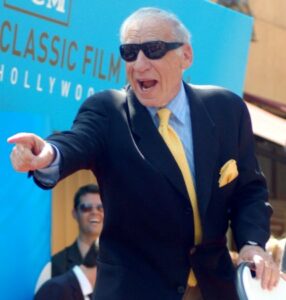
 

From wikipedia.org / © Angela George

The alternative Christmas movie list


© Pan-Canadian Film Distributors


The cinema at Singapore’s ArtScience Museum is currently showing a season of Christmas-themed films so a few days ago my partner and I visited it to catch a showing of John McTiernan’s action classic Die Hard (1987).  My partner hadn’t seen it before and I’d only seen it on a small screen back in the prehistoric days of Betamax video cassettes.


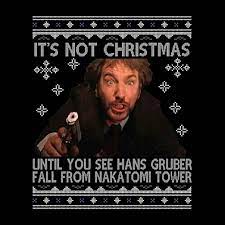
I know every festive season an argument erupts on social media about whether Die Hard is or isn’t a Christmas movie, but seeing it again in 2022 I have to say it seems very Christmassy, much more than I remembered.  It’s got Christmas trees, Christmas decorations, Christmas presents, Christmas carols and Christmas Santa hats – one gets planted cheekily on the corpse of a dead terrorist which Bruce Willis’s John McClane sends down in a lift to taunt the remaining bad guys.  There’s also a limousine stereo playing Run DMC’s Christmas in Hollis (1987) – ”Don’t you have any Christmas music?” McClane grumbles from the back seat.  And Die Hard has Alan Rickman as the villainous and sublimely withering Hans Gruber, who’s a sort of anti-Santa Claus.  Gruber’s intonation is priceless as he reads the message McClane has written in blood on the dead terrorist’s chest: “Now I have a machine gun.  Ho… ho… ho.”


From amazon.com / © 20th Century Fox


However, I tend not to be aficionado of Christmas movies, for two reasons.  Firstly, the way that Christmas is presented in these movies has never corresponded to Christmas as I know it.  For example, as a kid, when I heard Bing Crosby crooning White Christmas in the 1954 film of the same name and then looked out of my window in Scotland at the late-December weather, what I saw wasn’t Bing’s white, fluffy snow-scape.   What I saw was usually a charcoal-grey sky, leaking charcoal-grey rain down onto a charcoal-grey terrain.


Secondly, Christmas movies are, nearly without exception, rubbish.  Most of them eschew anything resembling quality and dial the schmaltz and saccharine up to 11 and assume that’ll satisfy audiences instead – which unfortunately, in many cases, it does.  The biggest offender in my opinion is Richard Curtis’s Love, Actually (2003), which I prefer to think of as Shite, Actually.  That thing wouldn’t have got anywhere near being a good film even if they’d rewritten the Alan Rickman character and allowed him to start killing people.


Still, there’s a small handful of what are officially deemed ‘Christmas movies’ that I like.  Die Hard is one and others include The Snowman (1982), Gremlins (1986), The Nightmare Before Christmas (1993), Rare Exports (2010) and The Muppet Christmas Carol (1992) – any film that has Gonzo the Great playing Charles Dickens is fine by me.


There’s also a number of movies that aren’t officially counted as Christmas movies, even though they take place during the festive season, that I like too.  No doubt they aren’t included in the accepted Christmas canon because they’re dark in tone and don’t conform to the Richard Curtis Law of Christmas-Movie Pap and Sentimentality.  Anyway, it’s in honour of those non-conforming films that I offer the following – my list of favourite alternative Christmas movies.


© Embassy International Pictures / Universal Pictures


Brazil (1985)

Terry Gilliam’s take on George Orwell’s 1984 (1949) has so much going on thematically and visually that it’s easy to forget it’s set at Christmas-time.  But while we try to get our heads around the workings of the dystopian society depicted in Brazil – where labyrinthine bureaucratic systems and labyrinthine plumbing systems go wrong with equal regularity, one with deadly results and the other with disgustingly gloopy ones – we’re assailed by Yuletide trappings: Christmas parties, presents, trees, music.  There’s a family reading Dickens’ A Christmas Carol (1843) – just before a terrifying squad of secret-police goons come crashing into their home, wrongly sent by a bureaucratic mistake involving a fly getting stuck inside a typewriter.  There are Christmas-decorated department stores that become hellholes – even more hellish than normal at this time of year – when terrorist bombs explode.


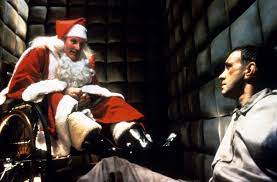
On a more symbolic level, the fate that befalls Robert DeNiro’s Harry Tuttle character – surreally engulfed in a mass of paper – suggests the horror of frantic, last-minute Christmas present-wrapping, when you begin to fear the unruly, recalcitrant paper is going to swallow you up.  And, late on, when Brazil’s everyman hero Sam (Jonathan Pryce) is imprisoned and facing torture, he gets a visit from Helpmann (Peter Vaughan), a senior official in the Ministry of Information, who ironically shows up wearing a Santa Claus outfit.  This underlines the fact that, like many an authoritarian, Helpmann believes he’s being benevolent towards his subjects, though in reality he’s anything but.


© Cinema Entertainment Enterprises


Rabid (1977)

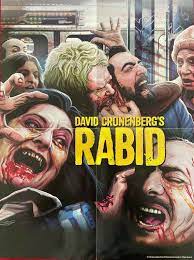
As you might expect, Christmas with Canadian director David Cronenberg is not exactly cosy.  Set during the festive season in and around Montreal, Cronenberg’s Rabid tells the tale of a woman (Marilyn Chambers) developing a weird, parasitic skin-puncturing / blood-draining orifice under her armpit following some experimental surgery.  She soon becomes a plague-spreader – her new body part infecting people who turn into ravening, blood-craving monsters.  One negative thing I always felt about Christmas was the sense of confinement – being stuck indoors because the weather was foul and because there was nothing to do outside anyway due to everything being closed.  Rabid conveys a similar feeling by showing Montreal under martial law, its wintry streets silent save for the trucks prowling around removing corpses from the sidewalks.  Though a more obvious Christmassy moment is when carnage erupts in a shopping mall and the cops unwittingly gun down the store Santa Claus.


The Silent Partner (1978)

You have to hand it to those Canadians – back in the 1970s, at least, they knew how to stage a dark Christmas movie.  Daryl Duke’s The Silent Partner (1978) is an excellent thriller, often amusing but with a few moments of nasty violence to keep the audience on edge.  Its villain is the psychotic but intelligent criminal Harry Reikle (Christopher Plummer).  Reikle becomes a formidable opponent for – and, as the film progresses, the title’s sinister ‘silent partner’ to – the film’s hero, Miles Cullen (Elliot Gould), a mild-mannered teller working in the Toronto bank that Reikle decides to rob.  As it’s Christmas time, and the shopping mall where the bank’s located is overflowing with festive cheer, Reikle carries out the crime disguised as a mall Santa Claus.  However, he meets his match in Miles.  After Reikle botches the robbery, Miles uses it as an opportunity to fill his own pockets with the supposedly ‘stolen’ money.  Reikle is predictably disgruntled by this and a game of cat-and-mouse ensues between them.


The Silent Partner later moves its action to a different time of year, but not before we see Miles at that traditional festive fixture, the staff Christmas party, where he has to listen to his weary, cynical workmates speculating longingly about what they’d do with the stolen money if they had it.  His colleagues include a very young John Candy, sporting an alarming 1970s side-parted hairdo.


© Hammer Films / British Lion Films


Cash on Demand (1961)

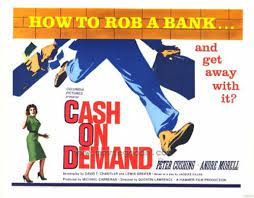
While we’re on the subject of movies about bank workers finding themselves in unhappy alliances with bank robbers, let’s mention the superlative Hammer Films B-movie Cash on Demand, directed by Quentin Lawrence, with Peter Cushing – better known for appearing in the studio’s horror films – as a snotty, uptight bank manager called Fordyce, who’s forced to help a criminal, Hepburn (Andre Morell), intent on robbing his bank.  Unlike The Silent Partner, Cash on Demand doesn’t show any violence but a lot of nastiness is implied, with Hepburn matter-of-factly informing Fordyce that he’s kidnapped his family and is going to start torturing them with electrical shocks if he doesn’t cooperate.


And, like The Silent Partner, the attempted robbery in Cash on Demand takes place during Christmas, with a Salvation Army band playing carols outside Fordyce’s bank.  Indeed, there’s a Scrooge / Christmas Carol subtext to the plot.  Fordyce begins the film as an insufferable prick, contemptuous of his workers, who are more interested in their upcoming Christmas do than the day’s toil at their desks.  However, by the ordeal’s end – and after his staff have come to his rescue – Fordyce is a much more appreciative soul, not just of his family but of the people who work for him.


© Amicus Productions / Metromedia Producers Corporation


Tales from the Crypt (1972)

Cushing also appears in the cast of the British horror anthology movie Tales from the Crypt, along with such notables as Sir Ralph Richardson, Ian Hendry and Patrick Magee.  Its first episode, All through the House, has the future Alexis Colby and all-round super-diva Joan Collins murdering her wealthy husband on Christmas Eve.  Just before she can make the murder – bashing his head in with a poker while he was reading a newspaper, smoking a cigar and wearing a Santa hat – look like an accident – falling down the cellar stairs – fate intervenes in the form of an escaped homicidal maniac who’s prowling outside and is dressed as Santa Claus.  We spend the story waiting to hear why he’s dressed as Santa Claus, but we never do – he just is.  In the climactic scene, Ms Collins gets her just desserts by being strangled by the maniac.  Actually, it looks like he’s just giving her a shoulder massage, but it’s still good, grisly, Yuletide fun.


© Rizzoli Film / Seda Spettacoll / Cineriz


Deep Red (1976)

Dario Argento’s ultra-stylish giallo movie Deep Red (Italian title Profondo Rosso) has David Hemmings investigating a string of gruesome murders around Turin.  It’s only tenuously a Christmas movie – the opening scene involves a child witnessing a murder next to a Christmas tree – but generally, in its dark way, the film feels Christmasy.  It’s due in part to the richness of Argento’s visuals and in part to the Christmas-like music by Argento’s frequent collaborators, German progressive-rock band Goblin, which alternates between a baroque organ-driven theme and a plaintive child’s refrain.  Meanwhile, the cackling clockwork puppet that makes a brief but unforgettable appearance is the sort of Christmas present you’d give to a child you really don’t like.


The Proposition (2005)

What does this Nick Cave-scripted, John Hillcoat-directed Australian western have to do with Christmas?  Well, the movie’s finale is a masterpiece of festive-season irony.  It has a beleaguered police captain and his wife, played by Ray Winstone and Emily Watson, prepare for their Christmas dinner – turkey, sprouts, pudding et al – with civilised English decorum in the midst of the festering, dusty, fly-ridden hellhole that was the 1880s Australian Outback.  There’s also a gang of vengeful, blood-crazed bushrangers on their way intending to kill Winstone and rape Watson, even while Winstone and Watson arrange the Christmas cutlery and crackers on their dining table.


Australians I know have described the weirdness of trying to celebrate a European-style Christmas against the backdrop of Australia’s sweltering December climate, and Cave’s script taps into that weirdness.  The Proposition is, incidentally, one of the mankiest films I’ve seen, with the grime-encrusted, matted-haired characters on view paying absolutely no attention to their personal hygiene.  The best thing Santa Claus could do for this lot is leave a few bottles of shampoo and conditioner in their stockings.


© UK Film Council / Sony Pictures Releasing


The Proposition would make a great Australian double-bill with my favourite Christmas movie of all time, which is…  Drum-roll…


Wake in Fright (1973)

One of the films that helped kick-start what is now known as Australia’s cinematic New Wave, Ted Kotcheff’s Wake in Fright is a reworking of William Golding’s Lord of the Flies (1954) – with a schoolteacher called John Grant (Gary Bond), not some schoolchildren, stranded in an isolated, primitive environment where the onion-skins of civilisation are gradually peeled off him and he descends into savagery.  The twist is that Grant isn’t stuck on a desert island but in a hellish Australian Outback town called Bundanyabba, where he’s foolishly gambled away the money he was using to travel home to Sydney.  And the brutish behaviour of Bundanyabba’s locals that infects him and drags him down isn’t, it’s implied, any different from that in any other Australian Outback town.


Famous for its scenes of squalor, drunkenness, brawling, vandalism, vomit, sweat-stains, flies, animal-slaughter and Donald Pleasence going bananas, Wake in Fright still qualifies as a Christmas movie.  Grant is trying to get back to Sydney for the Christmas vacation and events in Bundanyabba take place against a festive background of Christmas trees, decorations and carols.  Meanwhile, a scene near the end where a stained and begrimed Grant wakes up on a floor, haunted by memories from the night before of drinking about a hundred pints, gunning down about two dozen kangaroos, wrecking a pub, and shagging Donald Pleasance, will strike a chord with anyone who’s woken up in a similar state, with similarly traumatic memories, the morning after the work Christmas party.


© NLT Productions / Group W Films / United Artists


Merry Christmas!

Plummer and Plummer


© AVCO Embassy Pictures

© Carolco Pictures / EMC Film Corporation


One of the least pleasant consequences of the Covid-19 pandemic has been the argument, advanced mainly by right-wingers, that it’d be better for society to steam on without lockdown and its attendant economic damage because most people killed by the virus are elderly and will die soon anyway.  Old folks, in other words, are expendable.  I’m thinking of failed Australian ex-prime minister Tony Abbot, who opined that families should be allowed “to make elderly relatives as comfortable as possible while nature takes its course”; or Daily Telegraph columnist Jeremy Warner, who reflected that “Covid-19 might even provide mildly beneficial in the long run by disproportionately culling elderly dependents”.


However, the notion that elderly people are merely past-their-sell-by-date sacks of meat, helplessly sitting around with nothing to do but wait for death, in viral or other forms, to arrive at their doors, was surely refuted by the example of the great Canadian actor Christopher Plummer.


Plummer, who sadly bowed out last week at the age of 91, had been acting since the 1950s and had been on my movie radar since I was a kid in the 1970s.  But it wasn’t until well after he’d qualified for his free bus pass that he got the roles that earned him official recognition as acting royalty.  He received his first Oscar nomination when he was 80 years old, for a supporting role in Michael Hoffman’s 2009 film The Last Station.  Though he didn’t win that award, two years later at the Oscars he netted Best Supporting Actor for his performance in Mike Mills’ Beginners (2010).  And a half-dozen years afterwards, to prove he wasn’t yet over the hill, Plummer got another Oscar nomination for Best Supporting Actor in Ridley Scott’s All the Money in the World (2017).


Indeed, just last year, I was delighted to see him play a tough but kind-hearted patriarch in Rian Johnson’s entertaining murder mystery Knives Out (2019).  In this, Plummer effortlessly held his own not only among a starry ensemble cast that included Jamie Lee Curtis, Michael Shannon, Don Johnson and Chris Evans, but also against Daniel Craig’s scenery-shredding Southern accent.


So the acclaim heaped on the octogenarian Plummer, and his seeming ubiquity on the screen in the last decade, negate the idea that human beings are fit only for the scrapheap when they reach their allotted three-score-and-ten.  With hindsight, at the age of 70, Plummer’s best years were arguably still ahead of him.


That said, it’s for two films he made as a younger man, in the late 1970s, that I’ll particularly remember him.


© Carolco Pictures / EMC Film Corporation


Daryl Duke’s The Silent Partner (1978) is an excellent thriller, though one that’s strangely underrated.  I suspect mainstream critics neglected it because they felt uncomfortable with a couple of scenes of nasty violence in the film, which were included to show what a psychotic, misogynistic scumbag its villain is.  That villain is the criminal Harry Reikle, played by Plummer.  Reikle becomes a formidable opponent for – and, as the film progresses, the title’s sinister ‘silent partner’ to – the film’s hero, Miles Cullen, played by Elliot Gould, a mild-mannered teller working in the bank that Reikle has decided to rob.


Despite his violent disposition, Reikle is a criminal with an imagination.  He carries out one crime dressed in drag and another disguised as a shopping-mall Santa Claus.  However, he meets his match in Cullen, who uses Reikle’s botched robbing of his bank as an opportunity to fill his own pockets with supposedly ‘stolen’ money.  Reikle is unsurprisingly displeased at this and a game of cat-and-mouse ensues between them.


Besides being a bit nasty, The Silent Partner is suspenseful, twisty, ingenious and, thanks to its droll observations of the inanities, pettiness and officiousness its hero has to endure while working in the bank, very amusing.  You fully understand why the frustrated, put-upon Cullen wants to cheat his workplace out of a fortune and escape from it forever.  Plummer and Gould give the film its yin and yang, its enjoyable balance of tension and humour, shocks and laughs.  (On the laughter side, it’s also helped by the presence in a supporting role of a young John Candy, sporting an alarming 1970s side-parted hairdo.)


My other favourite Christopher Plummer performance came the following year when he donned the deerstalker for Bob Clark’s 1979 Sherlock Holmes epic Murder by Decree.  (Plummer had already played Holmes in a 1977 TV film called Silver Blaze).  Inspiring the film, which has Holmes investigating the real-life murder spree of Jack the Ripper, is Stephen Knight’s book Jack the Ripper: The Final Solution (1976), which postulated that the killings were the result of a conspiracy involving the Freemasons and the Royal Family.  The same theory informs Alan Moore’s celebrated graphic novel From Hell (1989-98) and its subsequent 2001 movie adaptation.


Murder by Decree is a classy movie with handsome production values and a big-name cast and Plummer essays a correspondingly classy and cultivated Sherlock Holmes.  Also deserving praise is James Mason as Doctor Watson.  Despite the disparity in their ages – Plummer was around 50 at the time, Mason around 70 – the pair make a delightful double-act.  They’re clearly bound by great affection and loyalty for one another, even if there are occasional moments of irritation and sulkiness, and they go about their business like a long-term and mostly loving married couple.  Incidentally, playing Inspector Lestrade in Murder by Decree is actor Frank Finlay, who had already played the same role in another movie where Sherlock Holmes encounters Jack the Ripper, 1965’s A Study in Terror.


© Dimension Films / New Art & Logic / Miramax Films


Plummer also appeared in a number of bad movies, of course, but like all great actors, he could feature in a godawful piece of guff and make it entertaining nonetheless.  He was, for example, very credible as the vampire hunter Van Helsing in Patrick Lussier’s Dracula 2000 (2000).  The fact that this particular movie has Gerard Butler playing Dracula tells you all you need to know about its quality.


Meanwhile, if you look between The Silent Partner and Murder by Decree in Plummer’s filmography, you’ll discover that he was in the less impressive Starcrash (1978).  This was an Italian Star Wars (1977) rip-off, of which the kindest thing that can be said is that the gap between what director-writer Luigi Cozzi imagined would be happening on the screen when he wrote the script, and what he could actually afford to put on the screen with his budget, is painfully obvious.  In Starcrash, Plummer plays the Emperor of the Universe and at one point he sagely tells his son (David Hasselhoff): “You know, my son, I wouldn’t be Emperor of the Universe if I didn’t have some powers at my disposal.”  Plummer later justified his participation in the film by saying it gave him a chance to be in Rome: “Give me Rome any day.  I’ll do porno in Rome, as long as I can get to Rome.”


13 years after Starcrash, Plummer had a rather better science-fictional experience playing the Klingon warlord Chang in the 1991 Star Trek movie Star Trek VI: The Undiscovered Country.  Plummer gives a deliciously no-holds-barred performance as Chang, who’s so badass that the eyepatch he wears isn’t tied around his head on a piece of string or elastic but is rivetted into his face.  In the final scenes, Chang bellows lines from Shakespeare’s Julius Caesar while he and his forces launch an attack on the Starship Enterprise: “Cry ‘Havoc!’  And let slip the dog of war!”  (Earlier, the Klingons had informed Captain Kirk that “you have not experienced Shakespeare until you have read him in the original Klingon.”)  I suspect the presence in the film of Plummer’s long-term friend and one-time understudy William Shatner, an actor not known for his subtlety, inspired Plummer to play Chang with his brakes off.


© Paramount Pictures


Plummer’s turns in Star Trek VI and The Silent Partner show his excellence as a screen villain.  Further proof of this is found in Taylor Hackford’s 1995 thriller Dolores Claiborne, perhaps the most underrated of all film adaptations of books by Stephen King.  Plummer plays the vindictive Detective John Mackey, who failed to pin a murder rap on the titular heroine (Kathy Bates) after the death of her abusive, alcoholic husband (David Strathairn) in the 1970s.  Two decades later, he believes he can finally nail her when her employer (Judy Parfitt) dies amid much circumstantial evidence suggesting Dolores has killed her.


I also associated Plummer with playing famous historical figures.  These included Rommel in Anatole Litvak’s Night of the Generals (1968), the Duke of Wellington in Sergei Bondarchuk’s  Waterloo (1970) – the epic Dino De Laurentiis production that proved such a financial flop that it helped scupper Stanley Kubrick’s plans to make a film about the life of Napoleon – and Rudyard Kipling in John Houston’s The Man Who Would Be King (1975), a film that poignantly lost another of its stars, Sean Connery, just a few months ago.


He had a profitable relationship too with director Terry Gilliam.  In 1995 he played Brad Pitt’s dad in Gilliam’s masterful 12 Monkeys, while 14 years later he played the title character in The Imaginarium of Doctor Parnassus.  Typical of Gilliam’s 21st century film-work, Parnassus is all over the place and sadly indicates that the director has passed his prime – though it didn’t help that the movie’s star Heath Ledger died during filming and his character also had to be played, through a series of unconvincing phantasmagorical transformations, by Johnny Depp, Colin Farrell and Jude Law.  But the scenes with Plummer and his endearingly ramshackle travelling theatre, the ‘imaginarium’ of the title, are good and recall the director’s glory days.


One other movie featuring Plummer that I admire is Terrence Malick’s gorgeous and beguiling 2005 epic The New World.  He plays Captain Newport, leader of an expedition to establish an English colony in Virginia in 1607.  Newport’s party includes Captain John Smith (Colin Farrell), destined to fall in love with Pocahontas (Q’orianka Kilcher), daughter of the chief of the local Native Americans.  However, Plummer was not enamoured with Malick’s unstructured and improvisational approach to filmmaking.  He was particularly galled when he saw the final cut of The New World and discovered that an important, emotional speech his character had given was now background noise in a scene with a different dramatic focus: “I could hear myself saying it, this long, wonderful, moving speech that I thought I was so fantastic in… way, miles in the distance while something else is going on in the foreground…”  Plummer subsequently voiced his displeasure to Malick in a letter.  “I gave him shit.  I’ll never work with him again, of course.”


Plummer’s willingness to speak his mind and slag off any film in his CV he didn’t enjoy making or watching was, of course, demonstrated by his attitude towards his most famous role, that of Captain von Trapp in Robert Wise’s saccharine The Sound of Music (1965).  Marvellously, he dubbed it ‘The Sound of Mucus’.  As well as just not liking the film, he found acting in it hard work: “To do a lousy part like von Trapp, you have to use every trick you know to fill the empty carcass of the role.”


No wonder that in a Facebook tribute to Christopher Plummer the other day, Terry Gilliam finished by writing: “I already miss him terribly and I hope to God they don’t play Edelweiss at his funeral.  It would kill him.”


© First Foot Films / Sarah Green Film / New Line Cinema