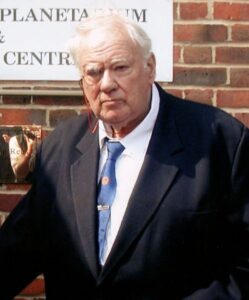
From wikipedia.org / © South Downs Planetarium
This seems a regular occurrence nowadays – the BBC is currently involved in a round of bloodletting, sorry, cost-cutting. According to the Independent, “popular shows being axed” include “Drag Race UK and Live at the Apollo” while “BBC Three, BBC Scotland and BBC Radio 4 Extra linear broadcast services will also close in spring 2027.” Oh, and Blankety Blank, a celebrity quiz show I last cringed at sometime in the early 1980s, is getting the chop too. I had absolutely no idea Blankety Blank was still a thing in 2026.
Anyway, I thought, shit. I hope The Sky at Night is okay.
In fact, when I checked the BBC’s venerable astronomy programme on IMDb, I discovered that its 70th season had been broadcast this year. The most recent episode went out on November 9th (wherein “the team journey to La Palma, where giant new telescopes and cutting-edge science are opening extraordinary new windows on our universe.”) Three episodes previously, in August 2026, Professor Brian Cox – the famously boyish-looking physicist and former keyboard player with the pop band D:Ream, not the craggy Scottish character actor who played Logan Roy in Succession (2018-23) – had joined the team “to explore the mind-bending mysteries of black holes discovered by the James Webb Space Telescope’s most exciting new observations.”
Ominously, the BBC’s page for The Sky at Night currently says ‘no upcoming broadcasts’ are scheduled for the future. So, fingers crossed the show’s still with us.
Anyway, the purpose of this blog-post is not to honour The Sky at Night itself, but to honour the man who presented it for the majority of its history, up until his death in December 2012. It felt appropriate that the astronomer Sir Patrick Moore dedicated his life to surveying the universe. For anyone who grew up accustomed to the monthly appearances of The Sky at Night on late-evening British television – its opening music, At the Castle Gate composed by Jean Sibelius, ringing out of one’s TV set with a lunar-cycle regularity – and was still watching it in the 2000s, Moore ended up seeming as old as the universe.
He wasn’t quite that elderly, of course, but in television terms he was astonishingly long-lasting. The Sky at Night, with Moore at the helm, was first broadcast on April 27th, 1957, five months before the Soviet Union launched Sputnik 1 into an elliptical low-earth orbit. That meant Moore was presenting the show while Jack Webb was still playing Joe Friday in Dragnet (1951-59) and Phil Silvers was still performing as Bilko (1955-59). Quatermass II (1955), the second of Nigel Kneale’s seminal sci-fi horror dramas featuring the rocket scientist Professor Bernard Quatermass, had aired but not the third one, Quatermass and the Pit (1958-59). He was on TV two years before The Twilight Zone (1959-64), a show indelibly linked in most people’s minds with black-and-white 1950s TV. He was also broadcasting two years before Rawhide (1959-65), three years before Coronation Street (1960-present) and five years before Doctor Who (1963-89, 2005-26).
Moore fronted The Sky at Night until its December 2012 episode, which was broadcast just before his death. Prior to that, he missed presenting an episode of it only once, in July 2004, when he almost died from salmonellosis after eating an infected egg. During those 55 years, Moore’s guests on the show included Wernher von Braun, Arthur C. Clarke, Fred Hoyle, Carl Sagan and Sir Bernard Lovell, the radio astronomer and director of Jodrell Bank Observatory who died just four months before Moore did in 2012. (Lovell claimed that during the Cold War the Soviets had tried to kill him with radiation poisoning. It’s said too that Nigel Kneale was sufficiently inspired by him to give his fictional scientist-hero Quatermass the same first name, Bernard.) Astronauts Neil Armstrong and Buzz Aldrin also turned up on The Sky at Night and it was a point of pride with Moore that he was the only person in history to have met Armstrong, Yuri Gagarin and Orville Wright.
But he was far more than a TV-presenting head. As an astronomer, he remained stubbornly amateur and unqualified, having turned down the offer of an academic grant and the opportunity to study at Cambridge University following World War II. Nonetheless, he was only amateur astronomer ever to be granted membership of the International Astronomical Union.
From wikipedia.org / © BBC
The moon was his special subject and he was credited with discovering the Marie Orientale, the Eastern Sea, though Moore later said the German astronomer Julius Heinrich Franz had found it first. He came up with the term ‘transient lunar phenomenon’ (TLP) to describe the mysterious light and colour changes that briefly occur on patches of the moon’s surface. In the middle of the Cold War, the Soviets took a shine to Moore and invited him over to meet Gagarin – they obviously preferred him to Sir Bernard Lovell – and he was also the first Western astronomer to see photographs taken by the Soviet Luna 3 probe in 1959, which allowed the moon’s far side to be mapped for the first time.
One aspect of Moore that’s often forgotten is that he was a writer of fiction – more precisely, of juvenile science fiction. He wrote several series of rip-roaring sci-fi children’s books that featured heroic (and obviously, scientific) teenage characters with names like Gregory Quest (1955-1956), Maurice Gray (1955-1959), Robin North (1960-1964) and Scott Saunders (1977-1979). Their titles conjure up images of a simpler and more optimistic science-fictional era: Quest of the Spaceways (1955), Captives of the Moon (1960), Spy in Space (1977), The Terror Star (1979) and so on. His writing earned him an entry in the online Encyclopaedia of Science Fiction:
Eccentric to say the least – as well as astronomy and writing children’s science fiction, his enthusiasms included cricket, playing the xylophone, wearing monocles and chess (he carried a pocket-sized chess set with him at all times) – his demeanour on The Sky at Night was that of a very old-style and somewhat intimidating school teacher. His urgent manner and the way his body barely seemed to fit into his buttoned suit gave him an aura of impatience and cantankerousness, even when he wasn’t feeling tetchy. However, given the technical problems he had to deal with on The Sky at Night, especially the dreadful British weather that spoiled many a view of a meteor shower, a passing comet or a lunar eclipse, any tetchiness was justified. There was also a moment during a live TV commentary about the Luna 4 probe when he opened his mouth to speak and a huge fly buzzed into it. Old pro that he was, Moore kept talking to the camera. As he remarked later, the experience wasn’t pleasant for him, but it was worse for the fly.
The British public, even the many who didn’t know or care about astronomy, took him to their hearts as a lovable eccentric. However, if you were within hearing range of him when he started expounding his political views, he might have seemed less lovable. In his autobiography, published in 2003, he readily described his politics as being to the right of Attila the Hun’s and professed to taking a dim view of immigrants, homosexuals and any women with ideas above their station. He was never short of a uncomplimentary word to say about the Germans – the ‘Krauts’ – though as his fiancé Lorna, who’d served during World War II as an ambulance driver, was killed by a German bomb that struck her vehicle in 1943, he might be excused that particular belligerence. Inevitably, following his death, when many were paying tribute to him, the New Statesman questioned whether someone with Moore’s political outlook really deserved all the hagiographies.
But he wasn’t wholly blimpish. He had a loathing for fox-hunting and the aristocratic types who indulged in it – ‘filthy people’, he called them once. An animal lover, he gave support to various animal charities and was particularly fond of cats – “A catless house,” he once remarked, “is a soulless house”. He also opposed capital punishment and disliked George W. Bush because of the Iraq War. He spent three years serving as director of the Armagh Planetarium in Northern Ireland in the 1960s, but was glad to leave the province because he was upset by the anti-Catholic prejudice he saw there.
Reactionary curmudgeon he may have been, but Moore always seemed popular with the younger and more right-on members of Britain’s comedy set. During the 1970s he made so many guest appearances in The Goodies (1970-80), a show best described as the anarchic kid-brother to Monty Python’s Flying Circus (1969-74), that he seemed almost a semi-regular on it. In one episode of The Goodies, Animals, there was a spoof nature documentary that studied the BBC’s science-programme presenters as if they were exotic species of wildlife. Moore was seen perched up a tree with a telescope and was described “a creature perfectly adapted to living at night… so specialised that it’s almost lost the use of its neglected eye”.
He appeared in a radio instalment of Douglas Adams’ celebrated The Hitchhiker’s Guide to the Galaxy (1978-80) and was good mates with impersonator Jon Culshaw who, like a couple of generations of British impersonators, had honed his impersonation of Moore to perfection. When Culshaw gave Moore a prank phone call on his show Dead Ringers (2002-07) pretending to be Doctor Who (the 4th Doctor / Tom Baker version) and asking for advice on where to land on Mars, Moore wasn’t in the least bit ruffled and gave him some suggestions. Incidentally, in 2010 Moore cameoed on the rebooted Doctor Who, playing himself in the episode The Eleventh Hour where Matt Smith made his debut as the 11th Doctor.
He was a guest too on Paul Merton’s name-your-pet-hates show Room 101 (1994-2007) where, politically incorrect as ever, one of the things he identified as a bête noire was ‘women newsreaders’. Merton ended the programme with a clip showing Culshaw and a bemused-looking Moore attempting to play the Prodigy song Firestarter (1996) on a pair of xylophones:
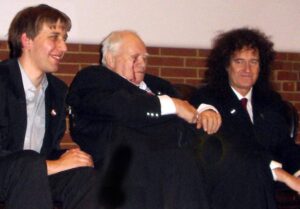
From wikipedia.org / flickr.com / © Steve Elliot
Though Moore described all modern pop and rock music as ‘indescribably awful’, he struck up a friendship with Queen guitarist Brian May, who long before had abandoned his studies for a PhD at the Imperial College Department of Physics and Mathematics to join Freddie Mercury and co. (though he did co-author two research papers, Mgl Emission in the Night Sky Spectrum and An Investigation of the Motion of Zodiacal Dust Particles [Part 1], in 1972 and 1973). I was never much of a Queen fan, at least, not after their album News of the World (1977), but I liked how after Mercury’s death in 1991 May went back to his studies and completed his PhD in astrophysics, at Moore’s urging. Given Moore’s uncharitable opinion of rock music, he probably assumed May was on his way to getting a proper job at last. He must have been disappointed, though, that May never got a proper haircut to go with it.
Meanwhile, Alex James – bassist with legendary 1990s Britpop band Blur, columnist, cheesemaker and ‘artist in residence’ at the Astrophysics Department of the University of Oxford – was such a Moore fan that he went and interviewed him at his home for the Idler magazine in 2001. James said later of the encounter that he “asked him what shape he thought the universe was. He said that he didn’t know, but that he’d asked Einstein that same question, and he didn’t know either.” I can’t find the interview online now but I recall it being somewhat surreal. While James burbled on about the shape of the universe, or whatever, Moore observed profoundly, “Look at that… The cat’s asleep.”
As for myself, I recall being eight or nine years old when I first stayed up late to see Moore on The Sky at Night. Back then I was still a bit scared of the night-time darkness outside my house – I lived in rural Northern Ireland, where there were few streetlights and many ghost stories in circulation. But I saw Moore on television extolling the wonders of the night-sky and his gruff enthusiasm was infectious. I can still remember how excited I felt when, for example, I was able to identify a particular star constellation or see a shooting star for the first time.
So thanks for that, Sir Patrick.
From pixabay.com / © Manuel-H