
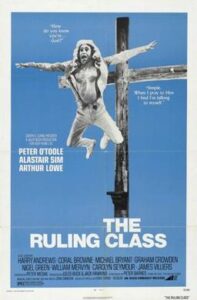
From wikipedia.org / © United Artists / AVCO Embassy Pictures
The British-Hungarian film and TV director Peter Medak died near the end of last month. Here’s an update of something I wrote a decade ago about what I consider to be Medak’s greatest movie, 1972’s The Ruling Class…
It’s fair to say that the British film industry hasn’t produced anything else quite like The Ruling Class, the satirical 1972 movie starring flamboyant Anglo-Irish actor Peter O’Toole, directed by émigré Hungarian filmmaker Peter Medak and scripted by English playwright Peter Barnes, who adapted for the screen his 1968 play of the same name.
Okay, The Ruling Class’s surreal but relentless lampooning of Britain’s social, religious and political establishments puts it in territory similar to that occupied by the famous film trilogy directed by Lindsay Anderson, If (1968), O Lucky Man! (1973) and Britannia Hospital (1982). Indeed, the similarities feel more pronounced due to the presence in The Ruling Class of Arthur Lowe and Graham Crowden, two actors who appeared regularly in Anderson’s work.
Also, the casting of Lowe, Coral Browne and Harry Andrews in The Ruling Class calls to mind Douglas Hickox’s delicious comedy-horror movie Theatre of Blood (1973), in which all three actors fall victim to a psychopathic Shakespearean actor played by Vincent Price. The Ruling Class contains a dose of the macabre too and shares with Theatre of Blood a mad but compelling antihero.
But for acting gusto, for directorial flair, for a story that blends a bewildering range of genres, and for mocking humour that veers between the delightfully subtle and the bruisingly un-subtle, The Ruling Class is in, well, a class of its own.
© United Artists / AVCO Embassy Pictures
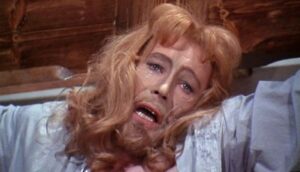
O’Toole plays Jack Gurney, the 14th Earl of Gurney, who inherits his title after the 13th Earl – a brief but barnstorming performance by Andrews – accidentally perishes during a disturbing sex-game involving a noose and a ballerina’s skirt. To the relief of the late earl’s brother, a Church of England bishop played by the incomparable Alistair Sim, he didn’t commit suicide, which would of course have been sinful.
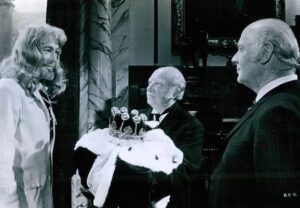
The Gurney family is dismayed to learn that young Jack is out-and-out, barkingly insane. He believes he is Jesus Christ and sports an appropriately Christ-like beard and mane of hair. He also wishes to bring peace and love to the earth and sleeps upright on a giant wooden cross. Before long, the most unscrupulous of his relatives, his Uncle Charles (William Mervyn) and Aunt Claire (Browne), are plotting to get rid of him.
Charles decides to ensnare Jack using his young opera-singing mistress Grace (Carolyn Seymour). He introduces them, calculating – correctly – that Jack will fall in love with her and marry her. When the marriage is consummated and an heir produced, Charles can then have Jack committed. Charles’s plans go astray, however. Grace falls in love with the crazy but unsettlingly charming Jack and, later, Jack seems to be cured of his madness by his psychiatrist Dr Herder. Herder is played by Michael Bryant, who for some reason does an uncannily accurate impersonation of the great Czech character actor Herbert Lom. Indeed, so much is Bryant like Herbert Lom that during the film I assumed I was watching Lom. I only realised it was Bryant in the role when I saw his name in the closing credits.
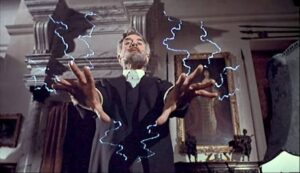
Herder bases his cure on the reasoning that there can only be one Jesus Christ, and if Jack can be convinced that somebody else is Christ then he’ll be cured of his own delusions. There follows a sequence in which Herder introduces Jack to a psychiatric patient called McKyle, played by Nigel Green, who believes himself to be a very different sort of Messiah: a wrathful, blood-and-thunder, take-no-prisoners, Old Testament-style one with a booming Scottish accent. Green’s performance here is electrifying – literally electrifying, because the panic-stricken Jack sees bolts of energy shooting out of his hands. Actually, it’s disconcerting to watch Nigel Green in a role like this if, like me, you mainly remember him for playing Colour-Sergeant Bourne in Zulu (1964), who was surely the most unflappable and down-to-earth character in the history of British cinema.
© United Artists / AVCO Embassy Pictures
And Charles’s scheme to have his troublesome nephew banged away in the loony-bin ultimately fails when the court psychiatrist (Crowden) discovers to his joy that Jack is a fellow old Etonian – the film’s dig at the ‘old-boy network’ that’s promoted incompetence and mediocrity in the upper echelons of British society for centuries. The pair of them then burst into a jolly rendition of The Eton Boating Song. Incidentally, the film is peppered with musical interludes like this one. None of them last long enough for it to quite qualify as a musical, but they add yet another colour to its palette.
Predictably, Jack isn’t really cured of his insanity. “I’m Jack!” he affirms a little too keenly, “I’m Jack!” He no longer believes that he’s Jesus Christ, but he soon develops a worrying interest in Victoriana and we realise that the Jack he thinks he is now isn’t Jack Gurney. It’s a different Jack, one who gained notoriety in the back-streets of Whitechapel in the late 1880s. In one phantasmagorical scene, splendidly orchestrated by director Medak, we see Jack step through the wall of his mansion’s living room and into a Victorian back-street, accompanied by one of the film’s female characters – who soon gets spitted on a long sharp blade.
However, in the film’s final spasm of irony, Jack Gurney’s confusion with Jack the Ripper does him no harm whatsoever. His Ripper-style murder is blamed on someone else – the film’s sole working-class character, the Gurneys’ butler Tucker (Lowe). Then, near the movie’s end, Jack takes his seat in the House of Lords and there delivers a debut speech that is a demented, psychotic hang-’em / flog-’em rant. The speech, needless to say, is wildly popular among the House’s venerable members. (Medak memorably shows the assembled lords through Jack’s eyes as a horde of rotting, cobwebbed but somehow animate corpses.) His infant son, meanwhile, is also gurgling, “I’m Jack! I’m Jack!” which suggests that the insanity of this particular branch of the ruling class will continue for another generation at least.
With all this going on, the success or failure of The Ruling Class depends on the ability of the actor in the lead role and Peter O’Toole is glorious. He’s at the height of powers – still surfing the waves he made in 1962’s Lawrence of Arabia, 1964’s Beckett and 1968’s The Lion in Winter; and before booze and bad movie choices, like 1979’s Caligula and 1984’s Supergirl, took their toll on his reputation. For the entire film his character is as mad as a hatter and yet you have no difficulty believing Carolyn Seymour’s Grace – and indeed, later, Coral Brown’s Aunt Claire – could fall for this wild-eyed, loquacious and charismatic lunatic.
But O’Toole is helped by his supporting cast. Arthur Lowe is wonderful as the beleaguered and cantankerous butler, Tucker. While Lowe’s career was full of delightful moments, I think the most delightful moment of all comes in The Ruling Class when he learns that the late 13th Earl of Gurney has left him 30,000 pounds in his will and he does a wee dance to celebrate. Coral Browne, meanwhile, who was pushing 60 at the time she made the film, gives a memorable performance as a mature lady who remains sexually charged, slinky and alluring. There’s nothing inelegant about the scene towards the movie’s end where she tries to seduce O’Toole, who’s some 20 years her junior. Actually, I can understand why in real life Vincent Price married Browne shortly after he’d murdered her onscreen in Theatre of Blood.
© United Artists / AVCO Embassy Pictures
The film also showcases the talents of several actors whose careers were never quite as successful as they should have been. Carolyn Seymour is excellent as Grace and it seems a shame that most of her subsequent work was on British and American television. William Mervyn, who was typecast playing upper-class gentlemen in the likes of The Railway Children (1970) and various Carry On films, makes a splendid main villain, Uncle Charles, and it’s unfortunate he wasn’t given some similarly meaty roles before his death in 1976. Also in the movie is James Villiers, playing Jack’s dim-witted but amiable cousin Dinsdale. I was used to seeing Villiers in villainous or officious roles, like in Seth Holt’s Blood from the Mummy’s Tomb (1972) or the 12th Bond movie For Your Eyes Only (1982) and it’s a pleasure watching him play a very different character in this.
Another person connected with The Ruling Class whose talent didn’t get to blossom as much as it should have was Peter Medak. This and his 1972 adaptation of the Peter Nichols play A Day In the Death of Joe Egg put plenty of wind in his sails, but that wind suddenly died in 1973 when he took on the near-career-ending task of directing the pirate-comedy movie Ghost in the Noonday Sun. He later described it as “the biggest disaster of my life.” The project was sabotaged by the almost pathological uncooperativeness of its star, Peter Sellers, then at his most unpredictable and volatile. Having the famously bipolar Spike Milligan involved probably didn’t help. Denied a cinematic release at the time, it finally saw the light of day on video in 1985. I’ve watched half-an-hour of it on YouTube and it’s bloody awful.
In 1980, though, Medak directed The Changeling, a brave attempt at staging a subtle, old-fashioned ghost story during a period when most scary movies involved screaming teenagers, masked knife-wielding maniacs and buckets of gore. And in the early 1990s he made a couple of decent British films like The Krays (1990) and Let Him Have It (1991) and also the ludicrous, overwrought but stylish thriller-noir Romeo is Bleeding (1993) with Gary Oldman and Lena Olin. In 1998 he directed the old tosh that was Species II but thereafter, gratifyingly, was able to work on episodes of several top-quality American TV shows like The Wire (2002-8), Breaking Bad (2008-13) and Hannibal (2013-15). Indeed, after Medak’s death on October 27th, Hannibal’s showrunner Bryan Fuller remembered him as a “gentle teddy bear of a Hungarian” and a “wonderfully talented, kind, and funny man who always had a great story to tell, both on and off the set.”
It was also gratifying that in Medak’s swansong, the 2018 documentary The Ghost of Peter Sellers, he managed to turn the darkest and most traumatic episode of his career, Ghost in the Noonday Sun, into a critically acclaimed account of the making of that luckless film. The Ghost of Peter Sellers gives fascinating insight into how, in multitudinous ways, film projects can go wrong. It’s also unexpectedly moving because, despite all the strife that Peter Sellers caused him, Medak vocalises with breathtaking magnanimity how much he loved and admired Sellers too.
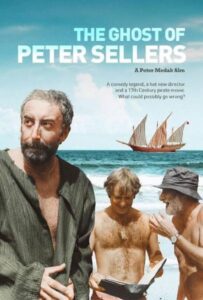
© Vegas Media / 1091 Pictures
But the finest monument to Peter Medak, in my opinion, remains the exuberance and chutzpah of The Ruling Class. At one point, Nigel Green’s deranged McKyle describes himself as “the high-voltage Messiah, the electric Christ, the AC/DC god”, and the film is something like a cinematic equivalent of that.